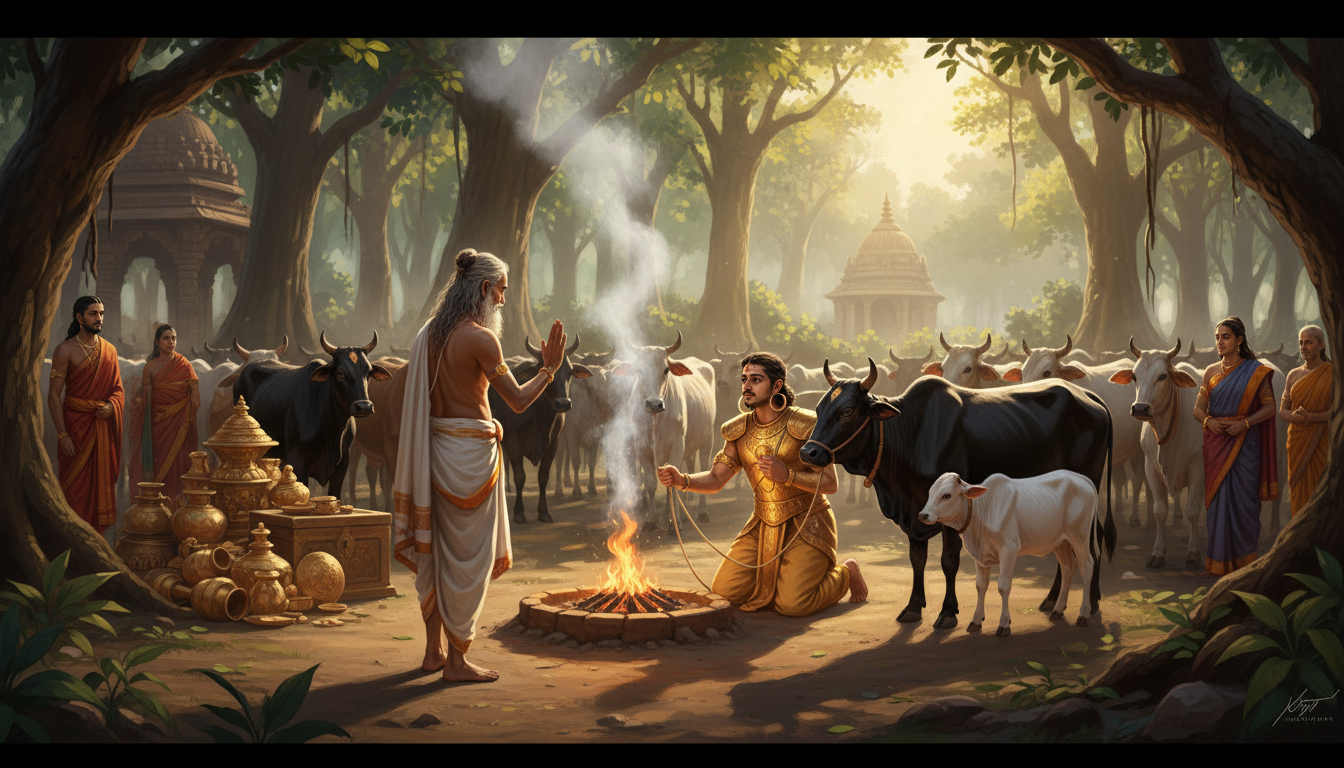
The Calf and the Wheel
Karna tells his charioteer the curse that will kill him
The Crow That Ate From Dishes
"So the swan put the crow down on dry land," Shalya said, "and comforted him, and went away where he wished to go, fleet as the mind. And the crow, having been fed on the remains of other people's dinners, cast off the pride of might and energy and adopted a life of peace and quiet."
He let the reins run through his fingers and let the silence sit exactly as long as it needed to.
"Even as that crow, fed upon the leavings of the dinners of Vaishya children, disregarded his equals and his superiors, so do you, Karna, fed by the sons of Dhritarashtra upon the remains of their dishes, disregard all your equals and superiors."
The car went forward. Neither of them was looking at the other.
"Why did you not slay Partha at Virata's city, when you had the advantage of being protected by Drona and Drona's son and Kripa and Bhishma and all the rest of the Kauravas? There, where you were all defeated with great slaughter by the diadem-decked Arjuna like a pack of jackals defeated by a lion, what became of your prowess? You saw your own brother killed by Savyasaci in the very sight of the Kuru heroes, and it was you who fled away first. By the skirts of the Dvaita lake, when the Gandharvas came at you, it was you who deserted all the Kurus and ran, and it was Partha who liberated Duryodhana and his wife. Rama himself spoke before the kings in the Kuru assembly of the prowess of both Partha and Keshava. You have heard Drona and Bhishma say in front of every king there that the two Krishnas cannot be slain."
A long breath.
"Like the sun and the moon, Keshava and Arjuna are celebrated for their splendour. You, however, are a firefly among men. Do not, out of folly, think disrespectfully of two luminaries. Those two are lions among men. Forbear indulging in such boasts."
You Have Never Seen Them
The high-souled son of Adhiratha listened to all of that unconvinced, and answered it, and the answer began quietly, which was not what Shalya had been expecting.
"What Vasudeva is and what Arjuna is, that is well known to me. The skill of Saurin in the management of cars, the might of the son of Pandu, his high weapons, all of this is well known to me at this hour. You, however, Shalya, have no ocular proof of any of those matters."
It was the flattest insult available to him and he chose it deliberately: you have been told about them. I have stood in front of them.
"I shall fight fearlessly with the two Krishnas, those two foremost of all wielders of weapons."
And then, without any change of tone at all, he said the thing that turned the whole quarrel into something else.
"The curse, however, of Rama, that best of regenerate persons, pains me greatly today."
Shalya did not answer, because there was nothing to answer. He had been holding the reins since dawn, saying every cruel thing that came into his head, and the man behind him had borne all of it with his jaw shut, and now, unprompted, in the middle of a battle, Karna had begun to tell him the truth about himself.
The Worm in the Thigh
"I dwelt in the disguise of a brahmana with Rama in former days, desiring to obtain celestial weapons from him.
"On that occasion the chief of the gods, wishing to benefit Phalguna, caused an obstacle. He assumed the dire form of a worm, and approached my thigh, and pierced it. My preceptor was asleep at the time with his head laid upon that thigh. The worm went on boring through it, and in consequence of the piercing a pool of thick blood flowed out of my body onto the ground. For fear of disturbing the slumber of my preceptor I did not move my limb.
"When he awoke, the brahmana beheld what had taken place. He looked at the blood, and at me, and witnessed my patience, and said, 'You are never a brahmana. Tell me truly who you are.'
"I then, Shalya, told him truly of myself, and said that I was a Suta.
"And hearing my words, that great ascetic, his heart filled with rage, cursed me. He said: 'In consequence of the deception by which you have obtained this weapon, it will never, at the time of need, when the hour of your death comes, occur to your memory. Brahma cannot certainly reside in one that is not a brahmana.'"
He stopped there a moment.
"I have forgotten that great weapon in this fierce and terrible battle. I have reached for it today. It is not there."
That is the shape of the thing, O king, and it is worth saying slowly. The curse did not take his strength, or his aim, or the bow, or any of the hundred other weapons Rama had put into him. It took one weapon and one hour, and it left him in full possession of the knowledge that both were coming. A man told that he will die at a particular moment may at least walk carefully. Karna was told only that at the moment when he most needed the greatest thing he had, he would open his hand and find it empty.
Like the Continent Holding the Ocean
Then, having said the worst thing he knew about himself, he went straight back to boasting, because that was the only other way he had of standing upright.
"Know, however, Shalya, that I will slay in battle that fierce bowman, that hero endued with activity, that warrior whose promises are accomplished, that son of Pandu, Dhananjaya. I have that weapon at least still under my control today with which I shall destroy large numbers of foes.
"The immeasurable Ocean, that lord of all waters, rushes with fierce impetuosity to overwhelm innumerable creatures, and the continent holds him and checks him. Even so will I today resist the son of Kunti, that foremost of all drawers of the bowstring, while he is engaged in ceaselessly shooting his countless shafts, none of which becomes futile. Like Himavat bearing the mighty, all-crushing god of wind, I shall stand without moving and bear the angry and vindictive Dhananjaya. Like clouds extinguishing a blazing fire that seems ready to consume the whole earth, I shall extinguish the son of Kunti with my showers of arrows. He is a terrible snake of virulent poison, difficult of being captured, endued with keen fangs, and I shall still him with my broad-headed shafts.
"Arjuna is proud. His weapons strike deep. He has great lightness of hands, he is conversant with steeds, he agitates vast hosts, he is reckoned an Atiratha. Such he is, and I shall yet strike his head from off his trunk today. What other man desirous of saving his own life, except myself, would fight with that Savyasaci, who vanquished all creatures including the very gods in the country called Khandava?
"I myself will gladly speak of the prowess of Phalguna in the midst of an assembly of kshatriyas. Why, then, do you, a fool and of foolish understanding, speak to me of Phalguna's prowess?"
Friendship Is Seven-Paced
"You are a doer of disagreeable deeds. You are cruel and mean, and being yourself unforgiving you are a detractor of one who forgives. I could slay a hundred persons like you. I forgive you, in consequence of my forgiving disposition and owing to the exigency of the times.
"Like a fool you have, for the sake of Pandu's son, rebuked me and told me many disagreeable things. Crooked-hearted as you are, you have said all these words to me, who am of a sincere heart. Cursed are you, for you are an injurer of friends, and we are friends, because friendship is seven-paced."
It is an old saying, O king, and Karna used it exactly. Walk seven steps beside a man and you are his friend; there is no further ceremony required and no way of unmaking it afterwards. They had walked a great many more than seven steps together on that chariot since sunrise.
"Terrible is the hour that is now passing. Duryodhana has himself come to battle. I am solicitous of seeing his purposes achieved. You, however, are acting in a way that shows you to have no friendship at all for the Kuru king.
"He is a friend who shows affection for another, who gladdens another, who makes himself agreeable to another, who protects another, who honours another, and who rejoices in the joys of another. I tell you that I have all those attributes, and the king himself knows it. He, on the other hand, that destroys, that chastises, that sharpens his weapons, that injures, that causes us to sigh, that makes us cheerless, and that wrongs us in diverse ways, is a foe. All those attributes are to be found in you, and you discover all of them in me.
"For the sake of Duryodhana, for the sake of doing what is agreeable to you, for the sake of victory, for the sake of myself, and for the sake of God himself, I will fight with Partha and Vasudeva with vigorous exertion. Witness today my feats."
And Shalya, who was uncle to two of the men on the other side and had been manoeuvred into this war against his own inclination, sat holding the reins of a Suta's chariot and was told that he was being forgiven, and said nothing at all.
If Only the Wheels Do Not Sink
"Behold today my excellent weapons, my brahmastra and my other celestial weapons, as also those that are human. I will today slay that hero of fierce prowess like an infuriate elephant slaying another. I shall, by my mind alone, hurl at Partha today, for my victory, that weapon of immeasurable energy called the brahmastra.
"Arjuna will never be able to escape that weapon, if only the wheels of my car do not sink into the earth in battle today."
And there it was.
It went past Shalya's ear like an arrow he had not seen coming. He had been driving for hours through a torrent of self-praise, and in the middle of the largest boast of the afternoon a small condition had been attached, quietly, in the man's own voice, as though it were an ordinary thing to say about a chariot.
Karna did not stop.
"Know this, Shalya. I would not take fright at Yama himself armed with his rod, nor at Varuna armed with his noose, nor at Kuvera with his mace, nor at Vasava armed with the thunderbolt, nor at any other foe whatever that may approach for slaying me. Therefore I have no fear from Partha, nor from Janardana. I shall encounter them both in today's destructive battle."
And then, in the same breath, without any transition at all, he began to talk about a cow.
A Solitary Forest
"Once on a time, while wandering for the sake of practising with my bow called Vijaya, I had, by shooting many fierce shafts of terrible forms, heedlessly struck the calf of a brahmana's homa cow with one of those shafts, and unwillingly killed it while it was wandering in a solitary forest."
That is the whole of the crime, O king, and I would not have you make it larger than it was. He was a young man in the years of his kingdom, alone, in a wood, shooting at nothing in particular to keep his hands sharp. The arrows went where such arrows go. One of them found a calf that belonged to a brahmana who kept a fire and needed that cow's milk for the offerings, and the calf died, and Karna had not meant it and would have given anything not to have done it.
He went to the man himself, which not every prince would have done.
"The brahmana then addressed me, saying: 'Since, becoming insensate, you have slain the offspring of my homa cow, the wheel of your car will sink into the earth while at the time of battle, and fear will enter your heart.'"
Karna said it out, word for word, the way a man says something he has repeated to himself ten thousand times in the dark.
"From these words of the brahmana I am experiencing great fear."
What Was Offered
The kings of the Lunar race, who are lords of other people's weal and woe, came and offered on his behalf. They began with a thousand kine and six hundred bovine bulls.
With even such a gift, O ruler of the Madras, the brahmana would not be gratified.
So Karna offered seven hundred elephants with large tusks, and many hundreds of slaves, male and female.
That foremost of brahmanas would still not be gratified.
So he collected next full fourteen thousand kine, every one of them black in hue and every one of them having a white calf at her side. It is a specific thing to ask for and a hard thing to assemble, and the specificity is the point: he was replacing what he had destroyed, in kind, fourteen thousand times over, with the exact animal the man had lost.
He was still unable to obtain the grace of that best of brahmanas.
Then he offered a wealthy mansion, full of every object of desire, and in fact whatever wealth he had, all of it, and wished to give it with due worship, in the proper form, with the proper words, as one gives to a brahmana.
And the brahmana refused to accept the gift.
Understand what was happening there, O king. This was not a man holding out for a better price. Karna had offered him everything a king possesses and then offered himself along with it, begging importunately for pardon, in front of witnesses, and the brahmana kept saying no to a fortune while standing in a poor man's clothes, and he was not saying no in order to be given more.
I Do Not Venture to Speak What Is False
"Unto me, then, that had offended and that had begged so importunately for his pardon, the brahmana said this.
"'That which, O Suta, has been uttered by me is sure to happen. It cannot be otherwise. A false speech would destroy creatures, and sin also would be mine. Therefore, for the preservation of virtue, I do not venture to speak what is false. Do not, again, destroy the means of a brahmana's support. There is none in the world that would be able to falsify my speech. Accept those words. It will be your atonement for the sin of having slain a calf.'"
That is the answer, O king, and it took me a long while to understand it.
The brahmana was not punishing him. He was not withholding a pardon that he was free to give. He had said a thing, and having said it he could not unsay it without making a false speech, and a false speech from such a man destroys creatures, and the sin of it would have been his own. He was not refusing Karna's cattle out of anger. He was refusing to buy his own truth back from himself at any price a king could name, because it had stopped being his to sell the moment it left his mouth.
And he did the only kind thing left to him, which was to tell Karna what the curse was for. Accept those words. It will be your atonement. Not your ruin: your atonement. Carry it, and the debt is paid, and you may go.
Karna, who had a great deal in common with that brahmana and never once seemed to notice it, took the words and carried them for the rest of his life.
Be Silent Now
The car had gone a long way while all this was being said. Somewhere ahead of them the Pandava line was re-forming and men were dying in the ordinary manner, and on that one chariot two kings had been having a conversation that neither of them would have had with anybody else alive.
Karna finished it the way he had begun it.
"Though rebuked by you, still, for friendship's sake, I have disclosed to you all this."
That is the sentence I would ask you to keep, O king. Not the boasts. The man had spent the whole day being told by his own driver that he was a crow eating from other men's plates, and he answered it by handing that driver the two secrets that could kill him, and gave as his reason that they were friends.
"I know you, that are rebuking me thus. Be silent now, and hear what I will presently say."
And Shalya was silent, and took the horses forward, and Karna went on with what he had to say, and neither of them mentioned the wheel again.
It was still early in the afternoon. There were several hours left of that day. When the hour did come, and the left wheel of that car went down into the earth at the exact moment his memory went empty, there was nobody on the field who was surprised except the man standing on it, and even he was not surprised. He had told it to his enemy's brother-in-law himself, out loud, in the sunlight, before it happened.
Dharma Lesson
A wrong done carelessly cannot be bought back at any price, because the man wronged is not selling anything. The brahmana refuses a thousand cows and seven hundred elephants and a whole mansion of treasure not out of spite but because his own word has stopped being his to unsay: a false speech would destroy creatures, and the sin of it would be his. What he gives Karna instead is the only mercy left in the case, which is to name the curse an atonement and let the debt be finished by being carried.