A Friend Lifted From Shame
Duryodhana returned from the forest a broken man in every way that mattered to his pride, though not a hair of his body had been touched by an enemy's weapon. The humiliation of the ghosha-yatra, where he had ridden out to mock the exiled Pandavas in their poverty and instead found himself captured by gandharvas and rescued, of all people, by Arjuna's own brothers, sat on him like a wound that would not close. He had gone to gloat and come home saved by the very family he meant to shame, and no victory afterward could fully wash the memory away.
It was Karna who found him first in that darkness, Karna who had ridden with him on that disastrous excursion and fled the field when the gandharvas proved too strong, and it was Karna who now refused to let his friend drown in the shame of it. Where others in the Kuru court offered careful silence or worse, quiet satisfaction, Karna offered something else entirely: a promise scaled to match the size of the wound. He would not merely comfort Duryodhana with words. He would go out from Hastinapur and conquer the earth in his name, bring every king in every direction to bow before the Kuru throne, and lay the tribute of the whole world at his friend's feet until the memory of gandharva laughter was buried under the weight of empires won.
It was an extraordinary vow for one man to make, even a man of Karna's gifts, and Duryodhana heard it the way a drowning man hears a hand offered from the bank. Whatever doubts a wiser counselor might have raised about the wisdom of such a campaign, or the cause it was meant to serve, went unspoken in that room. What Duryodhana needed was not wisdom. He needed to believe himself great again, and Karna, alone among all the men who called themselves his friends, was prepared to spend his own life's labor making that belief true.
East to the River Kingdoms
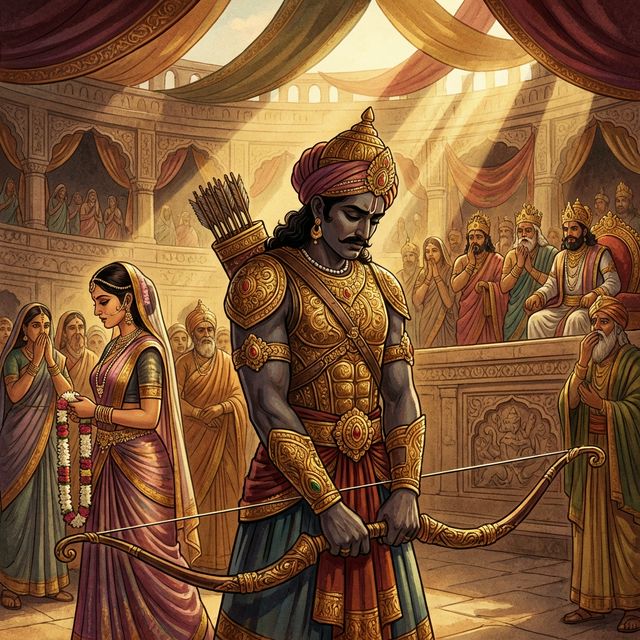
Karna set out from Hastinapur with an army that grew as it moved, the way armies gather momentum once the kings ahead of them understand that resistance carries a cost few of them wish to pay. He turned first toward the rising sun, into the river-threaded kingdoms of the east, lands he knew in one sense better than most in the Kuru court, for it was in the eastern realm of Anga that Duryodhana had made him king in the first place, on the very day the suta charioteer's son had been mocked at the archery tournament for lacking royal blood.
That old wound traveled with him even now, years distant from the humiliation that had first driven him into Duryodhana's arms - the memory of standing in the tournament ground, weapon in hand, matching Arjuna stroke for stroke, only to be told he had no right to the contest at all until a friend's hand placed a crown on his head and made the objection moot. Every kingdom that yielded to him now, every ruler who came out to offer tribute rather than face his bow, was in its own way an answer to that old insult, though the debt he believed himself to be settling was never quite his own.
The eastern campaign carried him further still, past the familiar borders of Anga into the delta kingdoms beyond, into Vanga where rivers braided into the sea and kings who had never troubled themselves with Hastinapur's quarrels found a Kuru general at their gates all the same. Some fought and were broken; more, hearing what had happened to those who fought, simply opened their treasuries and bowed. Karna accepted their submission without cruelty - he was not a man who took pleasure in another king's ruin, only in the scale of what he could lay at his friend's feet - and turned his army onward, southward now, toward lands the Kuru throne had never claimed before.
South Past the Vindhya, West to the Sea
South of the river kingdoms rose the dense, difficult country beyond the Vindhya range, forest and hill kingdoms less accustomed to the discipline of a marching army than the open plains further north, and here Karna's campaign found its hardest fighting. Kings who had ruled their small, defensible territories for generations without paying tribute to any distant throne did not yield as readily as the delta rulers had, and more than one battle in that stretch of the campaign was decided by Karna's own bow rather than by the reputation that had gone ahead of him. He fought as he always fought, without the divine armor and earrings that had once made him unkillable in battle, for those had already been given away in charity before this campaign ever began, and every victory here was won on skill and will alone.
Having broken the resistance of the southern hill kings, he turned the army west, toward the coast where the land finally gave way to ocean, and here too kings measured his approach and chose, one after another, the wiser path of submission over ruin. The western campaign closed with the sea itself at his army's back, tribute gathered from a stretch of the subcontinent that no single Kuru general before him had ever claimed in one unbroken sweep.
Only the north remained, and it was there, in the far reaches beyond even the Kuru heartland, that Karna turned his army last of all - toward Kamboja, a kingdom famed for horses and hard fighters, whose warriors did not bow easily to any outsider's claim. It was, by every account the tradition preserves, the fiercest fighting of the entire digvijaya, a campaign within the campaign, but even Kamboja could not hold against a general who had already broken the resistance of three-quarters of the known world and had, by that point, very little left to fear from a fourth.
An Emperor's Sacrifice
Karna returned to Hastinapur at the head of an army swollen with the wealth of four directions, elephants and horses, gold and gems, the accumulated tribute of kings who had chosen submission over the alternative he had shown them on the field. He laid all of it, without reservation, at Duryodhana's feet, exactly as he had promised on the day he made his vow, and for the first time since the shame of the ghosha-yatra, Duryodhana stood in his own court as a man whose name inspired something other than pity or contempt.
With the wealth of that conquest, Duryodhana performed the Vaishnava sacrifice, a rite of a magnitude few kings could ever hope to fund, let alone complete, and one that placed him, at least in the eyes of the assembled world, in the company of the great emperors whose names the age still remembered with awe. It was a claim made in defiance of the exiled Pandavas as much as in celebration of anything Duryodhana had done himself - a public declaration that the Kuru throne he occupied needed no absent cousin's return to be considered legitimate, that the glory of empire already sat comfortably on his own shoulders.
Karna stood beside him through the rite as he had stood beside him through every turn of the campaign that made it possible, asking for no share of the honor beyond the friendship that had always been payment enough for him. It was, by any measure, the height of what a suta's son could achieve in a world that had once told him such heights were not his to reach - conqueror of the four directions, architect of an emperor's sacrifice, the single man most responsible for restoring his friend's shattered pride. That the glory he had built belonged entirely to Duryodhana's ambitions, and not to any cause Karna could have named as just in itself, troubled him not at all in that moment of triumph.
The Vow Renewed
In the glow of that triumph, with the world's tribute still being counted into the Kuru treasury, Karna renewed before Duryodhana the vow that had defined him since the tournament ground where their friendship began: that he would meet Arjuna in battle one day and prove, beyond any court's doubt, which of them was truly the greater archer. It was not a new promise so much as an old one restated with fresh evidence behind it - a man who had just conquered the four directions had every reason to believe no single warrior, however gifted, could stand against him.
Alongside that vow he kept another, quieter discipline that the tradition remembers just as carefully: a rule he set for himself of performing his devotions at noon, and of refusing no request made of him by a supplicant while he sat at his prayers, however great the asking or however great the cost to himself. It was a generosity as total as his ambition, the same nature that had once made him hand away the divine armor grafted into his very skin because a brahmin asked for it, disguised though that brahmin secretly was.
That open door, kept for the sake of a discipline he would not compromise even in triumph, was the very weakness an anxious god would one day walk through, robbing him of his last certain advantage before the war that was still years away had even been declared - a debt collected on a battlefield neither Karna nor Duryodhana could yet see. For now, standing amid the wealth of a world he had conquered for a friend's sake rather than his own, Karna's peerless gifts were spent entirely on someone else's ambition, mortgaged so completely to Duryodhana's cause that not even the earth's conquest could be counted, in the end, as fully his own.
Dharma Lesson
The greatest gifts, given in friendship, can still be spent on causes that do not deserve them. Loyalty that never asks whether the cause is just becomes a debt paid in full only by the one who gave it, long after the friend it served has moved on.