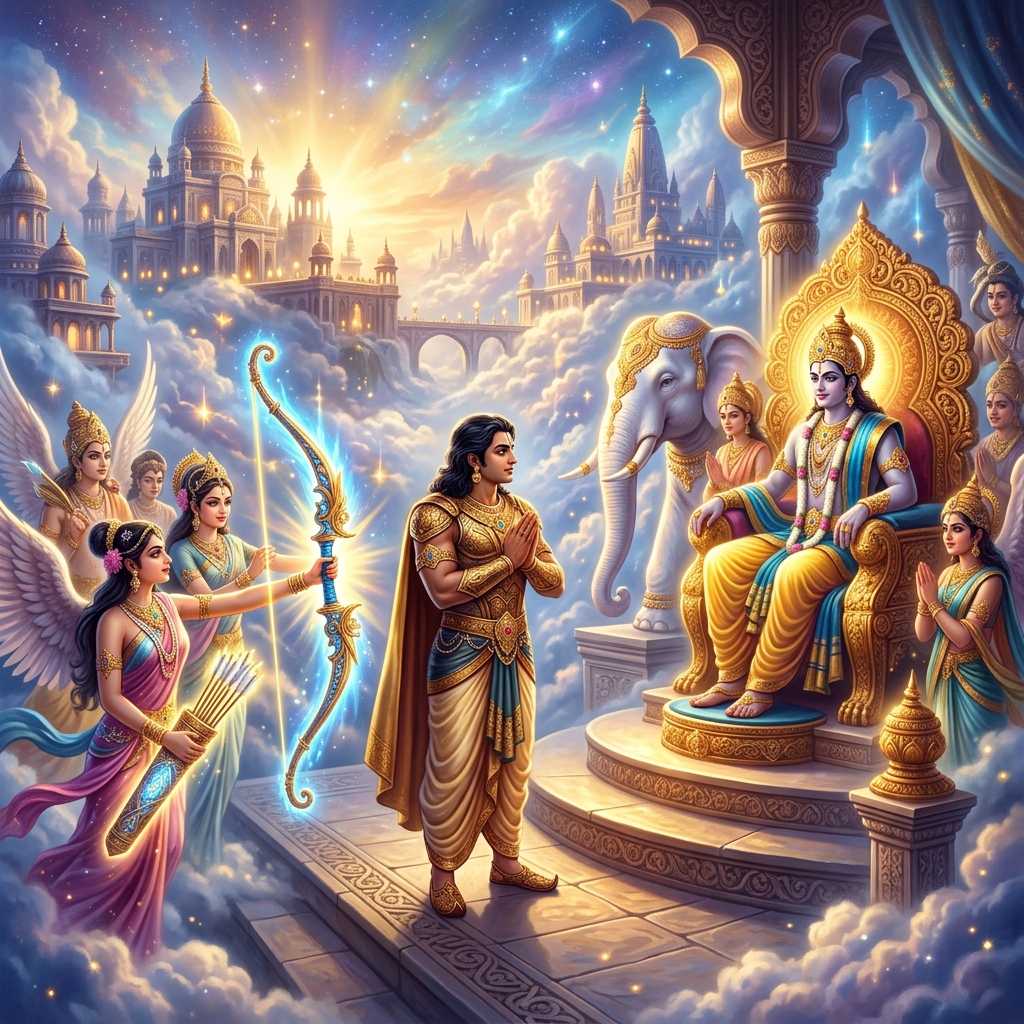
The Guest of Amaravati
Amaravati, the city of the thousand-eyed lord, was not built the way cities on earth are built. Its groves flowered without season, its lamps needed no oil, and the dust of the roads was gold that no one troubled to gather. Into that city Arjuna came as a guest, and he came having already won what he went for, since the penance in the high Himalaya and the weapons taken from Shiva and from the guardians of the quarters are told in another place.
Indra brought him up the steps of the assembly hall himself and seated him on half of his own throne, and the gods present looked at that and said nothing, because it was Indra's throne and Arjuna was Indra's son.
'Stay,' said the lord of the gods. 'The weapons are given, but weapons are not learned in a day, and a man who has swallowed lightning should sit still a while and let it settle. Stay, and let this city teach you what the forests cannot.'
'How long, father?' Arjuna asked.
'Long enough,' said Indra, which is how gods answer questions about time.
So Arjuna stayed, and the years went by in heaven while his brothers counted the same years in leaf huts and river caves far below. He rose before the court did and practiced with the great weapons where the plains of heaven ran out into empty light, calling them and dismissing them until the calling took no thought at all. He learned the words that recalled a released missile, which is harder than the words that release it.
And in the evenings he sat in the hall of Indra among gandharvas and sages and the shining dead, an earthly man with calluses on his fingers, listening to music that no one on earth had heard.
The Lessons of Chitrasena
'You listen to the singers as though you were reading a battle order,' said Chitrasena one evening, dropping onto the bench beside him. The king of the gandharvas was a handsome, unhurried being who had never in his existence needed to be anywhere on time. 'It is not a map. It is meant to move you.'
'It moves me,' Arjuna said. 'I do not know what it is doing while it moves me. That is what I dislike.'
Chitrasena laughed and went to Indra, and Indra was pleased, and so the third son of Kunti became a pupil again at an age when most men have stopped being pupils at anything. He learned song, and the playing of instruments, and then, with more difficulty and more stubbornness, the dance.
It was strange work for those hands. The bow had trained them to a single perfect economy, nothing moving that did not need to move. Dance asked the opposite: the wrist that says one thing while the eyes say another, the foot that lands exactly with the drum and not a hair before it, the whole body arguing and agreeing with itself at once. He was clumsy for a long while, and he did not mind being clumsy, which his teacher said was rarer than talent.
'Why do you want this so much?' Chitrasena asked him. 'You will go back down and be a warrior again, and no one down there will ask the son of Pandu to dance.'
'Someone might,' said Arjuna. 'And a thing you have learned properly does not sit idle. It waits.'
Five years he was in that city, and the counting of them stopped mattering. The gandharva taught, and the mortal learned, and among those who came to the practice hall to see the strange sight of Arjuna keeping time were the apsaras of heaven, and among the apsaras, first and most radiant of all of them, came Urvashi.
A Gaze Misread
There was a night of high festival in Indra's hall, and Urvashi danced.
She had been the ruin of ascetics and the making of songs. When she moved, the assembly stopped pretending to converse. Arjuna watched her with steady attention from beginning to end, and when the dance closed he was still watching, his eyes fixed on her with something that the whole court could see and that only he could have named.
Indra, who missed very little, leaned toward Chitrasena. 'Look at my son.'
'I see him.'
'He has been five years in this city and has asked for nothing. He watches her the way a thirsty man watches rain.' Indra was a father before he was anything else that evening, and fathers are not always the best readers of their sons. 'Go to Urvashi. Tell her that the greatest of the Bharatas honors her, and that she would give me pleasure by going to him.'
So Chitrasena went, and put it as gracefully as gandharvas put such things, and Urvashi heard him out with her ornaments still on.
'I have watched him too,' she said. 'He does not look at anyone the way he looked at me tonight. Say to Indra that I am not commanded in this and never have been. Say also that I will go.'
She bathed, and was dressed in silks the color of the moon at its thinnest, and garlanded, and perfumed with sandal, and the apsaras who attended her sang while they worked. She went out along the terraces of Amaravati in the late hours with her anklets deliberately quiet, and the flowering trees leaned toward her as she passed, and the guards at the gate of the guest house looked once and then looked at the floor.
Inside, a lamp was burning. Arjuna was awake, sitting with his hands on his knees, reciting to himself the syllables that recall a weapon.
Mother
He heard the anklets and he rose, and when he saw who stood in the doorway with the lamplight going over her he shut his eyes for a moment out of pure courtesy. Then he folded his hands and bowed to her as a son bows.
'Loveliest of the apsaras, you honor this house. Command me. I stand before you as I would stand before Kunti who bore me, or before Shachi the queen of the gods. You are to me what a mother is.'
Urvashi came in and did not sit. 'You did not look at me tonight as a son looks.'
'I looked at you,' said Arjuna, 'because you are the ancestress of my line. From you and from Pururavas of the lunar house came the fathers of the Purus, and I am of the Purus. That is why I could not take my eyes away. I was looking at the beginning of my own blood.'
'Blood,' she said. 'You bring me blood. Hear how it is here. We of heaven are bound by none of your rules of house and descent. We are free, and we are not wives, and no son of Puru who has come to this city has ever counted a line between himself and me. There is no fault in this, and no censure. I am not sent to you. I have come, and I am burning, and it is a discourtesy to refuse a woman who comes.'
'Then let me be discourteous,' he said, 'and be blameless in the other thing. Enter me as a daughter-in-law enters. That door is open. The other is shut, and I cannot open it, though you stand there all night and though it costs me your goodwill.'
She looked at him for a long moment. Then her brows drew together and heaven itself seemed to tighten around her.
'You refuse a woman who came to you at the word of your own father. Then be no man at all. Go among women as a dancer among dancers, sexless, honored as a eunuch is honored, and let them call you neither he nor she.'
Her anklets were not quiet going out.
The Curse Cut Down to a Year
Arjuna sat down where he had been sitting. He did not sleep. Before the light came he sent for Chitrasena, and told him plainly what had been said and what had been answered, leaving out nothing that made him look foolish.
Chitrasena went to Indra, and Indra listened, and those in the hall who expected the lord of the gods to be angry saw instead a father putting his hand over his mouth to hide his face.
He sent for his son and embraced him in front of the whole court.
'Kunti has become a mother indeed,' Indra said, 'and you have beaten the sages at their own work. There is not a rishi in the three worlds who would have held where you held last night, with that woman in that room. Do not grieve for the curse. A curse spoken in heat by one who has been refused cannot be unsaid, but it can be cut to size. Hear it now. It will not touch you for a lifetime. It will take you for one year only, and you will choose the year, and when it is finished your manhood will come back to you whole, and no shame will cling to it.'
'And in that year?' Arjuna asked.
'In that year,' said Indra, 'you will be a dancer among women, and you will be very good, because you had a very good teacher.' Chitrasena, standing behind, permitted himself to look pleased.
So the curse was folded up like a garment and put away, and Arjuna went back to his practice, and in time went back down to his brothers in the forest with the weapons and with this besides.
Years later, when the thirteenth year came and five of the most recognizable men alive had to vanish inside a single palace, one of them walked into the women's quarters at Virata's court in bangles and a braid, calling himself Brihannala, and taught the princess to dance. The curse of a woman scorned had become the only door through which he could pass unseen.
Dharma Lesson
Arjuna refuses Urvashi not because desire is beneath him but because lineage is a kind of truth, and a man does not unmake his ancestress to please a night. The refusal costs him a curse, which is what refusals often cost. Yet the punishment for holding a line becomes the exact instrument of survival a year later, and the epic quietly makes its point: what is done rightly is not always rewarded, but it is rarely wasted.