Counsel in the Forest
The Pandavas had been driven from their kingdom and condemned to twelve years in the forest, with a thirteenth year to be passed in disguise. In the wilderness of Kamyaka, beside a fire of dry wood, Yudhishthira and his brothers sat with troubled hearts. They knew that when the years of exile ended, the sons of Dhritarashtra would never yield Indraprastha without war, and arrayed against them stood Bhishma the unconquered, Drona the teacher of all, Karna the radiant, and Kripa the deathless. Earthly bows and earthly skill would not be enough.
Then the sage Vyasa came to the forest, and after him, in time, came Krishna of the Yadavas, dark as a rain cloud and wise beyond the worlds. They drew Yudhishthira aside. "There is one path," said Vyasa quietly. "The celestial weapons, the astras of the guardians of the directions, are not won by armies but by penance. Send Arjuna. Let him go alone into the high places and please the gods, and let him return with arms that no mortal can answer."
Vyasa imparted to Yudhishthira a secret knowledge, the science called Pratismriti, and Yudhishthira passed it to Arjuna, that by it he might ascend through the worlds to the abodes of the gods. The brothers turned to Arjuna. He was the third Pandava, the friend of Krishna, the bowman whose Gandiva had blazed at Khandava, and his face was grave as he understood what was asked of him.
"You alone can do this," Yudhishthira said, embracing him. "Go, and bring back the means of our deliverance. But the parting weighs on me already." Arjuna touched the feet of the elders, took his bow and his quivers that never emptied, girded his fingers with the leathern guards, and at dawn he set out northward, alone, toward the spine of the mountains where the gods are said to walk.
The Road to Indrakila
Arjuna went swiftly, for the Pratismriti lent speed to his feet, and the leagues fell away beneath him. He crossed rivers swollen with mountain melt and passed through forests where no village smoke rose. The land climbed beneath him, the air grew thin and bright, and at last he came to the great mountain Indrakila, a peak crowned with snow that touched the clear and burning sky.
There, as he stood marveling at the height, a voice spoke to him out of the air. "Halt, traveler." Before him stood an ascetic, lean and brown, leaning on a staff, his hair matted, his eyes deep and calm. "This is no place for a man armed for war. Here only those who have laid down anger and desire may dwell. Cast away your weapons, child. What does a bowman seek upon the roof of the world?"
Arjuna answered him with respect but did not lay down the Gandiva. "Holy one, I have come with a purpose laid on me by those I love. I seek the weapons of the gods, that my people may not perish." At his steadfastness the ascetic's stern face softened, and then it changed altogether, growing radiant and vast. For this was no forest hermit, but Indra himself, lord of the heavens, the father of Arjuna by Kunti's calling in the days before his birth.
"Well spoken, my son," said the god, and his thousand-eyed form filled the mountain air with light. "You are tireless and true. But the weapons you seek are not given for the asking. First you must look upon the three-eyed god, the lord Shiva, the highest of the high. Worship him with penance here upon this peak. When Shankara is pleased with you, then come to me, and I will give you all the weapons of heaven." So saying, Indra vanished like a flame blown out, and Arjuna was left alone upon Indrakila with his task before him.
The Great Penance
Arjuna chose a place upon the high slope of Indrakila and there began an austerity such as the mountains had seldom seen. In the first month he ate only fruit fallen of itself from the trees, taking food once in three nights. In the second month he ate once in six. In the third month he tasted nothing but withered leaves, and at last, in the fourth, he took no food at all, but lived on the air alone.
He stood upon the points of his toes with his arms upraised, a still figure against the blue, and he fixed all his thought upon Shiva, the lord of beasts, the dweller in the high cold places. Day and night he held the image of the god in his heart. His body, hardened by years of war and exile, wasted now to little more than sinew and bone, yet the fire of his concentration only burned the hotter, and from his tapas a great heat went out into the worlds.
The sages who dwelt upon the slopes of the mountain grew alarmed, for the radiance of Arjuna's penance scorched the heavens themselves. They went up in a body to Mount Kailasa and stood before Shiva. "Lord," they said, "a man upon Indrakila burns with such ascetic fire that the three worlds are troubled. Restrain him, or tell us what he desires, for we cannot bear the heat of his devotion."
Shiva smiled, the smile of one who already knows. "Be at peace," he told the sages. "I know the man and I know his heart. It is Arjuna, born of a portion of Nara the eternal sage. He does not seek heaven or long life or the love of the gods. He seeks only the strength to free his brothers and to do the work that is laid upon him in the war to come. Return to your hermitages. I myself will go to him, and I will give him what no other can." And the sages, comforted, went down again to their fires.
The Hunter and the Boar
Then Shiva took upon himself a strange form. He set aside his moon-crowned splendor and became a Kirata, a wild mountain hunter, broad and golden-skinned, clad in bark and the skins of beasts, a great bow upon his shoulder and a quiver at his side. Beside him came the goddess Parvati in the dress of a huntress, and behind them a host of the lord's attendants likewise disguised, so that the slope rang with the sounds of a great hunt.
Now there was among the enemies of the gods a demon named Muka, who had taken the shape of a monstrous boar, vast as a small hill, with tusks like spears, and he came charging through the trees toward Arjuna where he stood in penance, meaning to kill him. Arjuna, hearing the crash and the squeal, opened his eyes and seized the Gandiva. The earth shook beneath the beast's onrush.
"I will end your meditation and your life together," the boar seemed to roar as it bore down upon him. Arjuna bent his great bow. "You have come to slay me unprovoked," he said grimly, "and so I shall slay you first." He drew the string back to his ear.
But in that same heartbeat, from another quarter of the slope, the Kirata hunter loosed an arrow at the very same boar, crying out, "That beast is mine, by the law of the hunt. I marked it first." The two arrows flew as one. Together they struck the monstrous boar, and it fell with a sound like a falling tree, and as it died its false shape melted away and it lay revealed as the demon Muka, a fearsome thing of the lower worlds, struck down by a double shaft.
Whose Arrow
Arjuna lowered his bow and strode toward his fallen quarry, only to find the wild hunter approaching from the other side with the same proud step. The two men met over the carcass, and Arjuna spoke first, his old battle pride rising in him.
"Hunter, who are you to shoot at a beast I had already marked? Against the customs of the chase you have loosed your arrow at my prey. For this insolence you shall not escape me. I will repay you as you deserve."
The Kirata laughed, and there was thunder somewhere far off in his laughter. "Be calm, forest dweller," he said. "This is our country, where we hunt and where we live. It is you who are the stranger here, you with your soft city ways and your foolish penance. The boar was mine. My arrow struck it first. Do not in your weakness blame your betters for your own ill aim."
The words stung Arjuna more than any wound. "Whoever you are," he answered, "you shall regret these words. Stand and defend yourself, for I will now give you the death you have earned, and we shall see whose aim is the truer." And he set arrow to string, and the duel began upon the high slope of Indrakila, between the son of Pandu and the lord of the universe wearing the skin of a hunter.
Arrows Without End
Arjuna drew the Gandiva to its full and poured upon the hunter a torrent of arrows, a stream so dense that the air between them turned to a hedge of flying shafts. Any army on earth would have been swept away in the first moment. Yet the Kirata stood unmoved, and the arrows vanished into him as raindrops vanish into the sea, or as offerings vanish into a sacred fire, leaving him whole and smiling.
Arjuna's heart faltered. He had never in his life seen a foe untouched by the Gandiva. He reached behind him for more arrows, and to his deeper amazement his quivers, the gift of Varuna that could never be emptied, ran dry. The endless arrows had ended. "What manner of being is this," he whispered, "that drinks my shafts like water and empties the quivers of the gods?"
He took up his bow itself and swung it like a club against the hunter's head, but the Kirata wrenched it from his grasp as a man takes a toy from a child. Arjuna drew his sword, the bright blade flashing, and brought it down with all his strength upon the hunter's skull. The sword shattered into fragments and fell ringing among the stones.
Then Arjuna, who had lost his arrows, his bow, and his sword, fought on with what remained to him. He tore up trees and great rocks and hurled them; the hunter shrugged them aside. At last, weaponless and undismayed, Arjuna closed with the Kirata and they wrestled, body against body, and the mountain trembled beneath their feet and the snows slid from the high peaks. But the strength of the hunter was the strength of the world itself, and in the end he caught Arjuna and crushed him in his arms and dashed him senseless to the ground, so that the breath went out of the proudest bowman of the age.
The Garland on the God
Bruised, breathless, beaten as he had never been beaten, Arjuna lay upon the cold stone and gathered the ruins of his pride. It came to him, slowly, that no creature of flesh could have done these things, that the boar and the duel and the unbreaking calm of the hunter were signs he had been too proud to read. He rose, swaying, and his heart turned at last to the god he had come to worship.
With his own hands he gathered clay and earth and shaped a rude lingam, the emblem of Shiva, upon the ground. He plucked wildflowers from the slope and wove them into a garland, and singing the praises of the three-eyed lord, he laid the garland upon the clay image and bowed his face to the earth in worship.
When he lifted his eyes, the garland was gone from the clay. He looked up in wonder, and there upon the head of the wild hunter, around the rough brown neck of the Kirata, hung the very garland of wildflowers he had offered to the god of clay. In that instant the truth broke over Arjuna like dawn over the mountains.
"It is you," he breathed, falling to his knees. "There is no hunter here. There never was. The god I sought has stood before me and I raised my hand against him. Forgive me, Lord of the worlds, forgive a blind and arrogant fool." And he wept and pressed his forehead to the feet of the hunter, while the wind of the high places moved the flowers of the garland.
The Pashupata
Then the hunter's disguise fell away like mist before the sun. Tall and shining stood Shiva in his true form, blue-throated, the crescent moon upon his brow, the river Ganga falling from his matted hair, the trident in his hand, and beside him the goddess Parvati in her grace. The whole slope of Indrakila was bathed in a light not of the sun.
"Rise, Arjuna," said Shiva, and his voice was kind as a father's. "I am pleased with you beyond all measure. No man has ever stood against me in battle as you have stood this day. Your courage and your strength are matchless among mortals, and your devotion is true. In a former age you were Nara, the companion of Narayana, and you shall be great in this age also. Ask of me now the boon you desire, and it shall not be denied."
Arjuna joined his palms. "Lord, if you are truly pleased with me, grant me your own dread weapon, the Pashupatastra, the brahmasiras, that none in the three worlds can withstand, the weapon with which at the end of the ages you destroy all that is. With it I will not fail in the work that is laid upon me."
Shiva consented. He taught Arjuna the secret of the Pashupata, the mantras by which it is called and recalled, the manner of its release by mind, by eye, by word, and by bow. "Guard it well," the god warned him. "Never loose this weapon against a weak or a fleeing foe, for if it strikes one who does not deserve it, it may burn up the whole world. Keep it for the hour of utmost need." And the mountains shook and the gods in heaven sounded their drums as the awful weapon passed from the lord of destruction into the hands of the son of Pandu. Then Shiva and Parvati blessed him and vanished, and Arjuna stood alone, his strength restored, his bow and quivers whole again, the dread astra living now within his mind.
The Guardians of the Directions
No sooner had Shiva departed than the heavens opened around Arjuna, and the great guardians of the four quarters of the world came to him, drawn by the favor the highest god had shown. The air filled with light and the sound of celestial music, and the four lords descended to the mountain to honor the bowman whom Shiva himself had praised.
From the west came Varuna, lord of the waters, his form gleaming like the surface of the sea. "Take my nooses, O Arjuna," he said, "the Varuna-pasha, the cords that no enemy can break or escape." From the south came Yama, lord of death and of righteousness, dark and terrible and just. "Take my staff, the Yama-danda, the rod that ends all lives in their season, an unfailing astra." These he gave with their secret mantras.
From the north came Kubera, lord of wealth and of the yakshas, shining with treasure. "Take my favorite weapon, the Antardhana, that lulls the foe to sleep and confounds his sight." And last, having come down the sky in his own splendor, the lord of the east, Indra the wielder of the thunderbolt, embraced his son and promised the greatest gifts of all in his own heaven above.
One by one the guardians taught Arjuna the use of their weapons, the calling and the withdrawing of each, until the son of Pandu, who had come up the mountain with mortal arms alone, stood now girt with the powers of the four directions of the world. Then, their gifts bestowed, the lords of the quarters returned each to his own realm, and Arjuna waited upon the peak for the chariot of his father.
The Ascent to Amaravati
Down the sky, blazing like a second sun, came the chariot of Indra, drawn by ten thousand tawny horses, and upon it stood Matali, the charioteer of heaven. "Climb up, son of Pritha," called Matali. "Your father Indra summons you to his own realm, that you may learn there what no earthly teacher can teach. The lord of the gods awaits you."
Arjuna purified himself, bowed toward the mountain that had been his teacher, and mounted the celestial car. It rose through the regions of the air, past the paths of the wind, past the stations of the wandering stars, past the realms of sages and ancestors who have left the earth, until it came at last to Amaravati, the city of Indra. There the streets were paved with light, and the trees bore flowers that never fade, and the air was sweet with the music of gandharvas and the dancing of apsaras.
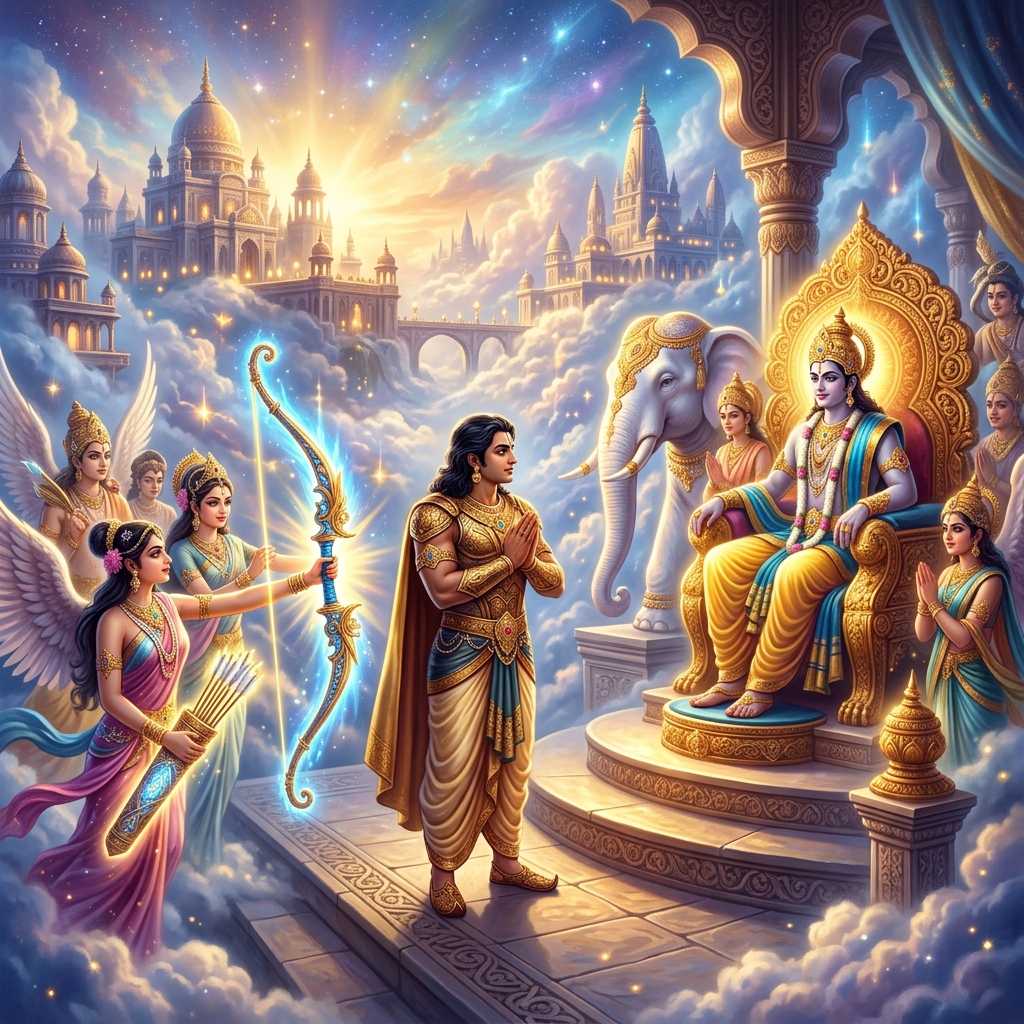
Matali brought the chariot down before the great hall of Sudharma, and Arjuna entered the court of the king of the gods. Indra sat upon a throne of glory, the thunderbolt at his side, the white elephant Airavata near, and the immortals gathered round. When Arjuna approached, Indra rose and drew his son up beside him upon the throne itself, and embraced him before all the host of heaven.
"You have done what few have done, my son," said Indra, his face bright with a father's pride. "You have pleased the three-eyed lord and won his dread weapon. Now stay with me here in Amaravati, and I will give you the thunderbolt and the lightning and all the astras of heaven, and you shall learn to wield them as the gods themselves wield them. And in the hours of leisure you shall learn the arts of music and the dance, that your mastery may be complete."
Lessons of Heaven and the Curse of Urvashi
For a long season Arjuna dwelt in Amaravati as the honored son of the king of the gods. Indra placed him under the finest teachers, and Arjuna mastered the Vajra, the thunderbolt of his father, the fire-weapon and the wind-weapon and missiles past counting, learning for each the mantra of its calling and the mantra of its withdrawal. And when the lessons of war were done, Indra set him to learn the gentler arts under Chitrasena, king of the gandharvas, who became his dear friend and taught him song and the playing of instruments and the steps of the celestial dance.
Now among the apsaras of heaven was Urvashi, fairest of them all, and watching Arjuna in the assembly she conceived a great love for him. One evening, adorned and longing, she came to his chamber. But Arjuna received her with bowed head and folded hands as a son receives an elder. "Noble lady," he said, "in the line of my fathers, Pururavas took you to wife in the ancient days, and from your union sprang my whole race. You are therefore as a mother to me, the ancestress of the Kurus. I look upon you with reverence and no other thought. Be gracious and forgive me."
Urvashi, rejected and inflamed, would not hear of fathers and dynasties. "Since you scorn a woman who comes to you of her own will," she cried, "and stand before me unmanned, you shall lose your manhood altogether. You shall pass your days among women as a dancer, a eunuch, without honor among men." And in her anger she departed. But when Indra heard of it, he comforted his son and softened the curse: it would not bind him for life, but for one year only, of Arjuna's own choosing, and in that year his skill in dance and music would serve him well. So the curse became a hidden mercy, for in the thirteenth year of exile Arjuna would live disguised in the court of Virata as Brihannala, the teacher of dance, unknown to his enemies.
In his time in heaven Arjuna also repaid his father's hospitality with his arms. When the fierce demons called the Nivatakavachas, dwelling in their sea fortress and proof against the gods, threatened the order of the worlds, Indra sent his son against them in the chariot of Matali. Arjuna fought them through their illusions and their numberless host and destroyed them utterly, and likewise broke the floating city of the demon Paulomas, so that all heaven rang with his praise. Then, his weapons mastered and the work of heaven done, Arjuna made ready at last to return down the long sky to the forest, where his brothers and Draupadi waited in their exile for the bowman who would one day set them free.
Dharma Lesson
Even the greatest warriors must recognize their limitations and seek divine grace. Arjuna's defeat by the 'hunter' destroyed his pride, making him worthy of Shiva's ultimate weapon. Furthermore, his steadfast adherence to dharma in rejecting Urvashi, despite the severe curse, proves that true character is forged when one refuses to compromise their morals, even in the face of divine temptation.