What Was Left
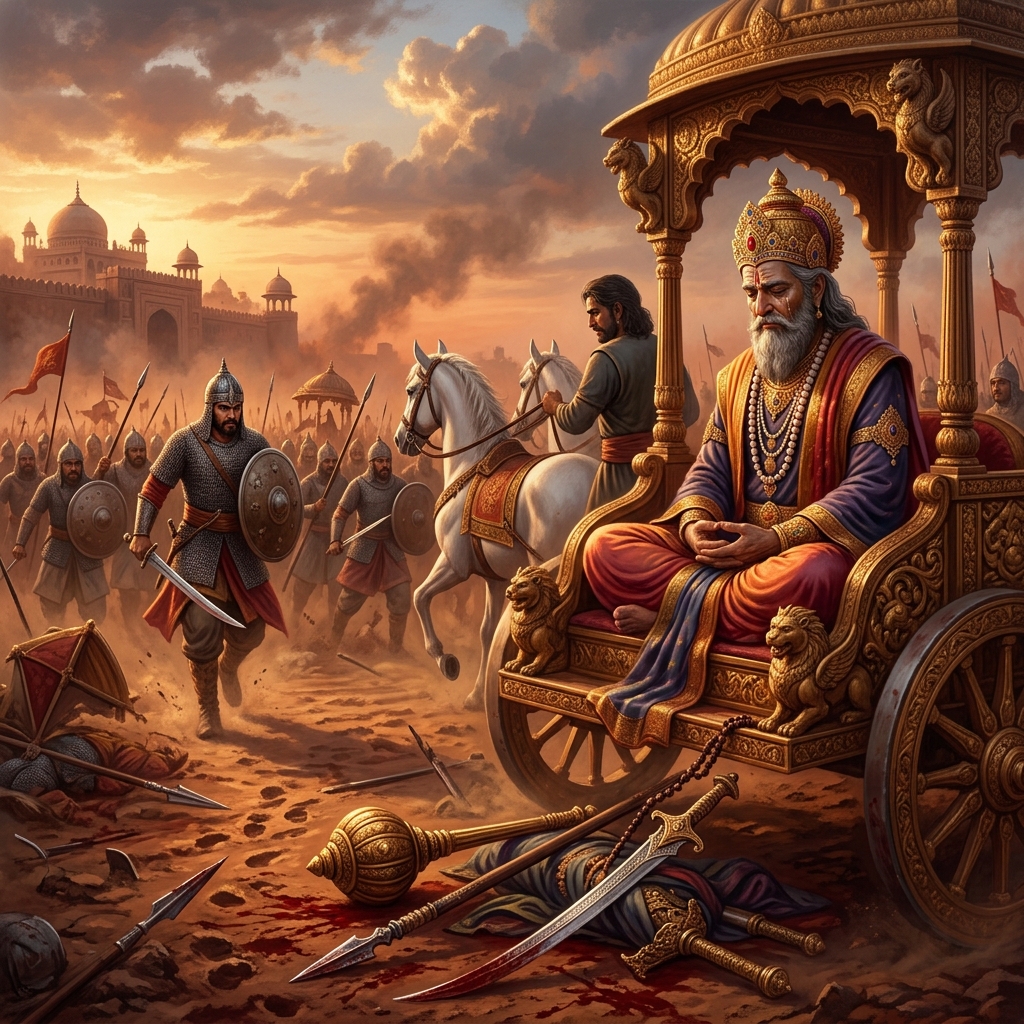
The fifteenth night was the worst the Kaurava camp had known. Bhishma lay on his arrows beyond the lines, still living, still refusing to die. Drona was dead - the old teacher had let go of his bow and sat down in his chariot to meditate when a lie about his son reached him, and Dhrishtadyumna had taken his head while he sat. Two commanders in sixteen days, and both of them men who had held the host together simply by standing in it.
Duryodhana walked through his own camp and did not recognize it. The great avenues of tents had gaps in them now like a mouth with teeth knocked out. Whole contingents had been reduced to a few chariots and a standard nobody wanted to carry. The wounded were laid in rows outside the surgeons' fires because there was no longer room inside them. Somewhere in the dark a man was weeping without trying to hide it, and no officer told him to stop.
He came at last to the tent he had been walking toward all along.
Karna was awake, sitting on the ground with his bow across his knees, oiling the string as though it were an ordinary evening before an ordinary day.
"They are broken," Duryodhana said. "Twice broken. I have no one."
"You have me," Karna said. "You have had me for sixteen years. You gave me a kingdom in front of an assembly that was laughing at me. There has never been a day since when I was not yours."
"Ten days Bhishma kept you off the field."
"Ten days," Karna agreed, "and five more under Drona, who never once let me stand where the fighting was thickest." He set down the oil. "Make me commander and I will end this. Tell the heralds tonight. I want the army to hear it before the sun does."
Duryodhana embraced him, and for the first time in three days he slept.
The Anointing and the Condition
They consecrated Karna at dawn, on the open ground before the tents, with the whole surviving host drawn up to watch.
The brahmanas poured the sacred waters over him from golden jars, and the drums began, and the men shouted his name until the sound rolled out across the plain to where the Pandavas were forming their own line and told them, without any herald, exactly who they would be fighting that day. Karna stood in the wet and the noise in his golden armor with the sun already on his shoulders, and no one who saw him standing there would have said the word charioteer's son aloud, though every man present had thought it at some point in his life, and Karna knew that too.
Then he asked for the one thing he needed and could not simply take.
"I will fight Arjuna today," he said, "and Arjuna has Krishna at his reins. A bow is only as good as the wheels under it. Give me a driver who is Krishna's equal with horses, and there is exactly one man on this field who is - Shalya, king of Madra."
Shalya, when the request came to him, went white with fury. He was a king. He had brought an army. He was uncle to Nakula and Sahadeva and had been maneuvered into this war against his own inclination in the first place, and now he was being asked to hold the reins for a man whose father, everyone said, had driven horses for a living.
Duryodhana asked him anyway, at length, with the particular humility he could produce when he needed something badly enough.
"I will do it," Shalya said at last, "on one condition, and you will not like it. While I hold those reins I say whatever I please. To him, about him, in front of whoever is standing near. You want my hands, you take my mouth with them."
"Granted," said Karna, before Duryodhana could speak. "Say what you like. Only drive."
So they mounted the same chariot, and the horses went forward, and the quarrel between those two men began at the very first turn of the wheels and did not stop all day.
The Promise on the Riverbank
There was a thing Karna carried that morning that no one on either army knew, except one woman in a house in Hastinapura and one man driving a chariot on the Pandava side.
Days before the war, at the river, standing waist-deep in the water with his hands raised to the sun as he had stood every morning of his life, he had heard a woman's voice behind him waiting for him to finish. When he turned she told him what she had carried for forty years: that she was Kunti, that he was her firstborn, that the basket she had set on the water had been her own child, and that the five men he meant to kill were his brothers. Come to us, she had said. Be the eldest. Take the kingdom, it is yours by birth, and every one of them will bow to you.
He had refused. Not out of anger, in the end, though there was anger in it. He had eaten Duryodhana's bread for sixteen years and he would not go over to the winning side on the day the winning side was decided. But he had given her something, because she was his mother and had come to him herself.
"Of your sons," he had said, "you will still have five when this is over. I will kill no son of yours but Arjuna. Either he dies or I do, and either way the number holds."
Now, in the middle of the sixteenth day, Yudhishthira came at him through the dust with his bow raised.
It did not take long. Karna cut the bowstring, and the next string, and then the bow itself, and killed the horses, and the king of the Pandavas stood on the ground in front of the deadliest archer alive with nothing in his hands.
Karna touched him with the end of his bow - not a blow, a touch, the way a man taps a child who has wandered where he should not.
"You are gentle," he said. "You were made for recitation and the sacrificial fire and the giving of alms, not for this. Go back. Fight men who are your equals, or fight no one. Live."
And he let him walk away, in front of both armies, and let every man watching think it was contempt.
Three More
Bhima found him near midday, and Bhima was not a man anyone spared by accident.
They fought until the ground around the two chariots was a wreckage of splinters and dead horses, and it ended with Bhima weaponless in the churned earth, breathing hard, waiting for the arrow. Karna came close enough to have used the bowstring on him.
"You," he said, "who were always happier at a cooking fire than a battle line. Go and find something to eat. The forest suited you. Go."
It was a cruel thing to say and it was said to be overheard, and Bhima, shaking with rage, understood it as the insult it was designed to look like and lived to remember it.
Nakula next, in the afternoon. He rode at Karna with real skill, and Karna took him apart with the patience of a man dismantling something he admired, cutting the bow, the quiver straps, the flagstaff, until Nakula stood empty-handed. Karna dropped the loop of his bow over the young man's shoulders like a garland and held him there a moment.
"Handsome," he said, almost kindly. "Too handsome for this. Fight someone nearer your strength, child. There is no shame in going back to your brothers." He lifted the bow away and let him go.
Sahadeva, before evening, and the same again: disarmed, unhurt, released with a word that stung and did not wound.
Four times in one day the greatest archer on that field had a son of Pandu at the end of his arrow and lowered it. Four times he made the mercy look like scorn, because scorn was the only disguise available to him. He could not say why. To say why was to hand the Pandavas his birth, and Duryodhana his betrayal, and his mother's forty-year secret to two armies.
And all day, at his shoulder, Shalya kept up his running commentary - the horses were too good for him, the Pandavas were beyond him, a driver's son should not have been given a driver of kings - and Karna kept his eyes forward and let it wash over him. There are only so many things a man can carry, and he had chosen his.
The Loneliest Man on the Field
The horns went at sunset and the armies drew apart, and Karna rode back through his own lines with men cheering him from both sides of the road.
They had watched him break the Pandava center. They had watched him take the king of the Pandavas apart in front of everyone and then let him walk. They thought it magnificent. They thought it was the arrogance of a man so certain of tomorrow that he could afford to hand back today's kill, and they roared for it, and Karna raised a hand to them because that is what a commander does.
He had spared four brothers in a single day. Nobody alive knew it was mercy. Yudhishthira had gone back to his tent burning with a shame that would poison him for two more days. Bhima had gone back swearing revenge for an insult about food. The twins had gone back young and humiliated. Not one of them had any idea that the man who let them live had done it because he could not bear to make his mother a liar.
Duryodhana came to him after dark with wine and a question.
"You had Yudhishthira," he said. "You had him disarmed on the ground. One arrow and there is no war left to fight. Why?"
Karna was quiet for a while. Outside the tent the wounded were being carried past, and somewhere beyond them, on the other side of the plain, the Pandava fires were burning in a line that seemed to have no end to it.
"Because he is not the one," he said at last. "There is only one of them I have come for. Tomorrow I will find Arjuna, and I will bring you his head or I will not come back off the field. That is all I have ever promised you, and it is all I will promise now."
Duryodhana embraced him and went away satisfied, and Karna sat alone with his bow across his knees the way he had sat the night before.
He had one day left. The vow to his mother had held four times over, and it would hold once more, because the fifth son was the one it had never covered. Tomorrow was the seventeenth day.
Dharma Lesson
Karna spent the sixteenth day holding death back four times over, and not one of the men he spared ever knew why, nor did the friend he was fighting for, nor the driver who spent the whole day belittling him. A promise kept in secret earns nothing - no praise, no gratitude, not even understanding - and that is precisely what makes it a promise rather than a transaction. Dharma is often practiced where no one is watching and no credit will ever come. Karna's loyalty was given to the wrong cause, but the word he gave his mother he kept to the last hour of his life.