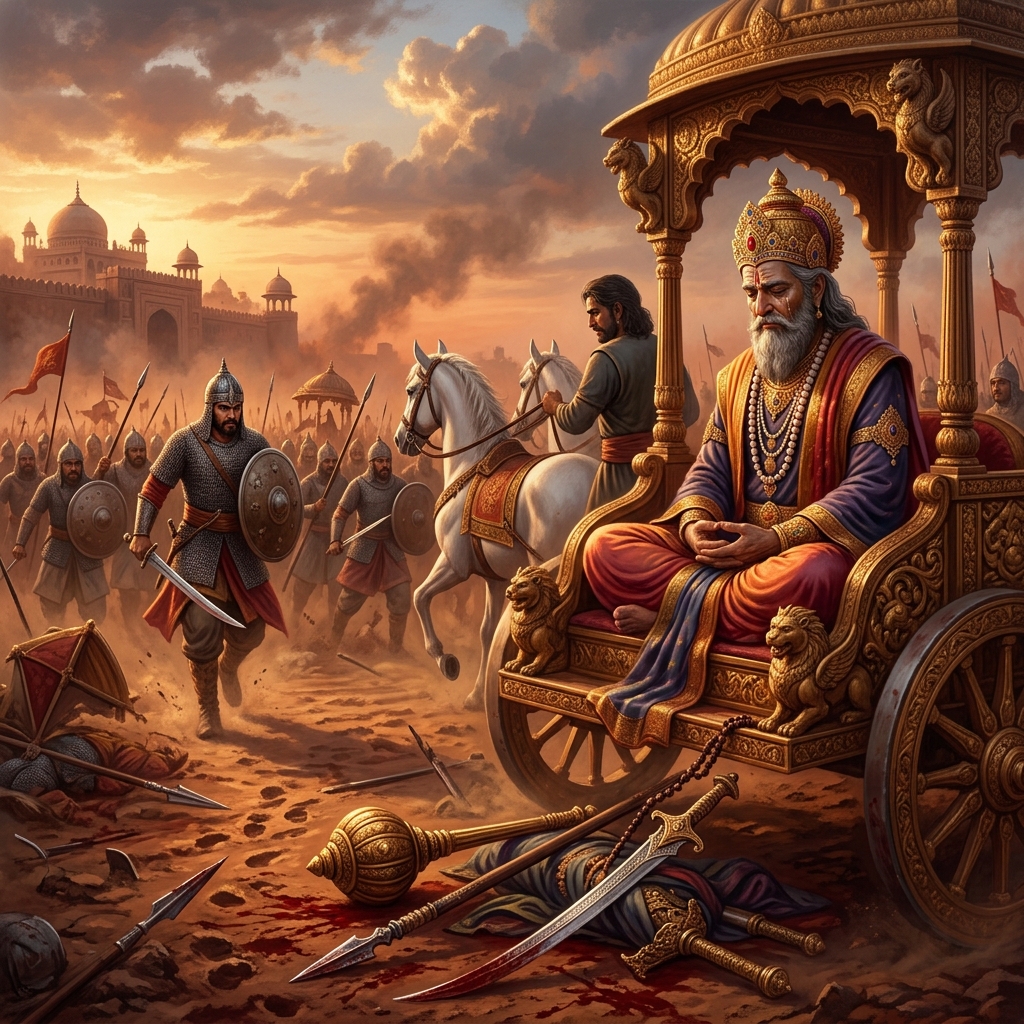
Arjuna's Vow and the Fall of Drona
Jayadratha, the Night Battle of Ghatotkacha, and the Lie That Killed a Teacher
The Chakravyuha and the Boy Inside It
On the thirteenth day of the war at Kurukshetra, Drona formed his army into the chakravyuha - the discus formation, a vast multilayered spiral of soldiers that wound inward upon itself like the coils of a sleeping serpent. He had designed it that very morning for one purpose: to break the Pandava line and capture Yudhishthira while Arjuna was elsewhere. Only a handful of warriors alive knew how to pierce that formation. Fewer still knew how to come back out of it once they were inside.
Drona's plan turned on Arjuna's absence. The Samsaptakas, the sworn warriors of Trigarta, challenged Arjuna at dawn and drew him far away to the southern edge of the field, where they had vowed to kill him or die. Arjuna could not refuse a challenge sworn upon death. He went south with Krishna driving him, and the central field was left without the one man who could shatter the spiral.
None of the remaining Pandavas knew the way in. None except a boy.
Abhimanyu, the son of Arjuna and Subhadra, was sixteen years old. He knew the entrance to the chakravyuha because he had heard his father describe it once, long ago, when Abhimanyu was still in his mother's womb. He had listened from inside her and remembered every word. But Arjuna had been interrupted before he could describe the way out, and Subhadra had drifted to sleep, so the boy knew only half the secret. He knew how to break in. He did not know how to break free.
Yudhishthira watched the iron spiral tighten around his lines and turned to the boy in desperation. "Can you do this, son? Can you open a path for us?"
Abhimanyu's face was bright with the eagerness of the young. "I can enter, Uncle. I have never been taught the way out. But if I cut the gate open and you follow close behind me, we will widen it together and break the formation from within."
"We will be at your heels," Yudhishthira swore. "Go, and we follow."
So the boy gripped the reins of his courage and charged the wall of the world.
The Gate That Closed
Abhimanyu's chariot struck the outer ring of the chakravyuha like a thunderbolt. He drove a wedge through the soldiers there, scattering them, and tore an opening in the spiral. He plunged inside. The Pandava chariots came after him, Bhima and Yudhishthira and the twins and Dhrishtadyumna and Satyaki, riding hard for the gap.
They never reached it.
Jayadratha, king of Sindhu, swung his forces across the breach and slammed it shut. He stood in the gateway like a wall of stone and would not be moved. Long before this war, Jayadratha had performed harsh penance to win a boon from the great god Shiva, for he hated the Pandavas with a cold and patient hatred born of an old humiliation at Draupadi's swayamvara and a later disgrace when the brothers had spared his life. Shiva, who grants what is asked even when the asking is unwise, had given him this: for the space of a single day, Jayadratha alone would hold at bay four of the five sons of Pandu - all but Arjuna. This was the day he chose to spend that boon. This was the gate he chose to hold.
And so, by the will of a god long ago and a king's old grudge, the rescuers were trapped outside while the boy was sealed within. Bhima hurled himself at Jayadratha again and again. Satyaki and Dhrishtadyumna struck from either side. Jayadratha held. The boon of Shiva was not a thing that a mortal arm could break, however mighty. The Pandavas raged at the closed gate while, deep inside the spiral, the gate behind their boy ground shut and the petals of the dreadful flower folded over him.
Yudhishthira's heart turned to ash in his chest. He had sent the child in on a promise he now could not keep.
The Lion Among Wolves
Inside the closing coils, Abhimanyu fought alone, and he fought like the son of Arjuna and the nephew of Krishna that he was. The veteran warriors of the Kaurava host watched in open disbelief as the boy cut through their finest ranks. His bow sang without pause; his arrows fell like rain in the month of the monsoon; whole companies broke and fled before a child not yet a man.
He slew Rukmaratha, the son of Shalya. He slew Brihadbala, the king of Kosala. He slew Lakshmana, the only son of Duryodhana, with a single arrow through the heart, and when Duryodhana saw his boy fall, a grief and a fury seized him that would harden into the cruelty of the hour to come. Abhimanyu broke car after car, toppled elephants, emptied saddles, and heaped the field with the slain until the great Maharathas of the Kaurava army stood at a loss before one young man.
Drona himself, watching, could not hide his admiration. "Look at him," he said to those near him. "This boy is Arjuna come again. I have never seen the like." Duryodhana, grinding his teeth over his dead son, rounded on his teacher and accused him of sparing the boy out of love. Stung, or perhaps resolved, Drona gave the only counsel that could stop Abhimanyu. "His chariot, his bow, his sword - strike them from him first. Surround him. He cannot be beaten while he stands armed and free."
It was the abandonment of every law of righteous war. A single warrior was to be met by a single warrior. But the boy had cost them too much, and the rules went into the dust along with the dead.
The Fall of Abhimanyu
They came at him all at once - Drona, Karna, Kripa, Ashwatthama, Kritavarma, Brihadbala while he yet lived, and Duryodhana, and many more, six and seven great warriors falling upon a single boy in violation of every vow they had ever sworn.
Karna, at Drona's quiet word, struck Abhimanyu's bow from behind and cut its string. Another sheared away his horses; another killed his charioteer. Stripped of his bow, the boy snatched up a sword and a shield and leapt down to fight on foot, and still they could not close on him, so swift and bright was his blade. They shattered the sword in his hand. They split the shield. He seized a chariot wheel from the wreckage around him and lifted it over his head like the discus of Vishnu, and with that broken wheel, his armor in tatters and the blood running into his eyes, he charged them, and even then the great men gave ground before him.
They broke the wheel. He took up a mace. He met Dushasana's son in a duel of maces, and the two fell stunned together. The son of Dushasana rose first. While Abhimanyu was still rising, dazed, the boy unarmed and reeling, Dushasana's son brought his mace down upon Abhimanyu's head.
The son of Arjuna fell, and the earth seemed to fall with him.
The Kaurava host raised a roar of triumph. But it was the triumph of jackals over a lion, and even among them there were those who turned their faces away in shame. When the Pandavas at last broke through Jayadratha's gate, the sun was already sinking, and they found the boy lying in the center of the ruined spiral, ringed about by the bodies of the mighty he had taken with him. He looked, in death, like the young moon set in a circle of fallen stars.
Arjuna Returns
Far to the south, Arjuna had broken the Samsaptakas and turned his chariot back toward the camp as the day failed. Krishna drove in silence, and Arjuna felt a coldness gathering in him that he could not name. The conches that should have sung of victory were silent. The camp, when they reached it, was hushed in a way that no camp is hushed except in mourning.
"Janardana," Arjuna said to Krishna, using the old name, "my mind misgives me. My limbs are loose. My mouth is dry. I do not see my son. Why does no one meet us? Why is Yudhishthira's face turned to the ground?"
Krishna did not answer with comfort, for there was none to give. He told him plainly. The chakravyuha. The boy who knew the way in and not the way out. The gate held shut by Jayadratha. The seven who fell upon one. The mace upon the bowed head of an unarmed child.
Arjuna heard it standing, and then he was not standing. He fell to the earth as a great tree falls when its roots are cut. For a long while he lay senseless. When his sense returned it came back wrong, fevered, and he wept and raged by turns, calling his son's name, blaming himself for the lesson left half taught, blaming Yudhishthira for sending the child, blaming the whole world that such a thing could be. His brothers stood around him and could not look at one another. Subhadra's grief, when word reached her, was a sound that those who heard it never afterward forgot.
Krishna let him grieve. He knew that a grief so great must either be poured out or it would burn the man hollow from within. But he watched Arjuna closely, for he knew his friend, and he knew that in a heart like Arjuna's, grief does not stay grief. It hardens into something with an edge.
The Vow
When the worst of the weeping had passed, Arjuna grew very still, and the stillness was more terrible than the rage had been. He rose. He took up the Gandiva, his great bow, and he held it before the gathered chiefs as a man holds a witness.
"Hear me," he said, and his voice was flat and cold as a blade left out in winter. "Hear my vow, and let the gods hear it, and let the spirits of my fathers hear it. The man who held the gate while seven butchered my son - Jayadratha, the king of Sindhu - I will kill him tomorrow before the sun goes down. I swear it by every good deed I have ever done, by the Gandiva in my hand, by the merit of my austerities and my gifts and my truth. If the sun should set tomorrow and Jayadratha still draw breath, then I will kindle a fire with my own hands and walk into it, and let the world be rid of a man who could not keep his word."
The Gandiva twanged of its own accord as he finished, a deep note like the growl of distant thunder, and the conches of the Pandavas and the drums all sounded together, and Krishna blew the Panchajanya so that the vow rolled out across the darkening field for both armies to hear.
Bhima embraced his brother and swore he would clear the road himself. But Krishna drew Arjuna aside, and his face was grave. "You have vowed a heavy thing, Partha, and you vowed it in grief without asking me. By now the whole Kaurava camp has heard you. They will spend the night building a wall of warriors around Jayadratha that we may not be able to break before sundown. You have given Drona a single task for tomorrow, and Drona is the greatest master of formations alive. Still - it is sworn, and we will keep it. Rest now. Tomorrow your arm must not tire, for it will work from dawn to dusk without rest."
Drona Builds His Walls
In the Kaurava camp the vow was received with fear and then with grim resolve. Jayadratha himself, hearing that Arjuna had sworn his death, was seized with terror and went to the elders and begged leave to flee the field, to ride home to Sindhu and save his life. Duryodhana would not hear of it, and Drona would not hear of it. "Where would you go that the Gandiva could not reach you?" Drona asked. "Stay, and we will set such a guard about you that the sun will set before Arjuna ever sees your face. I give you my word as your teacher and your shield: while I stand, you stand."
So through the night the master of war laid his plans, and at dawn Drona arrayed the army as it had never been arrayed before. He formed a vast formation many leagues deep, shaped like a cart at the front and a lotus behind it, and in the innermost whorl of the lotus he built a needle-eye formation, a tight ring of the very best warriors of the host, and there he placed Jayadratha. To reach the king of Sindhu, Arjuna would have to cut through the cart, then through the body of the army, then through the lotus, then through the needle, and at every layer Drona posted champions sworn to die before they yielded a step.
Drona himself took the mouth of the formation, that he might delay Arjuna there at the very entrance and bleed away his hours. Behind him stood Karna, Ashwatthama, Kripa, Bhurishrava, Shalya, Kritavarma, Vrishasena, and a wall of kings. Jayadratha was buried at the heart of it all like a seed in the deepest fold of a closing flower. The whole purpose of the Kaurava army on the fourteenth day was reduced to one thing: keep one man alive until the sun went down. Then Arjuna would die by his own fire, and the war would be won without another stroke.
The Long Drive
At first light Arjuna mounted his chariot, and Krishna took up the reins, and they drove at the formation like a flood breaking a dam. Arjuna would not let Drona delay him at the mouth. He saluted his old teacher with arrows, refused the duel Drona offered, and drove around him into the body of the army, calling back, "You are my teacher and as a father to me - but today I have no father and no teacher, I have only a vow." Krishna wheeled the horses past Drona's lines and plunged into the host.
What followed was the longest single fight of Arjuna's life. He cut through ranks without number. His arrows flew so thick that the field was roofed over with them and the sun came through as if through a net. Horses fell in heaps; elephants screamed and toppled; whole divisions broke and re-formed and broke again. When his horses tired and grew faint from thirst and wounds, Krishna did a thing unheard of in the middle of a battle: he halted the chariot in a clear space, leapt down, drew the arrows from the horses' bodies with his own hands, dug a well in the earth with a shaft of Arjuna's making, watered them, soothed them, and yoked them again while Arjuna stood guard over them both with the Gandiva, holding off the entire army alone on foot. Then they drove on.
Through the cart formation, through the body of the army, through the lotus they fought, hour upon hour, and the slaughter Arjuna left behind him was a thing the bards would sing of for a thousand years. Bhima and Satyaki came after him to keep the road open, sent by an anxious Yudhishthira, and they too vanished deep into the host. But the layers of Drona's design were many and deep, and for all his fury Arjuna could not be everywhere at once, and the great wheel of the sun rolled down the western sky faster than any arrow.
The Sun Goes Down
By late afternoon Arjuna had broken through to the needle at the heart of the lotus, and there at last he saw the place where Jayadratha was hidden - but a wall of the greatest warriors of the world stood before it. Karna was there, and Ashwatthama, Kripa, Shalya, Vrishasena, Kritavarma, and the king of Sindhu himself crouched behind them, pale and watching the sky. They had only to hold for a little while longer. The light was failing. The horizon had gone red and then deep, and the sun touched the rim of the western mountains.
Arjuna's heart sank as he fought, for he could count the minutes left to him in arrows, and they were too few. The whole Kaurava host knew it too, and a great roar of joy began to rise from them, a roar that swelled as the sun sank, the roar of men who see their enemy about to perish by his own oath. Jayadratha lifted his face and dared to believe he would live.
Then the sky darkened all at once, faster than any evening should fall. A great shadow spread across the dying sun, and the red light went out of the air, and a hush of gloom lay over the field as though night had come down in a single breath. The Kaurava warriors looked up and saw the sun gone, and the roar of joy became a roar of triumph. "The sun has set! The sun has set! Arjuna's day is over! Now let him burn!"
It was Krishna's doing. By his yoga the lord of the worlds had drawn a veil across the sun - in some tellings he cast the shadow of his Sudarshana discus, in others he clouded the orb by his power - so that to every eye on the field it seemed the sun had truly set while in truth it had not yet touched the line of the hills. He whispered to Arjuna, "Lower your bow. Let them think it is over. Watch for Jayadratha. He will come."
The Head in the Father's Lap
Believing the day won and his death escaped, Jayadratha could not help himself. He rose from his hiding place and stepped forward into the open, his face lit with a jubilant, mocking joy, lifting his eyes to the darkened sky to savor the moment of Arjuna's ruin. And in that exact instant Krishna lifted the veil. The sun blazed forth again upon the western hills, full and red and still above the line of the earth. It was not sunset. There was time yet, the span of a single breath.
"Now," said Krishna. "His head is yours. But hear me first, Partha, for this is no common killing." Quickly, in the last sliver of the day, Krishna told him the thing he needed to know. Long ago Jayadratha's father, Vriddhakshatra, had pronounced a curse to guard his son: whoever should cause Jayadratha's head to fall upon the bare earth, that man's own head would burst into a hundred pieces in the same moment. "If you let his head drop to the ground, the curse takes you. So do not let it fall here. Cut it from his shoulders and carry it away upon your arrows, far to the east, to where the old king sits in his evening prayers, and let it fall into his own father's lap. Then it is his hand, not yours, that brings it to the ground."
Arjuna understood. He drew the Gandiva to its full and loosed the Anjalika, a single great arrow charged with all his grief and all his love for his dead son. The arrow took Jayadratha's head clean from his shoulders. But it did not let the head fall. By Arjuna's will and aim it bore the head up and away, eastward over the field, over the rivers, mile upon mile, until it came at last to the holy place where Vriddhakshatra sat at his twilight devotions - and there the head of his son dropped softly into his lap.
The old king startled and rose, not yet seeing what had come to him, and the head rolled from his lap and struck the ground. In that instant his own curse, turned back upon its author, burst the father's head into a hundred fragments. Father and son perished together by the father's own word.
The Vow Fulfilled
On the field of Kurukshetra the false dusk had lifted and the true sun still stood, barely, above the hills. Jayadratha lay headless in the dust before the very wall of warriors who had been set to keep him alive. The Kaurava host, who a heartbeat before had been roaring in triumph, fell silent as men struck dumb. Their guard had failed in the last grain of the last hour. Drona's great design, leagues deep and built through a sleepless night, had been undone by a single breath of shadow and a single arrow.
Then the conches of the Pandavas spoke all at once, and the drums, and the lions among men raised a shout that shook the field, and Krishna blew the Panchajanya until the sound rolled to the edge of the sky. Arjuna stood in his chariot with the Gandiva lowered, and he did not shout. The vow was kept. His son was avenged. But the boy was still dead, and no oath fulfilled could undo that, and so there was a heaviness on him even in the hour of his triumph.
Krishna turned to him, and for once the smile he wore was gentle and without guile. "It is done, Partha. You swore before the sun and you have kept your word before the sun. Abhimanyu's debt is paid by the man who sealed the gate upon him." Arjuna bowed his head and said only, "You kept it, Madhava. Without you my arm and my oath would both have failed. The veil, the curse, the father's lap - I would have known none of it. You drove this day from first light to last."
The true sun touched the hills and went down at last, in its own time, upon a field where for once a thing sworn in grief had been made good. The war was far from over - terrible days and terrible deaths still lay ahead for both houses - but on the fourteenth day, a father had kept faith with a dead son, and a vow made at the edge of the fire had been answered before the fire was ever lit.
Dharma Lesson
Some victories cost more than they pay. Krishna spent the Vasavi-shakti to save Arjuna - by spending Ghatotkacha. Yudhishthira spent his lifelong truthfulness to break Drona - by speaking a half-truth that he himself could not bear to hear unmuffled. War leaves no one clean. A boy can win his way through six grown warriors and still die; an old teacher can survive every weapon and fall to a single sentence.