The Fallen Sun
Karna's life is the greatest tragedy of the Mahabharata.
The Crown of Command
Drona was dead. The great teacher, who had held the Pandava army at bay for five terrible days, lay slain by a half-truth and a sword, and the Kaurava host reeled like a body that has lost its spine. On the sixteenth night of the war, in a camp lit by guttering torches and heavy with the smell of blood and ash, Duryodhana turned at last to the friend he had always trusted above all others.
"Karna," he said, kneeling almost like a supplicant before the man he had crowned king of Anga long ago. "Bhishma fell. Drona is gone. You are the last of my great ones, and the greatest. Take command of my armies. End this. Bring me Arjuna's head, and the throne of the world is ours."
Karna rose. For sixteen days he had been forced to wait, for he had sworn he would not fight while Bhishma led the host, and Bhishma had despised him. Now his hour had come, the hour he had bought with a lifetime of insults swallowed and slights endured. He buckled on his armor and lifted his bow, the great Vijaya gifted to him long ago, and his eyes burned with the old, patient fire.
"I will fight Arjuna," Karna said quietly. "And one of us will not see another dawn. This I promise you, my friend. Whatever comes of it, remember that I gave you everything I had. You gave me a name when the whole world called me low-born. I will pay that debt in full, with my life if it is asked."
The Kaurava camp roared his name into the dark. Karna, son of a charioteer, son of the sun though he did not yet fully know it, was now the commander of all Duryodhana's hopes. Around him the curses he had gathered through his life waited like coiled serpents in the grass, biding their time.
The Reluctant Charioteer
Karna knew that to match Arjuna he needed more than a great bow. Arjuna had Krishna himself holding his reins, the finest charioteer who ever lived, who could read a battlefield like a sage reads scripture. Karna needed an equal. He went to Duryodhana with a single demand.
"Give me Shalya, king of Madra, as my charioteer," Karna said. "He alone among living men is the equal of Krishna at the reins. With him beneath me, I will not be outmatched on the field."
Shalya was a proud king, uncle to the Pandava twins by blood, who had been tricked into fighting for the Kaurava side. When Duryodhana asked him to serve as charioteer to a charioteer's son, Shalya flushed with fury. "You ask a king to hold the horses of a suta?" he raged. "This is an insult fit to make my ancestors weep."
But Duryodhana flattered him, comparing him to Krishna who served Arjuna though he was the Lord of the Yadavas, and Shalya, mollified, agreed on one condition: that he be free to speak whatever he pleased, however bitter, without rebuke. Duryodhana, desperate, consented.
So it was that on the seventeenth morning, Karna mounted his chariot and found at the reins a man who hated him. As they rode toward the Pandava lines, Shalya began to needle him, mocking his birth, belittling his boasts, predicting his death. "You bark like a jackal who thinks himself a lion," Shalya sneered. "Arjuna will silence you before noon." Karna answered insult with insult, praising Madra's people as drunkards and oath-breakers, and the two men rode to war trading venom, the commander of the host and the king who steered him both poisoned by pride.
The Field of Slaughter
When Karna entered the battle, he entered like a storm breaking over a plain. For all the curses upon him, for all the pride that steered his chariot, he was still the greatest natural archer the world had ever produced, and on this day he fought as though to burn an entire lifetime of waiting into a single afternoon of fire.
He scattered Pandava divisions like leaves before a gale. Warriors who had stood against Bhishma and Drona broke and fled before his arrows, which came so fast that the sky between the armies seemed strung with a roof of shafts. He met the Pandava brothers one by one, and one by one he humbled them, but he did not kill them, for he had given his word to Kunti.
He found Yudhishthira and overwhelmed him, shattering his armor and his bow, driving the eldest Pandava bleeding and shamed from the field, but he let him live, touching him with the tip of his bow and mocking him gently. "Go back, son of Dharma. The battlefield is no place for a gambler and a priest. Send me Arjuna." He found Bhima and fought him to a standstill, and remembering his promise to his mother, he spared the raging giant too, though he taunted him as a glutton and a fool.
Nakula and Sahadeva he disarmed and let go, brushing them aside as a man brushes aside children, keeping his deadly oath that he would lift his hand to kill only Arjuna among the five. With each spared brother Karna paid a secret debt to the mother who had abandoned him at birth, and with each one he narrowed the war down to the single contest that fate had been preparing since before he was born.
Two Suns Meet
At last the dust between the armies parted, and the two chariots that all of Kurukshetra had been waiting to see came face to face. On the one stood Arjuna, the white horses of his chariot lathered, the conch Devadatta still echoing, and at his reins Krishna, dark and calm as the deep. On the other stood Karna, the sun blazing at his back as though the god of day had come down to watch his unacknowledged son, and at his reins the bitter king of Madra.
The whole vast battle seemed to slow and turn inward, as if the hundreds of thousands of men on that plain understood that the true war, the war that had been brewing since two boys first measured each other at a tournament long ago in Hastinapura, was about to be decided here. Karna and Arjuna had circled each other their entire lives, rivals who were, though neither army knew it yet, brothers by blood.
Arjuna's lips were tight with old hatred, for he had not forgotten that Karna laughed when Draupadi was dragged into the dice hall, that Karna had a hand in the murder of his beloved son Abhimanyu. Karna's face was unreadable, for he carried a grief Arjuna could not guess, the knowledge that the man before him was his own younger brother, and the promise to their shared mother that only one of them would walk away alive.
"Now," Krishna murmured to Arjuna, "is the hour for which you were born. Here stands the only man on this field who is your equal. Do not falter, do not pity, do not look away. Fight as though the dharma of the whole world rides on your bowstring, for today it does." The two suns drew their bows, and the earth itself seemed to hold its breath.
The Duel of Duels
What followed, the bards would say ever after, had no equal in all the ages of the world. The two greatest archers who had ever lived loosed arrows so swiftly that the air between them became a single shimmering wall of iron and fire, and the gods themselves crowded the sky to watch, taking sides as the contest swayed.
Arrow shattered arrow in mid-flight. When Karna loosed a shaft of flame, Arjuna answered with a shaft of water that quenched it. When Arjuna sent a serpent of arrows hissing forward, Karna split them with a net of his own. They called upon celestial weapons, the astras gifted by gods and sages, and the weapons collided overhead in bursts of light that scorched the clouds and shook the standing armies to their knees. Mountains seemed to tremble, and the oceans, far away, were said to surge.
For a long while neither could gain the smallest advantage. Karna's chariot was driven back; then Arjuna's. The banner of one fell; then the other rose again. The watching warriors of both armies stood frozen, leaning on their bloodied weapons, knowing that whatever they had done that day was nothing beside this. Even Shalya, who despised the man he served, fell silent at the reins, for he had never imagined that human hands could do what these two were doing.
But fate had laid its traps long ago, in the form of curses Karna had earned and accepted across the years of his hard life. Those curses now stirred. The duel that seemed so evenly matched was not, in truth, even at all, for one of these two men carried a burden of doom woven into his very destiny, and as the afternoon wore on toward its terrible end, that doom began, one strand at a time, to draw tight.
The Serpent Ashwasena
Among the arrows in Karna's quiver was one he had saved for a single, perfect shot. It was no ordinary arrow. Hidden within it was Ashwasena, a great serpent whose mother had perished long ago when Arjuna and Krishna burned the Khandava forest. Ashwasena had survived, and had nursed his hatred for Arjuna across all the years since, waiting for the day he could take his revenge. He had crept into Karna's quiver and taken the form of a deadly shaft, begging only to be loosed at the head of his enemy.
Now Karna fitted that arrow to his great bow Vijaya and drew it back to his ear. Shalya, who knew its terrible power, warned him. "That arrow flies wild and low. Aim higher, or you will waste it." But Karna was proud, and he would take aim where he pleased. "Karna does not loose a second arrow to mend a first," he said coldly, and he let it fly.
The arrow streaked toward Arjuna's throat, blazing, certain, carrying within it the venom of a generation's grief. It would have taken Arjuna's life in that instant, and the war and the world would have turned upon it.
But Krishna saw. In a single motion the dark charioteer pressed his foot down hard upon the chariot floor, and the great war-car sank a hand's breadth into the earth, its horses buckling at the knees. The arrow, aimed at the throat, struck instead the crown upon Arjuna's head, shattering it and scattering its jewels but sparing his life. Ashwasena, robbed of his vengeance, returned to Karna and begged to be loosed a second time, fitted to the bow once more so that he might finish what he had started. But Karna refused. "It is not the way of the brave to strike the same blow twice with another's strength," he said. And so the serpent flew off alone to his death, and Arjuna lived, saved by a charioteer who was also a god.
The Curses Bear Fruit
Now the old curses, patient as roots beneath stone, broke at last into the open air.
Long ago, Karna had gone to the warrior-sage Parashurama disguised as a Brahmin, for Parashurama would not teach a kshatriya, and there he had learned the secrets of the most terrible celestial weapons, including the dread Brahmastra. But one day, while the sage slept with his head upon Karna's thigh, a stinging insect bored into Karna's flesh, and Karna, rather than wake his teacher, endured the agony without a sound until the blood flowed warm. Parashurama woke, saw the blood, and knew at once that no Brahmin could bear such pain so silently. "You have lied to me," he said. "You are a warrior. And because you gained this knowledge by deceit, hear my curse: at the very moment you need these weapons most, when your life hangs upon them, the incantations shall vanish from your mind."
That moment came now. Battered and pressed by Arjuna's relentless assault, Karna reached at last for the supreme weapon, the Brahmastra that could have ended the duel in his favor. He reached into his memory for the sacred words that would summon it, and found nothing. The incantation he had known perfectly for a lifetime was simply gone, dissolved like mist, leaving only a terrible empty silence where his greatest power should have been. He strained, he searched, he prayed, but the curse held fast.
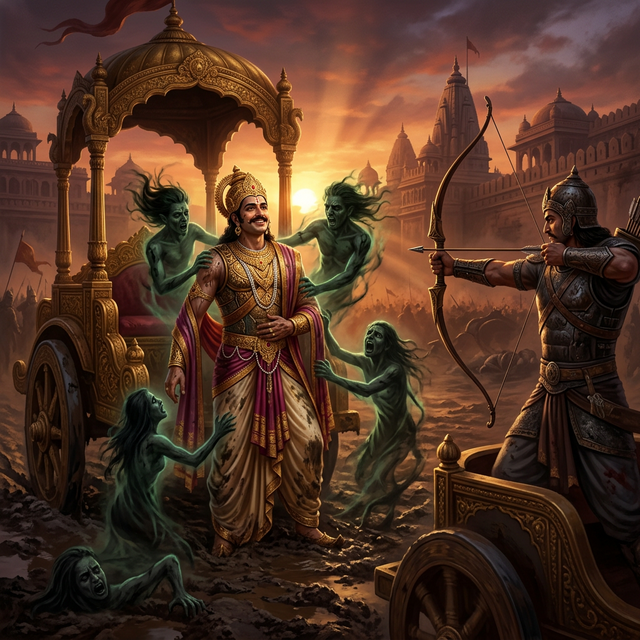
And then the second curse stirred. Years before, Karna had loosed an arrow at a sound in the brush and slain by accident the cow of a poor Brahmin. The grieving Brahmin had cursed him: "As you killed my helpless creature unaware, so in your hour of greatest danger your chariot wheel shall sink into the earth, and you shall be slain unable to defend yourself." Now, as Karna fought half-blind with desperation, his right chariot wheel struck soft ground soaked with the blood of the day, and Mother Earth herself seemed to reach up and seize it, swallowing it deep into the mire. The chariot lurched and stuck fast, tilting, helpless. The serpents in the grass had struck at last, all of them, in the same dreadful hour.
The Plea for Dharma
Karna leapt down from his tilting chariot to free the sunken wheel. He set his hands upon it, this man who had once cut the living armor from his own body without a cry, and he heaved with all his great strength, but the earth would not give it up. The wheel sank deeper still, as though the ground itself had become his enemy, and his hands, slick with his own sweat and blood, slipped uselessly against the spokes.
Across the narrowing space Arjuna stood with arrow nocked, watching his rival labor in the mud. And Karna, looking up from his hopeless task, called out to him in the name of the warrior's code that both of them had sworn to honor.
"Hold, Arjuna," he cried. "You are a man of dharma, born of a noble line. The rules of righteous war forbid you to strike a foe who is unarmed, who is dismounted, whose attention is turned away, who is in distress. I am all of these now. Grant me a moment to free my wheel and regain my chariot, and then we shall finish this as equals, as warriors, as the codes of honor demand. Do not stain your victory by cutting down a helpless man."
For an instant Arjuna's hand wavered, for the plea was just, and the law of arms was sacred to him. The arrow lowered a fraction. The whole field hung suspended upon that hesitation, and it seemed that the ancient code might yet save the doomed commander where his curses and his strength had failed him. Karna, sinking in the bloodied earth, lifted his face to his unknown brother and waited to learn whether dharma would be his shield.
The Reckoning
Then Krishna spoke, and his voice was cold as a verdict.
"Karna," he said, "how strange that you should remember dharma now, with the earth at your throat. Where was your dharma when Draupadi, a daughter of kings, was dragged by her hair into the assembly hall, weeping and half-clothed, and you laughed and called her a harlot and bid her choose another husband, for one with five husbands is no better than a fallen woman? Where was your dharma then?"
Karna's hands went still upon the wheel.
"Where was your dharma," Krishna continued, relentless, "when six great warriors surrounded the boy Abhimanyu, alone and unarmed, his bow broken, his chariot smashed, and you cut the string of his bow from behind so that the others could cut him down? He was a child, sixteen years old, and you helped to butcher him against every law of war you now invoke. Where was your dharma when Yudhishthira was cheated of his kingdom by loaded dice, and you cheered the theft? Where was your dharma when you counseled that the Pandavas and their mother be burned alive in a house of lac?"
The litany fell like blows. Every cruelty Karna had committed or abetted, every time he had stood silent or laughing while righteousness was trampled, Krishna named them all, until the proud commander sank in the mud beneath the weight of his own deeds.
"You who spit on dharma your whole life," Krishna finished quietly, "do not now hide behind her skirts. The wheel of the law turns slowly, but it has come around to you at last." Then he turned to Arjuna. "Loose your arrow. Send him to the death he has earned, and grieve for him later if you must, but do not let him rise." And Karna, hearing the truth of it, bowed his head, for he could not in honesty deny a single word.
The Anjalika Falls
Karna, scorned by his own past and abandoned by the earth, did not flee and did not beg again. He turned back to his chariot, climbed upon it as best he could, and snatched up his bow, for a warrior of his greatness would not die without lifting his weapon one last time. He fitted an arrow and loosed it at Arjuna, and even now, doomed, half-sunk, stripped of his sacred weapons, his aim was true and his shaft struck home, staggering his enemy. Such was Karna even at the gates of death.
But the hour had come, and fate would not be cheated of it. Arjuna drew from his quiver the Anjalika, a broad-headed arrow keen as a razor and bright as the noonday sun, an arrow he had reserved for the ending of endings. He set it to the string of Gandiva and drew the great bow until the wood groaned, until his whole body became one taut line of purpose, and he prayed over it the prayers his teachers had given him, that this shaft might find its mark and bring the long contest to its close.
Krishna, at the reins, watched without blinking. The two armies, the gods in the sky, the very wind across the plain seemed to fall silent. And then Arjuna released.
The Anjalika crossed the space between the two suns like a stroke of lightning and struck Karna full upon the throat, and the head of the son of Surya, beautiful even in death, was struck from his shoulders and fell to the bloodied earth of Kurukshetra. The commander of the Kaurava host, the unacknowledged eldest brother of the men who killed him, lay slain in the mud of the field he had nearly won, and a great cry of horror and triumph rose from the watching multitudes at once.
The Radiance Returns to the Sun
As Karna fell, a marvel was seen by all who had eyes to see it. A radiance, soft and golden, rose from his broken body and climbed into the sky, and there it touched the sun and was drawn into it, light returning at last to its source. For he was the son of Surya, the firstborn child of the god of day, and now the brightness that had always dwelt in him went home to its father. Even Arjuna, his slayer, lowered his bow in awe, and many in both armies wept without knowing why, sensing that something far greater than an enemy had just departed the world.
Duryodhana, when word reached him, fell from his chariot as though struck, and grieved more bitterly for Karna than he had grieved for his own brothers or his grandsire, for in Karna he had lost the truest friend he had ever owned. And in time the dreadful secret came out, as such secrets do. After the war, when Yudhishthira sought to honor the dead, Kunti at last confessed before her sons what she had hidden all her life: that Karna, the enemy they had fought and feared and finally slain, the man they had despised as a charioteer's son, was her own firstborn, conceived of the sun god before her marriage and set adrift upon a river in a basket of shame.
The Pandavas were stricken beyond words. They had killed their own eldest brother, and worse, they had hated him to the end without knowing his face was their own. Yudhishthira, who had longed his whole life for Karna's friendship without understanding why, wept inconsolably, and in his grief he cursed all women that they should never again be able to keep a secret. Karna's spared promise to their mother, that she would still have five sons whichever way the duel went, took on a terrible new meaning, for the brother who had let them live was the brother they had been born to lose.
So ended the song of Karna, the Karna-gatha: the foundling raised by a charioteer, the friend who paid his debt of honor in full, the warrior crippled by curses he had earned and accepted, who gave away his armor and his life and never once his loyalty, and whose light, when all was finished, returned to the sun that fathered him. Of all the tragedies of the great war, none was mourned more deeply, then or since, than the death of the brother who never knew his brothers, and the brothers who never knew him until it was too late.
Dharma Lesson
Karna's life is the greatest tragedy of the Mahabharata. Born a prince, raised a charioteer's son, cursed by fate at every turn - yet he never broke his word, never betrayed a friend, never stopped being generous even when it cost him everything. His story raises the deepest questions: Is destiny stronger than dharma? Can one be righteous while fighting for the wrong side? Perhaps the truth is that Karna was not a villain at all, but a hero standing on the wrong side of history.