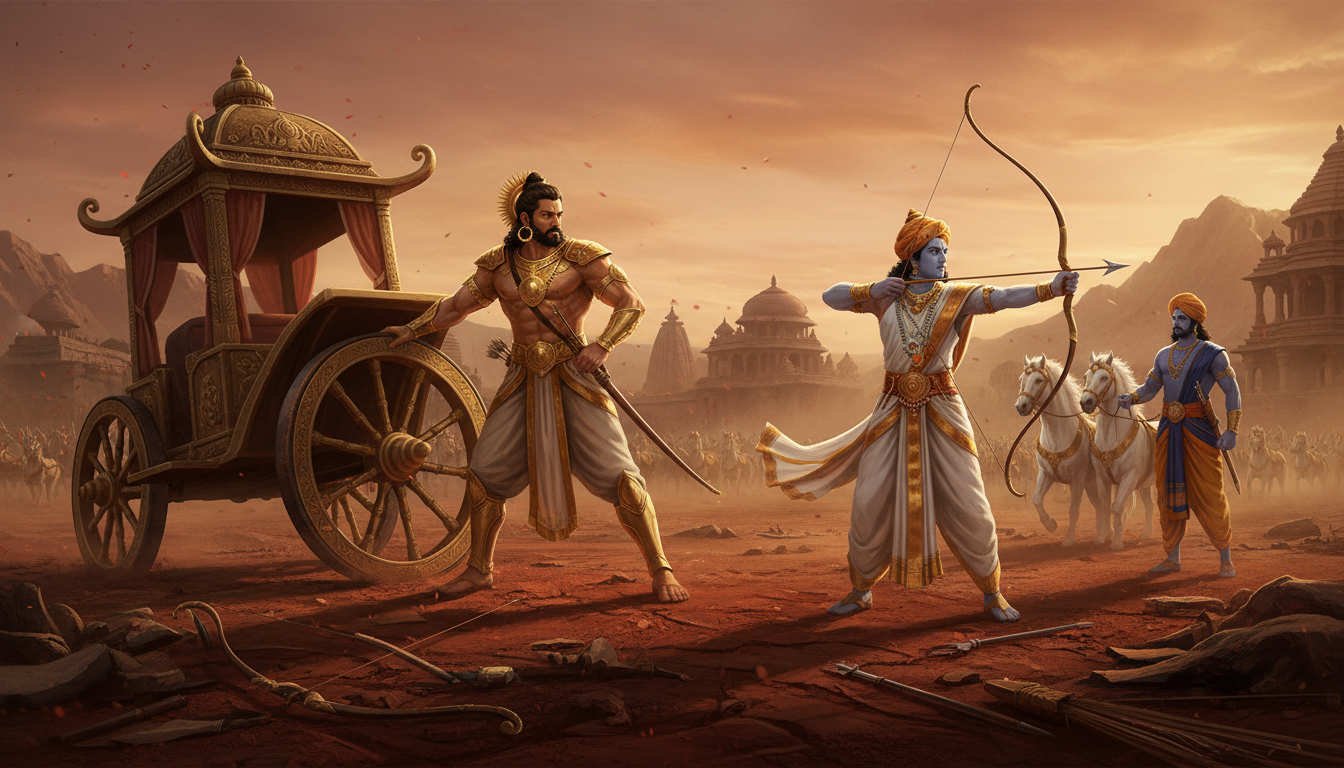
Kurukshetra Day 17: The Earth Takes the Wheel
Karna's Last Morning to Karna's Last Hour
Before the Drums
When the night was over Karna came to the king's tent before the drums.
"I will engage the son of Pandu today. Either I kill him or he kills me. My bow is Vijaya. Vishvakarman made it for Indra, and at its twang the Daityas found the ten directions empty; Rama of Bhrigu's race gave it to me. In bows I am the better man. Now hear where I am the lesser. His two quivers cannot be emptied, his car was given him by Agni and cannot be pierced, his horses have the speed of the mind. And Govinda holds his reins; I have nothing like Govinda. One man on this field is Krishna's equal with horses and he is sitting in your camp. Give me Shalya of the Madras for a driver and the victory is yours."
Shalya stood up out of the assembly with his face burning.
"You insult me, son of Gandhari, or else you suspect me. I do not regard Radha's son as my equal in battle at all. Why do you set me to a servant's work for a low-born man? The Sutas are the servants of kshatriyas; kshatriyas are not the servants of Sutas. My coronal locks have had the sacred bath and I was born in a line of royal sages. Give me leave to go home."
He turned to leave. Duryodhana caught his arm and held it.
"Karna is not superior to you and I do not suspect you. Your fathers took truth for their refuge, and that is why men call you Artayani. Karna is better than Dhananjaya in weapons, and the world holds you better than Vasudeva; your knowledge of horses is double his. When the gods built a car of their own parts to burn the three cities, Mahadeva stood on it and told them, 'Make him my driver who is superior to me,' and the Grandsire himself took the reins for Rudra."
Shalya's anger ran out of him like water from a cracked jar.
"Very well. Since you say before all these troops that I am greater than Devaki's son, I am gratified, and I will drive Radha's son. But let this be understood between us. In his presence I will say whatever I please."
Duryodhana looked at Karna. Karna nodded. "So be it."
The Crow and the Swan
In the morning Shalya equipped the car himself and brought it round and said, "Blessed be thou. Victory to thee." Karna walked once around the vehicle a priest had sanctified long ago, then stood facing the sun with his palms together as he had every morning of his life. "Ascend," he said, and Shalya went up like a lion going up a hill, and Karna after him, and the two stood like Surya and Agni on one cloud.
The quarrel began at the first turn of the wheels.
"There was a crow," Shalya said pleasantly, over his shoulder, "that lived on the leavings of some merchants' children and told the swans it knew a hundred and one kinds of flight. A swan flew with it over the sea using one slow flight only, and halfway out the crow began striking the water with its wings and its beak. 'Which of your hundred and one flights is this?' the swan asked. And the crow said, 'We are crows, we go about crying caw, caw. Save me, I place my life-breaths in your hands.' So do you, fed by the sons of Dhritarashtra on the leavings of their dishes, disregard your betters. You ran first at the Dvaita lake when the Gandharvas took your king. You are a firefly telling the sun and the moon that they are dim."
"What Vasudeva is and what Arjuna is, I know," Karna said. "You have never seen either of them fight. I have, and I will fight them both today."
Then his voice changed, and Shalya, who had been enjoying himself, heard it.
"What frightens me is not Arjuna. I went to Rama of Bhrigu's line dressed as a brahmana to get his weapons, and Indra came as a worm and bored into my thigh while my teacher slept with his head on it, and I sat still and let the blood run because I would not wake him. When Rama woke he said, 'No brahmana could bear that. Tell me truly who you are.' I told him I was a Suta. He cursed me: the weapon I got by a lie would not come into my mind at the hour of my death. It is already gone; I have hunted for it in this battle and it is not there. And there is an older curse besides, about a wheel and the earth. Now you know what my death will look like. Drive."
The Weapon Rama Gave Him
Whatever else was true of that quarrel, the bow on the chariot worked.
Karna sent five hundred of the Kaikayas to Yama's house before the morning was out. But Ashvatthama came at Arjuna and lost his horses and his standard and his driver, and after that the Kaurava host began to come apart. Men who had held for sixteen days walked out of the line. Karna stood up in the car and shouted "Stay! Stay!" and they did not stay.
Duryodhana came to him with the flat voice of a man watching the last thing he owns go away. "You are here, and still our army runs. Thousands of them are calling your name while they run. Do what the hour requires."
"Today I will kill all the Pancalas and all the Pandavas," Karna told his driver. "Take the car forward. It will be as I have said."
Then he strung the ancient bow Vijaya and rubbed the string up and down with his hand, and pledged the running men his own truth that he would hold the field; and they stopped and turned around, because it was Karna who had said it. On that string he set the weapon called Bhargava, which Rama of Bhrigu's race had given him with the bow, and out of it came arrows in millions.
The Pandava army could not see. The sky was feathers of the kanka bird and of the peacock, and under that roof elephants and horses and men went down in thousands until the ground shook. The Pancalas wailed. The Cedis lost their senses and ran in circles like elephants in a burning forest, and even the beasts and the birds were frightened.
The King Goes Back to Camp
Arjuna heard it from where he stood and knew what it was.
"There is no baffling that weapon, Krishna. Look at him lashing his horses and throwing angry glances at me. I will never be able to fly from Karna. A living man in battle may have victory or defeat; to a man already dead, even death is a victory. How can there be defeat for one who is dead?"
"The king has been badly wounded by Karna," Krishna said. "See him first and comfort him. Then you will kill Karna."
He turned the chariot out of the battle, reckoning that Karna would be tired by the time they came back, and Arjuna searched the army for his eldest brother and could not find him on it.
Karna had found Yudhishthira an hour before, going toward camp between Nakula and Sahadeva, so full of arrows that he was hardly conscious, and had put three more into him. The king struck him in the middle of the chest, and the twins came from both sides in a storm of shafts. Karna cut them apart with two broad-headed arrows, killed the king's white horses that were fleet as thought and had black hair in their tails, struck the headgear off his skull, then cut away Nakula's bow, so that both brothers had to climb into Sahadeva's car.
Their uncle, watching from Karna's reins, was moved to pity.
"You are to fight Phalguna today. Why spend yourself on Dharma's son? Your arrows are going, your armour is going, your horses are tiring. When you reach Partha you will be a joke."
Karna went on shooting, so Shalya tried the other handle.
"There, Bhimasena is fighting the king's son. Go, or Bhima kills Duryodhana in front of all of us. What do you get by killing the sons of Madri?"
That one worked.
Yudhishthira was carried into camp and sat on a bed while they drew the arrows out of him one at a time. "Go to Bhimasena's division," he told the twins when he could speak. "Vrikodara is out there roaring like a cloud." Then he lay back with the shame in him and waited.
Give That Bow to a Better Man
Arjuna came into the tent with Krishna behind him, and Yudhishthira looked up and understood that Karna was still alive.
"Your army has fled, and not honourably. You deserted Bhima and came here because you could not kill Karna, though in the Dvaita woods you told me you would kill him alone, on a single car. For thirteen years we have lived on you the way seed lies in the ground living on the hope of rain. If you cannot stand against Radha's son today, give that Gandiva to some other king who is your better with weapons. Fie on your Gandiva, and on the strength of your arms, and on your ape banner and the car the god of fire gave you."
Arjuna drew his sword.
"Why draw that?" Krishna said. "I see nobody here for you to fight."
"You know my vow. Whoever says to me, 'Partha, give your Gandiva to a better man,' dies by my hand that hour. The king has now said those very words to my face, in front of you, more than once. If I kill him I cannot live in the world one moment longer, and I have already sinned by wanting to. Find me something that keeps my vow true and leaves us both alive."
"He said those things to provoke you into killing Karna, because he knows nobody else in the world can bear that man," Krishna said. "Your vow must stand, and he does not deserve to die for it. A man lives as long as those who should respect him respect him; treated with contempt he is spoken of as dead though he breathes. You have always called this king 'your honour.' Call him 'you.' A superior addressed so by his junior is killed without being deprived of life."
So Arjuna, who had never spoken to him that way in his life, turned and did it.
"Do not upbraid me, you, who spend the battle two miles from it. Bhima may upbraid me, who is standing in the middle of the Dhartarashtras at this moment with a mace in his hand. You are strong in words and unfeeling. Lying on Draupadi's bed you insult me while for your sake I kill the mightiest car-warriors on the field. You gambled and you lost the kingdom. Do not goad us now."
Then he stopped, and turned the sword on himself.
"I will kill the man who did that wicked thing."
"Kill yourself and you fall into a worse hell than if you had killed your brother. You want to destroy yourself? Then praise yourself aloud. That is a suicide the righteous permit."
So Arjuna lowered the bow and declared before witnesses that there was no archer like him but the god who carries Pinaka, that he had conquered every quarter of the earth and laid it under this king's feet. Then he pushed the sword back into its sheath and stood with his hands joined.
"Be cheerful, king. Forgive me. What I have said you will understand a little while from now. Karna is coming toward me."
He touched Yudhishthira's feet and went out. Behind him the king rose off the bed. "Strike off my head today, Partha. I am idle and cruel and an insulter of the old. Bhimasena is fit to be king."
The Oath About Duhshasana
Out on the field Bhima had found the man he had been looking for since the gambling hall.
Duhshasana fought well that afternoon; even the enemy applauded one shot of his. He put a shaft deep into Bhima and Bhima felt it go in.
"That was quick and it was deep," Bhima said. "Now bear the stroke of my mace." And then, because there was no reason left to keep it private, "Wicked soul, today I drink your blood on this field."
Duhshasana threw a dart that came on like Death itself. The mace broke it in the air and took him in the head and threw him out of the car the length of ten bows, and the same fall killed his horses and ground his car to atoms. He lay trembling with his armour and his garlands scattered off him.
Bhima stood over him and remembered it all: a girl dragged out of the inner apartments by the hair, a single cloth, a room full of kings looking at their own hands.
"Today I kill this wretch," he said, loudly, to Karna and Duryodhana and Kripa and Drona's son and Kritavarma, all of them within hearing. "Let every one of you protect him if you can."
Nobody moved. He came down off his car, drew his sword, set his foot on Duhshasana's throat, opened his breast and drank the blood while it was warm. Then he cut the head off and drank again, a little at a time, the way a man tastes a thing.
"Better than my mother's milk," he said. "Better than honey or clarified butter or good wine or curds. Better than any sweet thing on the earth. What more can I do to you? Death has taken you out of my hands."
Men who saw it fell down where they stood, and the word went along the line: this is not a human being, this is a rakshasa. And Bhima walked the field with the blood on him, holding a little of it up in his palm for everyone to see.
"Now call us beasts again. They danced at us and said beast, beast; we will dance at them and give them back their own word. The poison in the food. The black cobras. The lac house set on fire. The kingdom taken with dice. The exile. Draupadi's hair. All of it came from you."
Then he turned to Krishna and Arjuna, bleeding from his own wounds. "What I vowed about Duhshasana I have done today. I will do the other soon, on that second beast Duryodhana, and put my foot on his head in front of the Kauravas, and then I will have peace."
The Serpent in the Quiver
Then the two of them found each other, and the field stopped being a battle and became an audience.
They shot until there was no sky, only a woven mat of arrows with no gap in it anywhere, and the beings in the air applauded them both by turns. Apsaras fanned the two men with young palm leaves and sprinkled them with sandal water, and Indra and Surya reached down and brushed the sweat from the face of each of their sons.
Underneath all this a snake called Ashvasena woke below the earth. His mother had died at Khandava when Arjuna burned it, and he had gone down through the ground carrying that. Now he rose, took the shape of an arrow and slid into Karna's quiver.
Karna, worn out, set his heart at last on the one shaft that lay by itself, kept for years in a golden quiver in sandal dust and worshipped like a god. He pulled it to his ear, and the sky went bright, and the Regents of the world wailed.
"That arrow will not take Arjuna's head," Shalya said. "Look properly and fix another that will."
Karna turned his eyes on him, burning. "Karna never aims twice. Men like us are not crooked warriors."
He loosed it, saying, "You are slain, Phalguna." It went up dividing the sky the way a comb divides a woman's hair. Krishna did not turn the car or shout. He pressed down with his feet and drove the whole vehicle a cubit into the ground, and the white horses went down on their knees with it. So the shaft, instead of taking the neck, took the diadem, the crown the Self-born had made with his own hands, which Rudra and Kuvera could not have broken with Pinaka and thunderbolt. It burst off his head in fragments of gold and pearl, and the sound all the worlds made then was the sound of earth and sky and water in a storm.
Arjuna, bareheaded, tied his hair up with a strip of white cloth and did not move.
The snake came back through the air to the bow that had sent him. "You shot me without looking at me, and that is why I missed. Shoot me again and I will kill your enemy and mine."
"Who are you?"
"One that Partha has wronged. He killed my mother."
"Karna does not want a victory that belongs to somebody else's strength. If I had a hundred Arjunas to kill I would not shoot the same shaft twice. Be happy, and go elsewhere."
The snake went at Arjuna himself out of nothing but hatred, and was cut to pieces in the air.
The Earth Takes the Wheel
Then the hour came, and Kala walked up to the chariot invisibly and said, so that only Karna heard, "The Earth is devouring thy wheel."
Three things went at once. The brahmastra that Bhargava had put into his memory went out of it, exactly as Rama had promised. The left wheel began to sink. And the car stopped and stood fixed like a post with a garland on it.
Karna railed at righteousness in front of his own driver. "They who know say that righteousness protects the righteous. We have practised it to the best of our knowledge, and it is destroying us instead of protecting us. I say righteousness does not always protect the men who worship it."
The arrows kept coming while he said it. He cut Arjuna's bowstring, and the second, and the third, and went on to the eleventh, not knowing that Gandiva carried a hundred strings and that Arjuna replaced each faster than he could see it go. Then he set a great blazing shaft on the string and it went into Arjuna's chest like a snake into an anthill, and Gandiva fell out of his hands.
Karna used the moment. He jumped down, took the sunk wheel in both arms and pulled, and the earth came up four fingers' breadth with her seven islands and her hills and waters and forests, and then came no further. He stood in the mud with his hands on it and wept from rage.
"Partha. Wait, only until I lift this wheel. Brave men who follow the practice of the righteous do not shoot at a man whose hair is loose, or who has turned his face away, or who joins his palms, or whose armour has slipped. You are standing on a car and I am on the ground. Remember the teachings of righteousness and excuse me a moment."
"By good luck you remember virtue, son of Radha," Krishna said from the car. "Mean men in distress rail at Providence and never at their own deeds. Where was this virtue when Draupadi was dragged into the assembly in one cloth? When the house at Varanavata was set alight over sleeping men? When you told that princess her husbands were lost and she should choose another? When a boy was surrounded by car-warriors and killed? If it was nowhere then, why parch your mouth with the word now?"
Karna hung his head and gave no answer. Then his lips began to shake and he picked up his bow again.
Arjuna blazed until fire seemed to come out of the pores of his skin. He cut down the standard first, the elephant rope worked in gold and pearl, and when it fell the pride and the hope of the Kuru army fell with it. Then he took the Anjalika out of the quiver, three cubits and six feet of it, and the rishis in the air cried, "Peace be to the universe."
He set it on the string. "If I have ever practised austerities, if I have ever pleased my elders, if I have ever listened to those who wished me well, let this shaft take Karna to Yama by that truth."
It took the head off at the neck. The head lay on the field with its face like a thousand-petalled lotus, the colour of the sun going down behind the Asta hills. And out of the fallen body a light came up and crossed the sky and went into the sun, and both armies stood and watched it go.
It was the afternoon of the seventeenth day.
What Was Left of the Kauravas
The Somakas beat their trumpets and embraced one another, saying, "By good luck, Karna is stretched on the earth." Bhima roared until the sky shook, and slapped his armpits, and danced, frightening men who were already running.
Warriors from both armies came and stood in a ring around the body, and on the faces in that ring you could see everything at once: joy, fear, sorrow, astonishment, and in some of them a grief with no bottom.
Shalya turned the car, which had no standard on it now, and drove to Duryodhana. "Your elephants and your horses and your best car-warriors are dead. Your host looks like the country of Yama. But Destiny has been running in Partha's channel. Do not grieve, Bharata. Success cannot always be had."
Duryodhana heard it, and thought about the things he had done, and stood there sighing over and over, the picture of woe.
After that nobody tried to rally that army. Cars were smashed by elephants and foot-soldiers trodden down by horsemen, all of it done by their own side in flight, and each man cried that Vibhatsu was behind him, that Vrikodara was behind him, and went pale and fell down running.
Duryodhana called to his driver over the noise. "Partha will never get past me while I stand with a bow in my hands. Take the horses slowly, behind all the troops. And when I have killed Arjuna and Govinda and that proud Vrikodara, I will be free of the debt I owe to Karna."
Twenty-five thousand men on foot, with no cars and no elephants among them, formed up to fight; and Bhimasena got down off his own car with the mace in his hand and went at them on foot, because they were on foot.
"Even so, O king," said Sanjaya, "did the seventeenth day close."
Dharma Lesson
Karna asks on the last afternoon of his life for the protection of rules he never invoked when they would have cost him something, and Krishna answers by reading the list back to him. A rule you keep only when it shelters you was never a rule you were keeping. The day argues the same thing from the other side too: Arjuna is stopped from killing his brother not by softening his vow but by finding the smallest honest way to satisfy it, which is what a man does when he means both his word and his love.