The Eighteen Days
War spares no one - neither the righteous nor the wicked.
The Plain Awaits
When every embassy had failed and every word of peace had been swallowed by pride, the two great hosts gathered upon the wide plain of Kurukshetra, the field of the ancestors. Eighteen armies in all stood ready - eleven divisions marshalled beneath the banners of Duryodhana, seven gathered behind the sons of Pandu. From horizon to horizon the field bristled with chariots, with elephants painted for war, with horsemen and rank upon rank of foot soldiers, until the dust of their assembling rose like a second sky.
Before the conches sounded, the leaders met and bound themselves with the laws of righteous war. Combat would cease at sunset. No man would strike one who had laid down his arms, none would slay the fleeing or the unarmed, equals would fight equals, and no warrior would be struck below the belt with the mace. These were the codes of the kshatriya, old as the dynasty itself, and on the first morning every heart believed they would hold.
Yet the gravest weight of the war lay upon the Kaurava side in a single old man. Bhishma the grandsire, son of Ganga, the patriarch who had cradled both Duryodhana and the Pandavas as infants, had pledged his sword to Hastinapura though his love lay with the sons of Pandu. He accepted command of the Kaurava host on one condition - that he would not fight beside Karna, for the two could not abide each other. So Karna, the sun-born archer and Duryodhana's dearest friend, sat out the early days in bitter silence while Bhishma rode to the front.
This is the chronicle of those eighteen days - of four supreme commanders who fell one after another, of vows kept and codes broken, of a victory so soaked in grief that those who won it could scarcely call it triumph.
The Grandsire's Ten Days
For ten days the grandsire led the Kaurava army with a fury that seemed to mock his years. Bhishma had looked upon the rise and fall of generations, and yet upon the field he fought as though youth had returned to his arm. His chariot moved like a wheel of fire through the Pandava ranks, and wherever his banner of the golden palm tree advanced, the enemy gave ground.
Day after day the lines clashed at dawn and broke apart at dusk, and day after day Bhishma's arrows fell like a season of killing rain. He cut down soldiers by the thousand. Whole divisions melted before him. The Pandavas threw their finest against him and could not stem the tide. On some days the slaughter went so heavily against them that Krishna himself, sworn to lift no weapon, leapt down from Arjuna's chariot in his wrath, ready to charge the grandsire bare-handed, and Arjuna had to seize him and beg him to honour his vow.
It was in these early days that Arjuna's own resolve had nearly failed him. Looking across the field at his teachers, his cousins, and the grandsire who had raised him, he had let his great bow Gandiva slip from his hand and sank down in his chariot, unwilling to kill his own kin. There, between the two armies, Krishna spoke to him the song that would outlast the war itself - of duty and the deathless self, of action without attachment to its fruit. Steadied, Arjuna took up his bow again. But against Bhishma even a steadied Arjuna fought with a divided heart, and the grandsire could not be brought down.
The Pandavas understood at last that no ordinary assault would fell him. As long as Bhishma chose to fight, he was unconquerable, for he held a boon that he would die only when he willed it. They would have to find the one crack in his armour - and that crack was not in his body but in his vows.
A Bed of Arrows
Despairing of victory, the Pandavas came by night to Bhishma's own tent, for he had told them long before that he would freely reveal the manner of his own undoing. The grandsire received his grandchildren with love and spoke the truth that would end him. "I cannot be slain by any man while I bear my bow," he said. "But I have taken a vow never to raise a weapon against a woman, or against one who was once a woman. Place such a one before me, and I will lower my bow. Then let Arjuna do what must be done."
The answer rode in their own ranks. Shikhandi had been born as Amba, the princess whom Bhishma had once carried off and then cast aside, and who had burned for vengeance across a lifetime and into a new birth. Reborn now in the house of Drupada as a warrior, Shikhandi carried the soul of that wronged woman, and Bhishma knew it.
On the tenth day the Pandavas put the terrible plan to work. Shikhandi rode at the very front of the charge, and behind that chariot, shielded by it, came Arjuna. When Bhishma saw who advanced upon him, he let his bow fall slack against the rail of his chariot. "I will not fight one who bears the soul of a woman," he declared, and stood unresisting.
Then Arjuna loosed his storm. Shaft after shaft drove into the grandsire's ancient body, until there was no span of him that was not pierced. Bhishma toppled from his chariot - and did not touch the ground. So thickly did the arrows stand from his flesh that he lay suspended upon them, a bed of arrows holding him above the earth. "I shall not depart yet," the old man said calmly, asking for a pillow and receiving from Arjuna three arrows to cradle his head. "I shall wait for the sun to turn northward, for the auspicious hour, and then I shall leave this body." The greatest warrior of the age lay dying for fifty-eight days more, watching the war he could no longer fight.
The Teacher Takes Command
With the grandsire fallen, the command of the Kaurava host passed to Drona, the master archer who had taught both Pandavas and Kauravas the whole art of war. Now Karna at last rode to the field, his old quarrel with Bhishma no longer barring him, and the fighting grew fiercer than before.
Drona fought his own students with a heart that broke at every arrow he loosed. He had loved Arjuna above all his pupils, had given him weapons he gave to no other, and yet his loyalty was pledged to Hastinapura and to the throne that fed him. He swore to Duryodhana that he would deliver Yudhishthira alive, hoping that a captured king might force an end without the death of his beloved Arjuna. But Krishna saw the danger and kept Arjuna ever between the teacher and the Pandava king, and the great plan came to nothing.
The days under Drona were a furnace. He formed his armies into vast and cunning battle-arrays, intricate as mandalas drawn in moving men, and the Pandavas hurled themselves against the patterns and tore them apart at fearful cost. The teacher ranged across the field like a wildfire, and the slaughter on both sides mounted past all reckoning.
Knowing that Arjuna was the one warrior who could undo all his designs, Drona and Duryodhana laid a trap. The king of the Trigartas and his brothers, men who had sworn to slay Arjuna or die, challenged him to a separate combat far to the south of the field. Bound by the code of the kshatriya to answer a challenge, Arjuna galloped away to meet them, leaving the main Pandava line without its greatest defender. The trap was set, and on the morrow Drona meant to spring it.
The Wheel of Death
With Arjuna drawn far away, Drona arranged his forces in the chakravyuha, the wheel-array, a spinning labyrinth of warriors that closed behind any who entered and crushed them within. None among the Pandavas knew how to break it open and come out alive - none but Arjuna, who was gone. Only one other knew even how to pierce it.
That one was Abhimanyu, the son of Arjuna and Subhadra, a boy of sixteen with the courage of his father and the blood of Krishna in his veins. While still in the womb he had overheard his father describing how to enter the chakravyuha, but his mother had fallen asleep before Arjuna explained the way out, and so the boy knew the entering but not the leaving. When the army begged him, Abhimanyu did not hesitate. "I can open the wheel," he said. "Follow close behind me, and we will break it together."
He split the array like a thunderbolt and plunged into its heart. But Jayadratha, king of the Sindhus, holding a boon from Shiva that for a single day he could withstand all the Pandavas save Arjuna, sealed the breach behind him. The other warriors could not follow. Abhimanyu was trapped alone at the centre of the wheel, surrounded by the greatest champions of the Kaurava host.
The boy fought as no boy had ever fought. He emptied chariots, scattered elephants, and held off the mightiest warriors of the age until they could overcome him only by abandoning every law of war. They broke his bow from behind, slew his horses and his charioteer, hacked away his sword and shattered his chariot wheel, which he lifted as a final weapon. Six maharathas surrounded one unarmed youth and struck him down together. Abhimanyu fell, and the field wept for him - and far away, Arjuna's heart turned cold, for he knew without being told that his son was dead.
Ashwatthama Is Dead
When Arjuna returned and learned how his son had been hemmed in and slaughtered by many against one, his grief turned to a vow as terrible as any in the war. "Before the sun sets tomorrow," he swore, "I will kill Jayadratha, who barred the gate and doomed my son - and if I fail, I will walk into the fire myself." The next day became a single desperate race against the falling sun. The whole Kaurava host gathered to shield Jayadratha and run out the hours, and at the last, with the light fading, Krishna veiled the sun behind a wheel of his own power so that the Kauravas thought the day already lost. When Jayadratha lifted his face in relief, Arjuna's arrow took his head. The codes of righteous war were cracking now on every side.
Still Drona could not be broken in open fight, and the Pandavas knew it. The teacher would lay down his life, Krishna said, only for one cause - the death of his son Ashwatthama, whom he loved beyond the world. So a grim deception was prepared. Bhima slew a war elephant that happened to bear the name Ashwatthama, and then raised a great shout across the field: "Ashwatthama is dead! Ashwatthama is slain!"
Drona's hands faltered, but he could not believe that his son, blessed with long life, could fall. He turned to the one man on the field whose word no one doubted, the man who had never in his life spoken a lie - Yudhishthira. "Tell me truly," the teacher pleaded. "Is my son dead?"
Krishna pressed the king to answer, for the war hung upon it. And Yudhishthira, the very soul of dharma, spoke the words that would stain him forever. "Ashwatthama is dead," he said aloud - and then, in a whisper lost beneath the din, "the elephant." Drona heard only the first words. His spirit broke. He let his weapons slip from his hands, sat down upon the floor of his chariot, and closed his eyes in meditation, surrendering his life. And Dhrishtadyumna, born from sacrificial fire for this very purpose, leapt up and struck the head from the unresisting teacher. It is said that for that half-truth, the chariot of the truthful king, which had always floated a little above the earth, sank at last to the common ground.
The Sun-Born Commander
Now the command passed to Karna, the friend whom Duryodhana had raised from a charioteer's son to a king, the rival whom Arjuna had hated and feared across a lifetime. Few knew the secret that the Pandavas' own mother Kunti carried in silence - that Karna was her firstborn, the son of the Sun-god, set adrift upon a river as an infant and raised by a humble family. He was, in truth, the eldest of the brothers he had vowed to destroy. Kunti had begged him to come over to his own blood, and he had refused, but he had granted her one promise - that of her five sons he would slay only Arjuna, so that whatever the outcome, she would still have five living children.
For two days Karna led the Kaurava host with a brilliance that turned the tide back toward Duryodhana. He fought his way through the Pandava ranks and met each of the brothers in turn, sparing them by his pledge even when he had them at his mercy. On the night of the great first day of his command, Ghatotkacha, the giant son of Bhima born of a forest demoness, fell upon the Kaurava army in the darkness with terrible sorcery and could not be stopped. In desperation Karna hurled at him the one weapon he had hoarded above all others - the infallible dart he had begged from Indra and meant to keep for Arjuna alone. It tore through Ghatotkacha and slew him, but it could be used only once. Karna's surest path to Arjuna's death was spent, and Krishna, who had maneuvered to draw that very weapon out, rejoiced even amid the grief, for he knew now that Arjuna would live.
The two greatest archers of the age circled each other through those days, building toward the duel that the whole war had been bending toward from the first morning. Karna fought beneath the weight of curses earned across his life, and Arjuna fought with the memory of his murdered son. When at last their chariots faced each other across the open field, every soldier who could still stand turned to watch, for they knew that the war itself would be decided here.
The Wheel in the Earth
The duel of Karna and Arjuna was such a clash as the field had never seen. Divine weapon answered divine weapon, fire was met with water, wind with mountain, illusion with light, until the very heavens seemed to lean down to watch. For a long while neither could gain the mastery, and each marvelled at the other's skill.
Then the curses Karna had gathered in his life came due all at once. The serpent Ashwasena, whose mother Arjuna had slain in the burning of the Khandava forest long ago, became Karna's arrow and flew at Arjuna's throat to take its vengeance; but Krishna pressed the chariot down into the earth with his foot, and the arrow struck only Arjuna's crown instead of his neck. Karna would not loose the same serpent twice, though it begged him, for he was too proud to win by another's strength.
And then the deepest curse closed upon him. Long before, a brahmin had cursed Karna that his chariot wheel would be swallowed by the earth at the moment of his greatest need, and his old teacher Parashurama, deceived as to Karna's birth, had cursed him to forget his finest weapons exactly when he needed them most. Now both came true together. Karna's left wheel sank into the soft ground and stuck fast. The sacred mantras he reached for slipped from his memory and would not come. He leapt down to free the wheel with his hands and called across to Arjuna, invoking the law of war: "Hold your bow! It is not righteous to strike a man on the ground and unarmed."
But Krishna answered for Arjuna, and his answer was a reckoning. "Where was your righteousness," he asked, "when Draupadi was dragged into the hall and shamed? Where was it when many of you surrounded one boy and cut down Abhimanyu? You speak of the law now only because it serves you." At his word Arjuna fitted his arrow. Struggling with the wheel, his memory empty of his greatest weapons, Karna fell as the shaft found him, and the secret eldest brother died without ever proclaiming his name. With his death the heart went out of the Kaurava army.
Shalya and the Breaking Host
For the eighteenth and final day, Duryodhana turned to Shalya, the king of Madra, to lead what remained of his shattered host. Shalya was the uncle of Nakula and Sahadeva, kin to the Pandavas by marriage, and his heart had never truly been in Duryodhana's cause; he had been won to the Kaurava side by a trick of hospitality on the road to war and had agreed to fight only under protest. Yet a king's word is a king's word, and he took up the command.
The last day's fighting was a thing of desperation rather than glory. The great commanders were gone - Bhishma upon his bed of arrows, Drona beheaded in meditation, Karna fallen with his wheel - and the Kaurava army, leaderless in spirit, fought on out of pride and habit and the impossibility of turning back. Yudhishthira himself, the gentle dharma king, sought out Shalya, for it had been foretold that the king of Madra would fall to him. Through the morning they fought, and at last Yudhishthira hurled a great spear that pierced Shalya through the breast and ended the fourth commander of the war.
With Shalya dead, the Kaurava host came apart like a rope whose last strand has parted. Shakuni, the gambler whose loaded dice had set the whole catastrophe in motion, was hunted down and slain by Sahadeva, who had sworn his death long before. Dushasana, who had dragged Draupadi by her hair into the assembly hall, fell to Bhima, who tore open his breast and drank his blood to fulfil an oath made in that very hall years before. One by one the hundred sons of Dhritarashtra were cut down, until only Duryodhana himself remained of all that mighty brotherhood.
Looking out upon a field heaped with the bodies of his kin and his armies, his commanders dead and his cause in ruins, Duryodhana could no longer hold the line. Alone, with only his mace, he turned and fled the field.
The Lake and the Mace
Duryodhana fled to a nearby lake and, by his mastery of the waters, congealed them about himself and lay hidden beneath the surface, breathing through his arts, hoping to wait out his sorrow and gather strength to fight another day. There the Pandavas found him, guided by the boasts of some hunters and by Krishna's knowledge. They stood at the water's edge and called him out with words sharpened to wound. "Rise, king of kings," they mocked. "Will the proud son of Dhritarashtra, who would not yield a needle's point of land without war, now hide in a pond like a frog? Come out and fight, or wear your cowardice forever."
Stung past bearing, Duryodhana rose from the lake. He would not flee again. But he would face only one of them at a time, and only with the mace, the weapon in which he had no equal save Bhima. Yudhishthira, in a moment of rash generosity, offered that Duryodhana might choose his opponent and his weapon, and that if he won a single duel he might keep the kingdom - an offer that nearly threw away all they had bled for. Duryodhana chose the mace, and he chose Bhima, the brother he hated most.
The two had been rivals since boyhood, matched in raw strength as no other pair in the world. They fell upon each other on the open ground beside the lake, and their maces rang like the meeting of mountains. For a long time neither could gain the advantage; Duryodhana, if anything, fought with the greater science, and Bhima began to tire and to falter.
Then Krishna, watching, reminded Arjuna of an old vow - the oath Bhima had sworn in the gambling hall that he would one day break the very thighs that Duryodhana had bared and slapped in lewd insult to Draupadi. Arjuna, understanding, struck his own thigh as a silent signal. Bhima saw, and remembered. As Duryodhana leapt into the air for a great blow, Bhima swung his mace low and shattered both his thighs - a stroke forbidden by every law of mace combat, which holds that no blow may fall below the navel. Duryodhana crashed to the earth, his legs broken beneath him, and the last of Dhritarashtra's hundred sons lay dying in the dust of the field his pride had filled with corpses.
The Night Massacre
Even broken-thighed and dying, Duryodhana's malice did not fail. As the sun set on the eighteenth day, three warriors yet lived on the Kaurava side and crept to where their king lay in the dust - Ashwatthama, the son of Drona; Kripa, the old teacher; and Kritavarma. Ashwatthama, wild with grief and rage at the deceit by which his father had been slain, swore before the dying Duryodhana that he would avenge them all. Duryodhana, with his last strength, named him commander of an army that no longer existed, and blessed the vow.
That night Ashwatthama saw an owl fall upon a tree full of sleeping crows and slaughter them where they roosted, and from the dark deed of the bird he took his plan. The Pandavas were away from their camp, but their allies and the army slept. In the dead of night the three crept into the Pandava camp. At its gate Ashwatthama beheld a towering figure barring the way, and could overcome it only by surrendering himself utterly to Shiva, the lord of destruction, who at last possessed him and lent him terrible power.
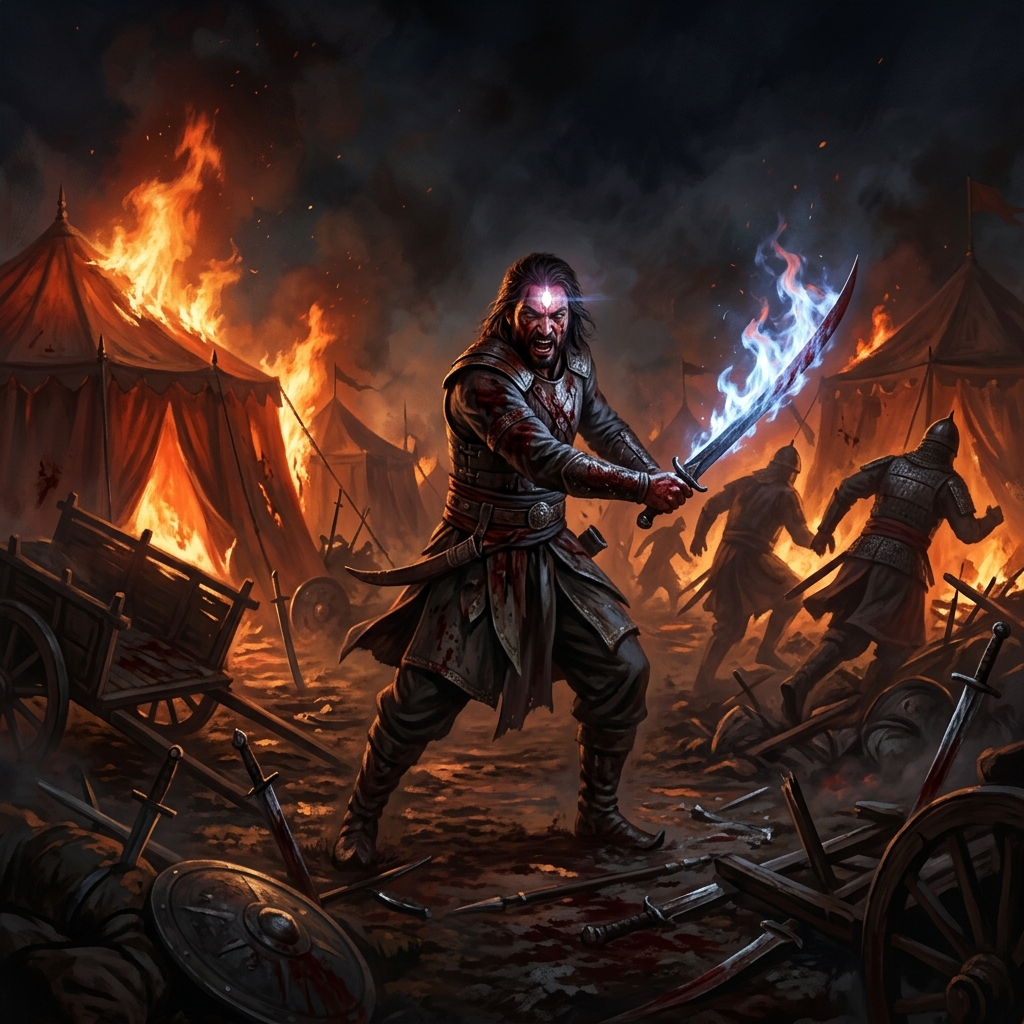
Then the massacre began. Ashwatthama fell first upon Dhrishtadyumna, who had beheaded his father, and stamped the life out of him as he begged for a warrior's death by the sword. He cut down the sons of Draupadi as they slept, mistaking them in the dark for the Pandavas themselves; he slew Shikhandi and Drupada's line and every soul his blade could reach. Kripa and Kritavarma set fire to the camp and cut down any who fled the flames. By the time the sky paled, the Pandava camp was a charnel ground, and almost all who had survived the open war lay murdered in their sleep.
When the Pandavas returned at dawn to find their children dead and their camp a smoking ruin, the bitterness of it broke even their joy in victory. They hunted Ashwatthama down. Cornered, he loosed the dreadful weapon called the brahmashira at the unborn child in the womb of Abhimanyu's widow, meaning to end the line of the Pandavas forever. Krishna struck the unborn infant back to life and laid upon Ashwatthama a curse to wander the earth for three thousand years, leprous and alone, friendless and unloved - a deathless punishment for a deathless crime.
The Taste of Ashes
And so the war was over. Of the eighteen armies that had darkened the plain at dawn on the first day, only a handful of men walked away alive. The Pandavas had won; their cause was just, their enemy had refused every peace, and the throne was theirs at last. Yet they walked across a field that stretched to the horizon heaped with the bodies of brothers, cousins, teachers, sons, and friends, and the victory turned to ash on their tongues.
The women of both houses came out to the field to seek their dead among the slain. Gandhari, the blind queen who had bound her own eyes in loyalty to her blind husband and who had now lost all her hundred sons in a single fortnight, walked among the corpses and lifted the veil from her grief. In her anguish she cursed Krishna himself, that as her house had perished so should his own, and that he too would die alone and unmourned - a curse he accepted without protest, for he knew the threads of fate. Far away, Kunti at last revealed to her sons the secret she had carried in silence, that Karna whom they had killed was their own eldest brother, and Yudhishthira, learning whose blood was on the field, was undone with sorrow and laid a curse upon all womankind that none should ever again be able to keep a secret hidden.
Bhishma still lay upon his bed of arrows through all of this, waiting for the sun to turn northward. When the auspicious hour came, the grandsire who had seen the whole tragedy from its first cause to its last grief spoke long counsel to Yudhishthira on the duties of a king and the nature of righteousness, and then released his life into the air and departed for the heavenly realms.
Yudhishthira was crowned at Hastinapura over a kingdom of widows and ashes, and he ruled it well, but the war never left him. He had won the throne his cousins would not share, and the cost of winning it was nearly everyone he had loved. This was the field of Kurukshetra, where dharma triumphed and the world was emptied of its heroes in the same eighteen days - and where the victors learned that some victories are indistinguishable, in the heart, from the deepest of defeats.
Dharma Lesson
War spares no one - neither the righteous nor the wicked. The Mahabharata war ended with Pandava victory, but the price was beyond measure. Millions dead. Families destroyed. An entire generation wiped out. This is the ultimate teaching: violence begets violence, and even just wars carry terrible consequences. Let those who seek conflict remember the ashes of Kurukshetra.