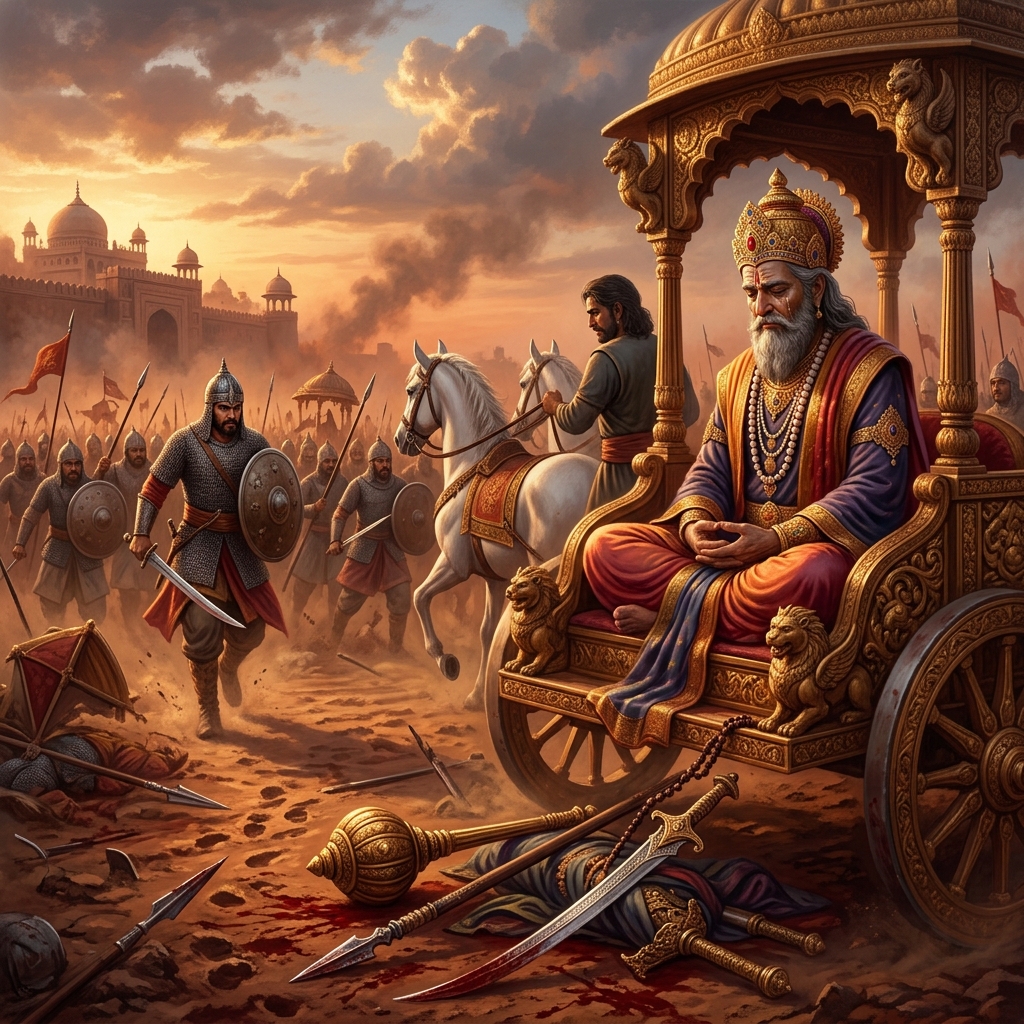
The Covenant Sworn at Dawn
The most hopeful thing that happened at Kurukshetra happened before anybody had been killed.
Heralds rode out from both hosts into the empty ground between them, and eighteen armies that had come there to destroy each other stood still and listened while the terms were spoken aloud.
Yudhishthira spoke them standing in his chariot, and Bhishma answered from the golden one under the palm banner, and this is what they agreed. Equals would fight equals: chariot against chariot, elephant against elephant, horseman against horseman, foot against foot. No man would strike another who had turned away, or lost his weapon, or lost his armour, or asked for quarter. No man would strike one already engaged with another, and no two would set upon one. Charioteers, drummers, conch blowers, water carriers, the men who tended the animals and the animals themselves were untouchable. Fighting would begin when the sun was up and stop when it went down, and after sundown men who had spent the day trying to kill each other would visit each other's camps as kinsmen, unarmed and safe. The wounded were sacred. Words would be answered with words, and arrows only with arrows.
"On these terms we fight," Bhishma said.
"On these terms," said Duryodhana, and that morning he meant it as much as anybody did.
It is a strange and moving document. Men who had already settled on slaughter took the trouble, in the last quiet hour any of them would have, to agree carefully upon its courtesies. Nothing in the epic is more civilised than that half hour, and nothing in the epic is destroyed more completely than that half hour, and both of those facts belong to the same eighteen days.
What follows is the ledger. Each of these days has its own full telling elsewhere on this site; this is only the accounting. It is kept honestly, which means it is kept against both sides, because both sides went on writing in it until there was nothing left to write on.
The Ledger Opens
Day ten. Shikhandi is set in the front of Arjuna's chariot as a living screen, because Bhishma has sworn never to loose an arrow at one who was born a woman, and the arrows that go into the grandsire come out from behind that screen.
The justification, spoken by its own side: "He told you himself how he could be killed," Krishna said. "A man who hands you the key to his own door has already opened it. And Shikhandi stands in a chariot with a bow in his hands. Look at him and tell me what you see."
The cost, as the tale tallies it: the first clause bent in that war was bent by the side that had proposed the clauses, against the man who had accepted them, using a scruple of his own as the instrument. Bhishma went down on a bed of arrows, both armies wept, and nobody who won that afternoon called it a victory out loud.
Day thirteen. Six of the first warriors of the age take a boy of sixteen together, from all sides, after cutting away his bow, his chariot, his horses and his driver.
The justification, spoken by its own side: "He cannot be taken singly," said Drona, to men who had each already lost to the child, and Duryodhana raised no objection, because his war had arrived at the place where it could not afford objections.
The cost: the cleanest clause in the covenant, no two against one, broken by six against one, against a boy, in front of both armies. Every breach the Pandavas committed afterwards was carried on the memory of that afternoon.
Day fourteen. The sun appears to set. Jayadratha's guards let their shields down, the man who has been hidden all day is brought out into the open, and Arjuna kills him under a deadline that had not in fact expired.
The justification: an oath of self-immolation would otherwise have taken Arjuna out of the world by nightfall.
The cost: the sky itself had been made to lie, and every man on that plain knew it before the light came back.
The Rules Drown in the Dark
The fourteenth night is where the covenant stops being a covenant and becomes a habit that people are in the middle of giving up.
Fighting was to end at sundown. On that night it did not end. The armies, mad with the day behind them, went on through the dark by torchlight, and torchlight is not sight. Men killed their own. Elephants went back through their own lines. Whole units died without ever seeing what killed them, and the clause about the sacred wounded meant nothing at all, because nobody could tell a wounded man from a dead one, or from a man on his knees feeling in the mud for his sword. Ghatotkacha came into his own hour in that darkness, since the rakshasa strength doubles at night, and he did such damage that Karna spent on him the spear he had kept his whole life for Arjuna.
Duryodhana had cheered when the torches went up. He stopped cheering some hours later.
Day fifteen. Drona cannot be killed while he holds a weapon, so a word is used instead. An elephant named Ashvatthama is killed, the cry goes up that Ashvatthama is dead, and Drona turns to the one man on that field who has never lied in his life and asks him whether it is true.
"Ashvatthama is dead," Yudhishthira said. "The elephant." And the second half of it was drowned, deliberately, under every conch and drum that Krishna could raise.
The justification, spoken by its own side: while Drona held a bow the Pandava army had perhaps two days left in it, and Drona was the man who had built the wheel that killed Abhimanyu.
The cost: a teacher laid down his weapons on the word of the pupil he trusted most, sat down on the floor of his chariot in meditation, and was beheaded unarmed. Two clauses went in one stroke, the unarmed and the surrendered. Something else went with them, because from that afternoon Yudhishthira's word was only a word, like anybody else's.
The Wheel, the Thigh, and the Night After
Day seventeen. Karna's chariot wheel sinks into the ground. He steps down unarmed to lift it out, and asks, by name, for the rule.
"Wait," he calls. "I am on foot. There is no bow in my hand. You know the law."
The justification, spoken by its own side, and Krishna gave it at length and without any gentleness: where was the law when a boy of sixteen was ringed by six, and where was it when a woman was dragged by the hair into a hall full of kings, and where was it in the lacquer house at Varanavata. "You have not once asked after dharma in your life. Do not ask after it now, on the single day when it would save you."
The cost: the finest archer of the age killed with his hands full of a wheel, and the man who loosed that arrow never afterwards spoke of it the way he spoke of his other shots.
Day eighteen. Bhima strikes Duryodhana below the navel with the mace, which the law of the mace forbids absolutely and without exception.
The justification: an oath sworn thirteen years earlier in a gambling hall, over a thigh that had been bared and slapped in front of a queen, and the plain fact that above the waist Duryodhana could not be beaten by any man then living.
The cost: Balarama, who had taught both of them the mace, lifted his plough to kill Bhima where he stood and had to be held back by force. And Duryodhana, dying in the churned mud, was given the last honest word of the war. He had fought inside the rules and been beaten outside them. He said so, at length, and nobody there contradicted him.
And then, when the war was over and won and the victors were asleep in tents on a plain with nothing left on it to fight for, three men walked into that camp in the dark and killed everyone in it, the sleeping, the unarmed, the children.
No justification is recorded for that one. Its author called it his triumph, and was cursed to walk the earth for three thousand years.
The Chariot That Touched the Earth
Read down the ledger and the pattern is not a collapse. It is an erosion.
Nobody woke one morning and abolished the covenant. Each breach was an answer to a breach. Shikhandi was answered by the ringing of Abhimanyu, which was answered by a false sunset, which was answered by a night that had no sunset at all, which was answered by a lie, which was answered by an arrow into a man lifting a wheel, which was answered by a mace below the navel, which was answered by murder in the dark. Every man in that sequence could point behind him at something worse and say, truthfully, that he had not begun it. That is how a covenant dies. Not shattered. Worn through, by people who each had a reason, and whose reasons were each, taken alone, quite good.
Krishna's position deserves to be stated fairly, because he stated it plainly himself and never hid behind it afterwards. Adharma held every gate at Kurukshetra. Bhishma could not be killed inside the rules, Drona could not be killed inside the rules, Karna could not be killed inside the rules, Duryodhana could not be killed inside the rules; and if the rules were kept perfectly, then the men who had burned a house full of sleepers and stripped a queen in open court would hold the earth, and the rules would have been the means by which they held it. So dharma was defended with adharma, knowingly, and the stain of it was accepted rather than argued away.
Against that stand Balarama, who walked off the field rather than watch it, and Gandhari, who cursed the man who arranged it; and both are given their full say elsewhere on this site.
The epic delivers its own verdict without a word of commentary.
Yudhishthira's chariot had ridden a hand's breadth above the ground his whole life, because he had never lied. On the fifteenth day he shaded one sentence in order to kill his teacher.
The wheels came down and touched the earth, and they never lifted again.
Dharma Lesson
A covenant is not shattered in one blow; it is worn away by answers. Every side at Kurukshetra could name a good reason for the rule it set aside, and every good reason licensed the next man's good reason, until the terms sworn at dawn on the first day meant nothing by the last. Yudhishthira's chariot rode above the ground until he shaded one sentence, and touched the earth for the rest of his life.