The Song of God
The Bhagavad Gita teaches that we must perform our duty without attachment to results.
Between Two Armies
The sacred plain of Kurukshetra stretched to the horizon, covered with the mightiest army ever assembled. On one side stood the eleven Akshauhinis of the Kauravas - a vast ocean of warriors, elephants, chariots, and horses gathered under Duryodhana's banner. On the other side stood the seven Akshauhinis of the Pandavas, smaller in number but burning with the memory of every wrong they had suffered.
The morning was sharp and cold. Conches roared across the field, drums thundered, and the cries of warriors rolled like waves. Bhishma, the grand patriarch, lifted his conch first, and the sound shook the hearts of the Pandavas. Then Krishna blew the Panchajanya and Arjuna the Devadatta, and the answering blast seemed to split the very sky.
Among the Pandava ranks a single chariot stood apart, its white horses still as carved ivory, its tall banner bearing the image of Hanuman. In that chariot sat Arjuna, the finest archer the world had ever known, and his charioteer was no ordinary man. It was Krishna, friend, kinsman, and counsellor, who had taken up the reins though he himself would not lift a weapon in this war.
Arjuna gripped the rail of the chariot and looked out at the gathered hosts. "Krishna," he said, his voice steady with a soldier's resolve, "drive my chariot into the space between the two armies. Let me stand where I can see those who have come here eager for battle. Let me look upon the men with whom I must fight on this day of reckoning."
Faces of the Enemy
Krishna urged the white horses forward, and the great chariot rolled into the open ground between the two armies. He drew it to a halt in plain sight of all the kings of the earth, and turned to Arjuna with a faint and knowing smile.
"Behold, Partha," he said, using one of Arjuna's many names. "Behold the Kurus gathered here."
Arjuna lifted his eyes and looked, and for the first time he truly saw who stood before him. These were not faceless enemies. There, beneath the white banner, sat Bhishma, the grandsire who had carried Arjuna upon his knee when he was a small boy, who had loved him as his own. Beside the Kaurava ranks stood Drona, the teacher who had placed the first bow in Arjuna's hands and taught him every secret of the archer's art.
He saw Kripa, another revered teacher. He saw uncles and great-uncles, the sons of Dhritarashtra who were his cousins, the fathers of brides and the brothers of friends. He saw companions of his youth, men he had laughed with and feasted with, now armoured and waiting to kill or be killed.
A cold weight settled into Arjuna's chest. On both sides he saw fathers, grandfathers, teachers, uncles, brothers, sons, grandsons, and dear companions, all arrayed in the eagerness of war. The sight of his own kinsmen drawn up to slay one another struck him like a blow he had not been trained to take.
The Bow Slips From His Hand
Arjuna's heart was overcome with pity, and a great sorrow filled him. He turned to Krishna, and his words came in a broken rush.
"Krishna, when I see my own people standing here, eager for battle, my limbs give way and my mouth runs dry. My body trembles and my hair stands on end. The Gandiva slips from my hand and my skin burns. I cannot keep my feet, and my mind reels."
The Gandiva, the celestial bow that had never once wavered in his grip through a hundred battles, slid from his fingers. His proud arms hung limp. "I see only evil omens, Krishna. I see no good in killing my own kinsmen in war. I desire no victory, no kingdom, no pleasures bought at such a price."
His voice fell almost to a whisper. "Those for whose sake we would want a kingdom and its joys, they are the very people standing here ready to give up their lives and their wealth. Teachers, fathers, sons, grandfathers, uncles, fathers-in-law, grandsons, brothers-in-law, and kinsmen. Even if they should kill me, Krishna, I would not wish to kill them, not for the lordship of the three worlds, let alone for this earth."
The sound of the conches and drums seemed to fade. In the space between the two armies, the greatest warrior of the age stood unmanned by grief, his weapon lying useless at his feet.
Arjuna's Collapse
Arjuna's grief poured out of him in a flood of reasoning, the desperate logic of a man trying to talk himself out of an unbearable duty.
"What joy could there be for us, Krishna, after we have slain the sons of Dhritarashtra? Only sin would come to us if we killed these men, even though they have come as aggressors. How can we be happy after killing our own people? Better to live in this world as a beggar than to enjoy a kingdom stained with the blood of my elders and teachers."
He spoke of the ruin that follows war, of families broken, of duties abandoned, of the long darkness that swallows a society when its order collapses. Each argument was noble, each was reasonable, and each was a chain binding him more tightly to his despair.
"It would be better for me," he said at last, "if the sons of Dhritarashtra, weapons in hand, should kill me here unarmed and unresisting on the battlefield."
With those words the strength left him entirely. Arjuna, the unconquered, sank down upon the seat of his chariot, casting aside his bow and arrows, his mind heavy with sorrow. This was the moment the sages would call Arjuna-vishada, the despair of Arjuna, the great collapse from which the whole teaching would rise. He had run to the very edge of his courage and found that it could not carry him across this particular field.
The Imperishable Self
Krishna looked upon his friend with infinite compassion, and then, almost sternly, he spoke. "From where has this weakness come to you at such an hour, Arjuna? This is unworthy of you. It will not bring you heaven or honour. Shake off this faint-heartedness and rise."
When Arjuna only protested that he could not see how slaughter could ever be right, and humbly begged to be taught, Krishna's voice softened into the tone of the teacher. "You grieve for those who should not be grieved for, yet you speak words of wisdom. The wise grieve neither for the living nor for the dead."
"There was never a time when I did not exist, nor you, nor these kings," Krishna said. "Nor will any of us cease to be in the future. As the soul passes in this body through childhood, youth, and old age, so it passes into another body at death. The steady of mind are not deluded by this."
He spoke then of the deathless thing that wears the body as a garment. "That which pervades all this is indestructible. No one can bring about the destruction of the imperishable. Bodies come to an end, but the dweller within them is eternal, unborn, and changeless. Just as a person casts off worn-out clothes and puts on new ones, so the embodied soul casts off worn-out bodies and enters others that are new."
"Weapons cannot cut the soul, fire cannot burn it, water cannot wet it, and wind cannot wither it. It is eternal, present everywhere, unmoving, and ancient. Knowing this, Arjuna, you should not grieve."
The Duty of the Warrior
Krishna turned from the eternal to the immediate, from the truth of the soul to the duty of the hour. "Consider also your own dharma, Arjuna, and do not waver. For a warrior there is nothing higher than a righteous war. Fortunate are the warriors who are offered such a battle, for it is an open door to a noble destiny."
"But if you will not fight this righteous war," he warned, "then you abandon your own duty and your honour, and you take on guilt. People will speak forever of your disgrace, and for one who has been honoured, dishonour is worse than death. The great warriors will think you fled the battle out of fear, and those who once esteemed you will hold you lightly."
This was svadharma, one's own proper duty, the truth that a person's path lies in fulfilling the task set before them rather than envying another's. Arjuna was born a kshatriya, a protector. To turn away from the defence of righteousness when injustice stood armed before him was not gentleness but a failure of his very nature.
"Treat alike pleasure and pain, gain and loss, victory and defeat," Krishna continued, "and engage in battle for its own sake as your duty. In this way you will incur no sin. Whether killed, you will gain heaven, or victorious, you will enjoy the earth. Therefore arise, Arjuna, resolved to fight."
Action Without Attachment
Now Krishna unveiled the heart of his teaching, the secret that would let a person act in the world without being burned by it. "You have a right to your action alone," he said, "never to its fruits. Let not the fruits of action be your motive, but do not be attached to inaction either."
"Perform your work, Arjuna, established in yoga, abandoning attachment, and remaining even-minded in success and failure. This evenness of mind is what is called yoga. Action done with selfish desire is far inferior to action done with a steady and balanced mind. Take refuge in this wisdom. Those who labour only for results are wretched."
This was karma-yoga, the path of selfless action. A person could not escape action, for even to live is to act, and even to sit still is a kind of doing. The way of freedom was not to flee the world but to act within it without clinging to what the action might bring. The farmer must sow without grasping at the harvest. The warrior must fight without lusting after victory or fearing defeat.
"One who is unattached to the results, ever content and dependent on nothing, does nothing at all even though engaged in action," Krishna said. "Offer your every deed as an act of devotion, free of craving and free of grief, and the bondage of karma will not touch you. Better is one's own duty done imperfectly than another's duty done well."
The Three Paths and the Divine
Arjuna listened, and his questions grew deeper. He asked which was higher, the path of action or the path of renunciation. He asked about the restless mind, harder to subdue than the wind. And Krishna answered each, weaving together the great roads that lead to the same summit.
"There is the path of knowledge, jnana," Krishna said, "by which the wise discern the eternal Self from the changing world. There is the path of action, karma, by which one serves without attachment. And there is the path of devotion, bhakti, by which one offers up the whole of oneself in love. All lead to me, but of all of these, the devotee who worships me with faith and surrenders the heart is dearest to me."
Then Krishna spoke of his own nature, lifting the veil a little. "I am the source of all. From me everything proceeds. I am the taste in water, the light in the moon and sun, the sacred sound in scripture, the strength of the strong, and the life in all beings. Whenever righteousness declines and unrighteousness rises, I take birth in age after age to protect the good, to destroy the wicked, and to re-establish dharma."
"Whatever you do, whatever you eat, whatever you offer or give, do it as an offering to me," Krishna said. "Fix your mind on me, be devoted to me, and you shall surely come to me. This I promise you, for you are dear to me."
The Plea for Cosmic Sight
Arjuna's despair had melted away under the warmth of the teaching, and in its place rose a longing he could not contain. He had heard Krishna speak as the source of all things, the lord of all worlds, the self seated in the heart of every being. His friend, his charioteer, the man who held the reins of his horses, was claiming to be the ground of the entire universe.
"You are all that you say you are," Arjuna said, his voice trembling now not with grief but with wonder. "I believe it. Yet I yearn to see it with my own eyes. If you think I am able to behold it, O Lord, then show me your imperishable Self. Reveal to me your supreme form."
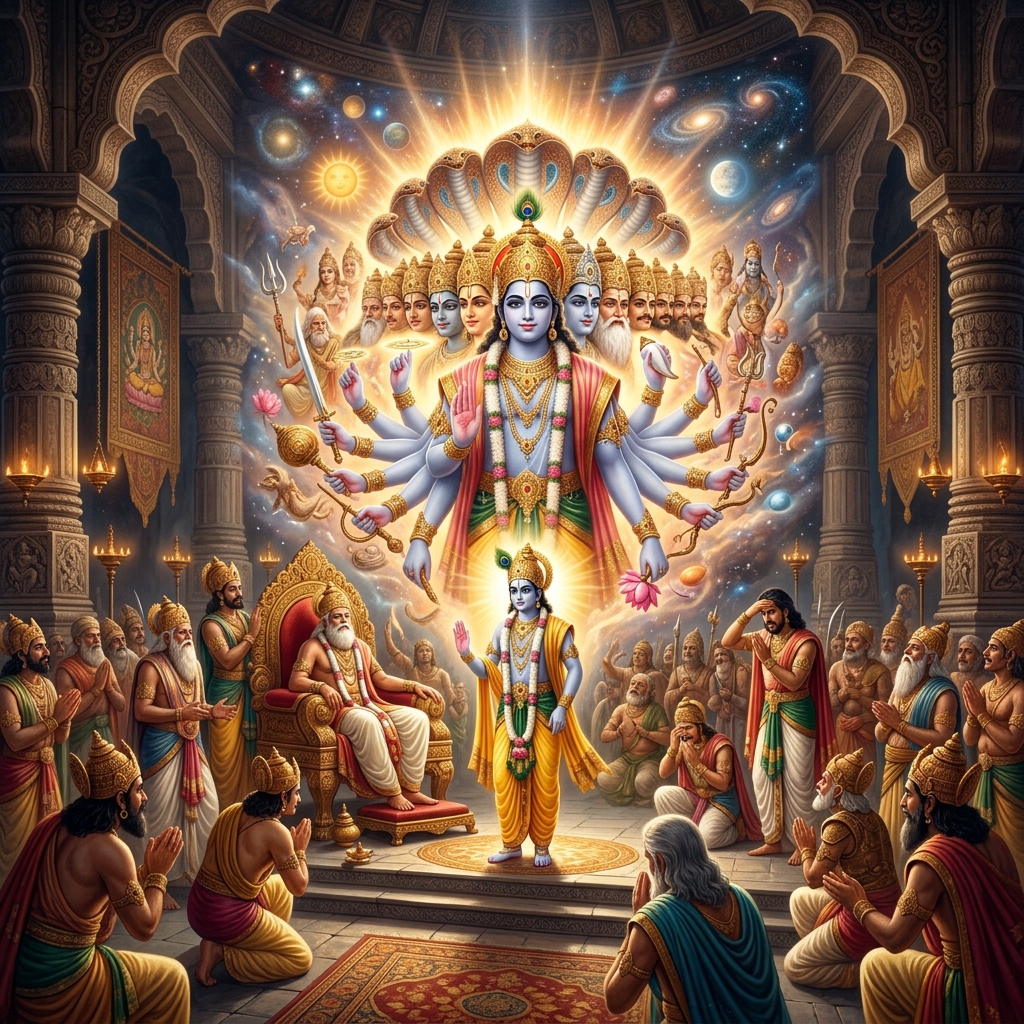
Krishna gazed at his friend, and there was great tenderness in his look. "Behold, Arjuna, my hundreds and thousands of forms, of many kinds, of many colours and shapes. Behold the whole universe, moving and unmoving, gathered together in this body of mine, and whatever else you wish to see. But you cannot see me with these eyes of yours. I give you a divine eye. Now behold my majesty."
And in that instant the ordinary world fell away, and Arjuna was given sight beyond mortal sight.
The Universal Form
What Arjuna saw then cannot be held within mortal words. He beheld the entire universe in its endless variety gathered into a single being, infinite in form, with countless faces, countless eyes, countless arms reaching out across all of space. He saw boundless light blaze forth as if a thousand suns had risen together in the sky.
He saw within that form all the gods, all the sages, and all of creation. He saw the worlds and the spaces between them, the beginning and the middle and the end of all things. The vision had no limit he could find, no edge his sight could reach. It was beautiful beyond bearing and terrible beyond enduring, and Arjuna's hair stood on end with awe.
Then the vision turned dreadful. He saw the form with flaming mouths and fearful tusks, blazing like the fires that end an age. And into those mouths he saw the warriors of both armies rushing as moths rush into a flame, as rivers pour into the sea. He saw Bhishma, Drona, Karna, and the sons of Dhritarashtra, with the great captains of his own side, swept into those burning jaws and crushed between those terrible teeth, some hanging mangled in the gaps.
Trembling, Arjuna cried out, "Who are you, in this fierce form? Tell me, I beg you. I cannot understand what you intend."
I Am Time
The voice that answered rolled through the cosmic form and shook the marrow of Arjuna's bones.
"I am Time," Krishna declared, "the mighty destroyer of worlds, come forth to annihilate these people. Even without you, all the warriors arrayed in the opposing armies shall cease to be. Therefore arise and win glory. Conquer your enemies and enjoy a flourishing kingdom. By me these men have already been struck down. Be only the instrument, Arjuna. Bhishma and Drona and Karna and the other warriors are slain already. Fight, and do not falter. You will conquer your foes in battle."
Arjuna, hearing these words, pressed his palms together and trembled. Terrified and bowing, he stammered out his praise. "Rightly does the world rejoice and delight in your glory. You are the first of gods, the resting place of the universe, the imperishable, the eternal. Salutations to you a thousand times, and again and again. Forgive me, O Lord, if in friendship and in ignorance I ever called you simply Krishna, or treated you carelessly at play or at rest, or made light of you as one makes light of a companion. I did not know this greatness of yours."
The overwhelming vision had broken every shred of his earlier reasoning, and in its place left only awe and surrender.
Arjuna Takes Up His Bow
Seeing his friend shaken to the depths, Krishna withdrew the terrible vision. The countless suns dimmed, the flaming mouths faded, and the infinite form gathered itself back into the gentle shape that Arjuna knew and loved. There stood Krishna once more, the dark and graceful prince, holding the reins of the white horses, with his calm and reassuring smile.
"Do not be afraid," Krishna said softly, "and let your mind no longer be confused at having seen this fearful form. Be free from fear. With a gladdened heart, behold once more my familiar shape." Arjuna let out a long breath, his trembling easing, and felt himself return to the ordinary ground of the battlefield as a man wakes from a vast dream.
Then Krishna gave the final word of the teaching, gathering all the long counsel into one essence. "Abandon all other duties and surrender to me alone. I shall free you from all sin. Do not grieve. Fix your mind on me, become my devotee, and you shall come to me. Now I have told you the wisdom that is the most secret of all. Reflect on it fully, and then do as you choose."
"Has your delusion, born of ignorance, been destroyed, Arjuna? Has the confusion of your heart been dispelled?"
Arjuna lifted his head, and his eyes were clear. "My delusion is destroyed," he said, "and through your grace I have regained my memory. I stand firm, my doubts gone. I will do as you tell me."
He bent and lifted the Gandiva from where it had fallen. He set arrow to string, and the strength flowed back into his arms. The despair was burned away, the teaching was complete, and the greatest archer of the age rose to his feet, resolved at last to fight the war that dharma demanded.
Dharma Lesson
The Bhagavad Gita teaches that we must perform our duty without attachment to results. The soul is eternal and cannot be killed. Action performed in devotion to the Divine liberates us from the bondage of karma. And in moments of our greatest confusion, seeking guidance from the Divine can illuminate even the darkest path.