The Secret of the Sun
A Mother's Plea, A Warrior's Promise
The Eve of Kurukshetra
The plains of Kurukshetra had become a sea of armies. Eighteen divisions stood facing one another across the wide field, banners snapping in a hot wind, the dust of countless horses and elephants hanging in the air like a shroud. The war that the elders had labored for years to prevent was now only days away, and every attempt at peace had failed.
In the Pandava camp at Upaplavya, the mood was grim but resolute. Yudhishthira had asked for five villages and been refused even a needle's point of land. Krishna himself had gone to Hastinapur as an envoy of peace, and Duryodhana had tried to seize and bind him in the assembly hall. There was nothing left now but the clash of weapons.
Yet beneath the open preparations, two people carried a secret heavier than any sword. Krishna knew it. And Kunti, mother of the Pandavas, knew it. The greatest warrior in the Kaurava host, the man sworn to kill Arjuna, was not the charioteer's son the world believed him to be. He was Kunti's own firstborn, conceived of Surya the Sun before her marriage, set adrift on a river as an infant to hide her shame. His name was Karna.
Kunti lay awake through the night, listening to the distant sounds of two camps that would soon devour each other. Whichever way the duel of Karna and Arjuna fell, one of her sons would die by the hand of another. The thought was a wound that would not close.
Krishna's Secret Errand
Before Kunti could act, Krishna moved first. When the failed embassy was done and Duryodhana had stormed from the hall, Krishna asked Karna to ride with him a little way from Hastinapur. Karna, who honored Krishna even as an enemy, climbed into the chariot, and the two rode out beyond the city walls where no one could overhear.
For a long while Krishna said nothing. Then, with the gentleness of a kinsman, he turned to Karna and spoke a truth that struck like lightning. "Karna, you who are learned in the scriptures know that a child born to an unmarried maiden by a divine being belongs by law to the man she later weds. By that very law, you are not the son of Adhiratha. You are the son of Kunti, born before her marriage to Pandu. You are the eldest of the Pandavas. You are a Kshatriya of the purest blood, of the line of Kuru and of the Sun itself."
Krishna let the words settle, then laid the whole of it before him. "Come with me this hour. Yudhishthira will yield the throne to you the moment he learns you are his elder. Bhima will hold the white umbrella above your head. Arjuna will guide your chariot. The Panchalas, the Vrishnis, the Andhakas, all will bow to you. Draupadi too will come to you as a wife, for you will be the eldest of the five. You will be anointed emperor of all Bharatavarsha, and your brothers will stand at your side as servants stand by a king."
It was an offer beyond any ambition Karna had ever dared to hold. The throne of the world, the love of brothers, the very honor that had been denied him his whole life. Krishna held the reins loosely and waited for the answer.
Karna's Refusal
Karna did not answer quickly. When he spoke, his voice was steady and without bitterness, the voice of a man who had already weighed his whole life and found his place in it.
"Krishna, I do not doubt a word you say. I believe that Kunti bore me, and that out of fear she abandoned me in my first hour, depriving me of the rites and rank that were mine by birth. But it was a charioteer, Adhiratha, who lifted me from the water, and Radha who pressed me to her breast and raised me as her own. For their love my milk has flowed, my rites were done, my marriages were made. I cannot now call them strangers and call myself a prince. Radha is my mother. Adhiratha is my father. That bond no revelation can dissolve."
He looked toward Hastinapur, where the Kaurava banners flew. "And there is Duryodhana. When the whole assembly of kings mocked me as low-born, when even the wise sat silent, it was Duryodhana alone who rose and made me king of Anga so that I might stand as Arjuna's equal. For thirteen years he has leaned on my strength, and I have leaned on his friendship. He has gathered this vast army trusting that I will cross swords with the Pandavas. To abandon him now, on the very brink of war, for the lure of a crown, would make me the meanest of men. I would rather die than betray the one who trusted me."
Then Karna said something that revealed he had already seen the end. "I know how this war must go, Krishna. You stand with the Pandavas, and where you stand, victory stands. I have read the omens. The Kurus are doomed. Yet I will fight on the losing side, for a friend, and I will not flee the death that is coming. Let this be our secret. Do not tell Yudhishthira that I am his brother, for if he knew, his tender heart would never accept the kingdom he is about to win."
Krishna smiled, for he had not truly come to turn Karna, but to measure him. He embraced him as a brother and let him go back to his doomed loyalty.
A Mother's Resolve
Word of the failed peace returned to the Pandava camp, and with it Kunti's last hope of avoiding the war died. Now only the duel of her two sons remained to fear. She had carried the secret of Karna for a lifetime, and a lifetime of silence had cost her dearly. She would not stay silent for the death of one son at the hands of another.
Through the small hours she turned the matter over and over. She could not command Karna as a queen, for he served her enemies. She could not appeal to his ambition, for Krishna had already offered him a throne and been refused. She had only one thing left to offer him, and it was the very thing she had withheld from him all his life. She would go to him not as a queen, not as the mother of the Pandavas, but simply as the woman who had borne him, and she would beg.
She knew where to find him. All the world knew Karna's vow that no one who came to him at his morning prayers to the Sun, while the water still ran from his hands, would ever be sent away without the gift they asked. Brahmins came from far kingdoms to receive his charity at that hour, for at that hour Karna could refuse nothing.
Kunti wrapped a plain cloth about her, told no one, and went out alone in the grey dark before dawn toward the river where Karna performed his daily worship. Each step was heavier than the last. She did not know whether she walked toward forgiveness or toward a refusal that would break her utterly. But she walked.
The Mother at the Water's Edge
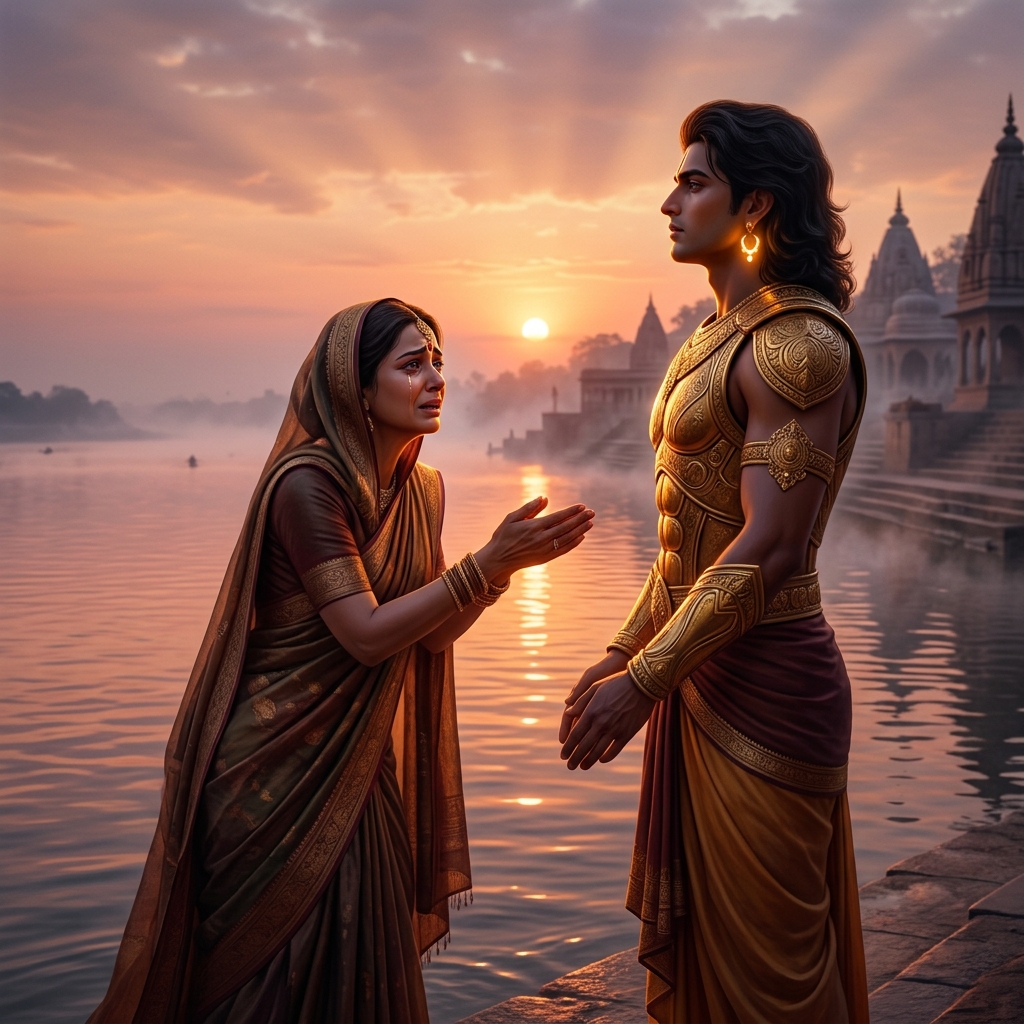
The eastern sky was just paling when Kunti came to the riverbank. There, standing waist-deep in the cold running water with his face lifted to the place where the sun would rise, stood Karna. His palms were joined, water streaming from his fingers, and from his lips rose the ancient hymns to Surya his father. The golden armor that was part of his very skin gleamed faintly in the half-light, and the earrings caught the first colorless gleam of morning. He was at his most radiant and his most defenseless, lost wholly in his god.
Kunti did not interrupt him. She stepped into the shade of his upper garment, which he had hung upon a branch, and she waited, and the lotus that was her face wilted in the rising heat as the long worship went on. She bore it without a word, the way only a mother waiting upon her child can bear discomfort, until at last the prayers were done.
Karna turned, and the water fell still around him, and he saw a woman standing in the shadow of his own cloak. He came up out of the river and bowed with the courtesy that never left him, and spoke the words he spoke to every petitioner at that hour. "I am Karna, son of Radha and of Adhiratha. I salute you. Tell me why you have come. Whatever you ask of me at this hour, that I will give."
But even as he spoke, he looked into her worn and weeping face, and something stirred in him that he could not name. The woman did not answer him as a suppliant. She only looked at him, and the tears ran down her face, and she could not for a moment find her voice at all.
I Am Your Mother
At last Kunti spoke, and her voice shook. "You are not the son of Radha, Karna. Nor was Adhiratha your father. You were not born to be a charioteer's child. I bore you. In the secret of my maiden days, by the grace of Surya the Sun, I carried you and brought you forth in fear and shame, and in my fear I set you upon the water and let the river take you. You are my firstborn. You are the eldest of the sons of Kunti. You are a prince of the Kuru blood, brother to Yudhishthira, to Bhima, to Arjuna, to the twins. It is not fitting that a son of mine should serve Dhritarashtra's sons and call the Pandavas his foes."
The words came out of her in a rush now, all the dammed grief of a lifetime breaking loose. "Come to your brothers, my son. End this dreadful thing before it begins. Let the world behold Arjuna and Karna standing side by side, and there is no power on earth that could stand against the two of you. With you and Arjuna as one, what could the brothers not accomplish? You would be supreme among all kings. Do not let it be said that brother slew brother on the field of Kuru. I have lost you once, my child. Do not let me lose you again to this war, or worse, lose another of my sons to your hand."
She sank down, the proud mother of the Pandavas, and she who had been a queen now begged at the feet of the son she had cast away. "I have wronged you. I know it. There is no penance that can undo it. But I am your mother, and I have come at last to claim you. Have mercy on a mother's grief, if you can find none for yourself."
Karna stood very still, and the river ran on at his feet, and for a long moment the only sound was a mother weeping by the water in the grey light before the sun.
The Voice of the Sun
While Karna stood silent, struggling against the storm her words had loosed in him, another voice spoke. It came from the disc of the sun now lifting above the river, warm and vast and tender, the voice of Surya his father, that he had heard before in his life at moments of great trial.
"Kunti speaks the truth, Karna," said the Sun. "She is indeed your mother. You are my son and hers. Do as your mother asks. It will be for your highest good."
So the truth was sealed. There could be no doubt now, no escape into the comfort of disbelief. The god who had fathered him confirmed what the queen had confessed. Karna's whole identity, the wound he had carried like a second skin, the insult of being called Suta-putra in every hall of kings, all of it was overturned in a single dawn. He was no charioteer's son. He was the eldest of the Pandavas, the senior prince of the Kuru line, the man with the truest claim to the very throne men were about to die for.
And yet even the voice of his divine father did not bend him from the path he had chosen. Karna bowed his head toward the rising sun, and when he lifted it again his eyes were wet but his resolve was iron. A lesser man might have leapt at the chance that both god and mother now pressed upon him. Karna only grew quieter, and sadder, and more certain of his duty.
I Cannot Abandon Duryodhana
When Karna spoke at last, he spoke without anger, but every word carried the weight of a grief that matched her own. "O lady, daughter of kings, I cannot do as you ask, and I will not pretend that my refusal does not wound me as it wounds you.
"You speak of duty to my brothers. But where was a mother's duty when I was born? You cast me out and robbed me of the rank that was mine, of the name, of the rites, of all that a Kshatriya holds dear. You did me the greatest of injuries, and you did it not for my sake but for your own honor. All my life I have borne the contempt of men because of that single act. And now, when the hour of battle is upon us, when I might be of use to your other sons, you come to claim me. You have always thought of yourself first, and you think of yourself now."
He softened, for he could not be cruel to a weeping woman, least of all this one. "Yet I do not hate you. Hear me. There is Duryodhana, who took me up when all the world cast me down, who made me a king, who has leaned his whole hope of victory upon my arm. His enemies have feasted at his table because of their faith in me. To turn from him now, in his hour of greatest need, drawn away by you, would be a betrayal blacker than any sin you ever committed against me. I would be a traitor and an ingrate, and no throne and no kinship is worth that. As Duryodhana has trusted me, so will I keep faith with him, even unto death. This war I must fight, and on his side I must fight it."
Kunti bowed her head, for she had no answer. Krishna had been refused a throne; she had been refused a son. There was nothing in her hands now but her grief.
The Promise of Five Sons
But Karna would not send his mother away with nothing, for he had never in his life refused a petitioner at his morning prayers, and he would not begin with the woman who had borne him. Seeing her bowed and broken, his hard resolve made room for one mercy, and that mercy he gave her in the form of a vow.
"You have come to me as a suppliant at the sacred hour," he said, "and you shall not go empty. Hear my promise, and let it be a comfort to you in the days of slaughter that are coming. Of your five sons by the Pandavas, four I will never harm. Though they come against me in the thick of battle, though I hold their lives in my hand, I will not slay Yudhishthira, nor Bhima, nor Nakula, nor Sahadeva. With them I will not raise my weapon to kill, whatever befalls.
"Only Arjuna I make no such promise to. Between Arjuna and me there is a vow already sworn, deeper than any I can unsay. He has sworn to kill me, and I to kill him. One of us must fall, for the world is not wide enough to hold us both. So in our duel, either I shall slay Arjuna, or Arjuna shall slay me. That is fixed, and not even you can move it."
Then he gave her the heart of his gift, and his voice broke as he gave it. "But mark this, Mother. Whatever the field decides, you will still have five sons. If I kill Arjuna, then I will live, and with your other four you will have five sons, and Karna shall be the fifth. And if Arjuna kills me, then he will live, and with him your count is five again. Either way, the tale of your sons will always be five. Only the names will change. You will lose no more children than you began with this morning. Go, and grieve no further on that account."
A Mother Who Cannot Claim Her Son
Kunti trembled at the terrible mercy of his words. He had given her five sons and at the same time told her that one she loved must die, and she could not even say aloud which of the two she most feared to lose. To beg for Arjuna would be to ask for Karna's death; to beg for Karna would be to ask for Arjuna's. She had borne them both, and she could save neither. She could not even claim her firstborn before the world, for the secret must hold to the end.
She drew Karna to her at last, and for one moment, the only moment of his whole life and the last, she held her eldest son in her arms. He bowed and let her hold him, this man of golden armor whom she had never once embraced as a child. Then she stepped back, and the queen returned to her face, for she could not be seen weeping over the enemy's champion.
"The world is bound by its destiny," Kunti said, scarcely able to speak. "You have given me four of my sons, and I take your gift, though it tears me in two to take it. Be true to your word, Karna. May you remember it, whatever the heat of the field. And whatever you are to the world, you are my son, and I have at last held you once. Fare you well."
"Fare you well, Mother," Karna answered. He bowed to her one final time, and turned back toward the rising sun, and Kunti gathered her plain cloth about her and walked away alone into the morning, carrying a secret that would crush a lesser heart, and leaving behind the son she had found only to lose him forever.
The Weight of the Vow
The promise made at the river did not stay at the river. It walked with both of them into the war, and it changed the shape of the slaughter on the field of Kurukshetra. When Karna at last took up the supreme command of the Kaurava host after Bhishma and Drona had fallen, he met the Pandava brothers one by one in the chaos of battle, and one by one the vow held.
He overpowered Yudhishthira and wounded him, and could have ended the eldest Pandava's life with a single stroke, yet he let him go with only a taunt and a touch of his bow. He came upon Bhima, who was unconquerable, and exchanged blows with him, but did not seek his death, only mocked him with his bowstring. He defeated the twins Nakula and Sahadeva in single combat and held their lives in his hand, and each time he spared them, reminding them with gentle scorn that they were no match for him and should keep to warriors of their own measure. The brothers did not understand why the deadliest archer of the age toyed with them and let them live. Only Kunti, far off, knew that a mother's plea was sheltering four of her sons in the heart of the killing.
For Arjuna alone there was no mercy, and none asked. Toward Arjuna all of Karna's gathered fury and all his sorrow drove him, for between those two the older vow could not be unsaid. And so the war narrowed, as Karna had foretold it would, to a single duel that the whole field seemed to circle, the duel of the two sons of Kunti who did not both know they were brothers.
Five Sons, One Lost
On the seventeenth day the two great archers met for the last time, and the heavens themselves seemed to halt to watch. Through a long and dreadful contest the advantage swung between them, until Karna's chariot wheel sank fast in the softened earth, swallowed by the very ground, the old curse of a brahmin and of his teacher coming due at the worst of all hours. As he climbed down to free the wheel, defenseless for an instant, Arjuna loosed the arrow that took his head. Karna fell, and the Sun his father seemed to dim, and a great cry went up across the plain.
The Pandavas rejoiced, for the most feared warrior of the enemy was dead, and Krishna praised Arjuna for a victory on which the whole war had turned. None of them knew that the man lying in the dust was their own eldest brother. Only after the fighting was wholly done, when the funeral rites of the fallen were performed, did Kunti at last reveal the truth, and the brothers learned in horror and grief that they had killed the brother who had spared them. Yudhishthira, who had been spared by Karna's own hand, wept the bitterest of all.
And so the vow was kept to its very letter, and the cruelty of it laid bare. Kunti still had five sons when the war was over, for the four were saved by Karna's mercy and Arjuna lived to be the fifth. The number never changed, just as her firstborn had promised in the dawn. Only the names had changed. She had gone to the river a mother of six who could acknowledge five, and she came away from the war a mother of five who would grieve the sixth in silence forever, the radiant eldest she had found for a single morning by the water and could never, in all the world, openly call her own.
Dharma Lesson
Loyalty and gratitude (Krithagnata) are among the highest virtues. Karna's refusal to abandon Duryodhana, despite being offered the ultimate empire by his birth mother, demonstrates that true bonds are forged through actions and support, not merely by blood. Yet, his promise to spare his four brothers shows his immense nobility and tragic compassion, sealing his fate as the Mahabharata's most complex hero.
Common Questions
What did Karna promise Kunti?
Karna promised Kunti that she would still have five sons after the war. He would spare Yudhishthira, Bhima, Nakula and Sahadeva whatever the fighting brought, and would fight only Arjuna - so either Arjuna or Karna himself would die, and her count of five would hold either way.
Why did Karna not join the Pandavas?
Because Duryodhana had crowned him king of Anga when the whole court mocked him as a charioteer's son. Karna told Kunti that gratitude and loyalty outweighed blood revealed too late, and that he would not desert the friend who honored him to claim an empire from the mother who abandoned him.
When did Kunti tell Karna he was her son?
Only on the eve of the war, after Krishna's peace mission had failed. Kunti went alone to the riverbank where Karna offered water to the sun and told him there that he was her firstborn by Surya. Krishna had already made the same revelation to him a few days earlier.
Did the Pandavas know Karna was their brother?
No. In most tellings only Kunti, Surya and Krishna knew while the war was fought. Yudhishthira learned the truth when Kunti revealed it at Karna's funeral rites, and in his grief he cursed all women to be unable to keep a secret.