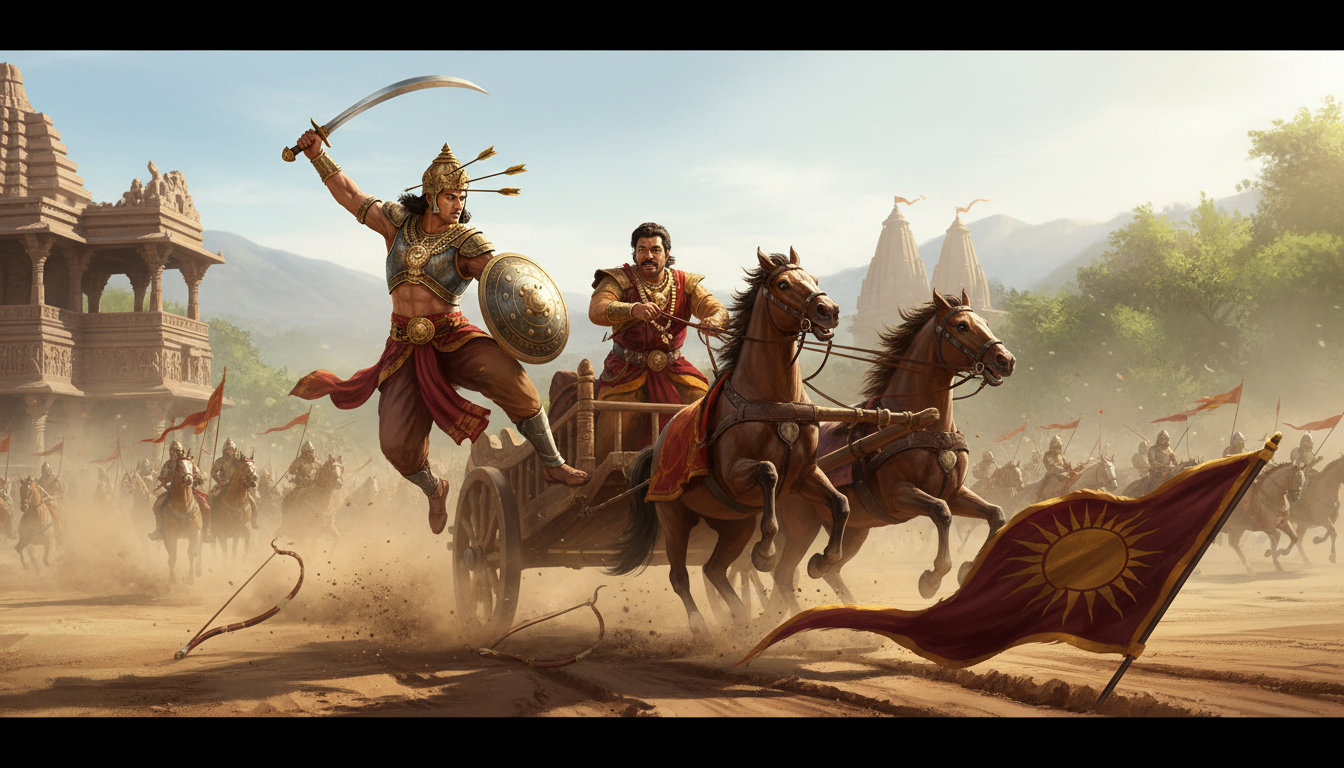
The Sons of the Sun Go Down
Nakula's one great hour, and the end of Karna's line
Take Me Where the Umbrella Is
"The army had broken," Sanjaya said. "I want you to understand that first, king, because everything after it follows from it. Your host was coming apart along its whole front, and the man who put it back together was not one of your sons."
Shalya, king of the Madras, had been commander of the Kaurava army for perhaps two hours. He stood in his car and looked out over a field on which his own left wing was dissolving, and then he spoke to his driver without raising his voice.
"Urge these horses. Make them go as fast as thought goes. Do you see the umbrella out there, the white one, held over the head of a man who is not shouting? That is Yudhishthira the son of Pandu. Take me to him and then watch what I do. The sons of Pritha cannot stand in front of me. Not one of them."
The driver did as he was told, and Shalya went into the Pandava host alone, and the host stopped.
"It stopped the way the sea stops at a shore," Sanjaya said. "A whole army, running forward, and it came up against one chariot and stood still. And your men saw it. They had been running the other way. They turned around and came back and made death their goal, and they took up their positions again in proper order, separately, each contingent where it belonged, and the battle began again from the beginning."
Dhritarashtra said nothing. The blind king had heard the names of the dead for seventeen days.
"Blood ran on that ground like water," Sanjaya said. "And out of all of it, what I remember best from that morning is the quietest of the five brothers, and three young men who had come to the war because of who their father was."
Two Clouds from Opposite Quarters
Karna had been dead a day. He had left four sons on the field, and Arjuna had killed the eldest of them, Vrishasena, in front of his father's eyes on the seventeenth afternoon, deliberately and slowly, to make the father watch. Three were left. The eldest of the three was Chitrasena.
He found Nakula in the press, and Nakula found him, and they closed.
They were both excellent bowmen, and for a while nobody watching could tell them apart in anything that mattered. They drenched each other with showers of arrows the way two rain clouds do when one has risen in the south and the other in the north and they meet over the same field. Both were accomplished in weapons. Both were strong. Both knew the whole practice of fighting from a moving chariot, which is a craft with as many rules in it as grammar.
And both of them, under the noise and the shooting, were doing the same cold thing: waiting. Each was watching the other for a lapse. A slow hand on the quiver, a wheel taken too wide on the turn, one breath spent looking at something other than the man opposite. That is what the duel actually was. The arrows were only the conversation while it went on.
Nakula had come out of the west years ago with a submitted continent behind him and no reputation, because Bhima roared and Arjuna burned and the youngest twin argued philosophy, and the fourth son of Pandu simply did his work and was called handsome. Men who had watched him at Virata's court knew what he could do. Almost nobody else did.
Chitrasena found the lapse first.
He had a right to be there. His father had been given the kingdom of Anga in an open arena by Duryodhana, in front of an assembly that had been laughing at a charioteer's son a moment before, and the sons of that king had grown up as princes of a real country with a real revenue, and had come to this field to hold it. Whatever men said about Karna behind their hands, nobody said it to his sons. They had never been anything but what they were.
A Mountain with Three Crests
The broad-headed shaft was well tempered and it was sharp, and it took Nakula's bow at the handle, which is the one place a bow cannot be repaired in the middle of a fight.
Chitrasena did not pause for the shout that went up. He put three arrows into the bowless man at once, three shafts winged with gold and whetted on stone, and all three struck Nakula in the forehead and stood there. Then, with a few more, he sent Nakula's horses to the house of Yama. Then three arrows for the standard and three for the driver, and both came down.
And Nakula stood on the deck of a ruined chariot with no bow, no horses, no driver, no flag, and three gold-winged arrows sticking straight out of his brow, so that from below he looked like a mountain with three crests, which is what the soldiers who lived through that morning said afterwards when they described him.
He did not put a hand up to his face. He reached down and took a sword, and he came off that chariot the way a lion comes off the top of a mountain, downhill and without hesitating.
Chitrasena poured arrows onto him as he ran. Nakula took the whole shower on his shield and kept coming, and he did not stop at the horses, and he did not stop at the wheel. He went up the side of Chitrasena's own car and onto its deck in the plain sight of both armies, which is a thing that is easy to say and that almost nobody in that war did.
Then he cut off Chitrasena's head from his trunk. The head had a diadem on it and rings in the ears, and a good nose, and a pair of large eyes, and it went over the rail, and the body of Karna's son fell backward on the terrace of his own chariot with the splendour still on it like the sun going down.
Every great car-warrior within sight roared.
Sanjaya said: "I want to be exact about this, because it will be told badly later. He did not shoot Chitrasena. He was disarmed and horseless and on foot, and he crossed the ground under a shower of arrows with a shield over his head, and he boarded a moving enemy chariot and killed its owner on his own deck with a sword. The son of Madri. The one who was famous for his face."
The Two Who Came for Their Brother
Sushena and Satyasena were watching when their brother's head came off.
They were both great car-warriors in their own right, and they came for Nakula at speed and together, the way two tigers in a deep forest will come at one elephant from two sides because neither of them can do it alone. They shot without any of the courtesies. They poured keen shafts on him from both quarters until the air between the three chariots was two masses of cloud emptying themselves in a single storm.
Nakula was pierced all over. He was standing in another man's wreck, bleeding from the forehead and from a dozen places on his arms and chest, and what he did was climb down, cross to a fresh car of his own, take up another bow, and stand up in it cheerfully. That is the word your bards used, king, and I will not soften it. Cheerfully. He stood there like the Destroyer in a rage and waited for the two of them to finish reloading.
They cut his second chariot into fragments around him.
Nakula laughed. Then he put four whetted shafts into the four horses of Satyasena, one each, and killed them where they stood, and with a long arrow winged with gold he cut Satyasena's bow in half.
Satyasena went to another car and took another bow, and his brother came with him, and the two of them rushed the son of Madri again, and Nakula, showing no fear at all in the very front of the battle, put a pair of arrows into each of them as they came.
Bow After Bow
What followed was a long exchange in which nothing was decided and everything was spent.
Sushena laughed while he did it and cut Nakula's formidable bow through with a razor-headed arrow. Nakula, out of his mind with rage now, took up another bow, put five arrows into Sushena and one into his standard, and then without losing a moment cut away Satyasena's bow and the leathern fence on his arm as well, and all the troops standing near shouted at that.
Satyasena took up a fresh bow, one built to bear a great strain, and shrouded Nakula with arrows from every side. Nakula baffled them and pierced each brother with a couple of shafts. Each of them pierced him back with many. They went for his driver next and covered the man with keen arrows, because a chariot without a driver is a box.
Then Satyasena, who had the lightest hands of the three sons and did not need his brother's help for it, cut off the shafts of Nakula's car and Nakula's bow with two arrows.
That is four bows in one morning. Any of the young men in your court who talk about single combat should be told that number, king. Four bows, three chariots, and the sun not yet at noon.
Nakula stood where he was. He did not jump down this time, because there was nothing left to jump to and nothing left to shoot with, and the two brothers were bringing their cars around for the last pass.
Sanjaya said: "I have been asked since whether he was afraid. I do not know. I know that men who are afraid do things quickly and get them wrong, and that everything he did that morning was done in the right order and at the right speed. He killed the horses before the bow. He took the shield up before he came down off the car. When his own vehicle was cut apart under him he did not look at it. Whatever was in him, it was not in his hands."
The Dart with the Golden Handle
There was a dart lashed inside the rail of the car, the way there is on every chariot of any quality, and Nakula took it up.
It had a handle of gold. Its point was very keen and it had been steeped in oil, and it was so bright that when he lifted it above his shoulder it looked, said the men who saw it go, like a she-snake of virulent poison darting her tongue in and out.
He raised it and he threw it at Satyasena.
The dart went into Satyasena's chest and found his heart and broke it into a hundred pieces. He was dead before he understood he had been hit. His senses went and his life went with them, and Karna's second son fell off the terrace of his car onto the earth.
Sushena did not shout. He went insensate with rage, which in a good archer is not the same thing as losing control, and he made Nakula carless on the instant, and then, without pausing even long enough to look at his brother's body, he began pouring arrows down on a man who was now standing on the open ground on foot with nothing over him.
That was the moment when the morning could have gone the other way. Two of Karna's sons were dead and the third had the last living son of Madri in the open with no chariot, no bow and no shield left, and an unobstructed line.
There is a version of this war in which that arrow lands. In it Sahadeva has no twin, Madri's line ends on the eighteenth morning with the rest of them, and the name Sushena is the one they carve, and the sons of the sun outlive the sons of Pandu by an hour. It did not happen, and the reason it did not happen was standing about eighty paces off with a chariot and no orders.
His Son Brings a Chariot
Sutasoma had been fighting somewhere off to the left. He was Draupadi's son and Nakula's son, one of the five young men the queen had borne to the five brothers, and he was near enough to see his father standing in the open under Sushena's arrows.
He drove straight into it.
There is no speech recorded between them. A car came through the dust at a gallop and pulled up hard with its side to the enemy, and a young man leaned out over the rail with his hand down, and the son of Madri took the hand and came up onto the deck of his own son's chariot and stood there, and the two of them went forward together.
Sanjaya paused. "He looked like a lion on a mountain," he said. "That is what they say of him. I have heard that phrase used of many men in eighteen days and I have not often thought it earned. Nakula had lost three cars and four bows and had three arrows in his forehead and had killed two brothers, and he was standing on his son's car with a fifth bow in his hands, and he looked like a lion on a mountain."
Sushena filled with rage at the sight of the rescue and struck them both, three shafts into the father, twenty into Sutasoma's arms and chest. The boy held his ground and kept the horses where his father wanted them.
Nakula covered every point of the compass with arrows.
In the Sight of All the Troops
The arrow he chose at the end was a sharp one with a semicircular head, the kind made for one purpose only, and he put great energy behind it and sped it at Karna's last son.
It cut Sushena's head from his trunk in the very sight of all the troops, and the men on both sides who had stopped to watch by then called it a wonderful feat, and Sushena fell the way a tall tree on a riverbank falls when the current has been working at the roots for a season and finally takes them, which is to say all at once and out into the water.
The house of Anga had four sons on that field at the beginning of the seventeenth day. It had none at the end of the third hour of the eighteenth.
They had done nothing to earn it except be born to a particular man. Chitrasena, Satyasena, Sushena: three princes of a kingdom on the Ganga who had come north with their father's contingent and would not be going home, and whose names, king, you will not hear again after today, because no one keeps the names of the sons of a man whose own name is a quarrel.
Your army saw it, king. They had watched the slaughter of Karna's sons one after another and they had watched what one man had done to bring it about, and they broke and ran in fear.
And Shalya turned them again. He came across the field roaring like a lion and making his bowstring twang so that the sound carried, and he put himself in front of them and rallied them and stood there fearlessly, and your troops, protected by that firm bowman, came back cheerfully once more from every side. They surrounded him. High-souled warriors, every one of them, and they arranged themselves around the king of the Madras and waited to be told where to go.
The Ledger and the Man It Sent
On the other side they were doing the same thing. Satyaki came in, and Bhimasena, and both sons of Madri, and they put Yudhishthira at their head and surrounded him on every side and roared, and made a loud whistling with the arrows they shot, and shouted in half a dozen different ways because there was no longer any reason to be quiet.
Then Arjuna, who had spent the early morning finishing the Samsaptakas, came against that part of your line, and Dhrishtadyumna came with him smiling, and the Kaurava divisions were so overwhelmed that men in them could no longer tell the cardinal points of the compass from the ones in between.
"And that was one hour," Sanjaya said, "of one morning, of the last day."
Dhritarashtra asked him something then, and Sanjaya did not answer it directly.
"You want to know why it was Nakula," he said. "Arjuna killed the eldest son. Everyone will remember that, because Arjuna killed the father too. But the three who were left were not killed by the man with the great name. They were killed by the brother nobody quotes, on borrowed chariots, with the fourth bow he had picked up that day. A debt was owed to the house of Anga for what was done and said in your assembly hall a long time ago, and when the accounting came it did not come with a famous face on it. It came with the quiet one."
"Both armies suffered," he added. "Your host was cut down in hundreds and thousands and so was theirs, and the two of them ran together like rivers in the rains, and a great fear entered the hearts of your warriors and of the Pandavas alike. Nobody was enjoying it any more. They were simply finishing."
Dharma Lesson
The debts of a father are collected from his sons, and the collector is rarely the man the story has been building up. Karna's line was ended by the brother nobody quotes, working through four broken bows on borrowed chariots while the field was watching someone else. Skill that is never celebrated is still skill, and it is often what the day actually turns on.