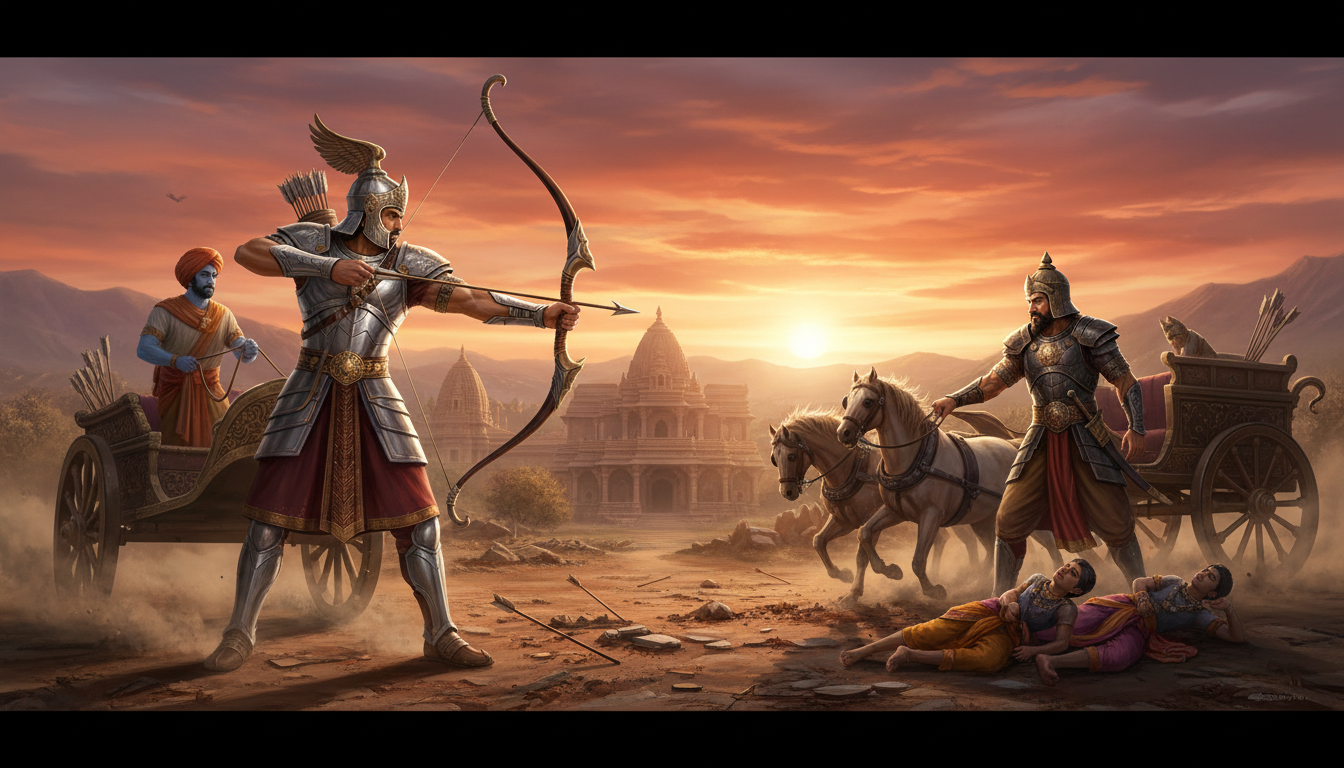
The Oath Comes Due
Susharman, his thirty-five sons, and the last of the sworn men
The Umbrella in the Middle of the Cavalry
It was the afternoon of the eighteenth day, and there were two sons of Dhritarashtra left alive on the earth. Duryodhana was one of them. Sudarshana was the other. Both of them were in the middle of what was left of the Kaurava horse.
Krishna held the reins and looked across the field and told Arjuna what he was seeing, the way a man reads out a page.
"A great many of our enemies, kinsmen who had our protection, have been killed. There, that bull of Sini's race is coming back, and he has taken Sanjaya alive. Nakula and Sahadeva are both tired, having fought the wretched sons of Dhritarashtra and their followers. Those three, Kripa and Kritavarma and the mighty car-warrior Ashvatthama, have left Duryodhana's side and taken up a position somewhere else. The Panchala prince is over there among the Prabhadrakas, very beautiful to look at, having killed Duryodhana's troops.
"And there, Partha, is Duryodhana himself, in the middle of his cavalry, with the umbrella held over his head, flinging his glances all around. He has re-arrayed the remnant of his army and he is standing in the middle of it. Kill this one with your keen shafts and you have everything you came for.
"Do it while those troops are still there. As long as they do not fly away, seeing you in the middle of them and seeing their elephant force destroyed, try to kill Duryodhana. Send someone to the Panchala prince and tell him to come here. The Kaurava troops are all tired, sire. The sinful Duryodhana will never manage to escape. He has killed a great many of your men today and he is wearing a proud face, as though he believes the Pandavas have been beaten. When he sees his own troops afflicted and slaughtered, the Kuru king will certainly come out and fight, for his own destruction."
Arjuna Counts What Is Left
Arjuna answered him, and what came out was not a plan. It was an inventory. He had been keeping it in his head.
"Almost all the sons of Dhritarashtra have been killed by Bhima, giver of honours. Only these two are still alive, and they will meet their destruction today as well. Bhishma has been killed. Drona has been killed. Karna, who is also called Vaikartana, has been killed. Shalya the king of the Madras has been killed, and Jayadratha, Krishna, has been killed.
"Of the troops of Shakuni the son of Subala there remain five hundred horse. Of cars, only two hundred. Of elephants there remain a hundred that are formidable, and of foot, three thousand. There remain also Ashvatthama, and Kripa, and the ruler of the Trigartas, and Uluka, and Kritavarma of the Satwata race. That is the whole of Duryodhana's force, Madhava.
"Truly, there is no escape from death for anybody on earth. Such a slaughter as this has taken place, and look, Duryodhana is still alive.
"Today king Yudhishthira will be free of all his enemies. Not one of them gets past me, I think. Even if they are more than men, Krishna, I will kill all of those warriors today, however furious they are, if only they do not run away from the field. By killing the prince of Gandhara with my keen shafts today I will dispel that sleeplessness which the king has suffered from for so long. I will win back every one of those valuable possessions that Subala's son, of wicked conduct, took from us at the gambling match in the assembly. Today all the ladies of the city called after the elephant will hear of the slaughter of their husbands and their sons and will wail aloud.
"Today, Krishna, our task is ended. Take the foolish son of Dhritarashtra to be a dead man, if he does not fly today from the battle I am going to make. Those horses of theirs cannot endure the twang of my bow and the slap of my palms. Drive, Krishna. I will kill them."
And he of Dasarha's race urged the steeds toward the division in which Duryodhana was standing.
The Ruler of the Trigartas
One name in that inventory had been sitting in Arjuna for a very long time, and it was not Duryodhana's.
The ruler of the Trigartas was Susharman, king of Prashthala, and he and Arjuna had a history that went back well before the war. It was Susharman who had driven the cattle of the Matsyas in the year the Pandavas were hiding in Virata's household, and who had been taken alive that day and let go. That is where the account gets its phrase about what Arjuna carried against him: wrath cherished for many long years.
But the debt that mattered was newer and much larger.
Susharman was the man who had invented the samsaptakas. He and his brothers had gone out in front of both armies, kindled a fire, put on their mail, tied on their quivers, and sworn a public oath in the hearing of everyone: they would kill Arjuna, or Arjuna would kill them, and they would not come back off the field alive with the thing undone. Men who swear that are the sworn ones, and the swearing is a weapon. It does not have to be kept in order to work. It only has to be issued, because a kshatriya who is called out by name and refuses to answer is finished, and Arjuna could not refuse.
So on day after day of that war, Susharman challenged him, and Arjuna went, and the two of them fought at the far end of the field while the battle was decided somewhere else. Five days it took him away. On the thirteenth of those days he answered the challenge as usual and rode to the south, and behind him Drona closed a wheel formation that nobody left in the camp knew how to open, and a boy of sixteen went into it because he knew the way in and had never been taught the way out.
The oath had been sworn against Arjuna's life. What it actually cost was Abhimanyu's. And on the eighteenth afternoon Susharman was still on that field, in the remnant, and Krishna had just read his title out loud from the reins.
Three Cars Go At the Cavalry
Three mighty car-warriors made ready to go into that force together, and they went with leonine roars, wanting Duryodhana: Bhimasena, and Arjuna, and Sahadeva.
Subala's son saw them coming and moved to that spot to meet them, and the matches sorted themselves out in the way such things do, each man taking the enemy in front of him.
Sudarshana went at Bhimasena.
Susharman and Shakuni together went at Kiritin.
And Duryodhana, on horseback, went at Sahadeva.
That is worth stopping on for a moment. The king of the Kurus, who had ninety-nine brothers when the war began and had one left alive now, who had been carried to and from that field in a car under a white umbrella for seventeen days, was up on a horse at the end of it, in the middle of five hundred surviving riders, going in personally against the youngest of the sons of Madri. His chariots were gone. That is what the two hundred remaining cars in Arjuna's count actually meant, spread across a whole army: the king rides.
He came at Sahadeva with great speed and great care, and he struck him on the head with a lance, forcibly.
Sahadeva went down onto the terrace of his car with all his limbs bathed in blood, and he lay there sighing like a snake.
For a moment on that field there were the makings of a completely different ending, in which the last living son of Dhritarashtra killed the last son of Madri from horseback in front of Arjuna.
Then Sahadeva regained his senses, and got up, and covered Duryodhana with keen arrows.
The Cavalry Division Comes Apart
Kunti's son Dhananjaya put out his strength and went to work on the horse.
He cut off the heads of many brave combatants on horseback. That is a particular kind of shooting: a rider is a small target moving fast and low, in a body of other riders moving fast, and the head is the smallest part of him, and Arjuna took them in numbers, with many arrows, until that entire division was destroyed. Five hundred horse had been the whole of Shakuni's remaining strength and the whole of the screen standing between the Pandavas and Duryodhana's umbrella.
Having felled all the steeds, he went on toward the cars of the Trigartas.
The great car-warriors of the Trigartas did the only sensible thing, which was to unite. They came together in a body and covered Arjuna and Vasudeva with showers of shafts from every direction at once, both men in the same car, the driver as much a target as the archer.
Two of them were Susharman's sons, and they went in front of their father.
Their names were Satyakarman and Satyeshu. Both names are built on the word for truth, which is what a man puts in his sons' names when he has staked his own life on an oath and means everyone to know it. They had grown up inside their father's quarrel with this archer. They had been at the fire when he swore. There were thirty-five of them altogether and every one of them was a great car-warrior, and on the eighteenth afternoon of the war they were all still there, and their father was behind them.
Satyakarman and Satyeshu
Arjuna took Satyakarman first, with a razor-headed arrow that cut off his car-shafts, so that the horses ran on with the traces and the young man stood still in the middle of the field in the wreck of his own vehicle.
Then a second razor-headed arrow, whetted on stone. The account puts in a detail here that most readers pass over and should not: he was smiling the while. And with that arrow, that celebrated hero cut off his adversary's head, which was adorned with bright gold.
He went at Satyeshu next, in the sight of all the warriors, and the man who wrote it down reached for a lion and a deer: like a hungry lion in the forest attacking a deer. Not like a duel between equals. Like feeding.
Having killed him, Partha pierced Susharman himself with three arrows.
Three. Not a killing volley, and he was well within range to make it one. It was a touch, the way you set a hand on a door you are coming back to. Then he turned away from the father and killed all those car-warriors adorned with ornaments of gold, the whole company that had come in around them, and cleared the ground between the two of them completely.
The old man had watched two of his sons killed in front of him, one with the shafts cut from under him and one run down like an animal, and had felt three arrows go into his own body from a bow that could have finished him with either of them, and had then been made to stand and wait while the archer worked his way through everything else that was standing.
There was a five-day debt on this. Arjuna was not going to settle it in one shot from a distance.
The Rod of Yama
Then he proceeded against Susharman the ruler of Prashthala, with great speed, vomiting the virulent poison of a wrath cherished for many long years.
That is the sentence in the book, and there is nothing like it anywhere else in the account of that day. Arjuna kills a great many men in the shalya parva and the text almost never tells you what is in him while he does it. Here it stops and says exactly what he was carrying and how long he had been carrying it.
He covered him first with a hundred arrows. Then he killed all the steeds of that bowman, so that the Trigarta king was standing in a car that could not move, in the open, at the far end of Gandiva.
Then Partha fixed on his bowstring a mighty arrow that resembled the rod of Yama.
The rod of Yama is not a figure of speech about a big arrow. It is the staff of the judge of the dead, the instrument by which a sentence already passed is carried out, and the man who chose that comparison chose it because nothing was being decided at that moment. The oath had decided it. Susharman had stood up in front of two armies and announced, on his own initiative, that either he would kill this man or this man would kill him, and there was no third clause in it, and it had been running ever since.
Smiling the while, he sped it at him, aiming it at him.
Sped by that bowman blazing with wrath, the arrow reached Susharman and pierced through his heart.
Deprived of life, the king of the Trigartas fell down on the earth, gladdening all the Pandavas and paining all the warriors of the Kauravas.
Thirty-Five
Having killed Susharman in that battle, Partha then despatched to the abode of Yama the five and thirty sons of that king, all of whom were great car-warriors.
The account gives them one line. It is a line worth sitting with, because thirty-five is not a number of men who fall in a moment; it is a number that has to be gone through, one after another, and the archer has to still be there at the end of it.
They could have gone. Their father was on the ground and the war was decided and there was nothing left to hold and no one left to hold it for, and men were running off that field in every direction all afternoon and nobody afterwards was in a position to blame them for it. Not one of these thirty-five went. They came at him in the order in which they could reach him, and Arjuna killed the thirty-five of them, and then he killed all the followers of Susharman with his keen arrows as well, the last remnant of the sworn men, the tail end of the vow.
That is what the oath finally cost. It was sworn to take one life. It took Abhimanyu's, which it had not been aimed at. It took Susharman's, which it had promised as the alternative. It took thirty-five sons, who had never sworn anything at all except by being born into the house of a man who had. And then it took everyone who had ridden behind them.
Having done it, the mighty car-warrior Arjuna turned and proceeded against the remnant of the Bharata host, and did not, so far as the record shows, say anything about it to anybody.
What Was Left By Evening
Elsewhere on the same ground, Bhima had been working through the other match.
Filled with rage, he made your son Sudarshana invisible with his arrows, and then, smiling the while, cut his head off his trunk with a razor-headed arrow of great sharpness, and the prince fell down on the earth deprived of life. His followers closed around Bhima, shooting whetted arrows from every side, and Bhima covered that force with keen shafts whose touch was like the touch of Indra's thunder, and within a very short time he had killed all of them.
There was one son of Dhritarashtra left in the world after that, and he was sitting on a horse under an umbrella.
Many Kaurava leaders of great might came up to Bhima and began to fight with him, and the son of Pandu covered all of them with his arrows, and your warriors covered the great car-warriors of the Pandavas with dense showers of shafts from every side, and both armies became exceedingly agitated. Struck by one another, the combatants of both sides began to fall down, wailing aloud for their dead kinsmen.
The thing the samsaptaka oath had been designed to do was to take the best archer in the world out of the place where he was needed and hold him somewhere else. For five days it worked perfectly, and Abhimanyu died inside the gap it made, and Jayadratha stood in the mouth of that gap and held it open, and the whole shape of the war bent around it.
It was answered inside a quarter of an hour on the eighteenth afternoon, and it was not a duel and it was not glorious and nobody made a speech. A man who had promised to kill Arjuna was pinned in a chariot with no horses and shot through the heart, and then his sons were shot, and then his followers, and the archer moved on to the next division without stopping.
An oath sworn against another man's life is a note drawn on your own. What the house of Prashthala found out on that field is that everybody in the house has signed it.
Dharma Lesson
An oath sworn against another man's life is a note drawn on your own, and the whole house signs it. Susharman promised in public to kill Arjuna or be killed, and the debt was collected from his two eldest sons, from himself, from thirty-five more sons who had sworn nothing, and from every rider behind them. It was answered in a quarter of an hour, without a duel and without a speech.