Trigarta, the Land of Three Rivers
The kingdom that swore to die fighting Arjuna
The Land of Three Rivers
In the northwest of Bharatavarsha, where the plains of the Punjab rise into broken hills, lay the kingdom of Trigarta, named for the three rivers that watered its fields and fed its pride. Its people were hardy hill folk and horsemen, proud of a lineage as old as any in the land, and for generations they had measured themselves against their southern neighbor, the kingdom of Matsya, in a rivalry that flared into raids whenever the grazing grew thin or a king grew restless.
At the time the Pandavas walked the earth in secret, wearing borrowed names in Virata's court through the last year of their exile, Trigarta was ruled by King Susharma, a proud and capable warrior who had never forgiven Matsya's rich pastures for lying so temptingly close to his own dry hills. Susharma had old scores to settle and a kingdom hungry for plunder, and when word reached him that Matsya's feared general Kichaka had died by unseen hands, he judged the moment ripe. A kingdom without its strong right arm was a kingdom to be tested.
Susharma sent word to his friends in Hastinapura, for Duryodhana had long courted Trigarta's goodwill against the day he might need hillmen at his back, and the two kings agreed on a plan: Trigarta would strike Virata's herds from the south while the Kauravas struck from the north, splitting the old king's strength between two frontiers at once. It was, on the surface, only a raid for cattle. It would grow into an oath that outlived the raid, the raiders, and very nearly Trigarta itself.
The Raid on Virata's Herds
Susharma led his horsemen down from the hills and fell upon Virata's southern herds in a rush of dust and lowing cattle, cutting down the herdsmen who stood in his way. Virata, old but unwilling to let his kingdom be shamed in his own lifetime, rode out with what force he could gather to meet the raiders himself. The fighting went hard against him. Susharma broke through his guard, seized the aged king, and dragged him bodily from his chariot as a trophy, meaning to carry him off to Trigarta in chains.
It was Bhima, serving that year in Virata's kitchens under the name Vallabha, who would not let a king he served be led away like a captured beast. He ran down Susharma's chariot on foot, tore Virata from the Trigartan's grip, and turned the rout around, driving the raiders back in disorder until Susharma himself was pulled from his own chariot and dragged before the Matsya king he had humiliated an hour before.
Yudhishthira, watching under the name Kanka, counseled against killing the captured king outright. A king who yields, he said, is not a king to be slaughtered like an animal for market; mercy toward a defeated enemy was itself a kind of victory. Susharma was released, but not before every soldier in both armies had seen him dragged through the dust the way he had dragged Virata, a humiliation sharper than any wound. He rode back to his hills with his life and nothing else, and carried the memory of that dust the rest of his days.
The Oath Before the Fire
Shame, left alone, does not heal; it hardens. Susharma could not forget that the hand which had dragged him from his chariot belonged not to Virata but to servants in a king's kitchen and, he came to learn, to the disguised Pandavas themselves, with Arjuna among them. By the time the war at Kurukshetra was gathering, the grudge had fixed itself on one name above all others. It was not Bhima who haunted Susharma's nights, but the thought that Arjuna's bow had stood behind that day's ruin.
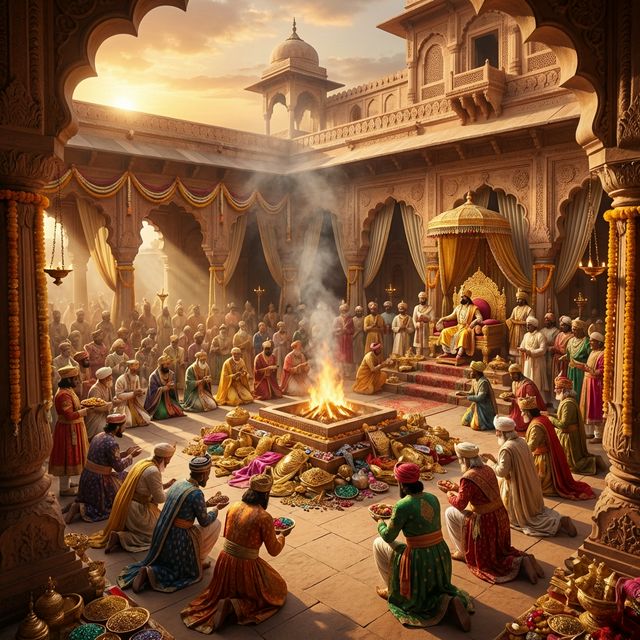
Before the armies marched, Susharma gathered his brothers and their allied kings and led them to a fire kindled for the purpose, and there, before the assembled host, they swore the oath that would name them ever after: they would seek out Arjuna in battle and slay him, or die in the attempt, every one of them, without retreat and without surrender. Those who took this vow came to be called samsaptakas, the sworn warriors, oath-bound men who had traded the ordinary hope of survival for a single fixed purpose.
It was a fearsome thing to watch, brothers and kinsmen circling a fire and binding themselves to death in the same breath as to victory, and it unsettled even seasoned men on both sides of the coming war. Duryodhana welcomed the oath eagerly, for a corps of warriors who would not break and would not flee was worth more to him than twice their number of ordinary soldiers, and he made certain Susharma's host had a place of honor when the armies at last took the field.
The Annihilation at Kurukshetra
True to their word, the samsaptakas made themselves Arjuna's shadow at Kurukshetra. Each morning they rode out ahead of the main host and challenged him by name, taunting and daring him from the field where the true battle was forming, and each morning Krishna turned the chariot toward them, for a vow sworn before fire could not be answered with silence. Day after day Arjuna was drawn away to fight Susharma's host in a separate, murderous battle of its own, even as the war's greatest crises unfolded elsewhere without him.
The samsaptakas fought as men fight who have already made peace with dying. They came on in formation after formation, refusing every chance to break and run, and Arjuna's arrows found them in numbers that would have broken any ordinary army's will in an afternoon. It broke nothing in them. What the oath had promised, the oath delivered: not victory, for they never came close to killing Arjuna, but the death they had sworn to rather than retreat. Wave after wave of Trigarta's warriors fell in that stubborn manner, kinsmen and allies together, until the kingdom that had marched to war behind Susharma was a kingdom of empty households.
Susharma himself endured longer than most of his sworn brothers, returning to the challenge day after weary day, until late in the war Arjuna's arrows found him as they had found the rest. The samsaptakas' oath, meant to humble Arjuna, instead became one of the great engines of Trigarta's own ruin, a proud hill kingdom bled white in the name of a single unkept vow.
The Last Raid
The war ended, the Kuru line was refounded under Yudhishthira, and in time the new king performed the horse sacrifice that proclaims a sovereign's unchallenged rule, releasing a consecrated horse to wander where it would with Arjuna riding in escort to defend its path and accept or answer whatever kingdom chose to bar it. Whichever land let the horse cross unhindered acknowledged Yudhishthira's supremacy; whichever land seized its bridle chose war.
Trigarta, rebuilt in the generation since Susharma's fall, was the very first kingdom the horse encountered, and its warriors were the first in all of Bharatavarsha to lay hands on the bridle and turn the animal back. It was, in its way, exactly the kind of defiance the old oath-takers would have recognized: a smaller power choosing to test itself against Arjuna one more time rather than bow without a fight. The clash that followed was fierce but brief, and Trigarta's warriors, for all their old courage, could not turn back what their fathers had failed to turn back at Kurukshetra.
Arjuna prevailed, as he had prevailed before, and the horse walked on into the next kingdom's lands, carrying Yudhishthira's claim across the earth. Trigarta submitted at last, its rivalry with the Pandavas finally spent, and passed into the epic's memory less as a place on a map than as the land of the vow, the kingdom of three rivers that had once sworn its finest sons to a single doomed purpose and paid that oath in full, twice over, a generation apart.
Dharma Lesson
Susharma's oath shows how wounded pride can harden into a vow that outlives reason, sending men to die for a grudge rather than a cause. Yet the story begins with Yudhishthira's mercy: a captured king, however treacherous, is released rather than slain, for dharma restrains even a just victory. The samsaptakas' end warns that courage divorced from purpose becomes only a slower form of ruin.