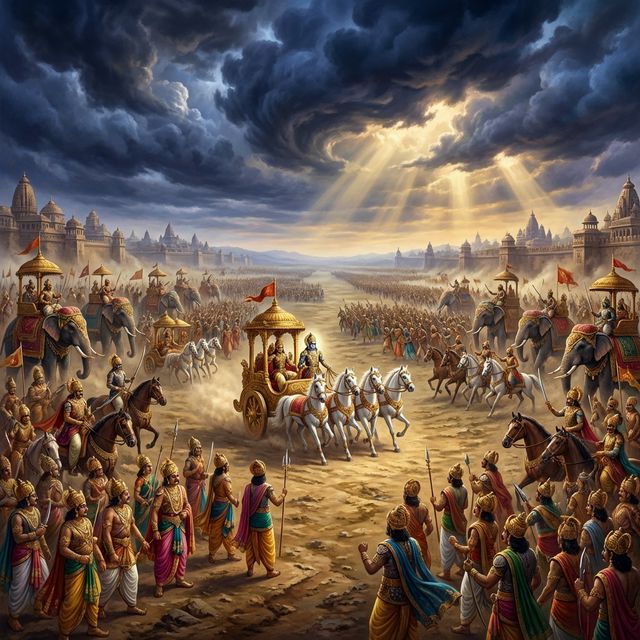
The Princess Who Became Death
Amba's story reveals how injustice, even unintentional injustice, creates cycles of suffering.
The Swayamvara at Kashi
On the banks of the holy river, the ancient city of Kashi shimmered with festival light. The king of Kashi had three daughters - Amba, Ambika, and Ambalika - and word had gone out to every court that their swayamvara would be held. A swayamvara was the proud old custom by which a princess chose her own husband, walking before the assembled kings with a garland in her hands, free to drop it over the neck of the man she desired. Kings had come from across the land, each hoping to be chosen, each dressed in his finest, each seated upon a carved throne beneath the wide pavilion.
Amba was the eldest, and she was the loveliest. Her sisters were beautiful, but Amba had a quiet fire in her that men noticed and did not forget. Yet Amba was not nervous as she dressed that morning, and she was not searching the faces of strangers. Her heart was already given. She loved Shalva, the young king of Saubha, and she had loved him for a long time. They had met in the gardens of her father's palace, and they had exchanged words and looks and promises that no one else knew of. Today, before all these kings, she would walk past every throne and stop only at his. The whole world would witness her choice.
"You are radiant," Ambika told her, fastening the last of the gold at her wrist. "You already know where your garland will fall."
Amba smiled and said nothing, for some happiness is too large for words. She looked out across the crowded hall and found Shalva among the kings, and he met her eyes, and for one moment the noise and the crowd fell away and there were only the two of them. She thought, as so many young people think, that the hardest part of the day was already behind her. She thought that nothing could come between a woman and the man she had freely chosen.
She was wrong, and she would spend the rest of her life learning how wrong.
Bhishma Arrives
Far to the north, in Hastinapura, the great prince Bhishma had a problem to solve that had nothing to do with his own desires. Bhishma had long ago renounced the throne and sworn a terrible vow never to marry, so that his father could wed the fisherman's daughter Satyavati. He had kept that vow without complaint. But now his young half-brother Vichitravirya was king, and the boy had no wife and no heir, and the line of the Kuru would die unless brides were found for him. Satyavati had asked Bhishma to find them. And Bhishma, who served the throne though he would never sit upon it, set out to do exactly that.
He had heard of the swayamvara at Kashi. He had heard that three beautiful princesses would be given away in a single day. To Bhishma, this was not a love story to be respected. It was a duty to be discharged. The ancient codes of the warrior allowed many forms of marriage, and one of them was the marriage by capture, in which a Kshatriya took brides by force from the midst of assembled rivals and bore them away by the strength of his arm. It was a hard custom, but it was a lawful one, and Bhishma intended to use it.
So while the kings of Kashi sat at their ease and Amba prepared to walk toward Shalva, a single chariot came thundering toward the city from the north, raising a long plume of dust across the plain.
It swept into the festival ground and through the gates of the pavilion, scattering attendants. The man who drove it was tall and grey at the temples, and there was about him an unmistakable air of one who had never lost a fight. The hall fell silent. Some of the older kings recognized him at once and went pale. This was Devavrata, son of Ganga and Shantanu, the prince the whole world called Bhishma, the man of the dreadful vow, the greatest archer of his age.
"I am Bhishma of Hastinapura," he said, and his voice carried to the farthest seat. "I claim these three princesses as brides for the king Vichitravirya. It is written that a hero may carry away maidens by force from among assembled suitors. I do so now. If any king here objects, let him take up his bow and stop me."
The Capture
For a heartbeat no one moved. Then the pavilion erupted.
The kings of Kashi were proud men, and they would not surrender three brides to a stranger without a fight. They sprang from their thrones, seized their weapons, and rushed toward Bhishma's chariot from every side. The festival ground became a battlefield in an instant. Garlands and overturned cups lay trampled in the dust where moments before there had been only celebration.
But these kings had never faced anyone like Bhishma. His bow moved faster than the eye could follow. Arrows flew from it in a steady, unhurried stream, and each one found its mark - a bowstring cut here, a chariot wheel shattered there, a raised arm pierced before the blow could land. He did not seem hurried and he did not seem angry. He fought the way a master craftsman works, calmly and without waste, and one by one the kings of Kashi were thrown down, disarmed, or driven back. Within the hour not one of them could stand against him.
Through all of this Amba watched, frozen where she stood. And she watched one man above all others. She watched Shalva.
Shalva had risen from his throne when the fighting began. He had drawn his sword. But seeing king after king broken before Bhishma's bow, seeing the impossible skill of the man, something in him faltered. He hesitated. He did not charge. He stood at the edge of the chaos with his weapon in his hand and he did not come for her. The man she had chosen, the man she had loved in secret and meant to garland before the world, watched her be taken and did not move.
Bhishma reached down and lifted the three princesses into his chariot - Amba, Ambika, and Ambalika - and wheeled his horses about. The crowd parted before him. He drove out through the broken gates and onto the open plain, northward, toward Hastinapura.
Amba twisted in the speeding chariot and looked back at the dwindling city, at the king who had not fought for her. Why did you not come? she thought. Why did you let me go? She did not understand it. She would carry that question, and the wound beneath it, for the rest of her days.
Amba's Confession
The chariot brought the three sisters to Hastinapura, the great capital of the Kuru. Satyavati was pleased, the preparations for the weddings began at once, and the palace bustled with talk of the double good fortune that had brought three brides where two would have been enough. Ambika and Ambalika, frightened but resigned, allowed themselves to be led to their new rooms and their new life. They had not chosen this, but they did not fight it.
Amba could not be silent. On the eve of the ceremony she asked to be brought before Bhishma, and when she stood before him she did not lower her eyes.
"Great prince," she said, "before this goes further, you must hear me. I am already promised. My heart was given long ago to Shalva, the king of Saubha. We loved each other. I came to my swayamvara intending to choose him and no other. He is the husband I have set my mind upon. To wed me now to your brother would be to wed a woman whose love belongs elsewhere. I beg you, by whatever honor you hold dear, let me go to the man I have chosen."
Bhishma listened, and Bhishma was, above all the things that he was, an honorable man. He had taken her by the law of the warrior, but he had no wish to bind a woman against her sworn heart. Forced marriage of an unwilling bride was a thing he would not do. The matter, to him, was simple.
"You should have spoken of this on the field," he said, not unkindly, "but you have spoken now, and that is enough. I will not give to my brother a woman who loves another. You shall go to Shalva, and you shall go with honor, escorted as befits a princess of Kashi."
Amba's heart leapt. She had feared the great cold prince, and instead he had set her free with a few words. She thanked him, and that very day an escort of elders and attendants was prepared, and she was sent south to the kingdom of Saubha, to Shalva, to the future she had always wanted. She rode out from Hastinapura believing that the worst was behind her and the rest of her life was about to begin.
Shalva Turns Her Away
Amba came at last to the court of Shalva, the man for whose sake she had defied a prince. She entered with hope shining in her face. She expected to be received as a long-awaited bride. Instead she was met with cold eyes and a colder silence.
"My lord," she said, "I have come back to you. Bhishma carried me away, it is true, but I told him of our love, and he is an honorable man and he has released me. He sent me to you with his own blessing. I am free. I am yours, as I always meant to be."
Shalva did not rise to greet her. When he spoke, every word was a stone.
"You were won by another man," he said. "Before all the kings of Kashi, Bhishma defeated your suitors and took you in his chariot and bore you away to his city. You went where he took you. You belonged to him, by the law of arms, in the sight of the whole world. I cannot take you back now. What would it make me, to receive into my house a woman who was carried off and then handed back like a prize that another warrior did not want? Go from here. I will not wed you."
Amba could not believe what she was hearing. She pleaded. She reminded him of every promise, every secret meeting, every word he had ever spoken to her in the gardens of Kashi. She told him that her heart had never wavered, that through everything she had thought only of him. She wept, and she begged, and she stood before his throne for a long time refusing to leave.
It changed nothing. His pride had decided the matter, and he would not move. To Shalva she was no longer a beloved but a thing already used, an honor already lost. At last, broken, she turned and left his hall.
Now she understood why he had not fought for her on the festival ground. He had not loved her enough to risk himself, and he did not love her enough now to forgive what was no fault of hers. The man she had chosen had thrown her away twice. She had refused a king, defied a prince, crossed half the land, and arrived at last at an empty door.
Nowhere to Go
Where does a woman go when every door is shut?
She could not return to Kashi. To go home rejected, a princess sent forth to a swayamvara and brought back unwed by two kings, would shame her father and her house. She could not stay with Shalva, who had cast her out. She could not go to Vichitravirya, for he would never accept a bride who had openly declared her love for another. For a time she lived among forest hermits, turning the matter over and over in her mind, and the longer she thought, the more clearly one truth rose above all the others. The man who had started this, the man whose chariot had torn her from the life she had chosen, was Bhishma. If Bhishma had not come to Kashi, none of this would have happened. Her ruin began with him.
So she made the long journey back to Hastinapura, and once again she stood in its great hall, but she was a changed woman now. The hope was gone from her face. In its place was something hard and fixed.
"You did this," she said to Bhishma. "You came to my swayamvara and you took me by force from the husband I had chosen. Because of you, Shalva will not have me. Because of you, I am no one's wife and no one's daughter. You took me. Now you must take responsibility. Marry me yourself."
Bhishma's face filled with sorrow, but his answer did not change. "I cannot," he said. "You know what I cannot say to any woman. Long ago I swore before the gods that I would never marry, never father children, never take a throne. I took that vow for my father's sake, and I have kept it through everything, and I will keep it until I die. I cannot marry you. It is not in my power."
"Then send me to your brother."
"He will not have you, for you have named another man as your beloved before the whole court. I will not force him, and I will not force you."
Amba stood in the center of that vast hall, and she felt the last door close. One man had carried her off. One man had cast her out. One man had bound himself by an oath that left no room for her. Three men, and not one of them would be her husband, and not one of them counted the cost to her. She had nothing left in all the world.
Nothing, except a rage that was beginning, quietly, to become the whole of her.
She Seeks Parashurama
If no king would right her wrong, Amba would find someone greater than any king. There was one man in all the world whom even Bhishma honored above himself - the warrior-sage Parashurama, the dreadful axe-wielder who had cleared the earth of unjust Kshatriyas, and who, long ago, had been Bhishma's own teacher in the art of weapons. If anyone could compel Bhishma, it would be the master who had trained him.
Amba sought Parashurama in his forest hermitage among the mountains. She fell at his feet and poured out the whole of her grief - the swayamvara, the abduction, the rejection by Shalva, the closed doors at Hastinapura. She held nothing back. When she had finished, she made her plea plain.
"You are his teacher," she said. "He will listen to you as he listens to no one else. Command him to take me as his wife and undo the wrong he has done me. And if he will not obey you, then kill him, for there is no other justice left for me on this earth."
Parashurama was moved by her suffering, and there was an old sternness in him that did not like to see a wrong go unanswered. He sent word to Bhishma, summoning him. And Bhishma came, for he revered his old teacher and would not refuse to face him. But when Parashurama commanded him to marry the woman, Bhishma bowed low and answered as he had answered everyone.
"Master, I honor you above my own life. Ask me for my life and I will give it to you here. But do not ask me to break my vow, for that I cannot do, not for you, not for anyone. I swore never to marry. I will die before I forswear myself."
Parashurama's eyes darkened. "Then," he said, "you will fight me. If you will not yield to reason, you will yield to my axe, or you will die upon it."
"If it must be so," said Bhishma quietly, "then teacher, I will meet you on the field. Forgive me. You have left me no other road."
Parashurama and Bhishma
They met upon a great plain, the master and the pupil, and the duel that followed was one of the most terrible the world had ever seen. For days it raged without rest. Parashurama, who had emptied the earth of warriors again and again, brought forth every weapon and every secret of his art. Bhishma, the finest archer of the age, matched him stroke for stroke and arrow for arrow. The sky was darkened with their shafts. Celestial weapons clashed in the air and burst like falling stars. The gods themselves are said to have gathered to watch, and even they could not say who was the greater.
Day after day they fought, and neither could overcome the other. Each was wounded, each recovered, each rose again at dawn to fight on. Amba watched from the edge of the field, and her hope rose and fell with the battle, for everything she had left rested on its outcome. If Parashurama won, Bhishma might be made to marry her, or be slain. If neither won, she had nothing.
Neither won. On the twenty-third day, with both warriors near exhaustion and no end in sight, the sages and ancestors of Parashurama appeared before him and bade him stop, for this was a fight that could not be finished and would only ruin two great men. Parashurama lowered his axe. He turned to Amba, and there was a heaviness in him that she had never seen.
"Child," he said, "I have done all that I can do. I have fought my own pupil to a standstill and I cannot defeat him. No power that I command can compel this man. I am sorry. I can help you no further. Make your peace, if you can, with what has happened, and let go of this Bhishma, for he is beyond my reach and beyond yours."
Amba heard the words, and she did not weep. She had wept all the tears she had. Even Parashurama, the destroyer of kings, could not give her justice. Then she would seek it from one who was greater still. She bowed to the sage, and she turned away, and she walked off the field alone, into the wilderness, to find a power that no weapon and no warrior could withstand.
The Terrible Penance
Amba went into the high and lonely places of the mountains, and there she gave herself wholly to penance. She had finished with kings and with sages. She would appeal directly to the gods, and she would not stop until they answered.
What she did to her body in those years has become a byword for the fury of a wronged soul. She fasted until she was little more than bone. She stood through the burning days of summer and the freezing nights of winter without shelter. She lived on fallen leaves, and then on water, and then on air. Through the long seasons she held a single thought before her mind like a flame she would not let go out: the destruction of Bhishma. Her penance frightened even the hermits who dwelt nearby, for there was no peace in it and no wish for heaven. There was only the will to be avenged.
The heat of her austerities rose like smoke until it reached the very thrones of the gods, and at last Lord Shiva himself, the great lord of the mountains, appeared before her. He was moved by the terrible single-mindedness of her devotion.
"Ask," he said, "and it shall be given."
"I ask for the death of Bhishma," she said, without hesitation. "I ask to be the cause of his fall. Grant that by my hand he will die."
Shiva looked upon her, and he spoke the words she had bled herself dry to hear. "It shall be so. You shall slay him. You shall be the cause of Bhishma's death in battle."
Joy and grief broke over her at once, for she understood what such a boon must mean. "But lord," she said, "I am a woman, and Bhishma will not raise his weapon against a woman, nor can a woman stand against him in war. How shall this come to pass?"
"It will come in another life," said the great god. "You will not see it with these eyes. But the deed will be yours, and the memory will be yours, and the victory will be yours. This I have promised, and it cannot fail."
The Fire
Shiva had promised her the death of Bhishma, but in another life. Amba would not wait for that life to come to her slowly, through age and the ordinary turning of years. She would go to meet it. If her vengeance lay on the far side of death, then she would cross to the far side of death at once.
With her own hands she gathered wood at the river's edge and built a great pyre. The hermits who watched could not turn her from it. She had the strength of one who has only a single thing left to live for, and is willing to die to reach it. When the pyre was ready she set it alight, and the flames leapt up tall and bright against the mountains.
She stood before the fire, and she spoke her vow aloud one final time, so that the whole world and all the gods would hear it and remember.
"I do this for the destruction of Bhishma," she cried. "I will be reborn, and in that life I will be the death of the man who ruined mine. This I swear by my own death."
And she walked into the fire.
The flames took her body, but they could not touch the thing that drove her. Her hatred was older now than her grief and stronger than her flesh, and it did not die with her. It passed out of the burning into the dark, whole and undimmed, a vow looking for a vessel. Amba, princess of Kashi, was gone. But what she had become would return.
Reborn as Shikhandi
In the kingdom of Panchala, King Drupada longed for a child who would bring about the downfall of his enemies, and he too had performed great penance for the favor of Shiva. The god granted him a strange and fateful boon: a child would be born to him who would begin life as a girl and become a man, and that child would be the death of Bhishma. Into Drupada's house, in answer to that boon, came the soul of Amba, carrying her vow unbroken across the gulf of death.
The child was born and named Shikhandi, and raised, by the will of the god and the secret of the prophecy, to fulfill a destiny set in motion at a swayamvara long ago. Through a granted transformation Shikhandi came at last into the form of a warrior, a man who could take up arms and stand upon the field of battle. And in the soul of that warrior lived the unforgotten memory of every wrong - the chariot at Kashi, the closed door at Saubha, the silent hall at Hastinapura, the fire in the mountains.
Many years later, on the great field of Kurukshetra, the moment that Shiva had promised arrived. Bhishma, grandfather of both the warring houses, stood unconquered at the head of the army, for no warrior alive could overcome him. But Bhishma had sworn another vow long before - that he would never raise his weapon against a woman, nor against one who had been born a woman. When Shikhandi came before him in the battle line, Bhishma knew the soul that looked out through those eyes. He recognized Amba. And he lowered his bow, and he would not fight.
With Shikhandi before him shielding the way, the arrows of Arjuna found at last the body that no one else could reach, and the invincible grandfather fell. Amba's vengeance, sworn before a swayamvara fire and carried through death itself, was complete. The wronged princess of Kashi had become, exactly as the great god promised, the cause of Bhishma's death. Hatred had outlasted a lifetime, and kept every word of its oath.
Dharma Lesson
Amba's story reveals how injustice, even unintentional injustice, creates cycles of suffering. Bhishma meant no harm - he was fulfilling his duty to his brother. But Amba lost everything because of that duty. Her rage became a force that transcended death itself. The lesson is not that Amba was right or wrong, but that actions have consequences we cannot foresee.