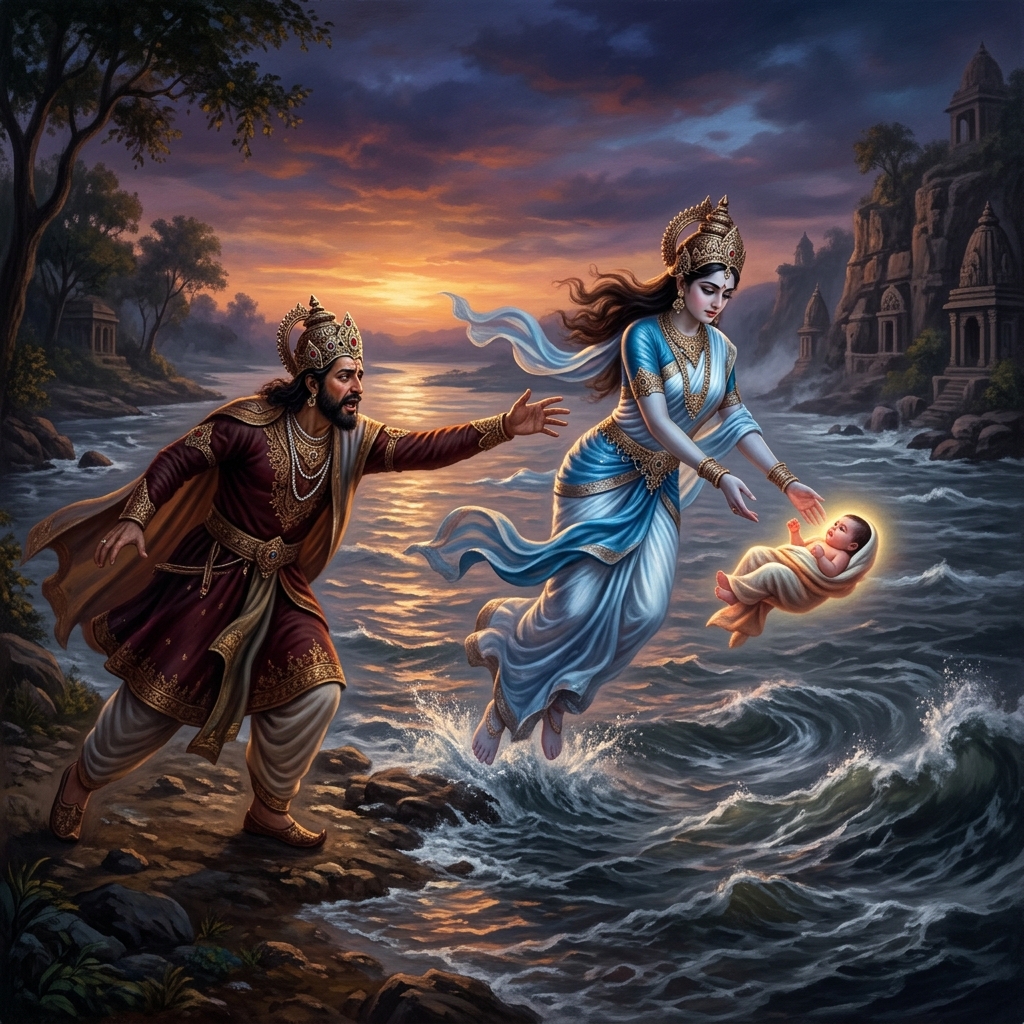
The Shadow Over Hastinapura
King Shantanu of the Kuru line ruled Hastinapura with a steady and generous hand. He was a king out of the old stories, righteous in judgment, fearless in the hunt, beloved by farmers and ministers alike. Travelers who passed through his city spoke of streets where no one went hungry and gates that were never barred against the weak. Under his rule the Kuru realm flourished, and the people called him father.
Yet those who knew him best had begun to notice a change. Where Shantanu had once laughed easily and ridden out at dawn with his bow across his shoulder, he now lingered in the shadowed corners of the palace. He would sit alone at the high windows that looked out over the plains toward the great river, and a heaviness would settle on his face that no courtier dared to name.
The king carried, locked within his heart, a grief that reached far back into his own past. Years before, he had loved and married a woman of unearthly beauty who came to him from the river itself - the goddess Ganga, though he had not known her divine nature when he first beheld her on the bank. She had borne him a son, radiant and strong, and then she had departed as mysteriously as she had come, taking the child with her, promising only that the boy would one day return to him grown and accomplished.
That promise had been kept. The child of the river had come back to his father a young man trained in every art a prince could master, and Shantanu had named him heir and crown prince. For a time the king's loneliness had eased. But grief is patient, and a new sorrow had now crept into the old wound, one that the king refused to speak aloud to any living soul.
The Prince of the River
The prince was named Devavrata, and there was no finer young man in all the kingdoms of Bharatavarsha. The blood of a king and a goddess ran in him, and it showed in everything he did. He had been raised by his mother among sages and celestial teachers, and he had learned the Vedas at the feet of the wisest, the use of every weapon from the greatest masters of arms, and the duties of a ruler from preceptors who had taught kings before him. When he returned to Hastinapura, even seasoned warriors who watched him at practice fell silent in admiration.
But Devavrata's true greatness lay deeper than his skill. He was gentle with the old and patient with the foolish. He spoke the truth even when a comfortable lie would have served him better. He honored his father not as a duty but with a love so plain that the whole court could see it. The people of Hastinapura looked at their crown prince and felt their future was safe in his hands.
So when Devavrata saw the sorrow gathering in his father's eyes, it troubled him more than any enemy or omen could have. He watched the king grow thin and silent. He saw him return from rides along the river looking as though he had left some part of himself behind on the bank. A son who loved his father could not let such grief pass unanswered.
One evening, as the sun sank low and turned the river to molten gold, Devavrata came and knelt before the king's seat. "Father," he said quietly, "a cloud has settled over you, and it darkens this whole house. Your ministers do not know its cause, and neither do I. Whatever it is that wounds you, tell me. I am your son. Let me carry some part of this weight, for I cannot bear to watch you suffer alone."
A King's Silent Refusal
Shantanu looked down at his kneeling son for a long moment, and his eyes grew soft and sad. He reached out and laid his hand upon the young man's head as he had done when Devavrata was a boy newly returned to him.
"My son," the king said at last, "it is true that a grief sits upon my heart. But it is not one you can lift, and I would be a poor father to lay it upon your shoulders. You are everything a king could wish for in an heir. You are brave, you are wise, and you are the sole pillar upon which this dynasty rests. That, in truth, is the very root of my worry."
Devavrata raised his head, puzzled. "How can my worthiness be a cause of sorrow to you, Father?"
Shantanu rose and walked to the window, looking out at the darkening plain. "In this world, my child, a man who places all his hopes upon a single son lives in fear. The bravest warriors fall in battle. The strongest bodies sicken. If anything were to happen to you - and you, of all men, court danger in war and in the chase - this great line would end, and Hastinapura would be left without an heir. One lamp, however bright, is a fragile thing. I grieve, but it is a grief I must keep to myself."
It was a half-truth, and Devavrata sensed it. His father would not meet his eyes. There was something more, something the king was ashamed to name, and he was choking it down out of love. Devavrata bowed and withdrew, but he did not let the matter rest. A wound hidden out of tenderness, he knew, only festers the deeper. He would find the truth, and he would find it not from his father's reluctant lips but from those who had watched the king's recent days.
The Fisherman's Daughter
Devavrata went to the king's old charioteer, a man who had attended Shantanu on every ride and knew his master's heart as few others did. Pressed gently and with a son's earnestness, the charioteer told what he had seen.
Not long before, the king had been hunting along the banks of the Yamuna when a fragrance unlike any he had ever known drifted to him across the water - sweet, clean, and somehow far-reaching, as though it could travel for leagues. Following it, Shantanu came upon a young woman of dark and astonishing beauty, the daughter of the chief of the fisherfolk who plied that stretch of the river. Her name was Satyavati, and the divine fragrance that clung to her was hers alone, a gift granted to her after a strange and holy origin in her early life.
The king's heart had been taken in an instant. Here was a beauty and a grace that stirred in him the same wonder he had felt long ago by the Ganga. He spoke to her with respect, learned that she was unmarried, and went straightaway to her father, the chief of the fishermen, a stern and shrewd old man whom people called Dasharaja, to ask for her hand in honorable marriage.
"And there, my prince," the charioteer said, lowering his voice, "the matter broke against a rock. The fisherman would not give a simple yes. He set a condition upon the marriage, and it was a condition the king could not in conscience accept. Shantanu came away that day with his desire denied and his honor intact, but his peace was gone. Since then he has wasted in silence, too proud and too just to take what was offered and too smitten to let the longing go."
Devavrata listened, and a quiet resolve hardened within him. "Tell me," he said, "the exact words of the fisherman's condition."
The Condition Upon the Throne
The charioteer drew a breath and repeated what he had overheard. "The fisherman said this, my prince. 'O King, I am honored beyond my station that you, the lord of Hastinapura, should ask for my daughter. I would give her to you gladly. But I am a father, and I must look to my child and to her children. You already have a son, Devavrata, a hero beyond compare, whom you have named your heir. After you, he will be king, and after him, his sons. What then becomes of my daughter's sons? They will be servants in the house where their mother is queen. This I cannot accept. I will give Satyavati to you only on one condition - that the son born of her, and his line after him, shall sit upon the throne of Hastinapura. If you grant this, take her with my blessing. If not, I beg your pardon, but I must refuse.'"
Devavrata understood at once why his father had fallen silent. The fisherman's price was the crown itself. To accept it, Shantanu would have to set aside his firstborn, the trained and beloved heir, the prince of the river, and hand the future of the dynasty to a child not yet born. No just king could do such a thing to a faithful son. And so Shantanu had refused, and had ridden home, and had let the longing eat at him rather than commit so great a wrong against the boy he loved.
It was, Devavrata saw, an act of fatherly love that was slowly killing his father. The king was sacrificing his own happiness to protect his son's rights, and would never breathe a word of it lest Devavrata feel the burden of the king's misery.
The prince thanked the charioteer and stood alone for a long while by the palace wall as night came on. His own birthright lay in one scale. His father's life and happiness lay in the other. To Devavrata, the choice was not difficult at all. He called for a chariot. "Take me," he said, "to the village of the fishermen, to the house of Dasharaja, their chief."
The Prince Renounces the Crown
Surrounded by the elders of the kingdom whom he had gathered to witness his word, Devavrata came to the dwelling of the fisher chief. Dasharaja came out and bowed low, for he knew this was the crown prince of Hastinapura standing before his humble door.
"Chief of the fisherfolk," Devavrata began, his voice clear and calm in the gathering dusk, "I have learned the condition you set upon the hand of your daughter Satyavati. You fear for the children she may bear to my father the king. You fear that I, the elder son and named heir, will keep them from the throne, and that they will live as lesser men in the house of their birth. Hear me, then, and let these honored elders be my witnesses."
The old man waited, his shrewd eyes narrowing.
"I renounce, here and now, all claim to the throne of Hastinapura," Devavrata said. "I will not be king. I lay down my birthright freely and forever. Let Satyavati marry my father with a glad heart. The son she bears him shall be the heir of the Kuru line and shall rule after him, and his sons shall rule after that. I will serve that king as I would have served my father. This I swear before these elders and before the gods."
A murmur of astonishment ran through the gathered elders. To give up the throne of Hastinapura - the richest and most honored of kingdoms - for the sake of a father's marriage was a sacrifice such as none of them had ever witnessed. They looked at the young prince with awe and with sorrow, for the kingdom was losing the finest king it would ever have known.
Yet Devavrata stood unmoved, serene, as a man stands who has weighed his own desire against his father's life and found the choice simple.
The Fisherman's Deeper Fear
But Dasharaja did not at once accept. He was a shrewd man, and a father, and he looked beyond the moment to the years that no one in that gathering could yet see.
"O great prince," he said slowly, "your nobility is beyond anything I had the right to ask for. There is no doubt of your truth or your honor. You yourself would never break your word, and you would never raise a hand against my daughter's children. Of this I am certain."
He paused, and the elders leaned in.
"And yet," the fisherman went on, "you are young. One day you will marry, as all men do. You will have sons. And your sons, prince - they will not have sworn the oath you have sworn this night. They will be born to the blood of Shantanu and to the strength that flows in you, mightier perhaps than any others in the land. What is to keep them, when they are grown, from looking at the throne and saying, 'Our father gave this up, but we did not. Our father was the firstborn. By right the crown is ours.' Who could stand against such heroes? My daughter's children would be swept aside, and your renunciation, for all its glory, would come to nothing in the next generation. Forgive an old man's plain speaking. I cannot give my daughter to so uncertain a future."
The elders fell silent, for the fisherman had spoken a hard truth. A man may bind himself with a vow, but he cannot bind his unborn sons. Devavrata had given up his crown, yet the old fear remained, only pushed forward one generation. To truly set the fisherman's heart at ease, something more terrible still would be required - and every man present understood, with a chill, what that something must be.
The Terrible Vow
Devavrata heard the fisherman's deeper fear, and he did not flinch. He had already given up a kingdom; he now saw what was needed to give his father true and lasting peace, and he resolved to give that as well, however dreadful the cost to himself.
He raised his right hand toward the darkening sky, and his voice rang out across the river and the assembled elders so that none who heard it would ever forget.
"Listen, then, O chief of the fishermen, and let heaven and earth be my witnesses," he cried. "I have already renounced the throne for the sake of my father. Now hear this further vow, that no doubt may remain in your heart for any generation to come. I swear that from this day forward I shall never marry. I shall never know a woman. I shall live my whole life in perfect celibacy, and no child shall ever be born of my body. I shall have no son to covet the crown, and no descendant to challenge the children of your daughter. This I vow, and may I forfeit all reward in this world and the next if ever I break it."
For a heartbeat the world seemed to hold its breath. Then a sound rolled across the heavens, and from the clouds above, unbidden, a rain of celestial flowers began to fall - soft and fragrant, drifting down upon the prince and the river and the awestruck crowd. The voices of unseen beings sounded in the air, and the gods themselves cried out in wonder at a sacrifice greater than any they had witnessed among mortals.
"Bhishma!" the voices proclaimed from the sky. "He shall be called Bhishma - he of the terrible vow!"
From that hour, Devavrata bore a new name. He was Bhishma, the one whose oath was so awful in its magnitude that the heavens themselves had paused to honor it. A man had given up not only his throne but his very lineage, his future, his name carried forward in children - all of it surrendered for love of his father.
Satyavati Comes to Hastinapura
The fisher chief Dasharaja fell to his knees, overcome by what he had seen and heard. Every fear he had carried was answered now, not by argument but by a sacrifice so total that no doubt could survive it. There was no longer any son and no longer any line of Devavrata to threaten his daughter's children. The throne of Hastinapura would pass without contest to the offspring of Satyavati.
"It is more than enough, O prince," the old man said, his voice trembling. "Forgive me that I ever doubted, and that I pressed so far. Take my daughter to your father with my whole heart. Such a soul as yours the world has never seen."
With every formality of honor, Satyavati was prepared and brought forth, and Bhishma himself, with the grace of a true son, took her into his chariot to carry her home to his father. As they rode back toward Hastinapura through the falling dusk, the prince treated her not as a rival who had cost him his crown, but as a mother to be honored. "You shall be the queen of the Kurus," he told her gently, "and your sons shall be my brothers and my kings. I will guard them and serve them all my days." Satyavati, who had heard from her father of the dreadful price this young man had paid, looked at him with wonder and with the beginnings of a deep and lasting reverence.
When they came at last before King Shantanu, the king's heart leapt and then nearly broke. For there was the woman he had loved and given up - and there beside her was his beloved son, who had somehow won her for him. Bhishma told him all that had passed: the renunciation of the throne, and then the terrible vow of lifelong celibacy. Shantanu listened, and joy and grief warred in him until tears stood in his eyes.
The Boon of Death at Will
Shantanu embraced his son, and for a long moment the king could not speak. When at last he found his voice, it shook with feeling.
"My child," he said, "what have you done? For my sake you have thrown away a kingdom that was rightfully yours. For my sake you have vowed never to marry, never to have children, never to carry our name into the future. You have given up everything a man holds dear, that your old father might know a little happiness in his late years. There has never been a son like you in all the ages of the world, and there never will be again."
Then the king, whose own life had been touched by the divine and who possessed a power granted to few mortals, made a resolve. "I cannot give you back what you have surrendered," Shantanu said, "but I will give you the only thing in my power that is worthy of so great a sacrifice. Hear my boon, my son. Death itself shall have no power over you against your will. You shall die only when you choose to die, and not before. No weapon, no sickness, no enemy, no span of years shall be able to take your life unless you yourself consent to lay it down. Ichcha-mrityu - death at your own wish - shall be yours."
The heavens, which had so lately rained flowers upon the prince, seemed to seal this blessing as well. From that day Bhishma walked the earth as a man over whom death waited rather than ruled. He would live long enough to see kingdoms rise and fall, to teach princes and counsel kings, to become the grandsire of a great and tragic house - and he would surrender his life, at the very end, only at the hour of his own choosing.
The Grandsire of the Kurus
So King Shantanu wedded Satyavati, and the long sorrow that had hollowed his days was lifted at last. The court rejoiced, and the people of Hastinapura blessed the prince whose sacrifice had restored their king to himself. In time Satyavati bore Shantanu two sons, and the line of succession passed, exactly as the fisherman had wished, to her children - while Bhishma, true to his word in every particular, sought nothing for himself and served the throne with a devotion that never wavered.
Yet thoughtful men in Hastinapura understood that something vast and irreversible had taken place by the river that evening. A prince had loved his father so completely that he had unmade his own future to give the old king a few years of joy. The cost of that love would ripple forward across generations no one could yet foresee. Because Bhishma never married and never fathered a son, the burden of the dynasty would fall in strange and tangled ways upon those who came after, and the grandsire himself would stand, vow-bound and sorrowful, through quarrels and disasters he could see coming but could not prevent.
But that lay far ahead. For now there was only the figure of Bhishma, towering and serene, the man who had given up a crown and then given up his very lineage, over whom even death now waited upon his pleasure. The celestial flowers that had rained upon him by the Yamuna were a sign the world would long remember: that here was a soul who had chosen duty and love over every reward, and who had paid for that choice with everything he had.
He was Devavrata no longer in the mouths of men. He was Bhishma - he of the terrible vow - the grandsire of the Kurus, the one who gave up all things for the love of his father, and whose name would be spoken with awe for as long as the great story of his house was told.
Dharma Lesson
True love is not possession but sacrifice. Devavrata gave up his kingdom, his future, and his chance at family - all so that his father might find happiness. This is the highest form of filial duty: to place the joy of those we love above our own desires.