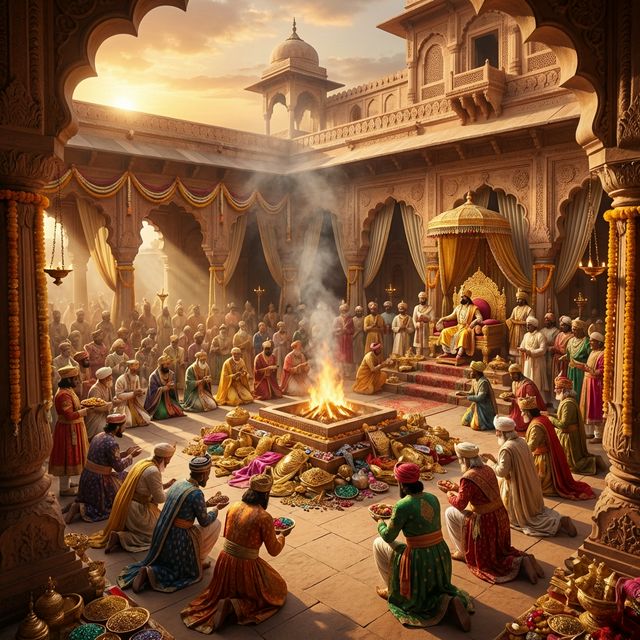
The Horse Sacrifice
Arjuna Follows a Wandering Horse, and Dies at His Own Son's Hand
The Grief That a Throne Could Not Cure
The war was won, the crown was worn, yet Yudhishthira walked through the halls of Hastinapura like a man carrying a corpse on his back. Eighteen days of Kurukshetra had emptied the earth of its warriors, and every night the dead returned to him in dreams - cousins, teachers, kings, the numberless foot-soldiers whose names he had never known. He had ruled now for a while, and still the throne felt borrowed, the prayers felt thin, the incense of the royal shrine could not mask the smell of the burning fields that lived on in his memory.
He said as much to Krishna and to the great Vyasa, who had come to counsel him. "I sit upon a seat of bone," he told them. "I am called Dharmaraja, the king of righteousness, and I have presided over the slaughter of my own kin. What rite is there that can wash this from a man's soul?"
Vyasa did not soften the truth, but he answered it. "There is one rite equal to your grief. Perform the Ashvamedha, the great horse sacrifice. It is the oldest and most demanding of the royal rituals. By it a king consecrates the very land he rules, makes the soil sacred again, and confesses before the gods that his whole dominion is held only by their grace. The Ashvamedha purifies the slayer of kinsmen as nothing else can. And it will give the world a sign that the house of the Pandavas reigns, not by the spilling of blood, but by the favor of heaven."
Krishna laid a hand on his cousin's shoulder. "Do this, Yudhishthira. Not for pride. For atonement, and for peace."
Yudhishthira bowed his head. "Then it shall be done. Tell me what the rite requires, and let nothing be spared."
The Treasure Beneath the Mountain
The Ashvamedha was the most costly of all sacrifices. To perform it, a king must give away gold beyond counting, feed multitudes, and reward thousands of Brahmins. The royal treasury, drained by years of war, could not bear it. When Yudhishthira confessed this difficulty, Vyasa smiled, for he had foreseen it.
"There is gold enough," the sage said. "In ages past, the king Marutta performed a sacrifice so vast that the gods themselves attended, and at its end he left behind a mountain of golden vessels in the Himalayas, in the country of the snowy peaks. It lies there still, untouched, guarded only by spirits. Go north, gather it, and let it serve the cause of righteousness."
So Bhima, with a chosen company, marched into the high country toward the slopes of Himavat where the gold was hidden. The Pandavas first propitiated Shiva, lord of the mountains, and Kubera, lord of treasure, and the unseen guardians of the place, for no man may take such wealth without the leave of those who keep it. Hymns were sung, oblations were poured, and the spirits gave their consent.
Then the long labor began. Thousands of vessels of pure gold were dug from the cold earth - bowls, jars, ritual implements, the leavings of a sacrifice older than memory. They were loaded onto camels and mules and the backs of strong men, and the great caravan wound its way down out of the mountains and across the plains to Hastinapura.
When the gold poured into the courtyards of the capital, the people stared in wonder. Here was wealth enough to honor every god and feed every guest. Yudhishthira looked on it without joy and without greed. "Let it all be given away," he said quietly. "I do not want a single coin of it left when the rite is done."
The Horse Released to Wander
On an auspicious day chosen by the priests, the rite began. A particular horse was selected, dark of body and pale of feature, marked with the signs the scriptures required. It was consecrated with mantras, bathed, garlanded, and blessed. Upon its forehead the priests bound a golden plate, and upon that plate was inscribed the proclamation of Yudhishthira's challenge to the kings of the earth.
The law of the Ashvamedha was simple and severe. The consecrated horse would be set free to wander where it willed for one full year. No man might guide it; it went where the wind and its own desire carried it. Wherever it crossed a kingdom's border, the king of that land faced a single choice. He might submit, letting the horse pass freely and so acknowledging Yudhishthira as his overlord, or he might seize the horse and fight the army that followed it. If, after a year of wandering, the horse returned alive, it would be brought home and offered to the gods, and the king who released it would be confirmed as paramount sovereign of the world.
To follow the horse, to walk and ride behind it for a year, and to fight every king who dared detain it, the Pandavas chose their greatest warrior. Arjuna volunteered without hesitation. "Let me go," he said. "I have killed so many in anger and in grief. Let me walk a year behind this horse and meet whatever comes, and let it test me." Krishna blessed him, and Yudhishthira embraced him, charging him above all to win without cruelty - to spare the kings who yielded, and to harm none who did not need harming.
At the appointed hour the horse was loosed. It tossed its head, scented the open country, and set off toward the south. Arjuna mounted his chariot, the army formed behind him, and the long pilgrimage of war and reconciliation began.
The Long Road of Battles
The horse wandered, and Arjuna followed. It went south and then east, then turned its head north and at last west, tracing a great circle across the inhabited world, and every land it entered was put to the test.
In the country of Trigarta, the sons and kinsmen of warriors Arjuna had slain at Kurukshetra came against him to avenge their dead. The fighting was bitter, for grief makes fierce soldiers, but Arjuna, mindful of his brother's charge, fought to subdue rather than to destroy, and in the end the Trigartas laid down their arms and let the horse pass. So it went in Pragjyotisha, the kingdom of the elephant-riding people, where the young king Vajradatta, son of the slain Bhagadatta, charged out upon a war-elephant and pressed Arjuna hard for three days before he yielded and bowed.
Among the Saindhavas, the kin of Jayadratha whom Arjuna had beheaded in the war, the women wailed for vengeance and the men fought with the desperation of the grief-maddened, and again Arjuna prevailed and again he spared. In the land of Manipura far to the east the horse would soon turn its steps, but first it carried him to many another realm. Everywhere the pattern repeated. Some kings came out with garlands and tribute and bowed at once; others came out with bows and chariots and were beaten down and then forgiven. Arjuna grew weary in body and heavy in heart, for he was fighting, over and over, the sons and brothers of men he had already killed once.
Yet he kept faith with his vow. He raised no man to slaughter who could be raised to friendship instead. Old enemies became sworn allies. Caravans of tribute - gold, horses, elephants, silks, and sandalwood - turned back along the roads toward Hastinapura. And the people of the lands he passed through, seeing a conqueror who pardoned rather than punished, began to speak of the Pandava peace not as a yoke but as a mercy.
The Son Who Did Not Know His Father
At last the horse turned eastward and crossed into Manipura. Arjuna had not set foot in that kingdom for many long years - not since the days of his first exile, when on his pilgrimage he had come to its court, fallen in love with the warrior-princess Chitrangada, and married her. By the terms of that marriage her father's line would continue through their child, and so Arjuna had left his infant son behind in Manipura when he departed, with the promise that the boy would never be required to leave his mother's land.
That infant was now a man, and a king. Broad in the shoulder, steady in the eye, bearing without knowing it the very cast of his father's face, he ruled Manipura wisely and was beloved of his people. His name was Babruvahana.
When word came that the sacrificial horse of the Pandavas had entered his borders, and that Arjuna himself rode behind it, Babruvahana's heart leapt with joy. Here at last was the father he had heard of all his life, the hero of heroes, come to his very gate. He gathered garlands and gold, fine cloth and jeweled ornaments, and rode out to meet him with reverence shining in his face. When Arjuna's chariot appeared, the young king dismounted, came forward humbly, and bowed low to lay his tribute at his father's feet.
But Arjuna, instead of joy, felt a strange anger rise in him - whether from the long weariness of the road, or from some design of fate, he could not say. He looked at the kneeling youth and his face hardened.
A Rebuke and a Whispered Deceit
"Is this how a Kshatriya greets the challenge of the horse?" Arjuna said coldly. "You are a king, and a king does not crawl with garlands before an army that has come to test his arms. The law of the Ashvamedha demands submission or combat. To submit without a fight, when you have the strength to fight, is the act of a coward or a merchant, not a warrior. You shame the blood you carry. Take up your bow and meet me as a man, or be remembered as one who knelt where he should have stood."
Babruvahana was stunned and grieved. His mother had raised him to honor his father above all men, and honor, as he understood it, meant garlands and reverence, not the drawing of a bow against an aging hero he longed only to please. He hesitated, his hands empty, his heart torn.
Beside him stood Ulupi, the Naga princess of the underwater realm, whom Arjuna had also married in those distant pilgrimage years, and who had come to dwell at Manipura and help raise her co-wife's son as her own. She understood, in that instant, what the unfolding moment required - and she understood a deeper thing that the men did not, for the curse of the Vasus hung over Arjuna, and the river-spirits had decreed how it must be lifted.
She leaned close to the trembling youth and whispered. "Listen, my son, and do not weep. The eight Vasus, the elemental gods, laid a curse upon your father for the manner of Bhishma's death, for Bhishma was a Vasu among men, and Arjuna slew him from behind the shield of Shikhandi. The curse can be lifted by one thing only - that Arjuna fall in single combat at the hand of his own son. He has come here to die so that he may be freed. Do not refuse him this. Take up your bow. Fight him with all your strength, and spare him nothing, for your arrows are the only mercy that can release him."
Babruvahana wept, but he obeyed. He bound on his quiver, strung his great bow, and stepped into the courtyard to face the father he had just met.
The Duel at Manipura
The duel began in the open ground before the palace, and it was no gentle thing. The boy fought with the fury his stepmother had demanded of him, and with a deeper fury besides - the anguish of a son set against the one man he had dreamed of honoring. His arrows came in dense flights, and Arjuna, astonished at his strength, found himself pressed as he had rarely been pressed by any warrior.
For a long while the two matched each other, father and son, neither yielding, the air between them thick with shafts. Arjuna's pride kindled into something like joy, for here was an opponent worthy of him, and the opponent was his own blood. But the fight wore on, and the boy's aim was true and terrible. An arrow loosed with all his desperate strength struck Arjuna full in the chest and breast. The great archer swayed upon his chariot, the bow slipping from his hands, and fell to the dust of his son's city.
Arjuna lay still. The conqueror of the world, the wielder of the Gandiva, the hero who had survived Kurukshetra, lay dead in the courtyard of Manipura, slain by the arrows of a son who had longed only to bow to him.
When Babruvahana saw what he had done, the fury drained out of him and left only horror. He cast away his bow and ran to the fallen body, and when he found no breath in it, no flutter of life, he gave a cry that emptied his whole heart and collapsed senseless across his father's chest.
Chitrangada came running from the palace, and when she saw her husband dead and her son lying as if dead upon him, her grief broke loose in a great wail. "Ulupi!" she cried, turning upon the Naga princess. "What have you done? What treachery is this, that you set my son to kill his father? If you have any power, any pity, restore my lord to life, or I will die here beside him and curse your name with my last breath."
The Gem That Brings the Dead to Life
When Babruvahana woke from his swoon and understood that his father lay dead by his own hand, he resolved to fast until death beside the body, refusing all comfort. Then Ulupi, who had kept her terrible composure through it all, spoke at last and told the truth.
"Rise, my son, and grieve no more. There was no curse upon your father that I told you of - or rather, the curse was real, but I shaped the tale to give you the courage to do what had to be done. Arjuna had to fall by your arrow for one reason alone. Only the dead can be raised by the Mritasanjivani, the jewel that hangs in the depths of the Naga kingdom, and only by his death could I bestow upon him that gift of life. Watch now, and lose your fear."
She lifted her face and called, and from the river that ran beside Manipura the Naga messengers rose, bearing in their coils a gem of living light - the Sanjivani, the serpent-stone that conquers death. Ulupi took the jewel and knelt beside the body of her husband. She laid the stone upon his breast, above the stilled heart, and spoke the word that wakes the dead.
Color flowed back into the grey flesh. The dreadful wound closed and sealed. The chest rose and fell. Arjuna opened his eyes, blinked at the sky, and sat up as a man waking from heavy sleep. "I have slept," he murmured. "How strangely I have slept."
Babruvahana fell at his feet with a glad cry, and Arjuna, full of wonder, raised his son and embraced him. Then the whole tangled truth was told - the curse of the Vasus, the deceit that had served mercy, the love of the two queens. Arjuna blessed his son as a true Kshatriya and a worthy king, and Ulupi and Chitrangada he blessed as the saviors of his life. He rested in Manipura some days, and when the horse resumed its wandering, he invited Babruvahana to come north when the year was done and stand among the kings at the great sacrifice. The young king promised that he would.
The Horse Comes Home
The year drew to its close. Across the whole circle of the earth the horse had wandered and Arjuna had followed, and there was no longer a king of any name who had not either bowed to the Pandava banner or been bowed by it. The roads to Hastinapura were thick with the traffic of tribute, and the city swelled with the coming of guests from every quarter of the world.
When the horse at last turned its head toward home and crossed back into the heartland of the Kurus, the people poured out to meet it. Arjuna rode behind it travel-worn and scarred, but victorious and, for the first time in long years, unburdened. Yudhishthira came to the gates to receive his brother, and the two embraced for a long time in the sight of the whole city, and there were tears on both their faces.
Now the great work of preparation began in earnest. The sacrificial ground was measured and made level, and altars were raised upon it. A golden ploughshare was brought, for by ancient rite the earth of the sacrificial enclosure must be turned by a plough sheathed in gold. Pavilions rose for the guests; storehouses were filled; the gold from the northern mountains was apportioned for the gifts. Vyasa himself directed the priests, and the rites were ordered with a precision the world had not seen in living memory.
Krishna came from Dwaraka to grace the sacrifice, and with him came the lords of the Yadavas. Babruvahana came north out of the east as he had promised, with Chitrangada and Ulupi, to stand among the kings and look upon his father in honor. From every land the sovereigns gathered - those who had yielded and those who had fought and yielded after - and they came not as captives but as guests, for Yudhishthira had conquered them into friendship. The capital had never held so many crowns at once.
The Great Sacrifice
On the appointed day the Ashvamedha was performed in its full and ancient splendor. The sacred fires were kindled and fed with offerings of butter and grain; the priests chanted the immemorial hymns; the consecrated horse, returned alive and unconquered from its year of wandering, was led to the altar and offered to the gods with the precision the scriptures demanded. The smoke rose straight into a clear sky, and those who watched felt that heaven itself leaned down to receive the rite.
Yudhishthira presided, robed in the simplicity he favored even amid such grandeur, and beside him stood Draupadi, the queen, sharing in the sacred acts as the rite required of a king and his consort. His four brothers stood at the quarters of the enclosure. Krishna watched with quiet approval, the dark god who had steered the whole great story to this hour of peace.
When the offerings were complete, the giving began, and it was giving such as the age had never seen. Yudhishthira gave away gold by the mountain-load, the whole northern treasure poured out into the hands of the Brahmins and the poor. He gave cattle and land, villages and ornaments, cloth and grain, until the storehouses stood empty and he was content that nothing remained for himself. Three times over, it was said, he would have given away the whole earth had Vyasa not counseled him to keep only what a king must keep to rule. The Brahmins were feasted until none could eat more, and the multitudes were fed until none went hungry, and gifts were pressed upon every guest who came.
The kings of the world looked on, and they acknowledged Yudhishthira as paramount sovereign, not bowing to a tyrant but honoring a man who had bled for his crown and given away its riches as fast as he had won them. The sacrifice was perfect. The blood of Kurukshetra, Vyasa said, was at last washed from the land. And Yudhishthira, hearing it, felt for the first time since the war a measure of peace settle into his weary heart - until a strange visitor came to the sacrificial ground.
The Half-Golden Mongoose
As the great rite drew toward its close and the kings still marveled at its splendor, a small creature came creeping among the altars - a mongoose, but no ordinary one, for one half of its body, down one whole side, was gilded and shone like pure gold, while the other half was the common brown of any mongoose of the fields. It rolled in the trampled earth of the sacrificial ground, then rose and spoke aloud in a human voice, and what it said silenced the entire assembly.
"This great sacrifice of Yudhishthira," the mongoose declared, "with all its mountains of gold and its multitudes of fed Brahmins, is not equal to a single handful of roasted barley flour given long ago by a poor Brahmin in a small town. I had hoped that here, at the grandest sacrifice in the world, my other half would also turn to gold. But see - it has not. So I tell you the truth: all this is less than that handful of flour."
When the astonished priests and kings demanded an explanation, the mongoose told its tale. In a time of terrible famine there had lived a poor Brahmin with his wife, his son, and his son's wife, who survived on whatever grain they could glean. After many days of starving they at last gathered enough barley to make four small portions of flour, and they sat to eat. But before they could begin, a hungry guest arrived at their door, and by the sacred law of hospitality the Brahmin gave the stranger his own portion. Still the guest hungered. The wife gave hers, then the son, then the son's wife, each in turn yielding their only food to the guest, though they themselves were dying of hunger. The guest was satisfied and departed - and that whole family died that night of their fasting, having given away the last food on earth that was theirs.
"That guest," said the mongoose, "was Dharma himself in disguise, come to test them. When I later rolled in the few grains of flour scattered on the floor of that hut, the half of my body that touched them turned to gold, so great was the merit of that gift. Ever since I have wandered the world, rolling in the leavings of every great sacrifice, hoping to gild my other half. I have rolled in the sacrifices of mighty kings, and nothing has changed. Here too, nothing has changed. There is no charity in all the gold of this rite to equal the barley of those four poor souls who gave away their very lives."
The Measure of a Gift
Having spoken, the half-golden mongoose looked about the silent assembly, and finding no gleam of new gold upon its brown flank, it slipped away among the altars and was gone, leaving the kings and priests and the great king himself to sit with the weight of what it had said.
Yudhishthira did not rage at the rebuke, nor did the wise among the assembly dismiss it. They understood that it had come, perhaps, as one more visitation of Dharma, to teach the lesson the whole long sacrifice had been circling toward. For the meaning was plain. A gift is not measured by its size but by the cost it bears to the giver and the purity of the heart that offers it. The poor Brahmin had given a handful of flour and with it his life, holding nothing back, seeking nothing in return, and that gift outweighed mountains of gold given out of abundance by a king who would not feel their loss.
Vyasa, seeing his grandson's face, spoke gently. "Do not be cast down, Yudhishthira. The sacrifice you have made is good, and it has cleansed the land and fed the hungry and honored the gods. But remember the mongoose. A king must give, and you have given greatly. Yet the smallest gift given in true devotion, with the whole of one's heart and at one's own cost, is dearer to heaven than the grandest offering made for show. Carry this with you onto your throne, and you will rule rightly."
Yudhishthira bowed his head and took the lesson into himself, and it eased him more than all the gold he had given away. He had set out to perform the Ashvamedha to cleanse his guilt and crown his sovereignty, and he had done both. But he came away with something he had not sought - the knowledge that the greatness of a deed lives not in its splendor but in the sincerity of the soul that performs it. The fires of the great sacrifice burned down to embers, the kings departed to their own lands in peace, and over the house of the Pandavas, washed clean at last, there settled a quiet that the long years of war had never allowed.
Dharma Lesson
Even after a war is won, the kingdom must be re-consecrated - by a horse released to wander, by tribute given without conquest, by a son willing to fight his unknown father. Sometimes the right way forward requires a strategic lie (Ulupi's) and a strategic death (Arjuna's). The line continued, in those months, in two places at once - Parikshit born in Hastinapura, Arjuna reborn in Manipura - and the future was made.