When the Grandsire Stopped Speaking
"My great grandsire Yudhishthira heard all of it," said Janamejaya, "the mysteries of duty, the ordinances that apply to gifts, and had every doubt of his removed with respect to righteousness and wealth. It behoveth thee, learned Brahmana, to tell me now what else the great Pandava king did."
Vaishampayana said: When Bhishma became silent, the entire circle of kings who were seated around him became perfectly silent too. Nobody moved. They sat there motionless, like figures painted on canvas, waiting for a voice that had been going for weeks to start again, and it did not start again.
Then Vyasa, the son of Satyavati, having reflected for a moment, addressed the royal son of Ganga.
"O king," he said, "the Kuru chief Yudhishthira has been restored to his own nature, along with all his brothers and followers. With Krishna of great intelligence by his side, he bends his head in reverence unto thee. It behoveth thee to give him leave for returning to the city."
It was said gently and it was said in front of everyone, and it meant: you are finished. He has what he came for. Let him go home and be a king, and stop lying here holding the door of your own death open for the sake of one more chapter.
Thus addressed by the holy Vyasa, the royal son of Santanu and Ganga dismissed Yudhishthira and his counsellors.
Go Back and Be a King
He spoke to his grandson in a sweet voice, and what he gave him was not a farewell but a list of duties, which was the only comfort he knew how to offer.
"Do thou return to the city, O king. Let the fever of thy heart be dispelled. Do thou adore the deities in diverse sacrifices distinguished by large gifts of food and wealth, like Yayati himself, foremost of kings, endued with devotion and self-restraint. Devoted to the practice of the Kshatriya order, do thou, son of Pritha, gratify the Pitris and the deities. Thou shalt then earn great benefits.
"Do thou gladden all thy subjects. Do thou assure them and establish peace among all. Do thou honour all thy well-wishers with such rewards as they deserve. Let all thy friends and well-wishers live, depending on thee for their means, even as birds live, depending for their means upon a full-grown tree charged with fruit and standing on a sacred spot."
Then he named the hour, and he named it as flatly as a man naming a day of market.
"When the hour comes for my departure from this world, do thou come here, O king. The time when I shall take leave of my body is that period when the sun, stopping in his southward course, will begin to return northwards."
The son of Kunti answered, "So be it."
He saluted his grandsire with reverence and then set out, with all his relatives and followers, for the city called after the elephant. He placed Dhritarashtra at the head of the procession, and Gandhari who was exceedingly devoted to her lord, and, accompanied by the Rishis and by Kesava, by the citizens and the inhabitants of the country and by his counsellors, that foremost one of Kuru's race entered the city named after the elephant.
Fifty Nights in the Capital
In Hastinapura, the son of Kunti did the things he had been told to do.
He honoured the citizens and the inhabitants of the province and dismissed them to their respective homes. He went to the women who had lost their heroic husbands and their sons in the battle, and consoled them, and gave them abundant wealth, which is what there was to give. Having recovered his kingdom, he caused himself to be duly installed on the throne. He assured all his subjects by diverse acts of good will. He set himself to earn the substantial blessing of the Brahmanas, of the foremost military officers, and of the leading citizens.
He was, in short, occupied, in the way that a man is deliberately occupied when there is a date in his mind that he is not looking at.
The blessed monarch passed fifty nights in the capital. Then he recollected the time indicated by his grandsire as the hour of his departure from this world, and he went out to look at the sky, and saw that the sun, ceasing to go southwards, had begun to proceed in his northward course.
So he stopped being a king for a few days and became a grandson with a funeral to arrange.
What He Took With Him
Accompanied by a number of priests he set out from the city named after the elephant, and the train behind him was loaded like a caravan going to a wedding.
He took a large quantity of clarified butter. He took floral garlands and scents and silken cloths and excellent sandalwood, and Aquilaria Agallocha, and dark sloe wood, for the cremating of the body of Bhishma. Diverse kinds of costly garlands and gems were among those stores. The sacrificial fires of Bhishma himself were borne in the procession, carried carefully so that they would not go out on the road.
He placed Dhritarashtra ahead, and queen Gandhari celebrated for her virtues, and his own mother Kunti, and all his brothers. Krishna went with him, and Vidura of great wisdom, and Yuyutsu, and Yuyudhana, and his other relatives and followers, forming a large train. Eulogists and bards walked with them, hymning his praises the whole way, because that is what happens around a king even when he is going to burn his grandfather.
Thus accompanied, the king set out from his city like a second chief of the deities. Soon he came upon the spot where the son of Santanu was still lying on his bed of arrows.
I Am Yudhishthira
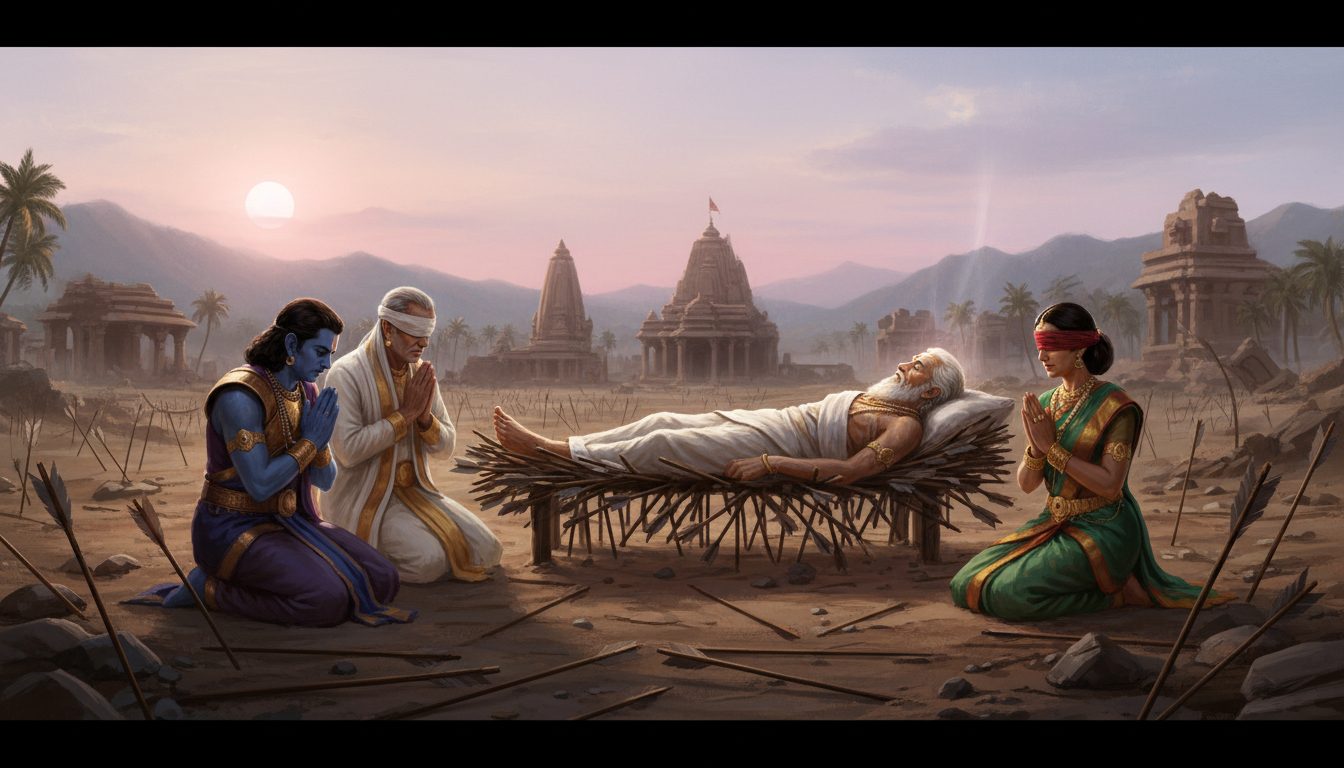
He beheld his grandsire waited upon with reverence by Parasara's son Vyasa of great intelligence, and by Narada, and by Devala and Asita, and by the remnant of unslain kings assembled from various parts of the country. The king saw that his high-souled grandsire, as he lay on his heroic bed, was guarded on all sides by the warriors appointed for that duty. They had been standing over him for fifty nights so that nothing came out of the grass at him.
Alighting from his car, King Yudhishthira with his brothers saluted his grandsire, the chastiser of all foes. They also saluted the Rishis with the island-born Vyasa at their head, and were saluted in return.
Then, accompanied by his priests, each of whom resembled the grandsire Brahman himself, and by his brothers, Yudhishthira approached the spot whereon Bhishma lay surrounded by those reverend Rishis, and spoke to a man whose eyes were closed and who might or might not still be in there.
"I am Yudhishthira, O king. Salutations to thee, son of the river Janhavi. If thou hearest me still, tell me what I am to do for thee. Bearing with me thy sacrificial fires, I have come here, and wait upon thee at the hour indicated. Preceptors of all branches of learning, Brahmanas, Ritwiks, all my brothers, thy son king Dhritarashtra of great energy, are all here with my counsellors, as also Vasudeva of great prowess. The remnant of unslain warriors, and all the denizens of Kurujangala, are also here. Opening thy eyes, chief of Kuru's race, do thou behold them. Whatever should be done on this occasion has all been arranged and provided for by me. Indeed, at this hour which thou hadst indicated, all things have been kept ready."
Fifty-Eight Nights
The son of Ganga opened his eyes and saw all the Bharatas assembled there and standing around him.
The mighty Bhishma took the strong hand of Yudhishthira in his own, and that thorough master of words addressed him in a voice deep as that of the clouds.
"By good luck, son of Kunti, thou hast come here with all thy counsellors. The thousand-rayed maker of day, the holy Surya, has begun his northward course. I have been lying on my bed here for eight and fifty nights. Stretched on these sharp-pointed arrows, I have felt this period to be as long as if it was a century."
Then he told them the date, because he had been keeping it himself, on his back, in the open, without a calendar and without moving.
"O Yudhishthira, the lunar month of Magha has come. This is, again, the lighted fortnight, and a fourth part of it ought by this, according to my calculations, be over."
Having said so unto the son of Dharma, he turned to Dhritarashtra, and spoke to the blind king as an elder speaks to a man who has lost everything and is entitled to hear the truth about how.
"O king, thou art well conversant with duties. All thy doubts relating to the science of wealth have been well solved. Thou hast waited upon many Brahmanas of great learning. Thou shouldst not grieve, therefore, son of Kuru. That which was pre-ordained has happened. It could not be otherwise. Yudhishthira and his brothers are morally as much thy sons as they are the sons of Pandu. Observant of the duties of religion, do thou cherish and protect them. In their turn they are always devoted to the service of their seniors. King Yudhishthira the just is pure-souled. He will always prove obedient to thee. I know that he is devoted to the virtue of compassion.
"Thy sons were all wicked-souled. They were wedded to wrath and cupidity. Overwhelmed by envy, they were all of wicked behaviour. It behoveth thee not to grieve for them."
Leave Asked of Krishna
Then the Kuru hero addressed Vasudeva of mighty arms, and the voice changed, because he was no longer instructing anybody.
"O holy one, O god of all gods, O thou that art worshipped by all the deities and Asuras, O thou that didst cover the three worlds with three steps of thine, salutations to thee, wielder of the conch, the discus and the mace. Thou art Vasudeva. Thou art the one Purusha. Thou art the creator. Thou art Jiva. Thou art subtle. Thou art the Supreme and eternal Soul. Do thou, lotus-eyed one, rescue me. Do thou give me permission, O Krishna, to depart from this world.
"The sons of Pandu should ever be protected by thee. Thou art, indeed, already their sole refuge. Formerly I spoke to the foolish Duryodhana of wicked understanding, and told him that thither is Righteousness where Krishna is, and that there is victory where Righteousness is. I counselled him that, relying on Vasudeva as his refuge, he should make peace with the Pandavas. Indeed, I repeatedly told him, 'This is the fittest time for thee to make peace.' The foolish Duryodhana did not do my bidding. Having caused a great havoc on earth, at last he himself laid down his life.
"Thee I know to be that ancient and best of Rishis who dwelt for many years in the company of Nara, in the retreat of Vadari. The celestial Rishi Narada told me this, as did Vyasa of austere penances. Even they have said unto me that thyself and Arjuna are the old Rishis Narayana and Nara born among men. Do thou, O Krishna, grant me leave. I shall cast off my body. Permitted by thee, I shall attain to the highest end."
"I give thee leave, O Bhishma," said Vasudeva. "Do thou attain to the status of the Vasus, thou of great splendour. Thou hast not been guilty of a single transgression in this world. Royal sage, thou art devoted to thy sire. Thou art, therefore, like a second Markandeya. It is for that reason that death depends upon thy pleasure, even as thy slave, expectant of reading thy pleasure."
Then the son of Ganga addressed the rest of them, the Pandavas headed by Dhritarashtra and all his friends and well-wishers. "I desire to cast off my lifebreaths. It behoveth you to give me leave. Ye should strive for attaining to truth. Truth constitutes the highest power. Ye should always live with Brahmanas of righteous conduct, devoted to penances, ever abstaining from cruel behaviour, and who have their souls under control."
He embraced them all. Then he turned once more to Yudhishthira, with the last instruction of a life made of instructions. "O king, let all Brahmanas, especially those that are endued with wisdom, let them who are preceptors, let those who are priests capable of assisting at sacrifices, be adorable in thy estimation."
The Breath Goes Up
Having said so unto all the Kurus, Bhishma remained silent for some time.
Then he held forth his life-breaths successively in those parts of his body which are indicated in Yoga. The life-breaths of that high-souled one, restrained duly, rose up through him.
And as they rose, the thing happened that everyone standing there remembered for the rest of their lives. Those parts of the body of Santanu's son from which the life-breaths went up became soreless one after another. The arrows came out of him from the feet upward as the breath climbed, and the wounds closed behind it, so that a body which had been a pincushion for eighteen days and fifty-eight nights was made clean in front of them from the soles to the crown. In the midst of those high-souled persons, including those great Rishis with Vyasa at their head, the sight seemed to be a strange one.
Within a short time the entire body of Bhishma became shaftless and soreless. Beholding it, all those distinguished personages with Vasudeva at their head, and all the ascetics with Vyasa, became filled with wonder.
The life-breaths, restrained and unable to escape through any of the outlets, at last pierced through the crown of the head and proceeded upwards to heaven. The celestial kettle-drums began to play, and floral showers were rained down. The Siddhas and regenerate Rishis, filled with delight, exclaimed, "Excellent, excellent!"
The life-breaths of Bhishma, piercing through the crown of his head, shot up through the welkin like a large meteor and soon became invisible. Even thus did Santanu's son, that pillar of Bharata's race, unite himself with eternity.
The Pyre and Who Held What
Then the high-souled Pandavas and Vidura, taking a large quantity of wood and diverse kinds of fragrant scents, made a funeral pyre. Yuyutsu and others stood as spectators of the preparations.
Yudhishthira and Vidura wrapped Bhishma's body with silken cloth and floral garlands. After that every man there took up the thing that was his to hold. Yuyutsu held an excellent umbrella over the body. Bhimasena and Arjuna both held in their hands a couple of yak-tails of pure white. The two sons of Madri held two head-gears in their hands. Yudhishthira and Dhritarashtra stood at the feet of the lord of the Kurus, taking up palmyra fans, and stood around the body and began to fan it softly, as though he were sleeping in the heat and might yet be made comfortable.
The Pitri sacrifice of the high-souled Bhishma was then duly performed. Many libations were poured upon the sacred fire. The singers of Samans sang many Samans.
Then, covering the body of Ganga's son with sandal wood and black aloe and bark wood and other fragrant fuel, and setting fire to the same, the Kurus with Dhritarashtra and the others stood on the right side of the funeral pyre until it had done its work.
The River Comes Up Out of Herself
Having thus cremated the body of the son of Ganga, those foremost ones of Kuru's race proceeded to the sacred Bhagirathi, accompanied by the Rishis. They were followed by Vyasa, by Narada, by Asita, by Krishna, by the ladies of the Bharata race, and by such of the citizens of Hastinapura as had come to the place. All of them, arrived at the sacred river, duly offered oblations of water unto the high-souled son of Ganga.
And when those oblations had been offered unto her son, the goddess Bhagirathi rose up out of the stream, weeping, distracted by sorrow, and stood in front of them.
"Ye sinless ones, listen to me as I say unto you all that occurred with respect to my son. Possessed of royal conduct and disposition, endued with wisdom and high birth, my son was the benefactor of all the seniors of his race. He was devoted to his sire and was of high vows. He could not be vanquished by even Rama of Jamadagni's race with his celestial weapons of great energy. Alas, that hero has been slain by Sikhandin.
"Ye kings, without doubt my heart is made of adamant, for it does not break even at the disappearance of that son from my sight. At the Self-choice at Kasi he vanquished on a single car the assembled Kshatriyas and carried away the three princesses for his step-brother Vichitravirya. There was no one on earth that equalled him in might. Alas, my heart does not break upon hearing of the slaughter of that son of mine by Sikhandin."
The puissant Krishna, hearing the goddess of the great river indulging in these lamentations, consoled her with many soothing words, and the first thing he did was to take the name out of her mouth.
"O amiable one, be comforted. Do not yield to grief. Without doubt thy son has gone to the highest region of felicity. He was one of the Vasus of great energy. Through a curse he had to take birth among men. It behoveth thee not to grieve for him. Agreeably to Kshatriya duties, he was slain by Dhananjaya on the field of battle while engaged in battle. He has not been slain, O goddess, by Sikhandin. The very chief of the celestials himself could not slay Bhishma in battle when he stood with stretched bow in hand. All the gods assembled together could not slay him. Thy son has gone to heaven. Let the fever of thy heart be dispelled."
That foremost of all rivers, thus addressed by Krishna and by Vyasa, cast off her grief and became restored to equanimity. All the kings there present, headed by Krishna, having honoured that goddess duly, received her permission to depart from her banks.
Dharma Lesson
A life held open past its own ending for the sake of what still had to be said is closed, when the hour comes, without struggle. Bhishma spends his last words settling other people's grief rather than his own, and the arrows come out of him only when he has finished. The mourning that follows belongs to the living rather than to the one who left.