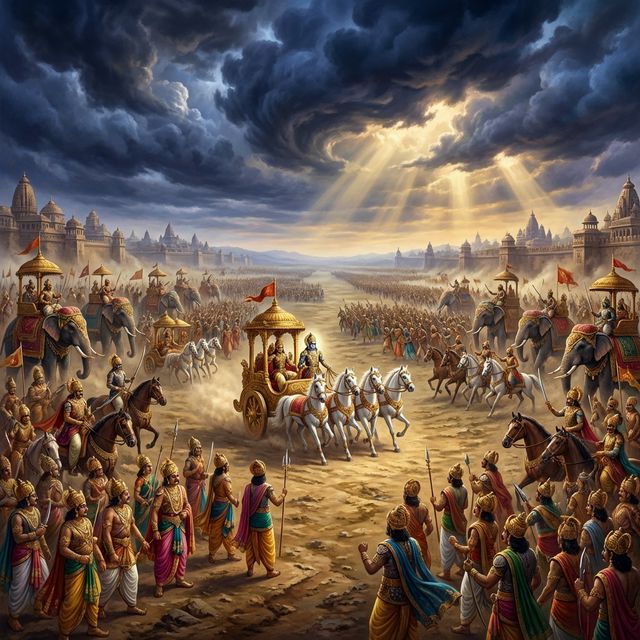
The Last Order of the War
The lament had spent itself. The women who walked out to find their husbands and their sons had found them, and their crying had gone on through a day and a night until it wore down into something quieter than sound; and in that quiet Yudhishthira understood that the war had one last order left for him to give.
He stood at the northern edge of the field with Vidura at his shoulder and his blind uncle beside him. What lay before them was no longer a battlefield. It was a city thrown down from a height. Chariot boxes lay overturned with their poles snapped off, elephants lay like fallen hills, and between them, past counting, lay men. Kings lay there whose names the bards had sung since these mourners were children. Beside them lay drivers and spearmen and the boys who had carried water, and no one living knew what most of those had been called.
"Vidura," Yudhishthira said, "how many are there?"
"More than can be numbered, king. The heralds have tried three times. They stop and begin again."
Yudhishthira was quiet a long while. "Then we will not number them," he said. "Hear my order and carry it to every quarter of the field. Every man lying here is to be burned with the rites due a king. Sandalwood for all of them. Ghee for all of them. Perfume and cloth and garlands for all of them. Where a man has a name, let his name be spoken over his fire. Where no name can be found, let the fire be lit anyway, and let the words be said over him as though he were Drona or Duryodhana."
Dhritarashtra turned his face toward the voice. "You would empty the treasury of Hastinapura on foot soldiers."
"I would spend it on the dead," Yudhishthira said. "They did not come here for their own quarrel. Ours burned them. The least we can do is buy the wood."
Vidura Counts the Wood
The order was easy to speak and immense to obey, and it fell to Vidura, who had spent a lifetime doing the difficult work that other men announced.
He began with an inventory, because he did not believe in a grief that skipped arithmetic. Sandalwood from the storehouses of Hastinapura, and when that ran out, from the merchants of every town within four days' travel, bought at whatever price they asked and paid without argument. Ghee by the jar, then by the cartload. Aguru and the other fragrant resins. Cloth, and when the weavers had no cloth left, the war banners of both armies, taken down from their poles and cut into shrouds.
Then he looked at the field itself and saw that it was full of fuel.
"Break the chariots," he told the work parties. "All of them, ours and theirs. Poles, axles, wheels, yokes. Split the spear shafts, and the bows, and every arrow shaft still whole. The dead will burn on what they fought from."
Men objected that some of those chariots were famous, that this wheel had been Bhurishravas's and that yoke had carried Susharma into the eleventh day. Vidura answered that a famous chariot with nobody left to drive it was firewood with a story attached, and that the story would keep.
He divided the plain into sectors and set a priest and a scribe over each, so that wherever a name could be learned it was written down before the fire took the body. He set servants to washing the faces of men they had never met. He laid the pyres in long ranks with lanes between them wide enough for bearers to pass, and in each rank a king and his charioteer lay side by side, because there was neither time nor reason left to sort them.
By the third evening the ranks of unlit pyres ran further than a man could see. Vidura, who had not slept since the order was given, went to tell the king that the field was ready.
One Fire
They lit them at dusk, beginning at the eastern edge, and the fire moved west across Kurukshetra all night like a slow tide.
The priests went along the lanes pouring ghee and chanting, their voices hoarse by the second hour and gone by the fourth, so that men who had learned the words by ear took up the lines after them. The bards walked behind the priests, singing the deeds of whoever lay on each pyre, and where no deed was known they sang the oldest verses, the ones that belong to any man. Conches sounded, then stopped. Nobody had the breath.
By midnight the separate fires were no longer separate. They had joined at the edges and run together down the lanes until the whole plain was one fire, a single sheet of light lying on the earth where two armies had stood, and the smoke went up and flattened under the night air and hung there, smelling of sandalwood and ghee and everything sandalwood and ghee had been brought to cover.
Dhritarashtra stood at the edge of it with his hand on Vidura's arm. "Describe it to me," he said.
Vidura did not answer at once. "It is the brightest thing I have ever seen," he said. "It is bright as a festival. If a man came over the hills tonight not knowing what had happened here, he would think a great and joyful sacrifice was being celebrated on this plain, and he would hurry to arrive before the end of it."
"And it is a sacrifice," the old king said. "I made it. I fed it for eighteen days."
Nobody contradicted him. The fire burned down through the night, and at first light, when the ranks had gone gray and the ground was too hot to walk on, Yudhishthira gave the second order: that every family on the field should rise and go to the river.
The Water and the Name
They went to the Ganga in a single broken column, and no one riding.
Kings walked with the wives of men who had driven their chariots. The Pandavas walked without ornament. Dhritarashtra was led. Behind them came thousands who had lost sons, and they came down the bank into the shallows and stood there in the cold water with their clothes on, the way the rite requires, having put off their jewels and untied their hair on the sand above.
Then the water offerings began, and they went on for a very long time, because every offering carries a name. A man would fill his cupped hands, and speak the name, and let the water fall, and stand a moment, and fill his hands again for the next name, and there were households that stood in the river until their legs shook. Bhima offered for cousins he had killed. Yudhishthira offered for Drona, who had taught him, and for Bhishma, and for Shalya, and for Dhrishtadyumna and the sons of Draupadi, and the priests behind him kept count.
Kunti had been standing apart in the water, further out than the others. She had let the first of it fall on the field among the women, and now she came forward and said the whole of it to her sons.
"There is one more," she said. "Offer water for Karna."
Yudhishthira turned. "Karna. Mother, why would I offer for Karna?"
"Because he was my son," Kunti said. "He was born before any of you, in my girlhood, of Surya, and I put him in a basket on a river not unlike this one and let the water take him. He was your eldest brother. He knew it before the war and would not leave Duryodhana. Offer water for him as kin, because he was kin, and no one on this earth ever gave him that name while he could hear it."
The Curse on Secrets
Yudhishthira did not speak. He stood in the Ganga with his hands still wet and looked at his mother, and those near him said afterward that they watched him become an old man in the time it took her to finish.
He was remembering feet. On a night before the fighting began he had gone to the enemy camp to ask leave of his elders, and he had noticed then, without knowing why it caught him, that the charioteer's son had feet shaped exactly like his mother's, and he had let the thought go.
Then the cry came out of him, and it carried down the bank over the heads of thousands of mourners.
"He was my brother. I sent Arjuna against my own eldest brother. The man I hated for thirteen years, the man whose voice in the assembly I could not forgive, was the first-born of this house, and I killed him for a kingdom I did not want. Mother, if you had said one word, one word before the armies moved, there would have been no war. Duryodhana would have had no champion, and I would have had a brother, and this river would not be full of us."
He struck the water with his open hand.
"Hear me, then, all of you. For this secret, and for the sons it has burned, I lay this on womankind from today: that no woman shall ever again be able to keep a secret. Let nothing hidden stay hidden in them. Let this be the last house destroyed this way."
Kunti bore it standing, and did not defend herself.
Then, because he was the king and the rite was not finished, Yudhishthira filled his hands again and offered water for Karna as his elder brother, speaking the name aloud with the priests behind him repeating it, and ordered that Karna's widows be brought and his surviving son honored as a prince of the house. Rite by rite, all that morning, grief was folded back into order.
Dharma Lesson
A king's last duty to a war he won is to pay for it, and Yudhishthira pays by refusing to rank the dead: the nameless spearman burns on sandalwood bought at a king's price. Rites are not decoration on grief but the machinery that makes grief bearable, converting an unspeakable field into named men who can be released one at a time. And a truth withheld to spare shame does not stay small; Kunti's silence cost more lives than any weapon on that plain.