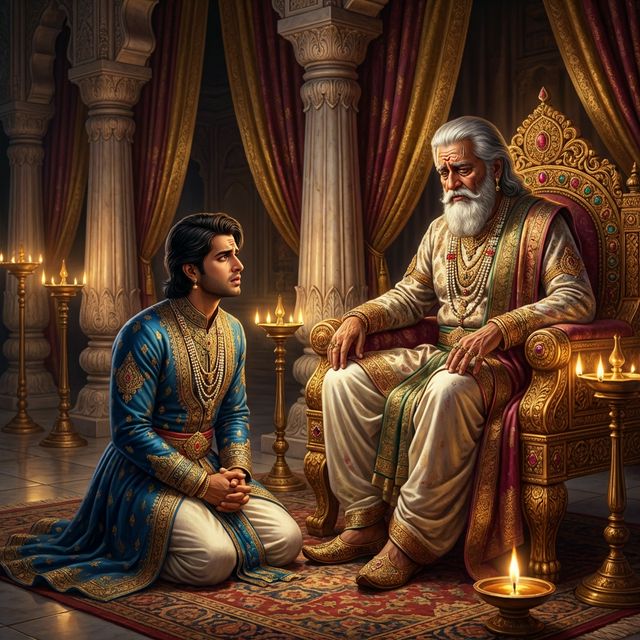
The King of Grief
The rites were finished. The dead of both armies had been given to the fire in heaps, and the whole surviving world had gone down to the Ganga and stood in the water to their waists and offered the handfuls to their fathers, their sons and their husbands. Then they came back up to Hastinapura, wet and silent, and the city waited to be given a king.
Yudhishthira sat on the floor of the hall with his hands open on his knees and refused it.
"Take it," he said. "Any of you. I have counted what it cost. Eighteen armies. My teacher. My grandfather. Abhimanyu. My own sons, all five of them, killed in their sleep by a man who had eaten at our table. And Karna, who was my brother, and I did not know it while I was hating him. This is not a victory that anyone can sit on. It is a heap of ash with a crown balanced on top. I shall go out of this city and eat nothing and let the ash finish what it began."
Bhima came off the wall like a bull turning in a narrow lane. "Say that again in the hearing of the men who died to put you there. You want to be a holy man now? Now, when the killing is over and the accounts are due? Your renunciation is very cheap, brother. You bought it with everyone else's life."
"Poverty is not dharma," said Arjuna, more quietly. "A kingdom in the hands of a man who does not want it is a kingdom in the hands of whoever wants it next."
And Draupadi, who had not sat down since the rites began, said only: "I asked one question in that hall, years ago, and it has not been answered yet. I did not think the answer would be that the throne stands empty."
They argued with him all that day and half of the next. They were right and they knew it and it made no difference at all, because grief does not lose arguments; it simply outlasts them. Krishna sat through it without a word, and once or twice looked toward the door as a man does who is expecting someone.
On the second evening the doorkeeper said that the island-born Vyasa was at the gate, and the sage Narada with him.
The Old Medicine
They came in together, the grandfather of the whole line and the wanderer who is at home in every world, and they sat down before the king who would not be king.
"Say your grief," said Narada. "Say it whole. It is worse when it is carried folded."
"I have won the earth," said Yudhishthira, "and lost every reason a man could have for wanting it. Every face I would have shown it to is gone. What is the use of talking to me of duty? I am not refusing the throne out of pride. I am refusing it because I cannot see it. There is too much smoke."
"Good," said Narada. "Now I shall give you the medicine that has been given to kings for this sickness since before your line began, and it is not comfort. It is a list. Sit up and listen to the sixteen.
"Marutta first. His sacrifice was such that the vessels were of gold and the ladles were of gold and the very stakes were gold, and the gods came down and sat in rows to eat, and Indra himself was a guest at the table of a mortal and drank beside him. No man before or since gave away so much in one day. He died, Yudhishthira.
"Suhotra, who ruled the whole earth to the sea. In his reign the sky rained gold upon his kingdom, gold in the fields and gold in the streets and gold caught in the branches, until the people were sick of picking it up; and he took none of it, but gave it all away to the brahmins in one great sacrifice. He died.
"Brihadratha, lord of the Angas, who performed a hundred horse sacrifices and gave a mountain of jewels for each; whose armies could not be counted. He died.
"Shibi, who put his own flesh on the scale to ransom a dove that had come to him for shelter, and would have given his whole body sooner than break the refuge he had granted. He died.
"Bharata, son of Dushyanta, who tamed the world from sea to sea and bound the wild kings to the wheel of his law, and left his name upon this whole land, so that you and I and every man in this hall are called by it. He died.
"Are you counting?"
Greater Than You in Every Measure
"Rama, son of Dasharatha," said Narada. "In his reign no father lit the fire for a son. Nobody was widowed young, nobody drowned, no plague came, no season failed, and old men made their offerings and lay down at the proper hour. He kept his father's word at the cost of fourteen years and a kingdom. He died.
"Bhagiratha, who stood on one foot through years without number until the river of heaven consented to come down, and went before her all the way to the sea to give water to the ashes of his fathers. He turned the sky itself into a river for the sake of the dead. He died.
"Dilipa, at whose sacrifices the stakes stood so thick that a man could not walk among them, whose gifts were counted in villages and not in coins, and who was so beloved by the gods that they came to his fire without invitation. He died.
"Mandhata, who was born out of his own father's side and suckled at the finger of Indra; who conquered the whole earth in a single day, from the rising of the sun to its setting, so that the four quarters had no time to make an alliance against him. He died.
"Yayati, who gave away his old age and took back his youth and enjoyed the worlds for a thousand years, and then rose into heaven itself, and stayed there until he had worn heaven out and was sent down again. Even heaven did not keep him. He died.
"Ambarisha, in whose service ten thousand kings walked as his household men; who was so beloved of his people that they went to war for him unpaid; whose righteousness was such that his enemies asked for him as arbitrator. He died.
"Are you still counting, Yudhishthira? Look at the size of them. Each of these gave more in one morning than your whole treasury holds. Each was more loved, and better born, and more just, and more victorious than you are. They are not comparisons meant to shame you. They are weights, and I am hanging them one after another on the rope of your grief to see whether it will hold."
The Bell That Keeps Ringing
"Shashabindu," said Narada, and his voice had settled into the flat calm of a man reading out a debt. "His wives were ten thousand, and each bore him a thousand sons, and every one of them was a bowman and a king; and he gave away the whole of that host, with all their horses and their wealth, in a single horse sacrifice. He died.
"Gaya, whose sacrifice lasted a hundred years, who fed the world at it and himself ate only what was left when the last beggar had gone from the gate. He died.
"Rantideva, in whose kitchens the fires were never allowed to go cold; who fed every creature that came, and gave away his own last mouthful and his own last cup of water at the end of forty-eight days without food. He died.
"Sagara, lord of the ocean that carries his name, who had sixty thousand sons and sent them out to dig up the world for the sake of one horse, and lost every one of them in a single instant to a glance from a sage. Sixty thousand sons, Yudhishthira. You lost five, and you are lying on the floor. He got up. And then he died.
"And Prithu last, the first true king, for whom the earth herself fled in the shape of a cow until he took up his bow and made her stand; and she yielded to him, and he milked out of her the grain and the herbs that all men live on to this day, and gave the earth her name. He died also.
"Sixteen," said Narada. "Bards recite them at every royal death, and the reciting has one purpose. Each of those men was greater than the man before him, and greater than you, and richer, and holier, and more necessary to the world; and there is no place on the earth where you can go and find any one of them. The fire took them, and their sons, and the sons of their sons. Well then. If death could take these, what is your grief, Yudhishthira? What is it, exactly? Name the thing that has happened to you which has not happened to every man who ever wore this crown."
Nobody in the hall spoke. Vyasa, who had said nothing, watched his grandson's face the way a physician watches a wound.
Not Consoled, Instructed
"Now hear the turn," said Vyasa, and the whole hall moved to listen, "for the list is only the road up to it.
"Your grief is not a debt you are paying to the dead. It is a comfort you are paying to yourself. Look closely and see what is in it: that you should have been able to prevent this; that the world's arrangements ought to have been submitted to you first; that a man of your goodness should not have had to live in a world like the one that actually exists. That is not love, child. That is vanity wearing mourning.
"The dead are not in your hall. They have gone where their acts have taken them, and they are being dealt with justly by hands better than yours, and there is not one thing you can add to them by starving. Your fasting feeds nobody. Meanwhile there are men outside this door tonight who are alive, and hungry, and frightened, and they belong to you. Their fields are trampled and their fathers are ash and the roads are full of masterless soldiers. They have no time to wait for you to feel better.
"The dead have their worlds. The living have their duties. Get up."
Yudhishthira sat for a long while. Then he put his hands on the floor and rose, and it was not the rising of a man who has been consoled. His face had not changed. He had merely been told a true thing and had accepted it, which is a colder and more durable business than comfort.
"I am not comforted," he said.
"No," said Vyasa. "You have been instructed. That is what you asked for, though you did not know it."
"Then let it be done tomorrow," said Yudhishthira, "and let it be done properly. Krishna, you will stand beside me. I do not want this throne. I have not wanted it since the dice fell. But I understand at last that whether I want it is the least important fact in this city."
Krishna smiled for the first time in many days, and said, "That is the only sentence a king ever needs to learn."
And in the morning they anointed him, and the drums went out over Hastinapura, and the people, who had buried everyone, came into the streets to see whether they had a protector again.
Dharma Lesson
Grief for the dead is often the vanity of the living: a private insistence that the world should have arranged itself around one's own goodness. The sixteen great kings gave more, ruled better and were more beloved than any mourner, and death took them all the same. The dead have gone to the worlds their acts earned them; the living are owed protection now, and that debt does not wait for a king to feel better.