Ash on the Water
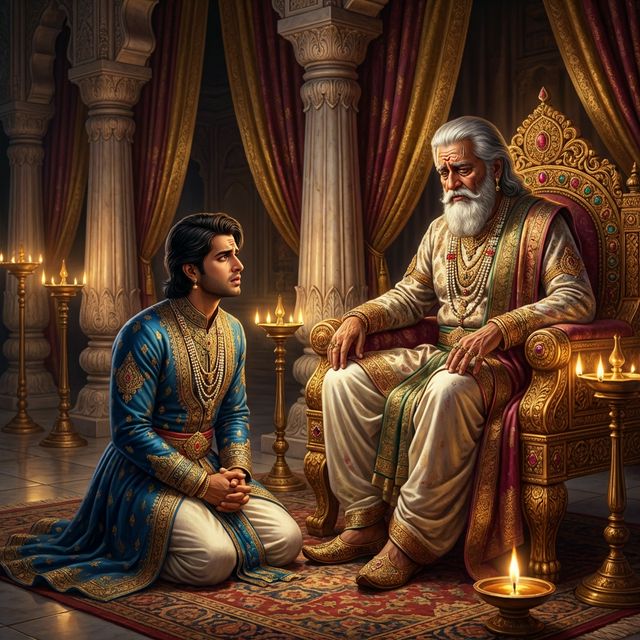
The bed of arrows had held Bhishma through the last light of the great slaughter, and now, in the slow days after, it held him still, an old man pinned upon iron and unable to rise, while the field of Kurukshetra dried its wounds around him. Yudhishthira came to him again, as he had come each day since the killing ended, but this time his hands still carried the smell of the river.
He had gone that morning to the Ganga and stood in the water to his waist, and had done what a king does for soldiers he cannot name one by one - he had offered tarpana, the water rite, to the vast unnumbered dead. Cousins, teachers, men who had eaten at his table and men who had never known his name, all had drunk from his cupped hands that morning, or so the rite claimed. Now he came to the one dying man on the field who could tell him whether the claim was true.
"Grandfather," Yudhishthira said, kneeling where the arrows let him kneel, "I gave water to the dead this morning, and rice will follow at the proper day, and I do not understand what I did. What can water do for a man who has no throat to drink it? Why do the dead need anything from the living, when they have gone wherever the dead go?"
Bhishma's eyes, sunk deep with pain and sleeplessness, found something like warmth. "You ask the oldest question the mourning ever asked, king. It has an answer, though the answer is older than either of us, and it begins the way most true things begin - with a father who could not stop grieving his son."
Nimi's Grief
"There was a sage named Nimi," Bhishma said, "who ruled his hermitage as carefully as any king rules a kingdom, and who had one son, and lost him. You have buried brothers and sons of your house in these last days, Yudhishthira, so you will not need me to describe what that grief does to a man. It does not end. It only changes what it asks of him."
"Nimi could not accept that the bond between father and son simply stopped at the funeral fire. He sat with his grief the way a smith sits with iron, turning it, testing it, until it gave him something he could use. What he arrived at was this: that if love had fed a son through twenty years of living, love need not stop feeding him merely because the body was ash. He took rice, worked it into balls with his own hands, and set it out with water and sesame, and spoke his son's name over it, offering it the way he would once have offered a meal to a guest arrived at dusk."
"It is said the fathers themselves - the pitrs, the vast assembly of the dead who had gone before - felt something reach them that had not reached them before. Not food, understand. The dead do not hunger for rice. What reached them was that they had not been forgotten, that a living hand still turned toward them, that the line had not simply closed over their absence like water over a stone. They tasted remembrance, and finding it sweet, they are said to have ordained the rite themselves, so that no house afterward would need to invent it alone in its grief as Nimi had."
"That is why we call it shraddha, Yudhishthira. Not because of what is offered, but because of what the offering means."
The Name of the Rite
"Shraddha," Bhishma said, "is named from shraddha - faith, trust, the turning of the heart toward what it cannot see and believing it still matters. That is the whole of the rite hidden inside its own name. A man who performs it without that turning has performed a motion, not a shraddha at all, whatever priests he has paid and whatever words he has had chanted over the fire."
"The mechanics you will learn from your priests, and I will not weary you with all of them from this bed. But I will tell you what they carry, since you asked what water and rice can do for the dead. The rite is set most properly in the dark fortnight, when the moon empties itself from the sky, because the pitrs are said to walk nearer the living in those nights than in any other, hungry not for food but for attention, as we are all hungriest for attention in the seasons when we feel most forgotten."
"The rice is shaped into pinda, small balls, and three are set out by name - not one and not a hundred, but three, for the father, the grandfather, and the great-grandfather, the three generations still near enough to memory to be called by name in the family's mouth. Beyond them the dead recede into a single unnamed multitude, the way your own grief this week has had to recede from calling out one fallen kinsman by name and calling out another by name, and has had to become, at some point, simply a grief for the war dead, unable to hold every name at once."
"Each portion is memory made into gesture. The great-grandfather receives what the grandfather received before him, and the grandfather rises, in the reckoning of the rite, to join the more distant dead, and a new name takes the innermost place. It is a wheel, Yudhishthira, turning the living toward the dead and the dead deeper into the peace of the forgotten-but-honored. No one falls out of it uncared for. That is the mechanism. The meaning is what I told you already - that trust which will not let love stop merely because breath has stopped."
The Guest at the Table
"There is a rule bound so tightly to the rite that the sages call it half of the shraddha itself," Bhishma said. "The dead will not eat while the living starve in sight of the feast. A guest, honestly received and fed at the meal that follows the offering, is not a courtesy added to the rite - he is the rite completing itself. Feed your ancestors and turn away a hungry man from your gate that same hour, and the tradition holds that the pitrs taste nothing at all. They will not accept an offering built on a witnessed cruelty."
"I have heard it said, and I believe it, that the fathers watch through the eyes of the guest as much as they receive through the food. A shraddha performed only for the dead and never for the living beside them is half a gesture wearing the clothes of a whole one."
"There are old, unkind tales the priests tell each other to frighten the careless - of kings who fed a hundred guests at their father's rite and were seen by no eye but their own scribes, who wanted the deed recorded before it was even certain it had been done with feeling; of a rich man who set out the finest rice and drove off his own poor cousin from the yard rather than seat him at the meal, and whose pitrs are said to have gone hungrier that year than if no rite had been held at all."
"The lesson in every one of them is the same lesson, worn into different shapes: a shraddha performed for the watching world, to be praised for its size, reaches no one. Faith cannot be counterfeited toward the dead, who have nothing left but the truth of what is meant toward them."
Karna's Portion
Yudhishthira was quiet a long moment, and Bhishma, watching him from the bed of arrows, saw where the silence was going before the king spoke it.
"Grandfather. I performed the rite these last days for a brother I did not know was my brother until he was already dead upon this field. I gave him water and I will give him rice, and I do not know if it is grief I am feeding or guilt, or whether the dead can tell the difference."
Bhishma's voice, when it came, had gone gentler than it had been through the whole telling. "Karna was fed nothing by this family in life, Yudhishthira. Not a seat at your table, not your mother's open hand, not the name that was his by blood and was kept from him by a fear none of you chose but all of you inherited. A rite of rice-balls performed after a battle cannot undo that. I will not tell you that it can."
"But I will tell you what the rite is for, in a case like his. It is the one door still open when every other door in a life has already closed behind a man. You cannot feed Karna at your table now. You can feed him at your fire. You cannot give him the seat beside his brothers he never had walking. You can give him the portion beside your father that is his by blood, spoken this time with his true name in your true voice, before the whole assembly of the pitrs who will hear it."
"That is what remembrance is, in the end - the one debt the living can still pay the dead, when every other debt has closed its books. Pay it to Karna with your whole shraddha, king, and let it be the truest one you perform in your reign, because it is the one that costs you the most to mean."
Dharma Lesson
Shraddha is not sustenance offered to the dead but faith enacted - remembrance is the one debt the living can still pay after every other debt has closed. A rite performed for praise reaches no one, living or dead; a rite performed alongside a fed guest and a true heart completes itself. Even a life denied its due in the world, like Karna's, can be given its true name and portion in death.