A Question About Birth
The bed of arrows had become, in these last weeks, less a deathbed than a second court, for the field around Bhishma still smelled of ash and the ministers of the new reign still came to him daily for judgments no one else living could give. The sun crossed him morning to evening like a slow clock counting down a debt not yet called due, and Kurukshetra dried its blood by inches beneath him.
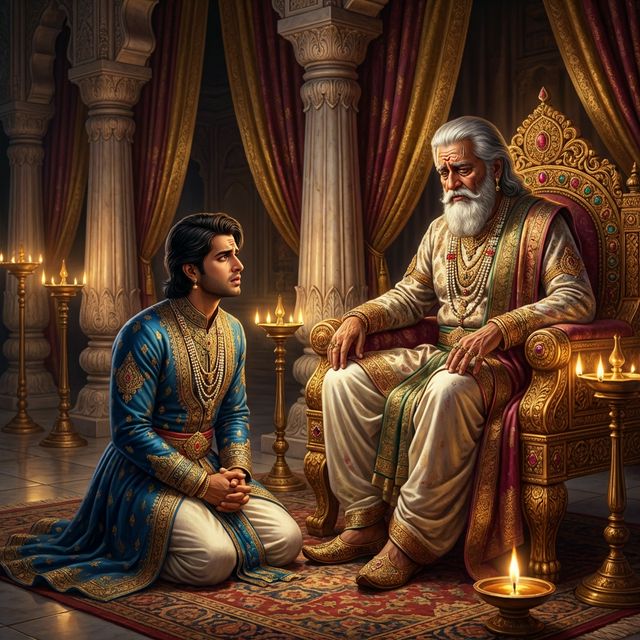
Yudhishthira came again on a morning when the camp behind him was arguing, as camps of the newly victorious always argue, about which men among the allies deserved which honors, and whose blood was too low for which seat. He had listened to the arguing longer than he wanted to and had come away troubled by something none of the arguers had said aloud.
"Grandfather," he said, "I am asked to seat men by their birth and I do not know, in my heart, whether birth is the true measure at all. If a man is born low and lives high - if he burns himself clean through discipline and worship and the hardest striving a life can hold - can he not simply become what his birth denied him? Can striving not unmake what birth has set?"
Bhishma was silent long enough that Yudhishthira thought the pain had taken him again. Then: "There is an old story, king, that answers you more honestly than any rule of mine could, and I warn you before I tell it that its honesty will not comfort you. It is the story of a man named Matanga, who asked your very question with his whole life, and received his answer from a god."
The Barber's Son
"Matanga was raised in a brahmin's house believing himself a brahmin's son, and lived the years of a brahmin's training - the Vedas learned by ear, the fire tended, the thread worn across his chest as a mark of a birth twice given, once by the body and once by the sacred rite. He was proud of it in the way young men are proud of things they have never had to question, which is to say completely."
"One day, driving out in his chariot, he struck the donkey that drew it, angry at some small stumble in the road. And the donkey - for the old tales allow beasts to speak the truths men will not speak to each other - turned its head and told him plainly that no true brahmin's hand would fall so cruelly, for brahmins are gentle by the very nature their birth confers, and that his hand betrayed a nature no thread could hide: he was no brahmin's son at all, but got upon his mother in secret by a barber of the town, a man of low and unclean caste."
"Matanga did not believe it, or would not, until he went to his mother and asked her to swear it was a lie. She could not swear it. She wept and admitted what she had never meant him to learn, that in a moment of youth and want she had gone to a barber's bed, and that the boy she had raised as a brahmin's son carried, by the reckoning the tradition holds most binding - the mother's line as much as the father's - no brahmin blood at all."
"The world he had lived in until that morning closed its doors on him before evening fell. The teachers who had taught him the Vedas would not receive him at the fire. The friends who had studied beside him would not eat from his hand. The thread stayed on his chest, but it had become, in a single day, a lie he wore in public."
The Fire He Chose
"A lesser man breaks under such a fall, Yudhishthira, or spends his life pretending it did not happen. Matanga did neither. He walked into the forest with a fury turned inward, and he made a vow that the sages who tell this story still repeat with something like dread: he would burn his way into the brahminhood the world had refused him. Not earn it by favor, not beg it by service - burn for it, in tapas so total it would force the three worlds to notice."
"He stood on one foot for years at a time until the foot forgot the ground. He fed on air and smoke and the little rain that reached his open mouth, until his body was less a body than a standing coal, banked and glowing and utterly still. Birds are said to have nested in his matted hair, taking him for a dead tree, and left again years later when the tree proved, after all, to be breathing."
"The heat of that austerity did not stay contained to the small clearing where he stood. It rose, the way great tapas always rises, until the seats of the gods themselves grew warm and uncomfortable, until Indra, lord of the thunderbolt, felt his own throne begin to shake with the force of one broken man's want. No king, however powerful, can long ignore a fire built with that much patience behind it, and Indra came down from heaven to see for himself what mortal was burning hard enough to trouble a god's sleep."
Every Boon But One
"Indra found a man scarcely recognizable as flesh, and, moved by the force of the austerity if not yet by its cause, offered what gods offer when they wish to end a tapas cheaply - a boon, freely given, before the asking could grow more dangerous still. Matanga did not hesitate. He asked to be made a brahmin."
"Indra refused, gently at first, the way one refuses a request one hopes will simply be forgotten. He offered kingship instead - vast lands, a throne, subjects beyond counting. Matanga refused it and held his tapas. Indra offered wealth without measure, granaries that would never empty. Refused. He offered long life, centuries beyond the span of ordinary men. Refused. He offered sons, an unbroken line to carry the name Matanga forward through ages. Refused. At last he offered heaven itself, a seat among the immortals earned outright by austerity alone, no birth required to enter that particular hall. Matanga refused even that, and asked again, each time, for the one thing: to be made a brahmin."
"It was here that Indra gave the answer the story is truly told to deliver, and gave it, the old telling insists, with something closer to sorrow than to refusal's usual coldness. 'What you ask, Matanga, is the one boon no tapas can purchase, in this life or in ten thousand like it. A river does not become a mountain by wanting hard enough, however long or however honestly it wants. Birth sets a channel, and the fiercest striving of a single lifetime does not cut a new one. Your fire has purified you until there is scarcely a fleck of the old anger left in you - I see that, and I do not dismiss it. But it has not, and it will not, unmake the womb you were born from. That gate does not open for austerity. It has never opened for austerity, for any man, in any age.'"
The God Who Is Sung, Not Seated
Matanga's fire did not go out at the refusal, though the old tellings say something in him went very quiet. He would not be bought off with the kingdoms or the centuries or the sons Indra had already offered and he had already refused, and for a long while he asked for nothing at all, simply standing in the ash of his own effort while the god waited.
What he finally accepted, when Indra pressed him to accept something rather than let so vast a tapas dissolve into bitterness, was a strange and particular honor: he was made a chhandodeva, a spirit of the sacred meters themselves, so that his name would be spoken and sung wherever the Vedic chandas were chanted, honored in every hymn's very shape though never seated among the twice-born at their sacrifice. He would be worshiped, in his way, by every reciter who ever opened his mouth to chant - and he would never be one of them.
"I will not soften this story for you, Yudhishthira, by pretending it ends kindly. Hold both of its truths at once, because the tradition holds both and will not let either go. The first truth is iron: birth is a gate that austerity in a single life does not open, and not even a god who admired Matanga without reservation would open it for him. The second truth is the sting the story cannot quite hide beneath the first - that Matanga's greatness was real, entire, undeniable even to Indra's own mouth, and the door stayed shut on it regardless. The epic does not tell you which truth should weigh more. It leaves that weighing to you."
"You will hear elsewhere, from the teaching that remembers the sage Bhrigu, that conduct makes the brahmin and not birth at all - and I will not pretend to you that the two teachings sit comfortably side by side, king, because they do not. Dharma has rooms in it the sages themselves still dispute. You are not given the office of settling which room is correct. You are given only the office of ruling in them - and where a room is disputed, rule it, always, with the extra gentleness owed to a question no one living has finished answering."
Dharma Lesson
Birth fixes rooms in the house of dharma that a single lifetime of austerity, however terrible, cannot unbuild - the tradition holds this even against Matanga's greatness. Yet the epic does not hide the story's sting: a good man's door stays shut and the reader is left to weigh the cost. Elsewhere the epic teaches through Bhrigu that conduct, not birth, makes the brahmin, and Bhishma admits the two teachings sit unresolved against each other, asking only that a king rule such disputed ground with extra gentleness.