The Man Who Would Not Be Satisfied
"You ask me how the world was made," said Bhishma from the bed of arrows, "and I will not answer you in my own voice. Two men settled that question between them before your grandfathers' grandfathers were thought of, and one of them asked better than any man has asked since. I will give you their words."
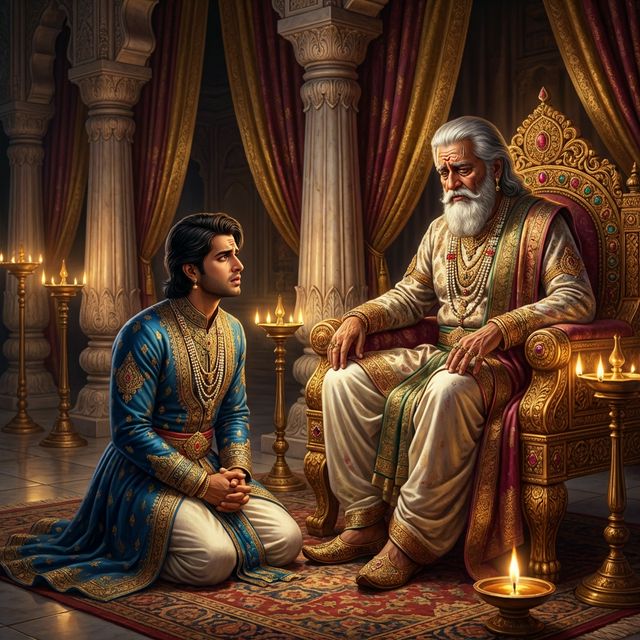
On the flank of the great mountain, in a place of cold streams and enormous silence, the sage Bhrigu kept a hermitage. He was of the first order of the born, a mind-son of the Grandsire, and he had been present, in the way that such beings are present, at events which had no witnesses.
To him came Bharadvaja, a great sage in his own right, who had the one quality that turns a great sage into a great student: he was not embarrassed to be ignorant, and he would not be put off by a beautiful answer.
He did not begin with courtesies.
"Bhrigu," he said, "this world. The earth under us and the sky over us and the space that holds them both. Who arranged it, and out of what, and by whose command does it hold together? The stars keep their roads. The seasons come round in their order. The rivers do not forget which way the sea lies. That is not accident, and I will not be told that it is a mystery, because a mystery is what men say when they wish the questioning to stop, and I do not wish it to stop."
Bhrigu looked at him for a while.
"Most men ask this once," he said, "and go away satisfied with the first sentence, because what they wanted was not the answer but the feeling of having asked. You will not go away."
"I will not."
"Then sit down," said Bhrigu, "and understand that I shall have to begin before there was anywhere to sit."
The Self-Born and the Ladder of Elements
"In the beginning," said Bhrigu, "there was neither day nor night, neither being nor not-being, neither above nor below. There was That: unmanifest, without beginning and without end, and it is called Manasa, the Mind-born, because no hand shaped it and no one thought it into place. It is the self-born. From it everything comes and into it everything returns, and it does not increase when the worlds are made or diminish when they are unmade."
"How did it begin to make?" said Bharadvaja.
"It did not begin as a smith begins. It became. First there arose from it a great light that had no source, and out of that light came space, which is the first of the elements and the largest. Space has one quality, and that quality is sound.
"From space, moving, came wind, and wind carries two qualities, sound and touch, for it kept the quality of what it came from and added its own. From wind, in friction, came fire, and fire carries three: sound, touch and form. Fire, cooled, produced water, and water carries four, with taste added. Water, thickened, produced earth, and earth carries all five, with smell, which is why earth alone can be smelled and space cannot.
"That is the ladder. Each rung keeps everything below it and adds one thing of its own. There is no sixth element, and nothing in the visible world is made of anything else."
Bharadvaja sat with this a while, and then he did what he always did, which was to take the answer and pull at the loosest thread in it.
"Space," he said. "You call it the largest. Then answer me this, and do not smile while you do it. If space has no end, where does it end? A thing without a boundary is a thing I cannot picture, and I do not think a man should assent to what he cannot picture."
"You may not be able to picture it," said Bhrigu, "and it is still so. The eye has an edge. Space has none. Where your seeing stops is not where the world stops, and to confuse the two is the oldest error there is."
The City of Five Elements
"Then tell me what a body is," said Bharadvaja, and he held up his own hand and turned it over. "Because if the world is made of five things, so is this, and I would like to hear it counted out."
"It is counted out easily," said Bhrigu. "Whatever in you is hard is earth: the bone, the tooth, the nail, the flesh, the hair. Whatever in you is wet is water: the blood, the fat, the marrow, the tears, the sweat. Whatever in you is hot is fire, and that fire sits in the belly and cooks what you have eaten, and it sits behind the eye and makes seeing possible, and while it burns you are called living, and on the day it goes out you are called dead. Whatever in you moves is wind, and the wind in a man runs five roads: the breath that rises, the breath that falls, the breath that spreads, the breath that gathers, the breath that keeps the whole frame level. And every hollow in you is space: the ear, the mouth, the throat, the chambers of the heart. Five, and no more."
"Then the body is a city," said Bharadvaja.
"The body is a city. It has nine gates. Its walls are rebuilt daily and worn down daily, and there is a fire in the middle of it that must be fed twice a day or the city goes dark."
"And who lives in the city?"
"That," said Bhrigu, "is the question you have been walking toward all afternoon, and I am glad you took the long road to it. The one who lives in the city is not made of the city. He is its resident, not its produce. The five elements assemble the house; they do not assemble the householder. Earth does not know. Water does not want. Fire does not remember its mother's face. Put the five together in any arrangement you please and you will have a body, and you will not have the one who says I."
"That is asserted," said Bharadvaja, "not shown."
"Then I will show it," said Bhrigu, "and I will do it with a log of wood."
The Log and the Fire
"Take a log," said Bhrigu, "and set it on the hearth and light it. The fire stands in the wood. It leans and flickers and takes whatever shape the wood permits; it is as long as the log is long and it thins where the log is thin. A man watching would say the fire belongs to the log, that it came out of the log, that it is a property of the log.
"Now let the log burn to the end. There is a handful of ash. Where is the fire?"
"Gone out," said Bharadvaja.
"Gone from that hearth. But tell me: was fire slain? Did the axe that split the log, or the burning that consumed it, kill fire itself? Fire was here before that tree was cut and it will be here after the ash has blown away. What ended was one lodging of it. Fire is not the log's child, though it lived in the log and wore its shape and could not be seen without it.
"So it is with the one in the body. He takes the shape the body permits. He is tall in a tall man and old in an old man, dull when the frame is fevered and quick when it is rested, and from this men conclude that he is the body's product and must finish with it. But when the fuel is done the fire does not die. It leaves. Consciousness is not slain when the body falls, any more than fire is slain when the log is ash.
"You cannot see it go. You never saw it come, either. You never saw it in the wood. You saw only the burning."
Bharadvaja was quiet a long time.
"You have not proved it," he said at last, and he said it without heat. "You have shown me that it need not be otherwise."
"That is honest," said Bhrigu, "and it is exactly as much as reasoning can do. The rest is not given to argument. But hear the size of what you have just conceded. If the resident is not the house, then the house is not the man. Not the tall body, not the fair body, not the strong body, not the highborn body. And that, Bharadvaja, brings us to the question you have been saving all day."
The World Was Brahmana First
"I have been saving it," Bharadvaja admitted. "Here it is. Men are divided into four orders, and we are told the division lies in the nature of things. But I have looked at men and I cannot find it. What is the difference between a brahmana and a kshatriya, a vaishya and a shudra? Cut them and they bleed the same. They are born the same way, they carry the same bile and phlegm and marrow, they hunger and sweat and grow old, the same fevers take them, and they are burned on the same wood. If the division is in nature, show me where nature keeps it."
"It is not there," said Bhrigu, "because it is not in nature. There is no difference of caste at all. This whole world was brahmana first, made so in the beginning, and it became divided by acts.
"Those who kept their calm and their study remained what they were and were called brahmanas. Those who took to anger and to force, to the pleasure of ruling and defending, grew red and were called kshatriyas. Those who turned to cattle and fields and trade and increase grew yellow and were called vaishyas. Those who fell to labour and to the serving of others, who took the work that was nearest and let the rest go, were called shudras.
"Colour there is temper, not skin. The orders came out of conduct, and conduct can change, and so the division is not a wall but a road, and men walk it in both directions. One born to the sacrifice who is greedy and cruel is a brahmana in name only. One of the last order whose conduct is pure and truthful and restrained has the thing itself, whatever his father did."
Bhishma let that sit in the winter air.
"There is the teaching, Yudhishthira, and your office will find it the hardest of all. Men will be brought before you and you will be told what each one is before he opens his mouth. You must learn to look past the body to the person inside it, as Bhrigu looked past the log to the fire, and to weigh a man by what he does and by what he refuses to do. A king who cannot manage that is not governing people. He is governing labels."
Dharma Lesson
The body is a city built of five elements, but the one who lives in it is a resident and not a product of the walls. As fire is not slain when the log burns to ash, awareness is not slain when the frame falls. From this follows the harder teaching: the world was one order first, and men became separate orders by their acts and tempers alone. Rank is earned by conduct, never conferred by birth, and a king must learn to see the person and not the label.