The Bed of Arrows
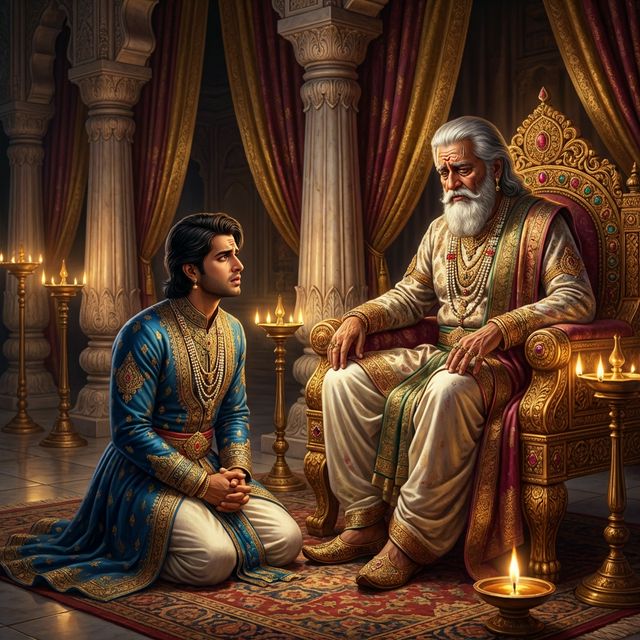
The camp at Kurukshetra had grown quieter as the days passed, the wounded tended or buried, the living settling into the strange stillness that follows a war too large to comprehend all at once. Smoke no longer rose from the horizon, and the plain itself seemed to be healing over, grass already pushing up green through the trampled earth. Bhishma still lay upon his bed of arrows, and Yudhishthira still came to him, each visit gathering another piece of the teaching he would need to carry a kingdom without a grandfather's voice beside him.
"Grandsire," Yudhishthira said, kneeling near enough to catch the old man's fading voice above the wind, "I wish to ask you about upavasa - fasting. The sages praise it as one of the great disciplines, yet I have watched men use it as a weapon, starving themselves loudly enough that their hunger becomes an accusation against everyone who has not joined them. Some even starve their own households to prove a piety that costs them nothing but another's meal. What is fasting truly for?"
Bhishma's mouth shaped something like a smile, faint as it was. "You have already seen the heart of the difficulty, king, in the very way you asked the question. Fasting is precious and fasting is abused, and the difference between the two has nothing to do with how long the stomach stays empty. Sit, and I will tell you what the tradition actually asks of a man who fasts, and what it never asked at all."
Yudhishthira drew closer, and the old warrior gathered his breath for a teaching that would outlast, he hoped, the body that gave it.
The Purpose of the Empty Bowl
"Understand first what fasting is not," Bhishma said. "It is not a transaction with heaven, as though the gods kept a ledger of hunger endured and paid out merit in exchange, coin for coin, the way a merchant pays for grain. A man who starves himself believing the gods are impressed by his suffering has misunderstood the whole exercise before he has missed his first meal.
"What fasting is for is quieter than that, and stranger. The senses are loud, Yudhishthira - hunger loudest of all among them, because it announces itself with an urgency the others cannot match. A man who has eaten his fill can still hear, faintly, the small voice that tells him he has spoken unkindly, or coveted what belongs to another, or let a lie pass his lips unchallenged. But when hunger shouts, that small voice is drowned entirely. The purpose of upavasa is to still the loudest voice for a time, not to punish the body that carries it, so that the quieter voices - conscience, restraint, the awareness of one's own conduct - might finally be heard clearly enough to be examined.
"The tradition marks certain days for this discipline - the lunar days when the moon wanes and waxes toward its poles, the vow-days a householder sets aside from the ordinary run of eating and acquiring - and I will not burden you with the full calendar of them now, for calendars are the least important part of the matter. What matters is what the emptied hour is used for. An empty stomach spent in idle irritation teaches a man nothing. An empty stomach spent in honest reckoning with his own conduct is worth a hundred such days spent full.
The True Fast and the False
"Now hear what the epic itself insists on, for it is stricter and stranger than most men expect," Bhishma continued. "The true fast is not chiefly a fast from food at all. It is abstention from cruelty - the day a man causes no creature pain, whether by whip or word, is a day he has fasted truly, whatever sat on his plate. It is abstention from falsehood - a tongue that speaks no lie, however hungry the body beneath it, has kept a fast that no empty stomach alone could match. It is abstention from envy, which eats a man from within far more persistently than any hunger eats him from without. And it is abstention from taking what is not given - the discipline of the hand as much as the discipline of the mouth.
"Hold this firmly, Yudhishthira: he who eats his ordinary meals every day of his life, but harms no creature, speaks no falsehood, and covets nothing that is not his, keeps a better fast than the man who starves his body publicly while his tongue slanders his neighbor in the same breath. The empty stomach without the disciplined conduct is theater. The disciplined conduct without the empty stomach is the whole of dharma already accomplished.
"And here is the false fast, which you must learn to recognize, for it wears the same clothes as the true one and fools onlookers easily. It is fasting undertaken for display - hunger worn like an ornament, so that others will remark upon the wearer's holiness. It is self-torture pursued for reputation rather than restraint, the starving body used as an argument in a debate about who is more pious. And it is crueler still when a man imposes hunger on his dependents in dharma's name - a household starved because its master has decided that his private austerity is worth more than their daily bread. That is not fasting. That is cruelty borrowing fasting's good name to escape blame.
The Poor Man's Sacrifice
"There is one more thing you must understand before I let this teaching rest," Bhishma said, "and it concerns why the wise have always spoken of fasting with such particular tenderness, even knowing how badly it can be misused. A great sacrifice - the kind that summons priests and spends a kingdom's wealth on ghee and gold and the labor of a hundred hands - is beyond the poor man's reach entirely. He cannot offer what he does not have.
"But fasting he can offer, for it costs no wealth at all. The poorest man in the realm can withdraw from food for a day as freely as the richest king, and in that single fact lies its dignity. It is the one sacrifice available to every soul regardless of station, which is why the tradition has never let it become the exclusive property of priests or kings. What it costs is not silver but ego - the willingness to be uncomfortable, to want and not have, to sit with the small daily insistence of appetite and simply decline it. That is a coin every person carries, rich or poor, and that is why fasting has always been called the poor man's sacrifice. It democratizes what wealth would otherwise monopolize."
Yudhishthira considered this a long moment, watching the last light move across the field where so many kings and commoners alike now lay beyond any further hunger. "Then the poorest beggar and the greatest emperor stand equal before this one discipline," he said slowly, "however unequal they stand before every other measure a kingdom keeps."
"Exactly so," Bhishma said. "Which is why it must never be corrupted into another instrument of pride. The moment fasting becomes a way to stand above others rather than a way to hear oneself more clearly, it has already failed at the one thing it was ever meant to do."
The King's Daily Fast
"Now let me bring this teaching home to the crown you wear," Bhishma said, his voice thinning further as the day wore on. "A king, Yudhishthira, will rarely have the freedom to fast in body the way a hermit or a householder can. Affairs of state do not pause for an empty stomach; a ruler weakened by hunger governs poorly, and a kingdom is not well served by a sovereign too faint to hear a petition or lead a council. So do not trouble yourself with matching the ascetic's calendar of vow-days. That is not the discipline your throne requires of you.
"Instead, let this be your fast, practiced daily rather than on marked days alone: fast from flattery. When your ministers praise you more than the truth allows, decline to feed on it, however sweet it tastes, for flattery swallowed daily bloats a king's judgment the way rich food bloats his body. Fast from revenue wrongly gathered - decline the tax that oppresses, the tribute extracted by fear rather than offered by loyalty, however much your treasury might hunger for it. And fast from revenge, which is perhaps the hardest abstention of all for a man who holds the power to indulge it - when a wrong is done you, decline the meal of retribution that your position would so easily let you serve yourself.
"These three fasts - from flattery, from wrongful revenue, from revenge - cost you no missed meal and no public display. No subject will see you keeping them, and no historian will record the days you observed them. But they are the true upavasa of kingship, practiced not on the lunar days alone but on every single day a crown sits on a head, and they will discipline your rule far more thoroughly than any hunger of the body ever could." Bhishma closed his eyes then, and Yudhishthira sat a long while in the settling dusk, turning the teaching over as a man turns a coin he intends to spend carefully.
Dharma Lesson
True fasting withdraws the senses' loudest demand so the quieter ones can be heard - it is measured by restraint from cruelty, falsehood, envy, and theft, not by an empty stomach alone. He who eats daily but harms no creature keeps a better fast than he who starves and slanders; a king who cannot fast in body should fast daily in appetite, from flattery, revenue, and revenge.