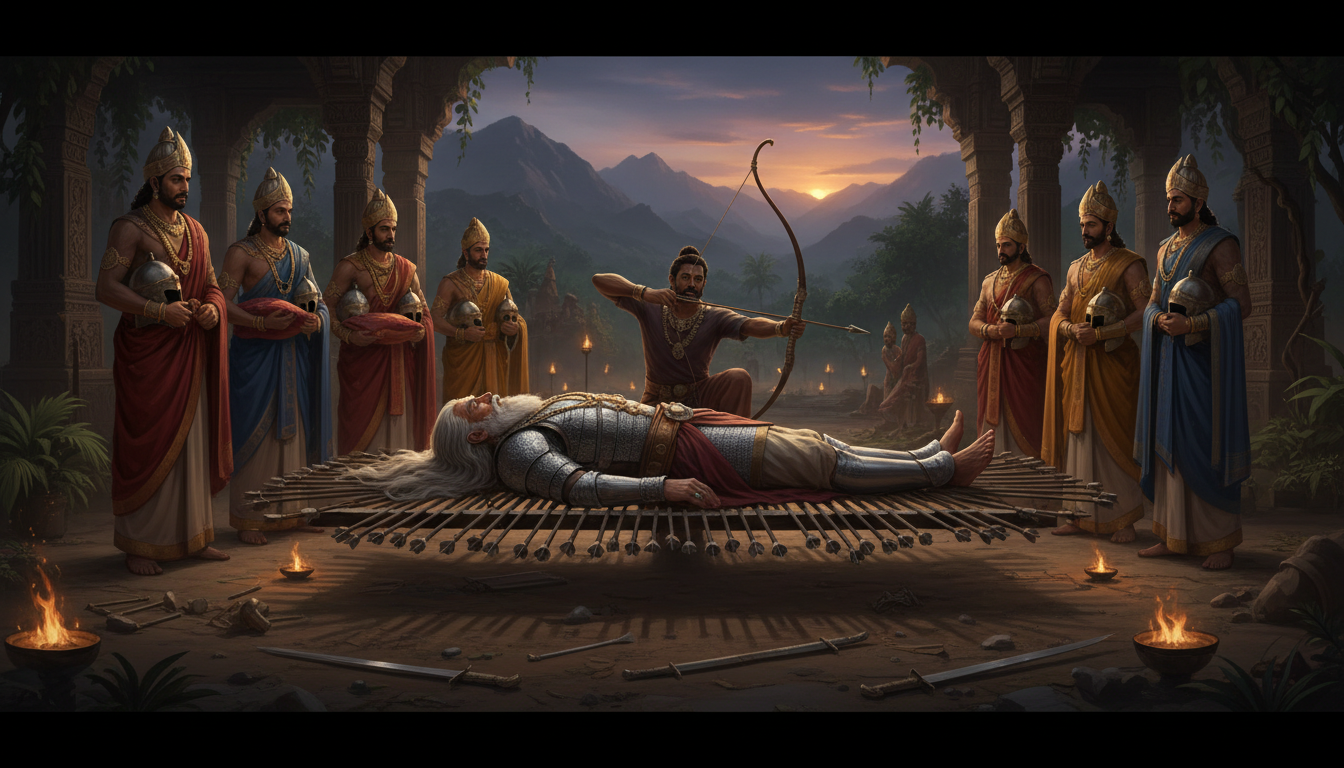
A Heart Made of Adamant
"Alas, what was the state of my warriors, O Sanjaya, when they were deprived of the mighty and god-like Bhishma, who became a Brahmacharin for the sake of his reverend sire? I counted the Kurus as already slain from the moment he despised the son of Drupada and would not strike him. And now, wretch that I am, I hear of my own sire's slaughter. What sorrow can be heavier? My heart must be made of adamant, since it does not break into a hundred fragments at the news.
"Tell me, O thou of excellent vows, what that lion among the Kurus did when he was slain in battle. I cannot brook it that Devavrata should be slain. He was not slain by Jamadagni's son in days of old, with all his celestial weapons. And he has now been brought down by Drupada's son Shikhandi, the prince of Panchala."
"He was struck down in the evening," Sanjaya said, "and he saddened the Dhartarashtras and delighted the Panchalas. He fell down on the earth and lay on his bed of arrows, and his body did not touch the ground anywhere. There were so many shafts in him that he came to rest on the ends of them, held up off the earth, and that is how he has lain ever since.
"When he went off the car, cries of oh and alas went up out of every creature. That boundary-tree of the Kurus was down, and fear went into the hearts of the Kshatriyas of both the armies together. Both sides saw the standard overthrown and the armour cut open, and both sides were made cheerless by it. The welkin filled with gloom. The Sun itself became dim. The Earth seemed to be shrieking."
What the Creatures Said
"This one is the foremost of those conversant with the Vedas," the creatures of the field were saying over him. "This one is the best of those conversant with the Vedas."
And the Rishis, and the Siddhas, and the Charanas, standing in the air above that bed, said the other thing about him, the thing that was said of him first and that will be said of him last.
"This one, long ago, finding his sire Santanu afflicted by desire, resolved to draw up his own vital seed."
On the ground the two armies were doing very different arithmetic. Your sons did not know what to do with their hands. The splendour went off their faces and they stood about in shame with their heads hanging. The Pandavas had won and they stood at the head of their ranks and blew their large conches decked with gold, and thousands of trumpets went off at once, and in the middle of that noise I saw Bhimasena sporting about in great glee, having just killed a great many strong men very quickly.
A swoon came over the whole Kaurava host. Karna and Duryodhana stood there drawing long breaths, one after another, and neither of them said anything to the other.
Then Dushasana turned his horses and went at speed into Drona's division. He had been posted by his elder brother, clad in mail and at the head of his own troops, for the protection of Bhishma, and he had failed at it, and now he had to carry the news himself. Wherever he went along that line he plunged the men into grief simply by passing them, and the Kauravas closed around his car because they wanted to hear what he had come to say.
The Teacher Falls Off His Chariot
He told Drona that Bhishma was down.
Drona heard it and fell off his car.
He was the second man of that army, the preceptor of both sides, a brahmana who had spent his life not being surprised by anything on a battlefield, and when the words reached him his body simply let go and he went over the rail onto the ground.
Then the valiant son of Bharadwaja got his senses back, stood up, and forbade the Kuru army to continue the fight. He gave no reason for it. Nobody asked for one.
And the Pandavas, seeing the Kurus desist, sent messengers out on fleet horses along their own line and stopped their army too. Nobody negotiated this. Nobody sent a herald across with terms. Both hosts stopped because the same man had fallen, and then the kings of both armies put off their armour and went out on foot to where he was lying.
Thousands of other warriors followed them, walking out over their own dead, the way the celestials go towards the Lord of all creatures. They came up to Bhishma where he lay on that bed and stood there, and offered him their salutations.
And he spoke to them, Kurus and Pandavas together, standing in one crowd in front of him.
"Welcome to you, ye highly blessed ones. Welcome to you, ye mighty car-warriors. I am gratified with the sight of you, that are the equals of the very gods."
Then, because his head was hanging back off the ends of the arrows and had been hanging back for some time, he said the next thing.
"My head hangs down greatly. Let a pillow be given to me."
The Kings Bring Cushions
The kings went and fetched pillows. They brought back a great many of them, and they were excellent pillows, very soft, made of the most delicate fabrics that could be found in the baggage of two royal armies, and they were the best thing that any of those men could think of to do for him.
The grandsire did not want them.
He looked at the heap of soft and costly things that a hundred kings had assembled at the side of his bed of arrows, and that tiger among men, that mightiest of car-warriors in all the worlds, laughed at them.
"These, ye kings," he said, "do not become a hero's bed."
And then he looked past all of them and found the one man on that field who would understand what he had actually asked for, and it was the man who had put him there.
"O Dhananjaya. O thou of mighty arms. My head hangs down, O sire. Give me a pillow such as thou regardest to be fit."
Three Shafts Into the Ground
Arjuna strung his large bow. He saluted the grandsire reverentially, and his eyes were full of tears, and he said what he had said to him at every stage of his life except one.
"O foremost one among the Kurus. O thou that art first among all wielders of weapons. Command me, O invincible one, for I am thy slave. What shall I do, O grandsire?"
"My head, O sire, hangs down. O foremost one among the Kurus, O Phalguni, get me a pillow. Give me one without delay, O hero, one that would become my bed. Thou art competent. Thou art the foremost of all wielders of bows. Thou art conversant with the duties of Kshatriyas, and thou art endued with intelligence and goodness."
"So be it," Arjuna said.
He took up Gandiva and picked out three straight shafts and inspired them with mantras, and then he asked the old man's permission, and got it. Then he shot the three of them into the earth under Bhishma's head, at such a height and such an angle that when he had finished, the head of Santanu's son was resting on them and was no longer hanging back.
Bhishma, who had asked for exactly that and had not said so, understood that Arjuna had divined his thought, and was highly gratified, and applauded him in front of everyone.
"Thou hast given me, O son of Pandu, a pillow that becomes my bed. If thou hadst acted otherwise, I would have cursed thee out of wrath. Even thus should a Kshatriya, observant of his duties, sleep on the field of battle on his bed of arrows."
Then he cast his eyes around at all the Bharatas standing there in the dusk with their armour off.
"Behold ye the pillow that the son of Pandu has given me."
Until the Sun Turns North
"I will sleep on this bed," he told them, "until the Sun turns to the northern solstice. Those kings who come to me then will see me yield up my life. When the Sun on his car of great speed, to which seven steeds are yoked, proceeds towards the direction that Vaisravana occupies, then I will let my life go the way a man dismisses a dear friend who is also dear to him.
"Let a ditch be dug here around my quarters, ye kings. Pierced with hundreds of arrows as I am, I will pay my adorations to the Sun from here.
"And as regards yourselves: abandon enmity. Cease from the fight."
He had chosen the hour of his own death when he was a boy, in a boon given by a father who had nothing else to give him, and now he was using it. He would not go while the sun was in the south. He would lie in the open field on the ends of Arjuna's arrows through as many weeks as that took.
Then the surgeons arrived.
They came with all the proper appliances of their profession, well trained men, skilled in the plucking out of arrows, sent for by somebody who had not yet grasped what he was looking at. Bhishma saw them coming and spoke to Duryodhana about them, not to them.
"Let these physicians be dismissed with presents of wealth, after proper respect has been paid to them. Brought to such a plight, what need have I now of physicians? I have won the most laudable and the highest state that is ordained in the Kshatriya observances. Ye rulers of men, lying as I do on a bed of arrows, it is not proper for me to submit to the treatment of physicians. With these arrows on my body I should be burnt."
Duryodhana honoured them as they deserved and sent them away. And the kings of the different realms, seeing that constancy in virtue, were filled with wonder, and saluted him, and walked around him three times, and posted guards all around the place where he lay, and went back to their tents in the evening with their bodies still drenched in blood and their hearts plunged in grief, thinking about what they had seen.
By Good Luck, Victory
Later that night Madhava came to the Pandavas, who were sitting together cheerfully, filled with joy at the fall of Bhishma, and spoke to Dharma's son.
"By good luck victory has been thine, O thou of Kuru's race. By good luck has Bhishma been overthrown, who is unslayable by men, a mighty car-warrior whose aim could not be baffled. Or perhaps, as destiny would have it, that warrior who was master of every weapon obtained thee for a foe who can slay with his eyes alone, and has been consumed by thy wrathful glance."
Yudhishthira the just did not take the compliment.
"Through Thy grace is Victory," he said. "Through Thy wrath is Defeat. Thou art the dispeller of the fears of those that are devoted to thee. Thou art our refuge. It is not wonderful that they should have victory whom Thou always protectest in battle, and in whose welfare Thou art always engaged, O Keshava. Having got Thee for our refuge, I do not regard anything as wonderful."
Janardana answered him with a smile.
"O best of kings, these words can come from thee alone."
And on the other side of the plain, in the Kaurava camp, nobody said anything at all like that to anybody.
The Morning the War Stopped
After the night had passed away, all the kings of both parties went out to the grandsire again. They saluted that bull of their order, that hero lying on a hero's bed, and stood in his presence.
Then the maidens came. They came by thousands, and they showered powdered sandalwood over Santanu's son, and fried paddy, and garlands of flowers, gently, so as not to move the shafts. Women came, and old men, and children, and ordinary spectators who had nothing to do with either army, all of them going towards him the way creatures of the world go out to look at the Sun. Trumpets came by hundreds and by thousands. Actors came, and mimes, and skilled mechanics.
And the Kurus and the Pandavas, with the fighting stopped and their coats of mail put aside and their weapons laid down, came and stood together around the invincible Devavrata.
They were assembled as they had been in the old days. They spoke to one another cheerfully, each according to his age, the younger deferring, the elder answering, exactly as men of one house do. That conclave of Bharata kings by hundreds, with Bhishma in the middle of it, looked as beautiful and as blazing as a conclave of the gods in heaven engaged in adorning the Grandsire.
It lasted one morning. Every man there knew what he would be doing to the man beside him the next day, and for that morning it did not seem to matter.
Bhishma lay in the middle of it holding his agonies down with fortitude, burning with the arrows that were still in him, sighing like a snake. Nearly out of his senses from the weapon wounds, he cast his eyes over those kings and asked for water.
Water Out of the Earth
The Kshatriyas ran and came back with excellent viands and several vessels of cold water, and set them down where he could see them.
"I cannot, O sire, now use any article of human enjoyment," Bhishma said. "I am removed from the pale of humanity. I am lying on a bed of arrows. I am staying here expecting only the return of the Moon and the Sun."
Having rebuked them with that, he said what he wanted.
"I wish to see Arjuna."
Arjuna came and saluted him and stood with his hands joined. "What shall I do?"
"Covered all over with thy shafts, my body is burning greatly. All the vital parts of me are in agony. My mouth is dry. Staying as I am with my body in this agony, give me water, O Arjuna. Thou art a great bowman. Thou art capable of giving me water duly."
"So be it," Arjuna said.
He mounted his car and struck Gandiva and began to stretch it, and at the twang of that bow and the slap of his palms, which together sounded like thunder, the troops and the kings standing about the field were filled with fear, because the last time they had heard it the war had still been going on.
He drove once around the prostrate chief of the Bharatas. Then he took a blazing arrow, inspired it with mantras and identified it with the Parjanya weapon, and in the sight of the entire army he pierced the Earth a little to the south of where Bhishma lay.
A jet of water came up out of the hole. It was pure, and auspicious, and cool, and it had the scent and the taste of nectar, and Partha gratified the old man's thirst with it where he lay.
The rulers of the earth were filled with wonder. The Kurus trembled like cattle afflicted by cold. Kings pulled off their upper garments and waved them in the air, and the conches blared and the drums beat all over the field, for water.
Let This Battle End With My Death
His thirst quenched, Bhishma praised him in front of all those kings.
"O thou of mighty arms, this is not wonderful in thee. Narada spoke of thee as an ancient Rishi. With Vasudeva as thy ally thou wilt achieve many mighty feats which the chief of the celestials himself, with all the gods, will certainly not venture to achieve. They that have knowledge of such things know thee to be the destroyer of the whole Kshatriya race. As human beings are foremost of all creatures, as Garuda is foremost of all winged creatures, as the Ocean is foremost among receptacles of water and the cow among quadrupeds, as the Sun is foremost among luminous bodies and Himavat among mountains, so art thou the foremost of all bowmen."
Then he turned his eyes to his nephew, who had been standing in that crowd the whole morning.
"Dhritarashtra's son did not listen to the words repeatedly spoken by me, and by Vidura, and by Drona, and by Rama, and by Janardana, and by Sanjaya also. Reft of his senses, like an idiot, he placed no reliance on any of it. Past all instruction, he will certainly have to lie down for ever, overwhelmed by the might of Bhima."
Duryodhana's face went cheerless, and Bhishma, watching him, changed his voice.
"Listen, O king. Abandon thy wrath. Thou hast seen how the intelligent Partha created that jet of cool and nectar-scented water. There is none else in this world capable of such a feat. The weapons of Agni, Varuna, Soma, Vayu and Vishnu, and those of Indra and Pasupati and Paramesthi, and those of Prajapati and Dhatri and Tashtri and Savitri and Vivaswat, are all known to Dhananjaya alone among men. Krishna the son of Devaki knows them also. There is none else here that knows them.
"With that truthful hero let peace be made, O king, and soon. As long as the mighty-armed Krishna is not possessed by wrath, it is fit that peace should be made with the heroic Parthas. As long as this remnant of thy brothers is not slain, let peace be made. As long as Yudhishthira with eyes burning in wrath does not consume thy troops, let peace be made. As long as Nakula and Sahadeva and Bhimasena do not exterminate thy army, let friendly relations be restored.
"Let this battle end with my death, O sire. What Phalguni has already done is sufficient. Let peace come to all with my death. Let these rulers of earth cheerfully mix with one another. Let sire get back the son. Let sister's son get back the maternal uncle. Relent, O king. Let half the kingdom be given to the Pandavas, and let king Yudhishthira the just go to Indraprastha. Do not earn a sinful notoriety among the kings of the earth as a fomenter of intestine dissension. If from want of understanding and possessed by folly thou dost not hearken to these timely words of mine, thou wilt have to repent greatly. What I say is true. Therefore desist even now."
Having said this out of affection, in the middle of all those kings, the son of the ocean-going Ganga became silent. His vital limbs were burning with the arrow wounds. He prevailed over the agonies and applied himself to yoga.
"And your son," Sanjaya said, "having heard those beneficial and peaceful words, fraught with both virtue and profit, accepted them not, like a dying man refusing medicine."
Dharma Lesson
The only bed fit for a man who kept a hard vow is the one his own choices made for him. Bhishma refuses the cushions and the physicians because comfort would falsify what he spent his life proving, and he asks instead for the pillow his enemy alone knows how to give. The care he does accept is the kind that respects what he chose, not the kind that undoes it.