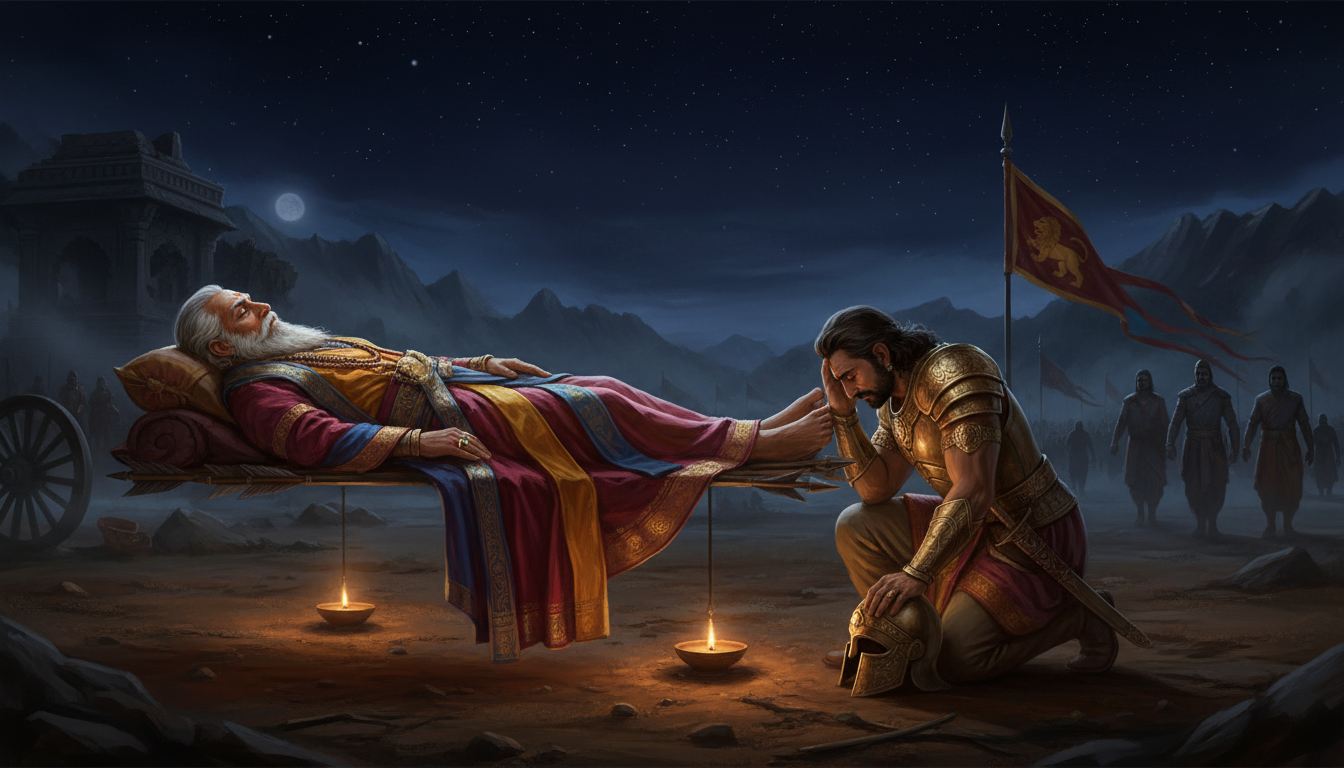
Karna at the Grandsire's Feet
The forgiveness that came too late to change anything
The Morning the Armies Laid Down Their Weapons
Sanjaya said: after the night had passed away, O monarch, all the kings, the Pandavas and the sons of Dhritarashtra, repaired to the grandsire.
The evening before, when he fell, they had brought him a pillow of soft cloths, and he had refused it and asked Arjuna for one fit for a bed like his, and Arjuna had put three arrows under his head. He had told them he would not die yet, that he would hold on until the sun turned north.
So in the morning they came, and saluted that bull of their order, and stood in his presence. Maidens by the thousand came out to the field and gently showered powdered sandalwood over Santanu's son, and fried paddy, and garlands of flowers. Women came, and old men, and children, and ordinary spectators who had no business on a battlefield, all approaching him the way creatures of the world approach the sun.
And ceasing to fight, putting aside their coats of mail, laying aside their weapons, the Kurus and the Pandavas came together to the invincible Devavrata, and were assembled as in days of old, and cheerfully addressed one another according to their respective ages. Men who had been trying to kill each other the previous morning stood in one conclave, hundreds of Bharata kings around one old man on the ground, and it looked, Sanjaya said, like a conclave of the gods.
Bhishma suppressed his agonies with fortitude, though he was burning with the arrows still sticking in his body, and he was sighing like a snake. Nearly deprived of his senses by his wounds, he cast his eyes on those kings and asked for water.
They brought excellent viands, and several vessels of cold water, and set them down where he could see them.
"I cannot, O sire, now use any article of human enjoyment," said Santanu's son. "I am removed from the pale of humanity. I am lying on a bed of arrows. I am staying here, expecting only the return of the Moon and the Sun."
He had rebuked them, and they stood holding their jars. Then he said what he wanted.
"I wish to see Arjuna."
Let This Battle End With My Death
Arjuna came and saluted him and stood with joined hands and said, "What shall I do?"
"Covered all over with your shafts, my body is burning greatly," Bhishma said. "All the vital parts of my body are in agony. My mouth is dry. Give me water, O Arjuna. You are a great bowman. You are capable of giving me water duly."
So be it, said Arjuna, and mounted his car and stretched the Gandiva, and the twang of the bow went across the field like thunder and frightened the troops who had come out unarmed to watch a man die. He circled the prostrate chief of the Bharatas once. Then he inspired an arrow with mantras, identified it with the Parjanya weapon, and in the sight of the entire army pierced the earth a little to the south of where Bhishma lay.
A jet of water rose out of the ground, pure and cool and auspicious, of celestial scent and taste, and with it Partha gratified the grandsire. The kings waved their garments in the air from sheer wonder, and conchs blew, and drums beat all over the field.
His thirst quenched, Bhishma praised him before all of them as the one bowman among the bowmen of the world. And then, having established in public that the man who had felled him was beyond any answer his own side could make, he turned his head toward Duryodhana and used the last authority he would ever have.
"Listen, O king. Abandon your wrath. As long as this remnant of your brothers is not slain, let peace be made. Let this battle end with my death. Make peace with the Pandavas. Let these rulers of earth cheerfully mix with one another. Let a sire get back his son, let a sister's son get back his maternal uncle. Relent. Let half the kingdom be given to the Pandavas. Let king Yudhishthira the just go to Indraprastha."
He had said it before, in the assembly, and so had Vidura and Drona and Rama and Janardana and Sanjaya, and Duryodhana had listened to none of them. He did not listen now either. Sanjaya, who was standing there, put it exactly: your son accepted those words not, like a dying man refusing medicine.
So the son of the ocean-going Ganga became silent. Though his vital limbs were burning with the arrow-wounds, he prevailed over his agonies and applied himself to yoga. And after Santanu's son had become silent, all those rulers of earth who were standing about him returned to their own quarters, because there was nothing else for them to do. The guards were set. The field emptied.
And when it was quiet, Radha's son heard what had happened.
I Am Radha's Son
He had not been on that field. He had not been on any field for ten days. He came now, that bull among men, quickly, and partly, O king, he came in fear.
He found the place by the guards and the lamps, and he saw the illustrious hero lying on his bed of reeds, on the shafts that would not let his body touch the ground, with his eyes closed. Vrisha, endued with great glory, came up to the old man, and his voice was choked with tears before he had said anything at all.
He fell at Bhishma's feet.
"O chief of the Kurus," he said, "I am Radha's son. I am the one who, whenever I stood before your eyes, was everywhere looked upon by you with hate."
That was the whole of it. He had come out across a dark field to a dying man to say his own name and the name of the woman who raised him, and to state the thing that had been done to him, and he asked for nothing.
It had been done in front of the entire war council. On the night before the first day, when the grandsire went through the muster and priced every man on it, he had reached Karna and had not granted him a place on the list. Neither a Ratha nor an Atiratha, he had said. A vile braggart. Kind out of season, and blundering. A man deprived of his natural coat of mail, deprived of his celestial ear-rings, under the curse of his own preceptor and under the curse of a Brahmana besides; and therefore, in my judgment, only half a Ratha. Having approached Phalguni in battle, he will not certainly escape with life. And Drona, foremost of all wielders of weapons, had said: it is even so as you have said, that is not untrue.
Karna had expanded his eyes in rage and answered him in front of the kings. You mangle me with your wordy arrows at every step, though I am innocent. Who else would seek to disunite and abate the energy of these kings, all equally brave, as you from your hatred of merit seek to do? And then the vow, heard by the whole hall: I will not fight as long as Ganga's son lives. After Bhishma has been laid low, I will fight with all the Maharathas of the enemy united together.
He had kept it for ten days while the army came back smaller every evening.
And now the commander was on the ground with the arrows through him, and the oath was over, and the first thing Karna did with his freedom was to walk out and find him.
The Guards Sent Away
The aged chief of the Kurus, the son of Ganga, whose eyes were by then covered with film, heard the voice and raised his eyelids slowly.
Then he did the first thing he had done for himself in ten days. He caused the guards to be removed.
They went, and the lamps went with them, and he saw the place deserted by everybody. There was no one left within earshot: no herald, no king, no son of Dhritarashtra, no charioteer standing at a respectful distance to say afterwards what he had heard.
Only then, lying on the arrows, he put out one arm and drew Karna in and embraced him, the way a father embraces a son.
"Come. Come," he said. "You are an opponent of mine who always challenges comparison with me. If you had not come to me tonight, without doubt it would not have been well with you."
He had eleven days of arrows in his body and one arm free, and he was holding on to the son of a charioteer in the dark with nobody watching, and that was the position from which he said the next sentence.
You Are Kunti's Son
"You are Kunti's son. You are not Radha's. Nor is Adhiratha your father."
Karna did not move.
"O you of mighty arms, I heard all this about you from Narada," Bhishma said, "and from Krishna Dwaipayana also. Without doubt, all of it is true."
Two names, and both of them settled it. Narada, who goes everywhere and carries what he sees between the three worlds. And Krishna Dwaipayana, called the Island-born, who was Bhishma's own kinsman and the father of Dhritarashtra and Pandu both, and who therefore knew the parentage of every man in that war including his own grandsons.
So it had not been a secret at all, or not the kind of secret Karna had been living inside. Narada knew. Vyasa knew. Krishna knew and had said so on the riverbank, offering him the whole earth to come across. Kunti knew and had come to him herself at the water with the sun on her face and asked him to be her eldest. The grandsire had known it since before the war was called. He had known it in the assembly where he priced him at half a Ratha and let Drona agree with him, and every day for ten days while Karna sat in his tent with his bow unstrung and his oath around his neck.
"I tell you truly, son, that I bear you no malice," Bhishma said. "It was only for abating your energy that I used to say such harsh words to you."
That was the confession. Not that he had been wrong about Karna, but that he had never believed a word of what he said about him. Every insult had been an instrument. He had taken the most dangerous archer in the Kaurava camp and kept him off the field for ten days by the simple method of telling him in public that he was not worth putting on it.
Why the Harsh Words Were Said
"You speak ill of all the Pandavas without any reason," the old man went on, and he did not soften it, even now. "Sinfully did you come into the world, and it is for this that your heart has been such. Through pride, and through your companionship with the low, your heart hates even persons of merit. It was for this that I spoke such harsh words about you in the Kuru camp."
And then the reason under the reason.
"For fear of dissension within the house I always spoke harsh words about you."
That was the whole calculation, set out plainly to the man it had been worked upon. There was Duryodhana, who would do anything Karna advised. There were the hundred sons of Dhritarashtra, who resented an outsider standing closer to the king than they did. There was Drona, who had refused to teach him. There was Bhishma himself, holding eleven armies together with nothing but his own person. Put Karna at the front of that host and the host would come apart from the inside before the Pandavas ever touched it.
He had said as much once already, in the same council, and nobody had understood it as an admission at the time. This burden, vast as the ocean, is about to be taken up by me. Now that the hour is come, dissensions among ourselves should not be created by me. It is for this, Suta's son, that you live.
So he had chosen. He had spent one man's honour to keep the army whole, and had done it in front of everybody, and had never once explained himself until he was lying on the ground with no time left in which anything could be undone by explaining.
The Reckoning Reversed
Then, having said why he had lied, Bhishma spent what breath he had left telling Karna the truth, item by item, as though he were going down the muster again and correcting his own figures.
"I know your prowess in battle, which can with difficulty be borne on earth by foes. I know also your regard for Brahmanas, and your courage, and your great attachment to alms-giving. You who resemble a very god: among men there is none like you."
"In bowmanship, in aiming a weapon, in lightness of hand and in strength of weapons, you are equal to Phalguni himself, or to the high-souled Krishna."
Phalguni. Arjuna. The comparison Karna had spent his life demanding from people who would not make it, made now by the one man in the world whose opinion of an archer nobody would argue with. And the same mouth that had said he would not escape Phalguni with his life said it, in the dark, eleven days later.
"Karna, you went to the city of Kasi alone, with your bow, and crushed the kings in battle to procure a bride for the Kuru king. The mighty and invincible Jarasandha, who was ever boastful of his prowess in battle, could not become your match in fight. You are devoted to the Brahmanas. You always fight fairly. In energy and in strength you are equal to a child of the celestials and certainly much superior to men."
Every item on that list was one he had publicly denied. The half Ratha had gone alone to Kasi and come back with a bride for a Kuru king.
And then, at the end of it: "The wrath I cherished against you is gone. Destiny is incapable of being avoided by exertion."
Let the Hostilities End With Me
"Slayer of foes," said Bhishma, "the heroic sons of Pandu are your uterine brothers."
He had been holding him with one arm all this while.
"If you wish to do what is agreeable to me, unite with them, mighty-armed one. Son of Surya, let these hostilities end with me. Let all the kings of earth be freed from danger today."
It was the same sentence he had spent on Duryodhana that morning, in daylight, in front of hundreds of kings, and had been refused. He was making the identical offer a second time, to a different man, in private, and with the one piece of information that gave it force.
It was the offer Krishna had made him at the river and Kunti had made him at the water's edge, and it was being made now for the third time by a man who had no personal stake left in the outcome, who would not live to see either army win, and who was asking not for a victory but for a stop.
And it was, for one moment, entirely available. Bhishma was down, the oath that had kept Karna out of the war had expired, he had not struck a single blow against his brothers, and he had not yet killed anybody's son. There would never again be a night on which he owed the Pandavas so little.
The field around them was quiet. Somewhere behind, in the Kaurava lines, Duryodhana was waiting for him to come back and take up the command that had been kept from him for ten days.
I Dare Not Falsify It Now
"I know this, mighty-armed one," Karna said. "All this, without doubt, is as you say. As you tell me, Bhishma, I am Kunti's son and not the son of a Suta."
He was still on the ground at the old man's feet.
"I was, however, abandoned by Kunti, and I have been reared by a Suta. Having so long enjoyed the wealth of Duryodhana, I dare not falsify it now. Like Vasudeva's son, who is firmly resolved for the sake of the Pandavas, I also am prepared to cast away my possessions, my body itself, my children and my wife, for Duryodhana's sake. Death from disease, O you of Kuru's race, does not become a Kshatriya."
"Relying upon Suyodhana I have always offended the Pandavas. This affair is destined to take its course. It is incapable of being prevented. Who is there who would venture to overcome Destiny by exertion? Various omens indicating the destruction of the earth were noticed by you, grandsire, and declared by you in the assembly. It is well known to me that the son of Pandu and Vasudeva are incapable of being conquered by other men. Even with them, we venture to fight."
He had granted every premise. He agreed that he was Kunti's son. He agreed that Arjuna could not be beaten, and that Krishna could not be beaten, and that the omens the grandsire had read in the sky meant what the grandsire said they meant. And having conceded the whole argument he declined the conclusion.
"I will vanquish the son of Pandu in battle. Even this is my firm resolve. I am not capable of casting off this fierce animosity. With a cheerful heart, and keeping the duties of my order before my eye, I will contend against Dhananjaya."
And then, having refused everything he had been offered, he asked for the one thing the dying man could still give him.
"Firmly resolved that I am on battle, grant me your permission, hero. I will fight. Even this is my wish. And it behoves you to forgive me also any harsh words that I may at any time have uttered against you, or any act that I may have done against you from anger or from want of thought."
Go, Moved by the Desire of Heaven
"If indeed you are unable to cast off this fierce animosity, I permit you, Karna," said Bhishma.
"Fight, moved by the desire of heaven. Without anger and without vindictiveness, serve the king according to your power and according to your courage, and observant of the conduct of the righteous. Have then my permission. Obtain that which you seek. Through Dhananjaya you will obtain hereafter all those regions which are capable of being had by fulfilling the duties of a Kshatriya. Freed from pride, and relying on your own might and energy, engage in battle, since a Kshatriya cannot have a source of greater happiness than a righteous battle."
It is worth noticing what he did not do. He did not withdraw the permission when Karna refused the offer, and did not curse him, though he had told the whole council eleven days earlier that this man would not come out of an encounter with Phalguni alive. He gave him the blessing a father gives, and told him how to fight: without anger, without vindictiveness, freed from pride. It was the only instruction he had ever given him.
There was a pause, and then the last words the grandsire spoke to him, and they were not about Karna at all.
"For a long while I made great efforts for bringing about peace. But I succeeded not, Karna, in the task. Truly do I say this unto you."
That was the second time in one day he had said it, and the second time it changed nothing.
Radha's son saluted him and obtained his forgiveness, and got up on his car, and drove away toward the quarters of your son.
He had been told he was a king's grandson, that the men he was going to kill were his own brothers, that the man who had insulted him for a lifetime had privately rated him the equal of Arjuna, and that the whole war might be ended tonight by his walking a mile in the other direction. He had heard all of it and refused it and asked for permission to fight instead.
Seven days later he would be dead on that same field with his wheel in the mud, and the woman who came to burn him would be the one whose name Bhishma spoke first that night.
Dharma Lesson
A truth withheld for a good reason is still a truth withheld, and it comes back due at the worst possible hour. Bhishma spent Karna's honour to keep an army whole and confessed it only when there was no time left to repair anything. Kindness delayed until it is safe to offer is no longer kindness; it is only relief for the one offering it.