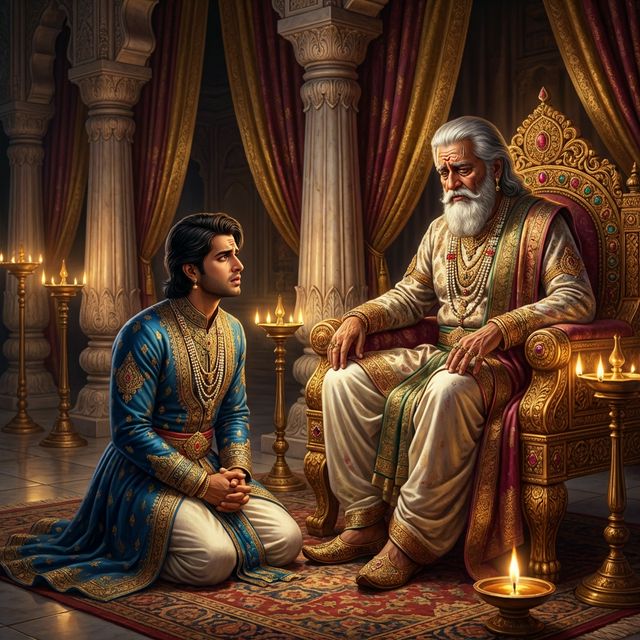
The Reckoning of the Warriors
Bhishma prices every man on the field, and Karna walks out
What Is This War Worth
The muster had been counted twice, and both counts agreed: eleven akshauhinis stood ready to fight for the Kauravas, seven for the Pandavas, an imbalance that should have made the coming war a short one. It was not, everyone in that assembly hall at Hastinapura understood, going to be short.
Duryodhana had just named Bhishma commander of the whole army, over Karna's open objection and his own uncle's quiet unease, and the old man had accepted the burden the way he accepted most things asked of him by the house he had sworn to serve: without joy and without refusal. Drona sat near him, Kripa beside Drona, Ashwatthama close to his father, and further down the hall, Shalya and Bhagadatta, kings who had come to fight for Duryodhana more from old obligation than from any love of his cause.
'Grandfather,' Duryodhana said, when the formalities of the appointment were done, 'tell me plainly, since you have agreed to lead us. How long will this war take? And what, in truth, is each man on that field worth, on their side and on ours?'
It was a fair question from a king about to spend a kingdom's worth of lives, and a dangerous one to ask a man as honest as Bhishma. Everyone in the hall who had ever heard Bhishma speak knew he did not know how to answer a direct question with a comfortable lie. Drona shifted where he sat. Karna's mouth was already a hard line, as if he guessed, before a word had been said, that whatever came next would not flatter him.
Ratha, Maharatha, Atiratha
'War is measured in men, not days,' Bhishma said, 'and a man is measured by what he can hold against him.' He named the ranks the way a teacher names them to a pupil, patient even here. 'A ratha can fight ten thousand archers and hold his ground. A maharatha can fight ten thousand ratha warriors at once, or so the old measure runs. An atiratha has no measure. He fights whom he pleases, in whatever number, and does not tire of it.'
Then he graded the muster, aloud, before both his own side and whatever spies of the Pandavas' might carry the words back. Drona and Kripa, he said, were atirathas, without doubt or flattery. Ashwatthama the same, young as he was. Shalya, a maharatha of the first order, worth every kingdom he had ever ruled. Bhagadatta, old but formidable, and his elephant with him worth an army by itself.
Of the Pandavas he was no less exact, and no less generous, though they stood on the far side of the field he was about to command against. Arjuna, he said, was an atiratha beyond any he had named yet, perhaps beyond any man living. Bhima he called a maharatha of terrible strength, more dangerous in a crush of soldiers than in single combat, a man who would eat through the ranks like fire through dry grass. 'I will give ten thousand deaths a day to this war,' Bhishma said into the silence that followed, 'for as long as I command it. That I promise you. What I will not promise is to strike a woman, or a man who was born, or made, a woman. That line I will not cross, whatever it costs us.'
No one in the hall asked him what he meant. Some of them, watching a certain name go carefully unspoken, already suspected.
Half a Chariot
Then Bhishma's eyes moved to Karna, and the hall went quieter still, because everyone present had been waiting, with varying degrees of dread, to hear what the old commander would say about the one warrior Duryodhana loved best and trusted most.
'Karna,' Bhishma said, 'I will not insult you with a number that is not true. You are half a ratha. No more.'
The words landed like a blow. Bhishma did not soften them with an explanation, but he gave one anyway, plainly, because plainness was the only courtesy he knew how to offer. 'You were born with armor grown into your own skin and earrings that made you nearly impossible to kill, and you gave both away to a brahmin who asked for them, not knowing, or not caring, that the brahmin was Indra himself, come to strip you of your one true advantage before this war was ever spoken of. That is a debt against you, however noble the giving was.
'You learned the Brahmastra from Parashurama by a lie, and he cursed you, when he learned it, to forget the mantra in the one hour you would need it most. And you killed a brahmin's cow by accident on the road, and that brahmin cursed your chariot wheel to sink into the earth at the moment your life depended on it staying free. Two curses, both waiting for the day you can least afford them. A great archer with two doors already unlocked against him, waiting for someone to walk through, is not a whole warrior. He is half of one.'
Duryodhana's face had gone the color of old ash. Karna's hand had closed, slowly, around the hilt of nothing, since he had come to the hall unarmed.
Karna's Vow
Karna rose. He did not raise his voice, which somehow made the silence that followed worse than shouting would have.
'You have named my faults in front of the men I am supposed to lead into a war for your grandson's throne,' he said to Bhishma, 'and you have done it, I do not doubt, believing every word of it true. Perhaps it is. I will not argue curses I cannot undo, or a gift I do not regret giving. But I will not fight under a commander who has already told this hall, and every spy in it, that I am worth half of what stands against me.'
He turned to Duryodhana. 'I will not lift a bow while Bhishma commands this army. Not one arrow. When he falls, or steps aside, send for me, and I will come, and I will show this hall what half a chariot can do to the men who called it that.'
Then he walked out, past Drona, past Kripa, past Shalya's carefully unreadable face, and did not look back at Bhishma once.
Duryodhana said nothing for a long moment. He had wanted, in asking his grandfather's honest measure of the war, some comfort about the size of the army he could still call his own. Instead he had lost, in a single morning, before a single arrow had flown, the willing service of the one archer he privately believed could match Arjuna. Bhishma, for his part, showed no sign of regret. He had been asked a true question and had given a true answer, and if the answer had cost him Karna's bow for however long he held the field, that was a cost he had weighed and accepted before he spoke.
Ten Days at Kurukshetra
The armies marched to Kurukshetra within days, camped along ground flat enough for eleven akshauhinis and seven to face each other without breaking formation, and Bhishma took up the command he had promised to hold.
He kept his other promise too, as closely as any man could. Day after day the Kuru host under his standard cut into the Pandava ranks, and day after day the count of the dead crept toward the number he had named in the hall at Hastinapura, ten thousand and more, until the field between the camps was a place no one could walk without stepping on something that had been a man that morning.
Karna kept his vow as well. He watched the battle from the Kuru camp each of those ten days, in his armor, his bow strung, and did not ride out once, not even when the fighting went badly, not even when men he had trained beside fell within sight of his tent. It was, by every account, the hardest discipline he ever kept, harder in its way than any curse laid on him, because it was entirely his own to break or hold.
Bhishma commanded for ten days exactly, as fate and his own choices about how he would die had already arranged, and what happened on the eleventh, when the field at last saw a new champion ride out in the front rank and Karna's bow finally strung again in earnest, belongs to another telling. What the assembly hall at Hastinapura had already shown, before either army moved, was simpler and harder to unlearn: an honest accounting of who is strong and who is not can hollow out an army's resolve as surely as any defeat on the field, and Bhishma, of all men, understood that better than most, and told the truth anyway.
Dharma Lesson
Bhishma's honesty cost him nothing in the assembly hall and nearly cost Duryodhana the war before it began, since naming a rival's worth plainly is itself a kind of respect that ambition rarely affords. Karna's vow shows how deeply a slight, even one wrapped in truth, can wound pride built on unproven strength. The scene asks whether truth spoken without tact is still a virtue when it weakens the very side that needed courage most.