Kurukshetra Day 11: The Teacher Takes Command
Drona's Vow to Take the King Alive
The Field Without Its Grandsire
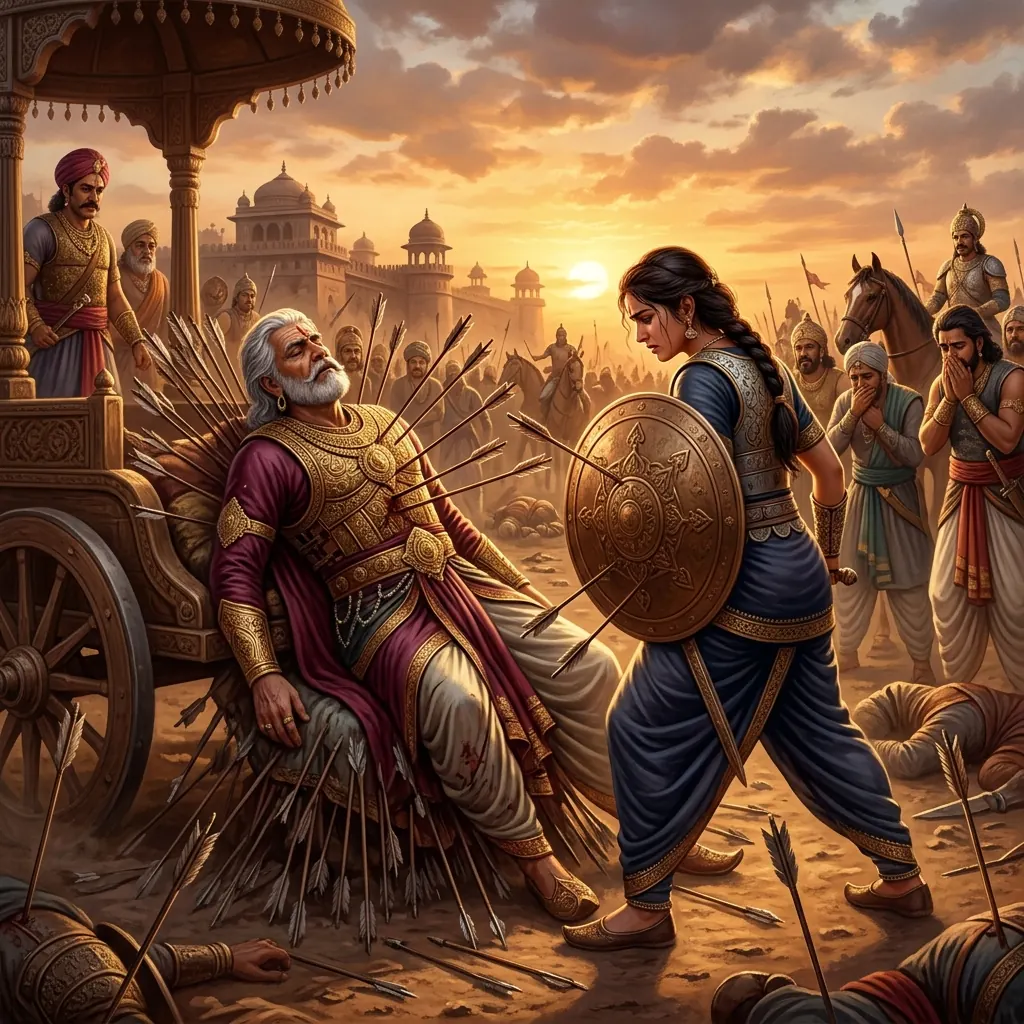
The eleventh morning broke over an army that had forgotten how to stand in ranks. For ten days the Kaurava host had been a single body with a single head, and every captain in it had known where to look when the horns sounded. Now Bhishma lay a bowshot beyond the lines on his bed of arrows, held above the earth on the shafts of Arjuna's arrows, and the men who filed past him at dawn walked back to their chariots not knowing whose banner to follow.
Grief in an army does not sit down and weep. It spreads outward as confusion. Horses were harnessed twice. Standards went up in the wrong quarter of the field. Officers argued over precedence that had not needed arguing over since the war began, and the great host of eleven divisions stood in the cold light like a body whose limbs had stopped hearing one another.
It was into that stillness that Karna rode at last. For ten days he had sat in his tent while the war he had waited his whole life for went on without him, because Bhishma had named him half a warrior and Karna had sworn not to fight while the old man led the host. Now he went first not to the battle line but to the bed of arrows.
He came down from his chariot with his eyes full and his hands joined, and stood over the old man. "It is Karna," he said. "Open your eyes and look at me, grandsire, and speak some auspicious word to me. There was no one among the Kurus like you, in counsel, in arrays, in arms. Now Arjuna will go through this army like fire through a dry forest with Krishna for its wind, and who is left who can stand against him? Give me leave, and I will fight him today. I have put death or victory in front of me."
The old man heard him, and his heart was glad. "Go," Bhishma said. "You conquered the Kambojas for Duryodhana, and the kings at Girivraja, and the hill tribes of the Himalayas. You are his refuge as much as his own kin are. You are like a grandson to me, as he is. The wise say that the bond of the good counts for more than the bond of birth. Do not make your bond with the Kurus false. Go and fight, and guard Duryodhana's army as if it were your own."
Karna touched his feet and went, and when the army saw him coming toward the lines at last, the men slapped their arms and roared like lions and twanged their bows, and for a while no one thought about the old man lying on his arrows.
The Teacher Is Made Commander
Duryodhana met him before the ranks, and the question could not be put off past the sounding of the first horn. An army without a commander is only a boat without a boatman, and the whole host was waiting to see who would take the steering oar.
Duryodhana turned to Karna first, because Karna was the friend whose counsel he trusted before any other. "Say the name," he said. "Bhishma is gone. Look at the men we have left and tell me who should lead them. Whoever you name, we will all accept."
"Choose any one of these kings and the others will sulk and hang back," Karna said. "Choose the one man they all look up to. He is the eldest, he is your own teacher, and there is no weapon he does not know. Let Drona lead."
Drona was standing among the ranks with his bow in his hand, and he did not answer at once. He was old, and he had been old for a long while, and the war had already taken from him the last comfortable illusion that a teacher can love his students and stand outside their quarrel. He had trained the five sons of Pandu with his own hands. He had trained the hundred sons of Dhritarashtra with the same hands. Now he was being asked to point one set of them at the other and call the aim true.
"You know what you ask of me," he said.
"I ask you to lead," Duryodhana said.
"You ask me to be the head of the arrow," said Drona, "and the arrow flies where the hand throws it." But he gave his word, because he had eaten the salt of the Kurus for many years and there was no honest way for him to refuse. "I will fight the Pandavas," he said. "I tell you that truthfully."
They consecrated him there on the field in the manner the shastras require, the sacred waters poured over his white head, the brahmanas chanting, the drums beginning slow and building until the whole eleven divisions took up the sound. The old teacher stood in the middle of the roar, and no one who watched him could tell whether the thing on his face was pride or something much closer to dread.
Take Him Alive
When the rites were done, Drona turned to Duryodhana in front of the whole army. "You have honoured me today, setting me where Bhishma stood," he said. "You will have fruits to match. Tell me what you want, and I will do it."
Duryodhana did not answer at once. He drew Karna and Duhshasana aside and spoke with them, and then he came back with a request no one had expected.
"Take Yudhishthira alive," he said. "Capture him and bring him to me."
For a moment Drona felt something in his chest unknot. Of all the men on the other side of the field, the eldest son of Pandu was the one he could least imagine putting an arrow through. "The son of Kunti is fortunate," he said, and the soldiers around them cheered to hear it. "You ask only for his capture, not his death. Why not his death? Is it that even you cannot bring yourself to hate him? He is well named Ajatashatru, the man with no enemy. Beat the Pandavas in battle if you must, and then give them a share of the kingdom, and live with them as brothers."
It was the wrong thing to say to Duryodhana, or perhaps the right one, because it made him show his face. Not even the teacher of the gods can always keep his heart out of his face, and Duryodhana did not try.
"If you kill Yudhishthira, I cannot win," he said. "The others will slaughter all of us to avenge him, and not even the gods could kill them. But he keeps his word. Bring him here alive and we will beat him at the dice again, and his brothers will follow him back into the forest, and my victory will last for years. That is why I do not want him dead."
The teacher looked at the crooked thing that had been set in front of him and was silent for a long while. He saw exactly what it was. He was a brahmana and a teacher of eighty-five years, and he had to choose, knowing.
Then he gave the boon, and fenced it round with the one condition that mattered. "While Arjuna guards him, not Indra with all the gods and the asuras could take him," he said. "Arjuna was my pupil. He has weapons from Indra and from Rudra, and you have made him angry. I will not go against him. Get Arjuna off the field by any means you can, and if Yudhishthira stands before me for even a moment, I will bring him to you."
Duryodhana knew the old man loved the Pandavas, and he meant to hold him to it. Before long he had it cried through every division of the host: the teacher has sworn to take Yudhishthira alive. The army roared like lions. Drona heard his promise go out across the plain in ten thousand mouths, and knew he could never call it back.
Arjuna's Answer
The Pandavas' spies brought the news across the plain almost as fast as the roar that carried it, and Yudhishthira called his brothers and his captains together and turned to Arjuna.
"You have heard what Drona means to do today," he said. "He has sworn it. But a pledge is not a certainty, and everything depends on you. Fight near me today, so that Duryodhana does not get what he wants from him."
Arjuna did not hesitate. "I could no more bring about my teacher's death than I could abandon you," he said. "I would give up my life before I fought him to the death. But while I am alive, Drona will never take you. Not if Indra came down with the gods and the demons to help him. I do not remember ever speaking a lie, or being beaten, or leaving a promise half kept. Do not be afraid."
Then the conches went up in the Pandava camp, and the Kauravas answered with their own drums, and the two hosts rolled slowly toward each other, Drona's cart-shaped array against the curlew the Pandavas had drawn up.
For most of that day neither side could break the other. Where Drona stood, the Srinjayas could not drive the Kauravas back; where Arjuna stood, the Kaurava chariots could not drive the Pandavas back. The old man took his golden chariot through the Pandava divisions so fast, loosing arrows in every direction, that the terrified Srinjayas thought there were several of him. He was like the sun at midday, drawing sweat from everyone beneath it, and no one could bear to look at him. All around him the duels of the day flared and died: Bhima against Vivimshati, Satyaki against Kritavarma, Abhimanyu hurling Shalya's own javelin back to kill his driver, and then Bhima meeting Shalya mace to mace until the king of Madra's weapon shattered in a shower of sparks.
And all day long the old teacher's eyes kept going back to one umbrella over one chariot in the Pandava centre.
The King Still Free
Late in the afternoon the Kaurava line began to give, and Drona saw it, and made his move.
"Do not run!" he shouted to his own men, and drove his red horses straight into the Pandava army at Yudhishthira. The king met him with arrows tufted with heron feathers, and Drona cut his bow in two and came on.
What saved Yudhishthira was not one warrior but a dozen. A young Panchala prince named Kumara, guarding the wheels of the king's chariot, threw himself into the old man's path and put an arrow into his chest and roared, and the Pandava ranks roared with him. Drona killed him. Yugandhara came next, and Drona brought him down from his chariot with a single broad-headed arrow. Virata and Drupada closed in, and the Kekayas, and Satyaki and Shibi, all of them shooting at once to wall the king off. Vyaghradatta of Panchala put fifty arrows into Drona, and Simhasena laughed aloud as he struck him, and Drona rubbed his bowstring, slapped his palms together, and took both their heads.
Then he was through, and nothing stood between him and Yudhishthira. A cry went up across the field that the king was as good as taken. On the Kaurava side men were already telling each other that Yudhishthira would be standing before Duryodhana by nightfall.
That was when Arjuna came.
He came across the field through a river of blood he had made himself, and the sound of the Gandiva reached the Pandava centre before the chariot did. He fell on Drona's division with a net of arrows so thick that the sky and the earth and every direction disappeared, and with the sun going down and the dust rising, no man could tell friend from enemy. Drona and Duryodhana called the retreat. Arjuna drew his own men back slowly behind them, and rode home last of all with Krishna beside him, while the Pandavas and Panchalas praised him like sages praising the sun.
In the Kaurava camp that night Drona could hardly look at Duryodhana for shame.
"I told you," he said. "While Arjuna is there, the gods themselves could not take Yudhishthira. You all tried against him today and you were thrown back. But draw him off. Let someone challenge him in another part of the field, and while he is gone I will go through the army and take the king, even with Dhrishtadyumna watching."
Susharma, king of the Trigartas, stood up with his brothers. Arjuna had always wronged them, they said, and they could not sleep for the anger of it. They would draw him away and kill him. Let the earth be without Arjuna, or without the Trigartas. And before the next day's fighting they lit their fires, put on garments of kusha grass, and swore the oath of the samsaptakas, the men who are sworn together, who come back victorious or do not come back.
The vow Drona had made that morning would live four more days and cost more than any of them guessed, and somewhere in those days a formation would be drawn on this same plain that only a handful of living men knew how to enter - and one of the few who knew the way in would be a boy of sixteen who had never been taught the way out.
Dharma Lesson
A promise is not only the words a man says but the use another man makes of them. Drona gave his word to capture Yudhishthira alive already knowing that his patron wanted the king breathing only so the dice could be thrown again. He saw the crooked purpose, thought about it for a long while, and granted the boon anyway. Dharma asks a person to weigh not just what is being requested but why, because a vow surrendered to another's purpose becomes that purpose. Once given, it cannot be taken back, and the days that follow will spend it.