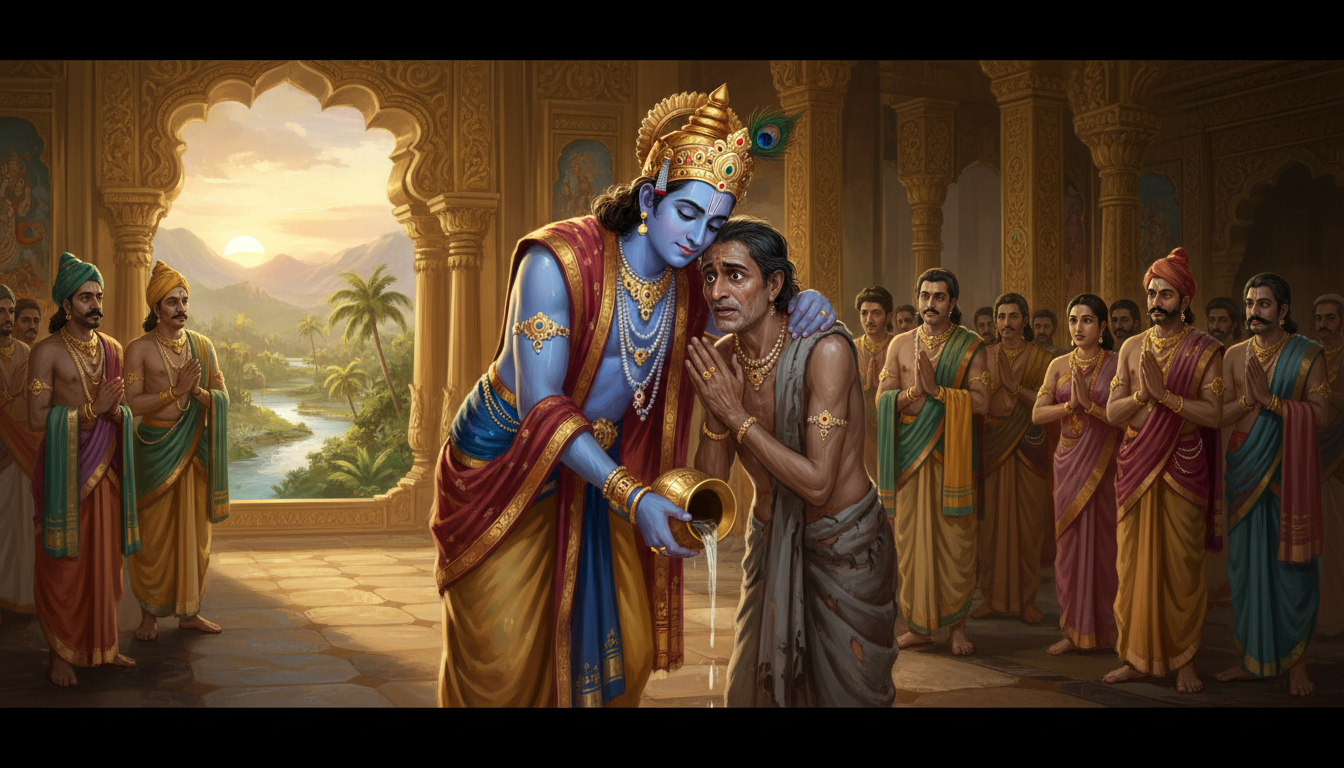
Bhagavad Gita Chapter 18, Verses 67-78: Delusion Gone, I Will Do Your Word
Transmission, Arjuna's answer, and Sanjaya's last verse
To Whom This May Be Given
The teaching is complete, and before Krishna asks whether it has landed, he sets conditions on its keeping.
Verse 18.67 is a closed door. This is never to be spoken by you to one who is without austerity, nor to one without devotion, nor to one who does not wish to hear, nor to anyone who speaks ill of me.
The restriction is easy to misread as priestly secrecy. It reads better as a statement about how understanding actually works. A teaching about acting without attachment to results is worse than useless to a mind that has no discipline to spend, no willingness to hear, and every incentive to twist it. Verse 18.17, that the man without ego-sense slays and does not slay, is the sort of line that becomes dangerous in a mouth looking for permission. The gate is set not to hoard the knowledge but to keep it from being weaponised.
Then the doors open wide. Verse 18.68 promises that whoever conveys this supreme secret to those devoted to me, performing the highest devotion to me, shall without doubt come to me. Verse 18.69 goes further than almost anything else in the poem: there is no one among men who does me dearer service, and there shall be no other on earth dearer to me. The highest place in Krishna's affection is given not to the ascetic or the warrior but to the one who passes the teaching on.
Verse 18.70 extends the circle again. He who studies this sacred dialogue of ours worships me with the sacrifice of knowledge, jnana-yajna. Reading, in this reckoning, is an offering.
And 18.71 opens it as far as it goes. Even the person who merely listens, with faith and without scorn, is liberated from evil and attains the happy worlds of the righteous. The requirement has been reduced to two things: attention, and the absence of contempt.
The Teacher's Question
Then Krishna stops, and asks.
Verse 18.72: "Has this been heard by you, Partha, with a one-pointed mind? Has the delusion born of ignorance been destroyed, Dhananjaya?"
It is worth pausing over how strange this is. The speaker has shown Arjuna the imperishable self, the field and its knower, the three gunas, the ladder of yogas, and his own universal form filling the sky with mouths and worlds. He is, by his own account in this very conversation, the origin of all beings. And he ends by asking a question he could presumably answer himself.
He asks anyway, and the asking is the last thing he teaches. The Gita does not conclude with a declaration that Arjuna has been enlightened. It concludes with an inquiry, put to the student, about whether the work has been done. Authority in this scene is not the power to pronounce a man cured. It is the willingness to check.
Notice what Krishna checks for. He does not ask whether Arjuna has understood the doctrine of the gunas, or can repeat the definition of tyaga, or accepts that the self is unborn. He asks two things: whether the listening was undivided, ekagrena cetasa, and whether the moha, the delusion, is gone.
That word moha reaches all the way back to the first chapter. It is the exact condition Arjuna described when his bow slipped from his hand, when his limbs failed and his mouth went dry and he sat down in the chariot saying he would not fight. The whole enormous teaching has been aimed at one specific symptom in one specific man on one specific morning. It was never an abstract lecture on metaphysics. It was a physician's response to a collapse.
So the question is really this: can you stand up?
And the poem waits, for one verse, on the answer of a man who has not spoken since verse 18.1.
Nashto Mohah
Arjuna answers, and his answer is the resolution of the entire poem. It deserves to be taken word by word.
Nashto mohah. The delusion is destroyed. He does not say it is easing, or that he sees the argument, or that he will try. He reports a thing already gone.
Smritir labdha. Memory has been regained. This is the most remarkable phrase in the verse, and everything turns on it. Arjuna does not say knowledge has been acquired. He says memory has been recovered. What he received on the battlefield was not, in the end, new information. It was the return of something he had always known and had lost track of in the panic - who he was, what the self is, what he was standing there to do. Despair had not made him ignorant. It had made him forgetful.
Tvat-prasadan maya acyuta. By your grace, O Acyuta. The recovery is not credited to his own effort. He names it as a gift, and calls Krishna by the name that means the one who does not fall away.
Sthito 'smi. I stand firm. The man who sank down onto the seat of the chariot in chapter one, casting aside bow and arrows, uses a word of standing. The physical collapse that opened the Gita is reversed in a single syllable.
Gata-sandehah. My doubts are gone.
Karishye vacanam tava. I will do your word.
That is verse 18.73, and it ends not in ecstasy, not in a vision, not in a vow of renunciation, but in the plainest sentence a person can say to someone they trust. I will do what you said.
The Gita's cure is measured by exactly one test, and this is it. Arjuna does not report bliss. He reports readiness. Eighteen chapters of the highest metaphysics ever set in verse arrive at a man who can now act - which was, from the first line, the only thing wrong with him.
The Listener in the Hall
And then, without warning, the chariot recedes and we are somewhere else entirely.
Verse 18.74 begins: Sanjaya said. The voice belongs to the charioteer's son who has been granted vision by the sage Vyasa, and he has been speaking from a hall in Hastinapura this whole time, describing the battlefield to a blind old king who cannot see it. Every word Krishna spoke to Arjuna has reached us through this man's report. The Gita has been a conversation overheard, relayed across a hundred miles to a father asking about his sons.
"Thus," Sanjaya says in 18.74, "have I heard this wonderful dialogue between Vasudeva and the great-souled son of Pritha, causing my hair to stand on end."
Verse 18.75 gives his credentials and his humility together. By the grace of Vyasa I have heard this supreme and most secret yoga directly from Krishna, the lord of yoga, speaking it in person.
Then two verses of pure, undisguised feeling. Verse 18.76: O king, remembering again and again this wondrous and holy dialogue between Kesava and Arjuna, I rejoice again and again. Verse 18.77: and remembering again and again that most wondrous form of Hari, great is my astonishment, and I thrill with joy again and again.
The repetition is not clumsiness. Sanjaya is a reporter, trained to give plain accounts of troop movements and the fortunes of the field, and here the language keeps circling because the experience will not sit still in it. He is describing what it is like to have been present at something too large for the vocabulary of a dispatch.
It matters that the poem gives its closing verses to him. Sanjaya is not the teacher and not the student. He is the third party, the one who was not addressed and had no stake in the argument, who happened to be listening. He is, in other words, the reader. And what he reports of the experience is not that he was instructed. It is that he was moved, and cannot stop remembering it.
Where Krishna Is, and the Archer
Then Sanjaya speaks the last verse of the Bhagavad Gita, and it is an answer to a question the blind king had asked long before, in the very first line of the poem, when he wanted to know what his sons and the sons of Pandu were doing, gathered on the field of dharma.
Verse 18.78: yatra yogesvarah krishno yatra partho dhanurdharah, tatra srir vijayo bhutir dhruva nitir matir mama. Wherever there is Krishna, the lord of yoga, and wherever there is Partha, the wielder of the bow, there are fortune, victory, prosperity and steadfast conduct; such is my conviction.
The whole war is decided in that sentence, and Dhritarashtra, who asked in hope, receives it as a verdict.
But notice how the poem chooses to end. Not with the formless absolute. Not with Arjuna dissolved in samadhi. The final image the Gita leaves in the mind is two figures on a chariot: one holding the reins, and one holding a bow. The teacher and the student, the divine and the human, counsel and capacity, standing side by side and about to work. Wisdom without a hand to act through, the verse implies, wins nothing; and a bow without wisdom behind it is just violence. Fortune follows the pair.
And then, in the epic, the conches sound and the battle resumes, with all its grief still ahead - a story told in full elsewhere.
That is the shape of the Gita's ending, and it is worth carrying. The teaching does not remove Arjuna from his situation. The armies are still drawn up, the kinsmen are still on the other side, the day will still cost more than he can bear to count. Nothing external has changed at all. What changed is the man, and the change is not that he found peace but that he found the ability to move.
Whoever reads this and expects the teaching to lift them out of their circumstances has misread the last verse. It puts you back in the chariot, and hands you the bow.
Dharma Lesson
A teaching is not finished when the teacher stops speaking; it is finished when the student can act. Arjuna's cure is described as recovered memory rather than new information, which suggests that clarity is less about acquiring something than about remembering what despair had hidden. And the Gita ends where it began, on a battlefield, with the work still to be done.