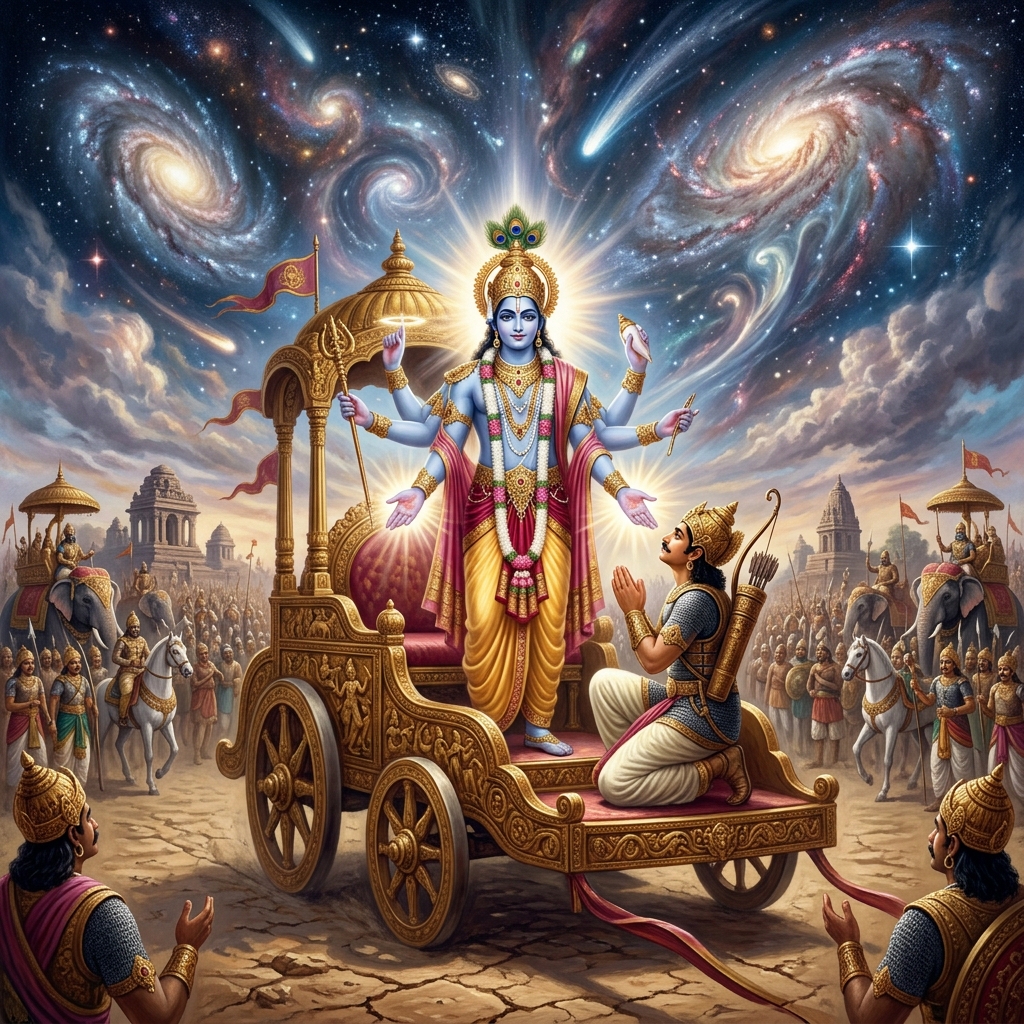
Bhagavad Gita Chapter 18: Liberation Through Renunciation
Moksha Sanyasa Yoga - The Final Teaching
Renouncing the Fruit, Not the Act
"Krishna," Arjuna said, "I wish to know the truth of renunciation, sannyasa, and of relinquishment, tyaga, and the difference between them."
It was, after everything, a plain question. The morning had been long, and he had been shown the imperishable self, the yoga of action, the form that had made him tremble and beg for the familiar face to return. What he wanted at the end was something he could carry in one hand.
"The sages understand sannyasa," Krishna said, "to be the laying aside of all works prompted by desire. The clear-sighted call tyaga the abandoning of the fruit of every work."
"Some say all action should be abandoned as an evil," Arjuna said. "Others say acts of sacrifice, gift and austerity should never be given up."
"Hear my conclusion, best of the Bharatas. Acts of sacrifice, of gift and of austerity are not to be abandoned. They must be performed. Sacrifice, gift and austerity are the purifiers of the wise. But even these works are to be done after abandoning attachment and the fruits. This is my certain and highest judgment."
Arjuna felt the ground steady under him. He had feared the final word would be a command to lay down the bow and walk away. Krishna was closing that escape.
"Renunciation of prescribed duty is not proper," Krishna went on. "To abandon it out of delusion is tamasic. He who abandons work because it is painful, or from fear of bodily trouble, performs a rajasic renunciation and gains nothing by it. But he who does the work that must be done because it must be done, letting go of attachment and of the fruit, his relinquishment is sattvic. He does not hate disagreeable work, nor cling to the agreeable."
The Five Causes of Every Deed
"It is not possible for an embodied being to give up actions entirely," Krishna said. "But he who gives up the fruits of action is called a true renouncer. For those who do not relinquish, the threefold fruit of action, pleasant, unpleasant and mixed, accrues after death. For the renouncer there is none at all."
"Then who acts?" Arjuna asked. "If I loose an arrow today, whose deed is it?"
"Learn from me, mighty-armed, the five causes declared for the accomplishment of every act. The seat of action, which is the body. The doer. The instruments of many kinds. The many separate movements of effort. And fifth among them, destiny, daiva."
Arjuna counted them against the act he was contemplating. The body braced in the chariot. Himself, the one who had chosen. The bow, the string, the shaft. And the fifth, which no man supplies: the wind, the hour, the turn of the field, everything that arrives uninvited and decides half the outcome.
"Whatever action a man undertakes with body, speech or mind, whether right or wrong, these five are its causes. That being so, the man of untrained understanding who looks upon himself as the sole agent does not see at all. He sees badly."
"And the one who sees rightly?"
"He whose state of mind is free from the sense of I am the doer, whose understanding is not stained, though he slay all these men, he does not slay, and he is not bound."
Arjuna was silent for a while. He understood that this was not permission to be careless with a life. It was the removal of the last hiding place, where a man might swell with pride at what his hands had done or collapse under the weight of it. Both rested on the same error: that the deed had one author, and that the author was him.
Knowledge, Action, and the Doer
"Knowledge, the object of knowledge and the knower form the threefold impulse to action," Krishna said. "The instrument, the act and the doer form its threefold basis. And knowledge, action and the doer are each of three kinds, according to the gunas. Hear how they differ."
He began with knowledge.
"That knowledge by which one sees the one imperishable being in all beings, undivided in the divided, know that to be sattvic. That knowledge which sees in all beings only separate entities of many kinds, know that to be rajasic. And that which clings to one single effect as if it were the whole, without reason, narrow and trivial, that is tamasic."
Arjuna turned to the field and saw all three at once. Somewhere in those ranks stood a man who could see the same life looking out from behind an enemy's helmet. Beside him stood ten thousand who saw only separate men, ours and theirs, to be counted and subtracted. And somewhere among them was a man who had fixed upon one grievance and let it become his entire world.
"An action performed as duty, free from attachment, done without love or hatred by one who seeks no fruit, is called sattvic. An action driven by desire, or done with egotism, or with great strain, is called rajasic. And an action undertaken from delusion, without regard for consequence, for loss, for injury done, or for one's own capacity, is called tamasic."
"And the doer himself?"
"The doer who is free from attachment, who does not speak of himself, who is filled with resolve and endurance, unmoved in success and failure, is called sattvic. The doer who is passionate, who craves the fruit of work, who is greedy, cruel, impure, swept by joy and sorrow, is called rajasic. And the doer who is undisciplined, vulgar, unbending, deceitful, malicious, lazy, despondent and slow, is called tamasic."
Poison at First, Nectar in the End
"Hear now the threefold division of the understanding and of resolve," Krishna said, "according to the gunas."
"That understanding, buddhi, which knows when to act and when to refrain, what is to be feared and what is not, what binds and what frees, that is sattvic. That understanding by which one wrongly grasps right and wrong, what should be done and what should not, that is rajasic. And that which, wrapped in darkness, takes wrong for right and sees all things reversed, that is tamasic."
Arjuna thought of the elders sitting silent in a hall while a queen was dragged across it, each certain he understood his duty.
"That resolve, dhriti, by which a man holds fast the workings of mind, breath and senses through unwavering yoga, is sattvic. That by which he holds fast to duty, pleasure and wealth with attachment, longing for their fruits, is rajasic. And that by which a fool will not let go of sleep, of fear, of grief, of despair and of conceit, that resolve is tamasic."
"Then even endurance can be a fault," Arjuna said.
"A man may hold on to his own sorrow with the same grip he would need to be free of it," said Krishna. "Now hear from me the threefold happiness, in which a man rejoices by long practice and comes to the end of pain."
"That which is like poison at first and like nectar at the end, born of the clear serenity of one's own mind, that happiness is sattvic. That which arises from the meeting of the senses with their objects, like nectar at first and poison at the end, that is rajasic. And that happiness which deludes the self both at the beginning and afterward, arising from sleep, sloth and heedlessness, that is declared tamasic."
Arjuna knew both flavours well. He had tasted the second at dice. He had tasted the first in twelve years of forest.
Better One's Own Duty
"There is no being on earth, nor among the gods in heaven, free from these three gunas born of nature," Krishna said. "The duties of the brahmanas, the kshatriyas, the vaishyas and the shudras are distributed according to the qualities born of their own inner nature, svabhava."
"Serenity, self-restraint, austerity, purity, patience, uprightness, knowledge, realization and faith in what is beyond: these are the duties of the brahmana, born of his nature. Heroism, vigor, firmness, skill, not fleeing in battle, generosity, and the bearing of authority: these are the duties of the kshatriya, born of his nature."
Arjuna heard his own life read back to him in a single line, and did not look away.
"Ploughing, protecting the herds and trade are the duties of the vaishya, born of his nature. And work of service is the duty of the shudra, likewise born of his nature."
"A man attains perfection," Krishna said, "by devotion to his own duty. By worshipping, with his own proper work, that one from whom all beings arise and by whom all this is pervaded, a man attains perfection."
Arjuna understood that this was the door being held open for him: not a lesser path grudgingly allowed a soldier, but the same door as any other, entered through the work that was his.
"Better is one's own duty, though imperfectly performed, than the duty of another well performed. He who does the work laid down by his own nature incurs no stain. One should not abandon the work to which one is born, even if it is flawed, Arjuna, for all undertakings are clouded by defect as fire is clouded by smoke."
"Then no work is clean," said Arjuna.
"No work is clean. Only the doing of it can be. He whose understanding is unattached everywhere, who has conquered himself and is free from longing, attains through renunciation the supreme perfection of freedom from action."
Abandoning All Dharmas
"Learn from me in brief, Arjuna, how a man who has attained perfection reaches Brahman, the highest state of knowledge. Endowed with a pure understanding, restraining himself with firmness, turning away from the objects of sense, casting aside liking and hatred, dwelling in solitude, eating little, controlling speech, body and mind, ever absorbed in meditation, released from egotism, force, arrogance, desire, anger and possession, at peace and free from the sense of mine, he becomes fit to be one with Brahman."
"Having become Brahman, serene in spirit, he neither grieves nor desires. Regarding all beings as alike, he attains supreme devotion to me. By devotion he comes to know me, who I am in truth, and having thus known me he enters into me immediately."
Something in the air between them changed, the way it does when a man who has spoken all morning is about to say the one thing he came to say.
"Fix your mind on me," Krishna said. "Be devoted to me. Sacrifice to me. Bow down to me. So shall you come to me. I promise you truly, for you are dear to me."
And then, quietly: "This is the most secret of all, the deepest knowledge. Since you are dear to me, I shall tell you what is for your good."
He said it once, without ornament.
"Abandoning all dharmas, take refuge in me alone. I will free you from all sins. Do not grieve."
Sarva-dharman parityajya. Arjuna did not move. Everything else that morning had been given as instruction, to weigh and apply. This was a hand held out.
"Never speak this to one who is without austerity, or without devotion, or who does not wish to hear, or who speaks ill of me," Krishna said. "But he who declares this supreme secret to my devotees shall doubtless come to me. Have you heard this, Arjuna, with a concentrated mind? Has your delusion, born of ignorance, been destroyed?"
Where Krishna Is, and Where Arjuna Is
Arjuna lifted his head. The bow that had slipped from his hands at the beginning of the morning was in his grip again, and he had not noticed picking it up.
"My delusion is destroyed," he said. "My memory has been restored through your grace. I stand firm, and my doubts are gone. I will act by your word."
Far away, in a palace at Hastinapura, a blind king sat in a hall with his charioteer beside him, and the charioteer was shaking.
Sanjaya had been given sight by the grace of Vyasa, and through it he had heard every word of the supreme and secret yoga spoken by Krishna in the presence of Arjuna. Now he had to hand it on to a man who had asked only what his sons were doing on the field of dharma.
"O king," Sanjaya said, "remembering again and again this wondrous and holy dialogue between Krishna and Arjuna, I rejoice, and I rejoice again. And remembering again and again that most wondrous form of Krishna, great is my astonishment, and I rejoice again and again."
Dhritarashtra said nothing. He had asked about armies, and even blind he could feel that he was being given something else.
"Wherever there is Krishna, the lord of yoga," said Sanjaya, and his voice was steady now, "and wherever there is Arjuna the archer, there will surely be fortune, victory, prosperity and firm justice. This is my conviction."
On the plain, the conches were being lifted. The teaching was over and the day was still to be fought, and nothing about the field had changed: the same ranks, the same kinsmen, the same grandfather with his white banner at the head of the other line. Only the man in the chariot had changed. He raised the Gandiva, and the sound of the tested string carried far in the still air.
Dharma Lesson
The Gita ends not by releasing anyone from work but by changing what the work is for. Do the thing in front of you because it is yours to do, let go of what it will earn you, and offer the doing itself. Your own duty done badly is worth more than a borrowed one done beautifully, because only your own can be offered honestly. And when even duty grows too tangled to read, Krishna's last word is to stop calculating and take refuge, which is the one act that asks nothing of a person except that he stop pretending he can carry it alone.