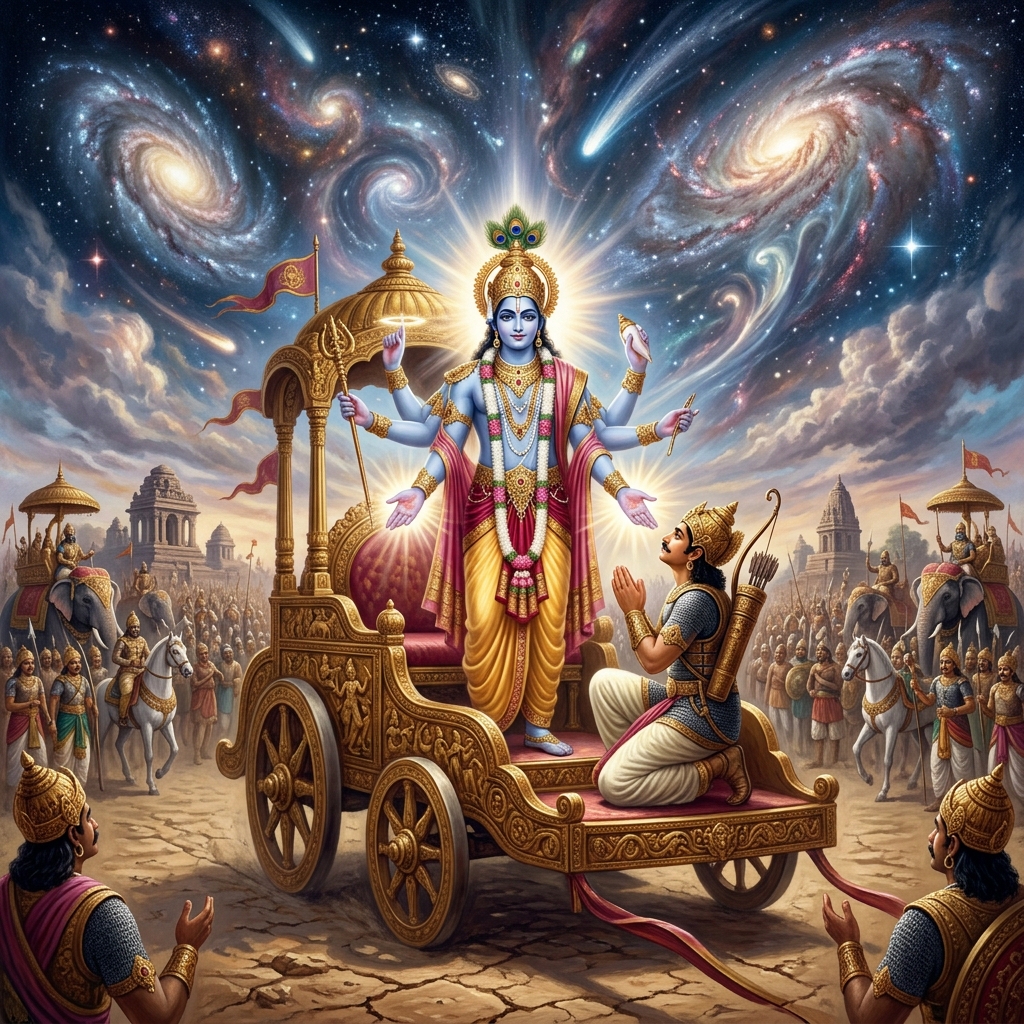
Bhagavad Gita Chapter 17: The Three Kinds of Faith
Shraddhatraya Vibhaga Yoga - Faith, Food, Sacrifice, and Charity
As His Faith Is, So Is He
Arjuna had heard the closing word of the teaching on the two destinies, that scripture should be a man's authority in deciding what to do, and it left him with a question he could not put down.
"Krishna," he said, "what of those who set aside the ordinances of scripture and yet make their offerings full of faith? What is their condition? Is it sattva, or rajas, or tamas?"
It was a generous question, and Krishna received it as such. Arjuna was not asking about hypocrites. He was asking about the sincere man who has never been taught, the villager who lays flowers at a stone with his whole heart because no one ever told him otherwise.
"The faith of embodied beings," Krishna answered, "is of three kinds, born of their own nature: sattvic, rajasic and tamasic. Hear now of these."
He let a moment pass, and then said the sentence that Arjuna would carry for the rest of the day.
"The faith of every man conforms to his essential nature, Arjuna. A man is made of his faith. As his faith is, so is he."
Arjuna sat with that. He had assumed all his life that a man had beliefs the way he had possessions, holding them, setting them down, exchanging one for another as the years taught him better. Krishna was saying something else. Faith was not a thing a man held. It was the shape of the hand that did the holding. Whatever a person trusted at the bottom of himself, before any argument reached him, was not a piece of him but the pattern the rest of him grew along.
"Then a man cannot simply decide to believe differently," Arjuna said.
"He cannot decide it in a moment," Krishna said. "But faith reveals itself in what a man worships, in what he eats, in what he calls discipline and in how he gives. Change those, patiently, and you have reached down to the root."
What Men Worship, and What They Eat
"Men of sattva worship the gods," Krishna said. "Men of rajas worship the yakshas and the rakshasas, the spirits of power and appetite. And men of tamas, sunk in darkness, worship the ghosts of the dead and the hosts of nature-spirits."
Arjuna understood at once that this was not a ranking of shrines but of hungers. A man reaches toward the kind of power he most wants to be like. One asks the gods for light and order; another asks the spirits of force for advantage over rivals; a third bargains in the dark with whatever will answer.
"There are those," Krishna went on, "who practise fierce austerities not enjoined by scripture, driven by hypocrisy and egotism, by the force of lust and attachment, tormenting the elements in their own bodies and me who dwell within. Know that their resolve is demonic."
Then he turned, unexpectedly, to something ordinary. "Even the food that is dear to men is of three kinds, Arjuna, and so are sacrifice, austerity and gift. Hear how they differ."
Arjuna, who had eaten from golden dishes in a palace and from a leaf plate in a forest, leaned in.
"Foods that increase life, clarity, strength, health, ease and gladness, foods that are savoury, smooth, firm and pleasant, these are dear to the sattvic. Foods bitter, sour, salty, excessively hot, sharp, harsh and burning, these are craved by the rajasic, and they bring pain, grief and disease. And food that is stale, tasteless, gone cold, putrid, left over from another's plate and unfit for offering, this is dear to the tamasic."
It struck Arjuna as almost too small a matter for such a morning. Then he thought of the men behind him in the ranks, and what they had eaten before dawn, and how a man's temper on a battlefield is not built in the hour before the conches sound. Nothing, it seemed, was too small to be part of what a man was becoming.
The Offering and the Threefold Austerity
"Sacrifice too is of three kinds," Krishna said. "That sacrifice is sattvic which is offered according to the rule by men who desire no fruit from it, whose minds are settled in the conviction that this simply is to be done."
Arjuna heard the emphasis. Not offered for rain, not for sons, not for victory. Offered because the offering was right.
"But that which is offered with an eye on its fruit, or for the sake of display, know that to be rajasic. And the sacrifice performed against the rule, in which no food is distributed, no sacred word is spoken, no gift is given, and which is empty of faith, that is called tamasic."
"And austerity?" Arjuna asked. "Men mean many things by that word. Some of them frighten me."
"Austerity, tapas, has three fields," Krishna said, "the body, the speech and the mind, and each must be understood in turn."
"Reverence for the wise and the pure, uprightness, restraint, non-violence: this is called the austerity of the body."
Arjuna noted what was absent from that list. No fasting unto ruin, no lying on thorns, no punishment of the flesh at all. Only the discipline of using the body well and harming nothing with it.
"Speech that causes no distress, that is true, pleasant and beneficial, together with the regular recitation of what is sacred: this is called the austerity of speech."
He named four conditions, and Arjuna weighed each. That it not wound. That it be true. That it be pleasant to hear. That it do good. He thought of how few sentences spoken in the hall at Hastinapura would have passed all four gates, and of how much of the day ahead had been made by the ones that did not.
"Serenity of mind, gentleness, silence, self-restraint, purity of purpose: this is called the austerity of the mind. It is not what a man denies himself, Arjuna, but what he no longer needs to be defended from."
Three Modes of Discipline, Three Kinds of Giving
"This threefold austerity," Krishna said, "practised with the highest faith by men who are steady and who desire no reward, is called sattvic."
"And when a man wants something from it?"
"Austerity performed for the sake of honour, respect and reverence, or for show, is called rajasic here. It is unsteady and does not last. A man who fasts to be seen fasting is not disciplining his appetite; he is feeding it by another mouth."
Arjuna almost smiled. He had known such men, and had once or twice been one.
"And austerity performed under a deluded notion of the self, with self-torture, or to destroy another, is called tamasic. Discipline turned into a weapon is the darkest use to which discipline can be put."
Then Krishna spoke of giving, and this Arjuna had not expected to be difficult. A gift was a gift. Yet Krishna divided it as finely as the rest.
"That gift which is given because it ought to be given, to one who can make no return, at the right place and the right time, and to a worthy person, is held to be sattvic."
Three conditions, Arjuna counted. That it be given as duty and not as impulse. That the receiver be unable to repay, so that nothing comes back, not even the small coin of obligation. That it be placed where and when it will actually do good, for a gift dropped at the wrong hour is only a gesture.
"But that gift which is given reluctantly, or with an eye on what will be returned, or looking to the fruit of it, is held to be rajasic. And the gift given at the wrong place and the wrong time, to unworthy persons, without regard, or with contempt, that is declared to be tamasic."
"Then a gift can wound," Arjuna said.
"A gift given with contempt," Krishna answered, "has already taken more than it gave."
Om Tat Sat
"Om Tat Sat," Krishna said. "This has been declared to be the threefold designation of Brahman. By this were ordained of old the sacred word, the sacrifices and the offerings."
Arjuna knew the syllables the way he knew the sound of his own name, having heard them at every fire since childhood without once asking what they carried.
"Therefore," Krishna said, "acts of sacrifice, of gift and of austerity, as laid down by the ordinance, are always begun with the utterance of Om by those who study the sacred word. With the word Tat, meaning That, and desiring no fruit for themselves, the various acts of sacrifice, austerity and gift are performed by those who seek release. For That is not any thing a man can hold. It is what stands behind all things, and to say it over an offering is to loosen one's grip on the offering."
"And Sat?" Arjuna asked.
"The word Sat is used for reality and for goodness, and it is also applied to any act that is praiseworthy. Steadfastness in sacrifice, in austerity and in giving is likewise called Sat, and any act done for the sake of That is called Sat."
Arjuna saw the shape of it then. Three words laid over an act like three seals: Om, which turns the act toward the whole; Tat, which strips the doer's claim upon its fruit; Sat, which asks whether the thing is good and true in itself. An offering that could carry all three seals needed no further defence.
"And then the last word," Krishna said, and his voice fell. "Whatever is offered in sacrifice, whatever is given, whatever austerity is performed, and whatever is done, if it is without faith, it is called asat, Arjuna. It is nothing. It is of no account here, and of none hereafter."
The armies stood in their ranks. Arjuna looked at his own hands on the bow and asked himself, for the first time, not what he would do with them today, but with what faith.
Dharma Lesson
What a person believes in, at the level below argument, quietly decides what he eats, what he worships, what he calls discipline and how he gives. Krishna's teaching is that these are not separate choices but one nature showing itself in many small acts, and that the way to change the nature is to change the acts. A gift given at the right time to someone who cannot repay it, a word spoken that is true and does not wound, a meal taken for strength rather than for excitement: these are how faith is made clean. Without faith behind it, no offering, however costly, amounts to anything.