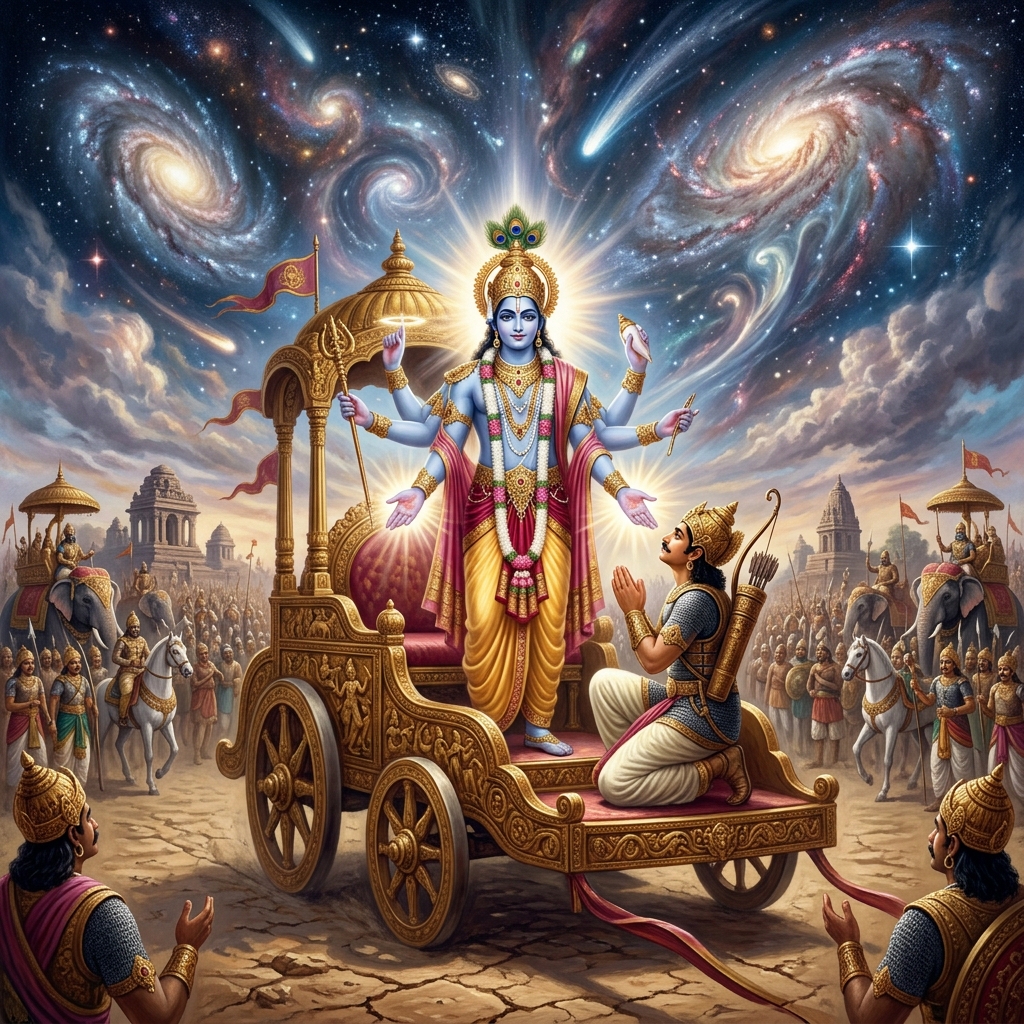
Bhagavad Gita Chapter 16: Divine and Demonic Natures
Daivasura Sampad Vibhaga Yoga - The Two Destinies
The Wealth Born of the Gods
The sun stood high over Kurukshetra now, and the two armies held their ranks as they had held them since dawn, spear points steady, banners barely stirring in the heat. Between them the chariot kept its ground, and in the quiet that had gathered around it Krishna began, without preamble, to name a certain kind of man by naming what such a man is made of.
"Fearlessness," he said. "Purity of heart. Steadfastness in the yoga of knowledge. Giving. Self-restraint. Sacrifice. The study of what is sacred. Austerity. Straightforwardness."
Arjuna listened, and heard that this was not a rule being handed down but an inventory being taken. Krishna was not telling him to acquire these things. He was describing what is already present in some men the way strength is present in a bow, whether or not the bow has yet been drawn.
"Non-violence," Krishna went on. "Truth. Freedom from anger. Renunciation. Tranquility. Absence of fault-finding in others. Compassion toward all beings. Freedom from greed. Gentleness. Modesty. Absence of fickleness."
He named them slowly, one after another, as a man might count out coins from a purse to show that the purse is full. And then the last of them: "Vigor. Forgiveness. Fortitude. Cleanliness. Freedom from malice, and freedom from pride."
"These, Arjuna, belong to one born to the divine endowment, the daivi sampad."
Arjuna turned the list over. It was a strange kind of wealth. Not one item on it could be taken from a man by force, and not one of them could be seized by force either. Vigor sat beside gentleness without contradiction; fearlessness sat beside modesty. It was, he realized, a description of a person who has nothing left to defend, and who therefore has no reason to be cruel.
Do Not Grieve, You Are Born to the Divine
"Hear now the other," Krishna said, and the second list was far shorter, as though such a nature required fewer words to exhaust it.
"Hypocrisy. Arrogance. Self-conceit. Anger. Harshness. Ignorance. These, Arjuna, belong to one born to the demonic endowment, the asuri sampad."
Six words against the twenty-six that had come before. Arjuna noticed the imbalance and understood it. The divine nature had needed a long naming because it opened in many directions, each virtue a door onto another. The demonic nature needed six because it kept circling the same small room: a self insisting on itself, and everything else arranged around that insistence.
"The divine endowment leads to liberation," Krishna said. "The demonic leads to bondage." Then his voice changed, and he spoke not as a teacher setting out categories but as a friend who had seen a man's face go pale. "Do not grieve, Arjuna. You are born to the divine destiny."
It was the second time that morning that Krishna had told him not to grieve, and Arjuna felt the difference between the two occasions. Earlier he had grieved for his kinsmen. Now, hearing the two natures set side by side and thinking of the arrows he would loose before evening, he had begun to grieve for himself, wondering which list his own name belonged to when the day was done.
"There are two kinds of beings brought forth in this world," Krishna continued, "the divine and the demonic. The divine I have described at length. Hear now from me, Arjuna, of the demonic, and of how such men see the world they walk in. For a man is not made a demon by his weapons or his enemies or the blood on his hands. He is made so by what he believes about the world, and by what that belief permits him to want."
A World Without Truth
"Men of demonic nature," Krishna said, "know neither what is to be done nor what is to be refrained from. Purity is not found in them, nor good conduct, nor truth."
Arjuna waited. He had expected a catalogue of crimes and was given instead a catalogue of blindness, which he began to see was the older thing.
"They say the world is without truth, without foundation, without a lord. They say it did not arise from any order, and is caused by desire alone, and by nothing else."
The words hung there in the hot air. Arjuna thought about what a man would be free to do if he held that view honestly. If there were no truth beneath appearances, then a lie was only a sound arranged more usefully than another sound. If there were no order holding things together, then no act could carry any consequence beyond the one a man could see with his own eyes. If the world were the child of appetite alone, then appetite was the only lawful ruler, and everything and everyone in reach was raw material.
"Holding to this view," Krishna said, "these lost souls of small understanding and cruel deeds come forth as enemies of the world, for its destruction. Filled with desire that can never be satisfied, full of hypocrisy, pride and arrogance, holding false ideas through delusion, they act with impure resolve."
"Then it begins in the mind," Arjuna said quietly, "and not in the hand."
"It begins in what a man decides the world is," Krishna answered. "The hand only follows. A man who believes there is nothing to be true to will find, in time, that there is nothing he will not do, and he will not experience this as wickedness. He will experience it as clear sight. That is the cruelty of the thing. It does not announce itself as darkness. It announces itself as freedom from illusions that other men are too soft to give up."
This I Have Gained Today
"Giving themselves over to cares beyond measure, which end only with death," Krishna said, "holding that the satisfying of desire is the highest aim, certain that this and no more is all there is, bound by a hundred cords of hope, given over wholly to lust and anger, they strive to heap up wealth by unjust means for the enjoyment of their cravings."
Then he did something he had not done before that morning. He gave the demonic man his own voice, and let Arjuna hear him speak.
"This I have gained today; that longing I shall obtain tomorrow. This wealth is mine, and that also shall be mine. This enemy I have slain, and the others also I shall slay. I am the lord. I am the enjoyer. I am successful, powerful, happy. I am rich and highborn. Who else is equal to me? I shall sacrifice, I shall give gifts, I shall rejoice."
Arjuna felt the words land like a stone dropped into still water. He had heard that voice. He had heard it across a gaming hall in Hastinapura, and in a court where a woman was dragged by her hair while elders studied the floor. He had heard it, on certain nights, somewhere close to the inside of his own skull.
"So they speak," Krishna said, "deluded by ignorance, bewildered by many thoughts, wrapped in the net of delusion, addicted to the enjoyment of desires. They fall into a foul hell. Self-conceited, stubborn, drunk on wealth and pride, they perform sacrifices in name only, for show, and not according to any rule."
"And after?" Arjuna asked.
"Clinging to egotism, force, insolence, lust and anger, these envious men hate me in their own bodies and in the bodies of others. These cruel haters, lowest of men, I cast again and again into demonic wombs. Birth after birth, deluded, never reaching me, they sink from there to the lowest state of all."
The Three Gates
"Then how does a man guard himself?" Arjuna asked. "You have described a road, Krishna, and a man walking it does not know he is on it. He believes he is thriving."
"There are three doors," Krishna said, "and everything that ruins a man comes through one of them. Threefold is this gate of hell, destroying the self: desire, kama; anger, krodha; and greed, lobha. Therefore let a man abandon these three."
Arjuna considered them and saw how they held hands. Desire reaches for what is not yet his. Anger flares when the reaching is blocked. Greed refuses to let go of what the reaching brought back. Three doors, but one corridor running between them, and a man could enter by any and find himself in all.
"A man freed from these three gates of darkness works out his own welfare," Krishna said, "and thereby reaches the supreme goal. But he who casts aside the ordinances of scripture and acts under the drive of his own desire attains neither perfection, nor happiness, nor the highest way."
"And when a man cannot tell," Arjuna said, "which of his impulses is desire wearing the mask of duty?"
"Then let scripture be your authority in determining what is to be done and what is not to be done. Knowing what is declared by the ordinance of the sacred word, you should act here in this world."
Arjuna understood the mercy in that. Krishna was not telling him to trust his own certainty, because certainty was precisely the thing the demonic man had in abundance. He was pointing instead to something older than any single man's hunger, a measure handed down and tested across generations, against which a person could hold his own resolve and see whether it stood straight.
The armies waited. Between them, in the small stillness around the chariot, Arjuna set the three gates in his mind and quietly closed them, one by one.
Dharma Lesson
Character is not a decoration laid over a life; it is the road the life will travel. Fearlessness, honesty, restraint and compassion open outward into freedom, while hypocrisy, arrogance and cruelty close a person inside an appetite that can never be filled. Krishna names desire, anger and greed as the three doors through which every ruin enters, and says that shutting them is the whole of the work. When a person cannot see clearly what should be done, the tested wisdom handed down to him is the lamp, not his own craving.