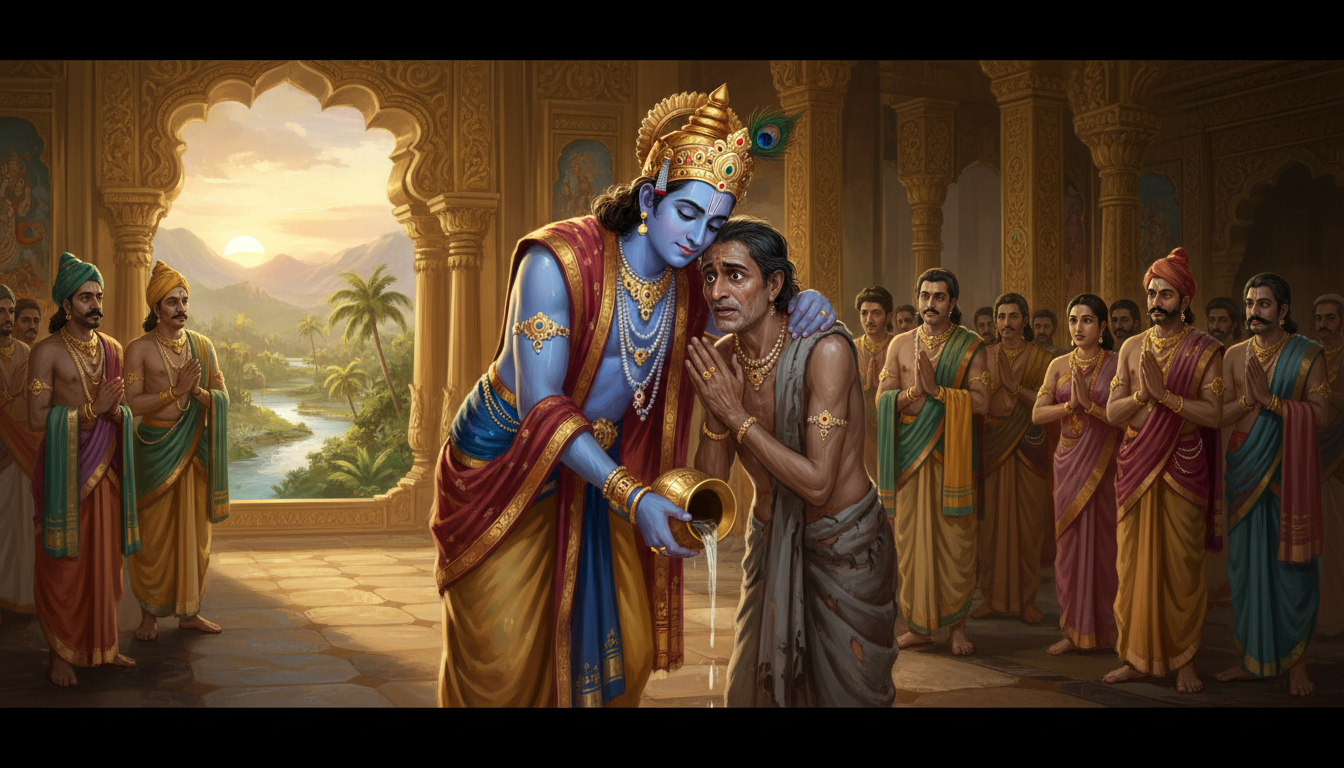
Bhagavad Gita Chapter 18, Verses 41-66: Your Own Work, and the Final Refuge
Prakriti will compel you, so choose freely and surrender
Work Born of One's Own Nature
Having finished the table of the gunas, Krishna turns from analysis to assignment. Verse 18.41 states the principle: the duties of brahmanas, kshatriyas, vaishyas and sudras are distributed according to the qualities born of their own nature, svabhava.
Then he sketches each. In 18.42 the brahmana's work is calm, self-restraint, austerity, purity, patience, uprightness, knowledge, discernment and faith in what is beyond the senses. In 18.43 the kshatriya's work is heroism, vigour, firmness, resourcefulness, refusal to flee from battle, generosity and the bearing of a leader. In 18.44 the vaishya's is agriculture, the tending of cattle and trade, and the sudra's is work of service.
Two readings of these verses have long stood side by side, and honesty requires naming both. The classical reading, held by most of the tradition and by the epic itself, takes the four orders as the inherited social divisions of the world Arjuna lived in, and reads the verse as telling each person to do the work of the station they were born into. The second reading leans on the phrase Krishna actually uses, svabhava-prabhavair gunaih, qualities born of one's own nature, and on 4.13, where he says the four orders were created by him according to the distribution of guna and karma, quality and work, not by birth. On that reading the categories describe temperaments, and a person is placed by what they actually are.
The verses will not settle the argument by themselves, and it does no service to make them say more than they say. What is beyond dispute is the use Krishna puts them to. He is not building a hierarchy of worth here; he is answering a man who wants to trade his own work for someone else's because his own has become unbearable.
The whole force of the passage falls on the next verses. Whatever the category, the instruction is the same: the way through is not somebody else's life. It is the one in front of you, done rightly.
Fire and Smoke
Verse 18.45 states the promise plainly. Devoted each to his own duty, a person attains perfection. Then Krishna explains how such a thing could possibly be true, and the explanation lifts the whole subject out of sociology.
Verse 18.46 is the hinge: he from whom all beings arise, by whom all this is pervaded, worshipping him with one's own work, a person attains perfection. Ordinary labour becomes an act of worship, not by adding a ritual to it, but by the direction in which it is offered. The farmer's field and the archer's bow become altars. Nothing in the task changes. Everything about its address changes.
Verse 18.47 then repeats, almost word for word, a line Arjuna first heard back in 3.35: sreyan sva-dharmo vigunah, better is one's own duty though imperfectly performed than the duty of another well performed. Doing the work ordained by one's own nature, one incurs no stain. The repetition is deliberate. In chapter three the words were an argument; here, after fifteen chapters of metaphysics, they arrive as a conclusion.
And Krishna knows the objection forming in Arjuna's mind, because it is the objection every serious person raises. What if my own work is dirty? What if it involves killing kinsmen?
Verse 18.48 meets it head on. One should not abandon the work born with him, even if it is flawed, for all undertakings are enveloped by defect, as fire is enveloped by smoke.
There is no clean job. There is no career, no household, no vocation, no cause that comes without its attendant harm, its compromises, its share of soot. The seeker who waits for a blameless task to appear will wait forever, and will call the waiting purity. Krishna's counsel is not to accept wrongdoing but to stop treating the unavoidable smoke of embodied life as proof that the fire should never have been lit.
The Ascent, and Its Surprise
From verse 18.49 the chapter climbs. He whose understanding is unattached everywhere, whose self is conquered, from whom desire has departed, attains by renunciation the supreme perfection of actionlessness. The word is naishkarmya, and it does not mean idleness. It means acting without accumulating.
Verse 18.50 promises to show how such a person reaches Brahman, which Krishna calls the highest state of knowledge, and the next three verses give the method as a plain list. Purified intelligence. The self held with firmness. Sound and the other objects of sense set aside. Attraction and aversion cast off. A quiet place, light eating, speech and body and mind controlled. Constant practice of dhyana-yoga, taking refuge in dispassion. And, in 18.53, the pieces that must be put down: egotism, force, arrogance, desire, anger and possessiveness. Free of the sense of mine, at peace, such a one is fit for union with Brahman.
Then comes 18.54, one of the summit verses of the Gita. Brahma-bhutah prasannatma na socati na kanksati. Having become Brahman, serene in the self, he neither grieves nor craves; equal toward all beings, he attains supreme devotion to me.
Read that ending again, because it is the surprise of the whole chapter. The path has climbed through discipline, solitude and the dissolution of the ego into the impersonal absolute, and at the top of that climb it does not stop. It flowers into bhakti. In most maps of the spiritual life, love is the beginner's road and formless realisation the destination. Krishna reverses the order. Devotion is not what you practise until you know better; it is what breaks out when there is finally no ego left to obstruct it.
Verse 18.55 completes the circuit. By devotion he comes to know me in truth, what and who I am; and having known me in truth, he enters into me immediately after. Knowledge leads to love, and love to knowledge of a deeper kind, and that knowledge to entry.
Mounted on a Machine
Then the teaching turns back to the man in the chariot, and hardens.
Verse 18.56 keeps him in the world: doing all works always, taking refuge in me, he attains by my grace the eternal, imperishable abode. Verse 18.57 gives the practice in one line - mentally surrendering all actions to me, holding me as the highest aim, resorting to buddhi-yoga, think on me constantly. Verse 18.58 states both outcomes without softening either. Thinking of me, you shall cross over every difficulty by my grace; but if from egotism you will not listen, you shall perish.
And then the hardest passage in the Gita, the one aimed at Arjuna's opening refusal like an arrow.
Verse 18.59: if, filled with self-will, you think I will not fight, that resolve of yours is vain, for your own nature will compel you. Verse 18.60: bound by your own karma, born of your nature, that which from delusion you do not wish to do, you will do helplessly, in spite of yourself.
This is not a threat. It is an observation about the kind of creature Arjuna is. A kshatriya who has stood in the field with a bow in his hand does not become a forest ascetic by an act of announcement on the morning of battle. The nature built over a lifetime will assert itself, and the man who has refused consciously will act anyway, unconsciously and worse. The choice was never between acting and not acting. It was between acting with clarity and being dragged.
Verse 18.61 widens the frame to include everyone. The Lord dwells in the heart of all beings, causing them to revolve by his maya as though mounted upon a machine. The image is startlingly mechanical, and it is meant to be. Left to themselves, beings are turned like figures on a wheel.
Verse 18.62 offers the one exit. Take refuge in him with your whole being; by his grace you shall attain supreme peace and the eternal abode.
Do As You Wish
Having said that nature will compel him, Krishna does something remarkable. He hands the decision back.
Verse 18.63: thus has wisdom more secret than all secrets been declared to you by me; reflect on it fully, and then do as you wish. Yathecchasi tatha kuru. After eighteen chapters, after the vision of the universal form, after the warning that prakriti will override refusal, the teacher does not command. He tells his student to think it over and choose.
That single clause governs how everything before it should be read. The Gita is not an instrument of coercion. Its argument is offered to a free mind and waits on consent.
Then, in 18.64, Krishna says he will speak once more, the most secret of all, because Arjuna is dearly loved. Verse 18.65 gives it in its simplest form: fix your mind on me, be devoted to me, sacrifice to me, bow to me; you shall come to me, truly I promise you, for you are dear to me.
And then verse 18.66, the carama sloka, the verse that whole schools of thought have been built upon: sarva-dharman parityajya mam ekam saranam vraja, aham tvam sarva-papebhyo mokshayishyami ma sucah. Abandoning all dharmas, come to me alone for refuge; I shall free you from all sins, do not grieve.
Commentators have disputed for a thousand years what abandoning all dharmas means. Some read it as the surrender of every other means of liberation in favour of one. Others read it as letting go of the anxious sense of being the one who must get his duties right. The tradition has never agreed, and the verse is large enough to hold the argument.
What is unmistakable is its tone. The chapter that began with a careful analysis of duties ends by telling a man to stop carrying them alone. The last two words are the plainest in the poem: ma sucah. Do not grieve. The teaching that opened with Arjuna weeping over his own dharma closes by lifting the weight of it off him.
Dharma Lesson
The work that suits your own nature, done as an offering, is worth more than a finer task performed badly out of envy. No undertaking is free of defect, so waiting for a clean one is a way of never starting. And freedom, in the Gita's last word on it, is not the absence of surrender but the choice of what to surrender to.