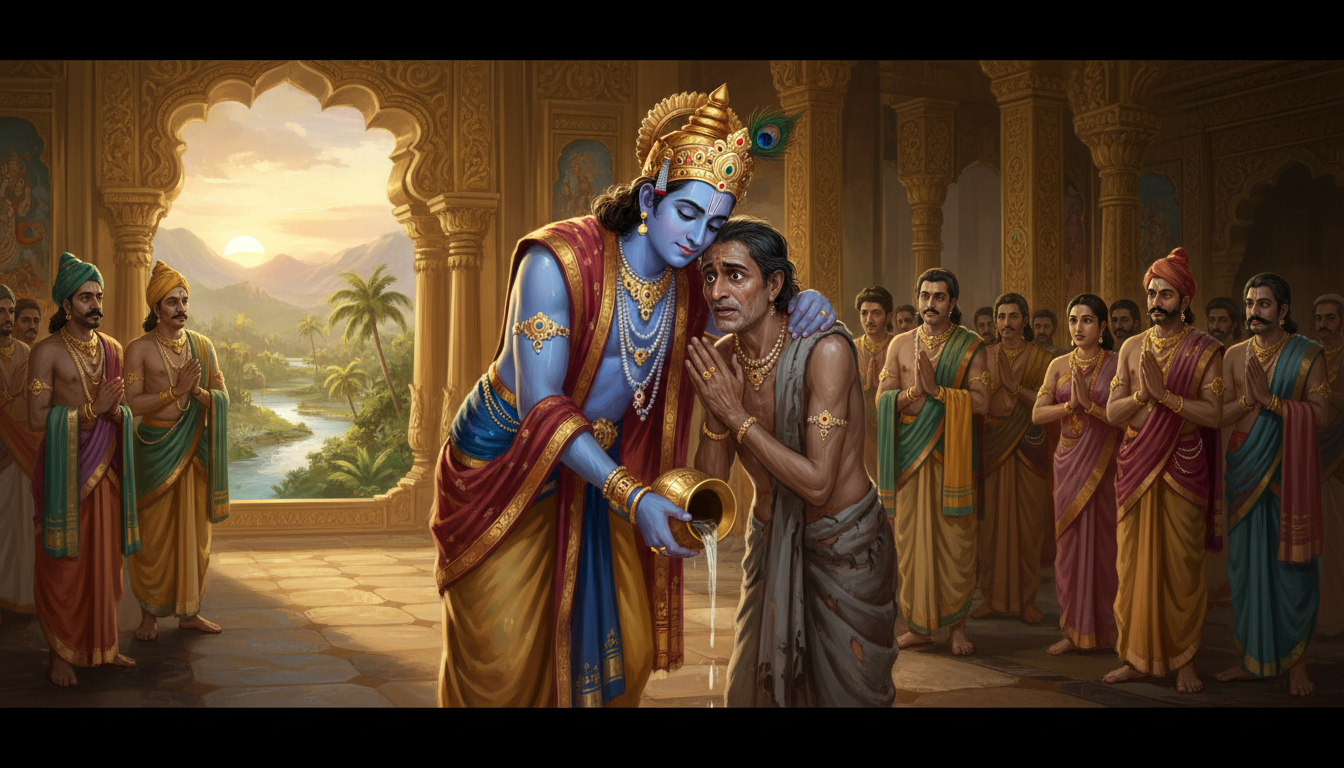
Bhagavad Gita Chapter 18, Verses 1-40: Renunciation Rightly Understood
Tyaga, the five factors, and the great threefold table
The Last Question
The seventeenth chapter had closed, and for a moment there was no sound around the chariot but the shifting of the white horses. Arjuna had asked a great deal that morning. Now he gathered the whole day's teaching into one last request.
"Krishna," he said, "I wish to know the truth of sannyasa, and of tyaga also, and how the one differs from the other."
That is verse 18.1, and it is the final question of the Bhagavad Gita. Everything after it is Krishna speaking, uninterrupted, until the very end. Arjuna has heard about action without attachment for seventeen chapters, and what he wants now is the vocabulary made exact. Is renunciation the giving up of works, or the giving up of something inside the works?
Krishna answers by reporting the disagreement honestly before settling it. In verse 18.2 he says that the wise call sannyasa the laying down of actions driven by desire, while tyaga is the surrender of the fruit of all action. In 18.3 he notes the two camps plainly: some thinkers hold that all action should be abandoned as a defect, and others say that acts of sacrifice, gift and austerity must never be abandoned at all.
Then he gives his own verdict. In 18.4 he declares tyaga itself to be threefold, and in 18.5 he rules: acts of sacrifice, of giving, and of austerity are not to be given up but performed, for they purify the wise. Yajna, dana and tapas survive every renunciation, because they are the very instruments by which a mind is cleaned of the grasping that renunciation is meant to cure.
In 18.6 he tightens the screw one turn more. Even these must be done with attachment and fruits let go. "This," he says, "is my highest and settled opinion." So the line is drawn. Sannyasa drops the desire-born deed. Tyaga keeps the deed and drops the claim on the outcome.
Three Ways to Walk Away
Having defined tyaga, Krishna sorts it by the three gunas, and the sorting is merciless.
Verse 18.7 begins at the bottom. The renunciation of prescribed duty is not proper at all; to abandon what is yours to do, out of confusion about what is real, is renunciation of the mode of darkness. Nothing has been surrendered there. A man has simply mislaid his life and called the loss a discipline.
Verse 18.8 is sharper, because it catches a subtler self-deception. He who abandons work because it is troublesome, or from fear of bodily hardship, performs a renunciation of the mode of passion, and gains none of the fruit of renunciation. This is the verse that stands between the Gita and every comfortable withdrawal ever dressed as detachment. Difficulty is not impurity. Walking out because the work is hard is not tyaga; it is fatigue with a spiritual vocabulary.
Then 18.9 gives the genuine article. When prescribed work is done simply because it ought to be done, with attachment and the fruit both let go, that renunciation is held to be of the mode of goodness. And 18.10 describes the man who has it: intelligent, his doubts cut away, he neither hates disagreeable work nor clings to agreeable work. Notice what has changed. Not his schedule. His relationship to his schedule.
Verse 18.11 then settles the entire argument in a single stroke. It is not possible for an embodied being to abandon actions entirely. To breathe is to act, to think is to act, and even the decision to renounce is a deed. Therefore, Krishna says, he who relinquishes the fruits of action is the one truly called a tyagi. Renunciation is relocated from the hands to the heart.
Verse 18.12 closes the case with its consequence. Threefold fruit - desirable, undesirable, and mixed - accrues after death to those who have not renounced, but never at all to those who have. The renouncer is not idle. He is simply no longer collecting.
The Five Factors
Krishna now takes the ego apart, not by moral rebuke but by simple accounting.
"Learn from me, O mighty-armed," he says at verse 18.13, "the five factors declared in the Samkhya for the accomplishment of all action." He lists them in 18.14. There is adhishthana, the seat or field, which is the body and its situation. There is the karta, the agent. There are the karanas, the instruments, meaning the various senses and organs. There are the cheshtas, the many separate efforts and motions. And there is daiva, the divine factor, the share of the outcome that no one in the chariot controls.
Verse 18.15 applies this without exception. Whatever action a person undertakes with body, speech or mind, whether right or wrong, these five are its causes. Not some actions. Every action, including the ones we are proudest of.
From this comes the correction of 18.16. He who, with untrained understanding, looks upon the self alone as the doer, does not see rightly; his mind is unrefined. The ego's error is presented here as a perceptual failure, a bad piece of arithmetic. One factor out of five has claimed the whole ledger.
And then 18.17, one of the most severe verses in the poem: he whose state of mind is free of the sense of I am the doer, whose understanding is not stained, though he slay these people, does not slay, and is not bound.
This is not a licence, and Krishna has spent seventeen chapters making sure it cannot be read as one. The verse belongs to a man who has been told to do his duty without hatred, without appetite, without any private profit in the killing. Its point is that binding karma is generated by the claim of ownership, not by the motion of the limbs.
Verses 18.18 and 18.19 then set out the machinery of the last section. Knowledge, the object of knowledge and the knower are the threefold impulse to action; the instrument, the act and the agent are its threefold basis. Each of these, Krishna says, is spoken of as threefold by the gunas.
Knowledge, Action, and the Agent
What follows is the great threefold table of the Gita, and it works less like doctrine than like a mirror held at three angles.
Knowledge comes first. In 18.20, the knowledge of the mode of goodness is that by which one sees a single imperishable being in all beings, undivided among the divided. In 18.21, the knowledge of passion sees only separate entities of different kinds in all beings, a world of unrelated items. In 18.22, the knowledge of darkness clings to one small effect as though it were everything, without cause, without truth, and narrow.
Then action. In 18.23, sattvic action is what is ordained, done without attachment, without love or hatred, by one who seeks no fruit. In 18.24, rajasic action is undertaken from desire, with a great deal of strain, driven by the sense of self-importance. In 18.25, tamasic action is begun out of delusion, without any regard for the harm done, the loss incurred, or one's own capacity to finish it.
Then the agent, and here the descriptions turn into portraits. Verse 18.26 gives the sattvic doer: free from attachment, without egotistic speech, endowed with steadiness and enthusiasm, unmoved by success or failure. Verse 18.27 gives the rajasic doer: passionate, hungry for results, greedy, willing to injure, unclean, tossed between elation and grief. Verse 18.28 gives the tamasic doer: unsteady, coarse, obstinate, dishonest, malicious, lazy, easily discouraged, and forever putting things off.
Read them together and something becomes clear. Krishna is not describing three kinds of people so much as three settings of the same person. Anyone who has led a project has met all three doers in themselves within a single week.
The table is diagnostic rather than condemnatory. It hands Arjuna, and the reader, a way to ask a practical question about any given hour of the day. Not am I good, but which of these is running me right now, and what would it take to move one step up the scale.
Poison First, Nectar After
The table continues through the inner faculties, and here it comes closest to the reader's own experience.
Verses 18.29 to 18.32 sort the buddhi, the deciding intelligence. The intelligence of goodness knows what is to be done and what is not, what is to be feared and what is not, what binds and what frees. The intelligence of passion tells right from wrong imperfectly, always shading the judgement toward what it wants. The intelligence of darkness, wrapped in gloom, takes wrong for right and sees every matter upside down. This is a rare and honest admission in a scripture: a person can be entirely sincere and entirely inverted at the same time.
Verses 18.33 to 18.35 sort dhriti, firmness. Sattvic firmness holds the mind, the breath and the senses steady in unwavering practice. Rajasic firmness holds on hard to duty, pleasure and wealth, but only for what it can extract from them. Tamasic firmness is the stubbornness that will not let go of sleep, fear, grief, despair and conceit. Persistence, it turns out, is not automatically a virtue. It depends entirely on what one refuses to release.
Then happiness, in 18.36 to 18.39, and the most useful line in the chapter. Verse 18.37 says that the joy of the mode of goodness is like poison at first and like nectar at the end, born of the clear serenity of self-knowledge. Verse 18.38 says the joy of passion, born of the contact of the senses with their objects, is nectar at first and poison at the end. Verse 18.39 says the joy of darkness deludes from beginning to end and arises from sleep, laziness and heedlessness.
Nothing in the chapter travels better than this. Every worthwhile thing tastes wrong at the start, and the pleasant shortcut collects its bill later. The test of a good life, on this measure, is simply which end of the experience you are willing to judge it by.
Verse 18.40 closes the section without flattery. There is no being on earth, or among the gods in heaven, free from these three gunas born of nature. The table is not about other people.
Dharma Lesson
Renunciation is not the abandonment of work but the abandonment of the claim on its result. The practices that purify a person - sacrifice, giving and self-discipline - are the last things a seeker should drop. And since every act has five causes and not one, the ego that says I alone did this is simply mistaken about the facts.