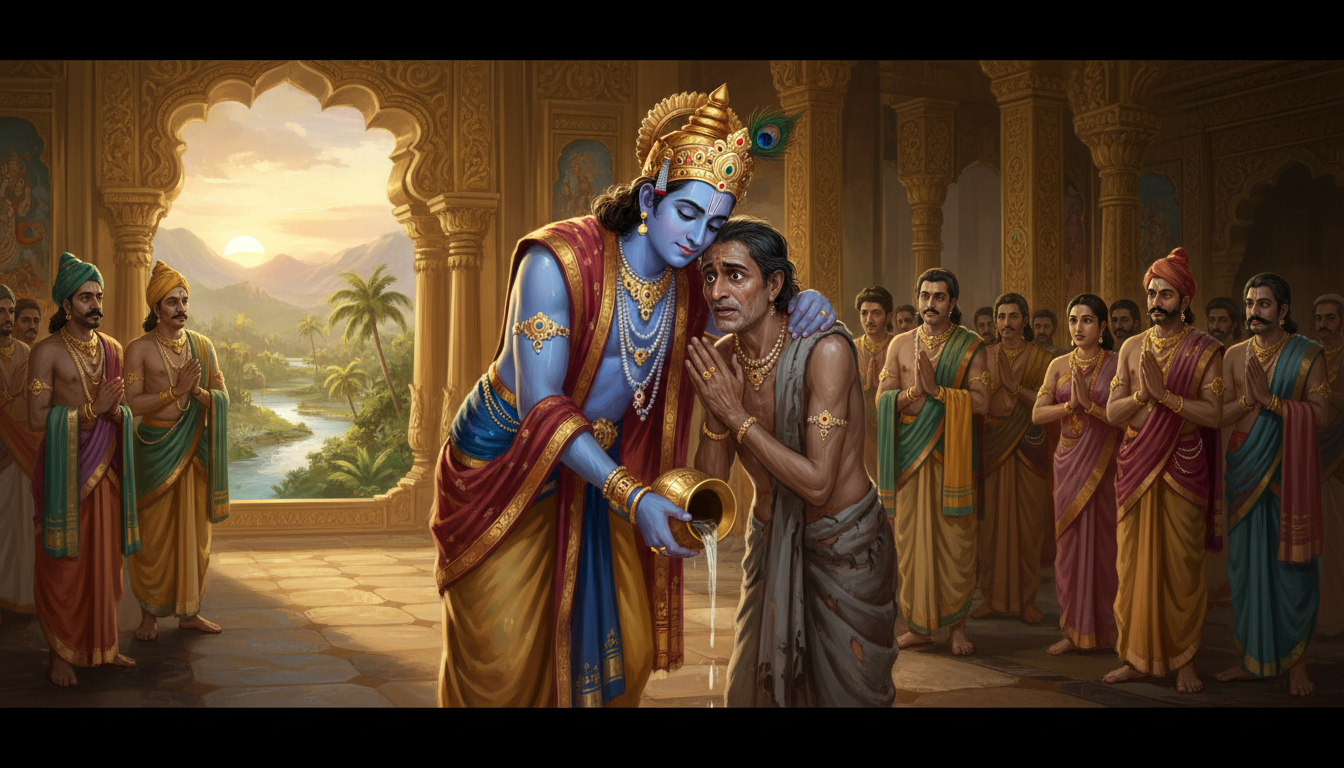
Bhagavad Gita Chapter 17, Verses 1-14: As His Faith Is, So Is He
Faith, food and the sacrifices we choose
A Question the Manual Does Not Answer
Krishna had just finished describing the gates through which a life ruins itself, and had told Arjuna to let scripture be the standard for what should and should not be done. It was a clean instruction, and Arjuna, ever the one to test an edge, found the gap in it immediately. "Krishna," he asked, "what of those who set aside the injunctions of scripture and yet worship with faith? What state are they in? Sattva, rajas, or tamas?"
It was not a rebellious question. Arjuna had watched enough of the world to know that devotion rarely waits for the rulebook. Villagers who could not read a single verse of the sacred texts still lit lamps at dusk with a sincerity that put learned priests to shame. Warriors on the eve of battle made vows to gods whose correct rites they had never formally studied. If scripture alone was the measure, what became of all of them?
Krishna did not treat the question as a loophole to be closed. He treated it as an opening into something he had not yet said plainly, though it had been implied since the poem began. The field around the chariot had not changed, the armies still waited at their distance, but Krishna's answer would reach further than ritual law. He was about to tell Arjuna that faith was not first a matter of correctness at all, but of nature, that the real question was never simply whether a man's worship matched the manual, but what kind of man was doing the worshipping, and what that kind of faith revealed and produced in him, in his eating, his discipline, and his giving alike.
A Person Is Made of Faith
"The faith of embodied beings," Krishna said, "is of three kinds, born of their own nature, sattvic, rajasic and tamasic. Hear now of these." He was not going to hand Arjuna a single answer that covered every worshipper outside the manual, because no single answer was true. Some among them worshipped from clarity and steadiness, some from the pull of desire and pride, and some from dullness and habit barely distinguishable from superstition. The same outward act, faith practiced apart from scripture, could belong to any of the three, and only the quality of the person performing it would say which.
Then Krishna offered the line that would outlast every other in the chapter. "Sattva-anurupa sarvasya shraddha bhavati, bharata," he said, and gave it to Arjuna in plain words: the faith of every being conforms to its own inner nature. "Shraddha-mayo 'yam purushah," a person is made of faith itself, not merely possessing faith the way one possesses an opinion, but constituted by it, the way a river is constituted by the water running through it. "Yo yach-chraddhah sa eva sah," as a man's faith is, so is he.
Arjuna heard in this something quietly severe. It meant faith could not be treated as a separate compartment, sealed off from character, doctrine held on Tuesdays and discarded by Wednesday's conduct. It meant that what a person trusted, revered and gave themselves to in worship was not incidental information about them but nearly the whole of the information. Krishna was not going to rank the rule-breakers against the rule-keepers. He was going to teach Arjuna to read the three gunas directly out of what a person's faith actually did to them, starting with the plainest evidence of all, how they treated their own bodies.
Austerity That Starves the Dweller Within
Krishna turned first to the harshest case, the ascetics who starved and tortured their bodies in ways scripture had never prescribed, and he did not disguise his verdict. "Men who practice fierce austerities not enjoined by scripture," he said, "given over to hypocrisy and egotism, impelled by the force of desire and attachment, senseless, torturing all the elements that compose the body, and me also, who dwell within that body, know these to be of demonic resolve."
The charge was precise and, Krishna knew, uncomfortable, because such self-denial often wore the costume of the highest devotion. A man who starved himself publicly, who wore his suffering visibly, looked to onlookers like the most serious seeker on the field. But Krishna asked Arjuna to look past the display to the motive underneath it, and the motive, in these cases, was rarely humility. It was hypocrisy performing for an audience, and egotism convinced that suffering itself was proof of superiority. Desire had simply changed its object, no longer chasing wealth or conquest but chasing a reputation for holiness, and attachment had simply changed its target, clinging now to the identity of the ascetic rather than to any worldly good.
Worse, Krishna said, such practice did violence in both directions. It tortured the very elements, earth, water, fire, air and space, that had been lent to the body for its brief use, treating them as enemies to be punished rather than as a trust to be honored. And it tortured him as well, since he dwelt within that same body as its innermost witness. An austerity that damaged the instrument of practice in order to feed the practitioner's pride was not austerity at all in the sense that mattered. It was tamas and rajas working together under a sattvic disguise, and Krishna wanted Arjuna able to see through that disguise everywhere he later met it.
The Threefold Meal
From the body's discipline, Krishna moved to something even more intimate, its food, arguing that the same three natures showed themselves at every table as clearly as at any altar. "Foods that are dear to each are also of three kinds," he said, "as are sacrifice, austerity and giving. Hear now the distinctions among them."
The sattvic person, Krishna said, was drawn to foods that increased life, purity, strength, health, joy and cheerfulness, foods that were juicy, oily, firm and naturally heartening to the heart. He did not describe a joyless diet of restriction. He described food that nourished, that a body took pleasure in because the pleasure and the nourishment were, at this level, the same thing.
The rajasic person craved foods that were bitter, sour, salty, excessively hot, pungent, harsh and burning, foods that produced pain, grief and disease even as they satisfied a momentary appetite. Krishna's list read like a catalog of intensity for its own sake, flavor pushed past the point of nourishment into irritation, chosen by a palate that had confused stimulation with satisfaction and would pay for the confusion later in the body's discomfort.
And the tamasic person was drawn to food that was stale, tasteless, putrid, rotten, leftover and impure, the refuse of another's meal, food chosen not from craving even but from indifference, from a dullness that could no longer tell the difference between what nourished and what merely filled. Krishna offered no exception here for circumstance or poverty; he was describing an inclination of taste, not a judgment on those who lacked better options. What mattered to him was that Arjuna see the pattern extend this far, that the three gunas were not abstract philosophical categories reserved for temples and scripture, but forces visible in the plainest daily choice of what to put in one's own mouth.
Three Ways to Offer the Same Fire
Having read the gunas into eating, Krishna returned at last to the very question Arjuna had asked, the worshipper outside the rulebook, and completed the answer through sacrifice itself. "The sacrifice enjoined by scripture, performed by those who expect no reward, who believe firmly that it is their duty to sacrifice, with a concentrated mind, is sattvic," he said. Here the manual and the motive aligned; the offering was made because it was right to make it, not because anything was wanted in return.
"But that offered with a view to reward, or for the sake of ostentation," Krishna continued, "know that sacrifice to be rajasic." The rite could be letter-perfect and still belong to a lesser order, if its true purpose was to be seen giving, or to purchase some future benefit from the gods the way a merchant purchases goods from a trader. The scripture followed the correct form while the heart pursued an entirely different transaction.
Then came the answer Arjuna had actually been waiting for. "Sacrifice which is contrary to scriptural injunction, in which no food is distributed, no mantras are chanted and no gifts are given, performed without faith, that is declared to be tamasic." Krishna let the definition land precisely. It was not the absence of scriptural correctness alone that made an offering worthless, since a sincere villager's untutored lamp could still carry sattva if lit in faith and duty. It was the absence of shraddha itself, faith, that emptied an act of meaning, whatever its outward form.
For a modern reader, the lesson travels easily past temple ritual. Any discipline, any diet, any gift, any promise kept can be performed correctly and still be hollow, or performed imperfectly and still be whole, depending entirely on what actually animates it. Krishna's real claim across these fourteen verses is simple to state and hard to live: watch not only what you do, but what kind of person is doing it, because that, more than the rulebook, decides what the act becomes.
Dharma Lesson
Faith is not a rule a person keeps but a nature a person has, so the honest question is never only what someone believes but what kind of faith, austerity, food and offering that belief actually produces. As the faith, so the person, and the three gunas read as clearly in a meal or a fast as in a creed.