Bhagavad Gita Chapter 17, Verses 15-28: Speech, Mind, and Giving
Austerity that heals, gifts that cost nothing back
Beyond the Body's Discipline
Krishna had shown Arjuna how the three gunas revealed themselves in austerity and in food, in the starved ascetic's hidden pride and in the plain difference between a nourishing meal and a merely intense one. But the body, he said now, was the easiest place to practice austerity and the easiest place to fake it. A far harder test lay in the parts of a person that left no visible mark of discipline at all, the tongue, the mind, and the hand that gives.
"There is austerity of speech," Krishna said, and Arjuna, who had spent a lifetime among warriors whose words could wound as surely as their weapons, leaned into this part of the teaching more than he had expected to. Words spoken in war councils, words spoken to kinsmen across a battlefield, words spoken in grief or in triumph, all of it fell under a discipline most people never thought to examine.
He was not going to give Arjuna a vague ideal about kindness. He intended, instead, a working test, specific enough to apply the very next time Arjuna opened his mouth, whether on this field or in the long life he hoped to have after it. And beyond speech, Krishna said, there was still the mind to govern, and beyond the mind, the far subtler discipline of giving, where austerity took on its opposite shape, not restraint turned inward but generosity turned outward, and where the same three gunas would prove just as visible, just as easy to mistake one for another, and just as revealing of the person practicing them.
The chariot stood still on the plain, but Krishna's teaching had moved from the body's hunger to the mouth's habits, and from there, he told Arjuna, it would move further still, all the way to the single syllable that Vedic teachers had always used to consecrate the beginning of any sacred act.
A Four-Part Test for Every Word
"Words that cause no agitation," Krishna said, beginning the test, "that are truthful, pleasant and beneficial, and the regular recitation of scripture, this is called austerity of speech." He gave Arjuna the four conditions almost as a checklist, deliberately practical, because he wanted it usable, not merely admirable.
A word had to cause no agitation, first, meaning it should not be spoken to wound, to provoke, or to unsettle another out of the speaker's own careless temper. Second, it had to be true, which Krishna did not treat as optional or negotiable simply because a lie might be more comfortable in the moment. Third, it had to be pleasant, which was not the same as flattering; a hard truth could still be delivered without needless harshness, and Krishna clearly expected both truth and kindness to be held together rather than traded against each other. Fourth, it had to be beneficial, spoken because it served some real good, not merely because it could be said.
Arjuna noticed at once how demanding this was in combination. A word could easily satisfy one or two of the four conditions while failing the others; a truth spoken cruelly failed the test as surely as a kindness that was false. What Krishna asked for was the harder discipline of finding language that met all four at once, a standard most people, Arjuna included, rarely applied even to their most important conversations.
He added svadhyaya, the regular recitation of scripture, to this same category of speech-discipline, treating the practice of returning daily to sacred words as itself a form of austerity, a habit that trained the tongue toward truth even outside of ritual hours. Speech, Krishna was arguing, was not a neutral tool a person happened to use well or badly. It was a discipline in its own right, as demanding in its way as any fast, and one whose failures left no visible scar but caused real damage all the same.
The Austerity of an Undisturbed Mind
"Serenity of mind, gentleness, silence, self-restraint, and purity of intention," Krishna continued, "this is called austerity of the mind." If speech-discipline had given Arjuna a checklist he could apply mid-conversation, mental austerity was quieter and, in some ways, harder to verify, since no one else could see it directly.
Serenity, Krishna said, meant a mind not constantly disturbed by the small provocations of the day, neither collapsing into anxiety nor flaring into irritation at every setback. Gentleness meant a disposition that did not need to dominate or diminish others in order to feel secure in itself. Silence, here, was not merely the absence of speech but a settledness that did not need to fill every space with commentary, a mind capable of simply being present without narrating itself constantly. Self-restraint governed the impulses that arose moment to moment, the reflexive reactions a less disciplined mind would simply obey. And purity of intention, perhaps the deepest of the five, meant that the motives behind action were not secretly tangled with malice, envy or hidden self-interest even when the outward behavior looked exemplary.
Krishna rated the value of any austerity, mental or otherwise, chiefly by the motive behind it, and here he offered Arjuna the same threefold division once more. Austerity practiced with supreme faith, by people who desired no reward and sought no result, was sattvic. Austerity performed ostentatiously, for the sake of respect, honor and worship, was rajasic, and Krishna warned that such austerity, however impressive to onlookers, was unsteady, since it depended entirely on an audience's continued approval to sustain it. And austerity performed with deluded self-torture, or performed specifically to destroy or injure another, whether through curses or ill will disguised as discipline, was tamasic, austerity turned into a weapon rather than a practice. The mind, Krishna was saying, could counterfeit its own holiness as easily as the body could, and the counterfeit was often harder to detect precisely because it left no visible bruise.
A Gift That Expects Nothing Back
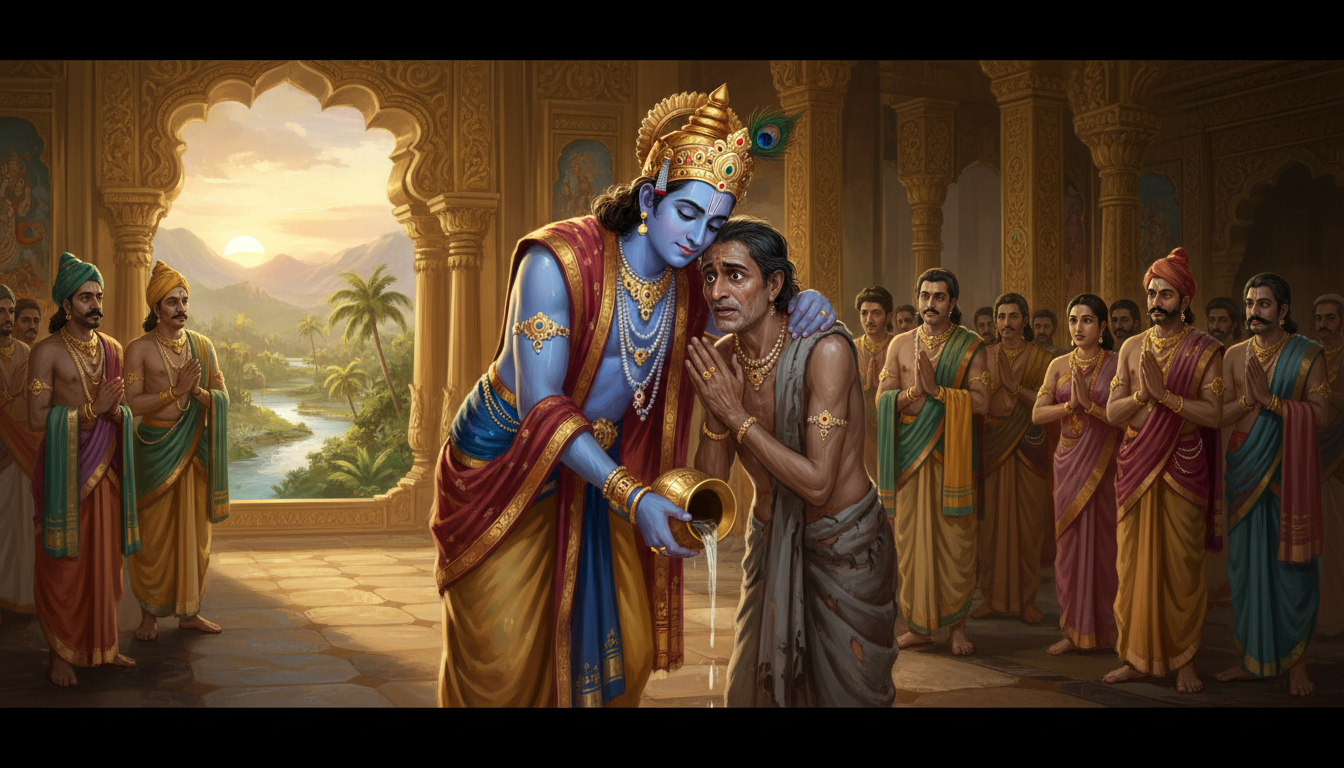
From discipline, Krishna turned to its opposite in appearance though not in spirit, generosity, and gave Arjuna the same threefold reading applied now to giving. "A gift given because it is right to give," he said, "to one who can make no return, at the proper place and time, and to a worthy recipient, that gift is held to be sattvic." Each qualifier mattered. The gift was given simply because giving was the right thing to do, not because the giver calculated some future advantage from it. It went to someone who could not repay the favor, which ruled out the transactional generosity that expects influence or gratitude to come circling back. It was given at the right time and place, not carelessly or thoughtlessly, and to a recipient genuinely deserving of it, not scattered without discernment.
"But a gift given with reluctance, in hope of some return, or looking for a future benefit," Krishna said, "know that gift to be rajasic." This was the far more common kind, generosity that quietly kept score, that expected gratitude, favor or advantage to flow back eventually, even if the giver would never admit this openly, even to themselves.
"And a gift given at the wrong place or time, to an unworthy recipient, without respect or with contempt," Krishna continued, "that gift is declared to be tamasic." This was giving that humiliated even as it appeared to help, generosity delivered so carelessly or with such visible disdain that it wounded the very person it claimed to benefit. Arjuna understood at once how easily any of the three could wear the same outward form, a hand extended with something in it, and how only the manner and motive behind the extension separated an act of real dharma from an act that merely resembled one. The measure, once again, was never the object given but the spirit in which it changed hands.
Om Tat Sat, and the One Thing That Ruins Everything
Krishna brought the chapter to its close with the syllables Vedic teachers had used since before memory to consecrate sacred action. "Om tat sat," he said, "this has been declared as the threefold designation of Brahman." From these three words, he explained, the priests, the scriptures and the sacrifices of old had all proceeded. Om marked the beginning of every Vedic rite, every recitation of scripture, every act of charity, performed by those who sought liberation. Tat, meaning that, was uttered by seekers of the highest good who performed sacrifice, austerity and giving without any desire for the fruit of the action, releasing their grip on the outcome even while fully engaged in the act. Sat, meaning existence, or that which is real and good, was used to describe an act, a sacrifice or a state of being that was praiseworthy and true, and steadfastness in sacrifice, austerity and giving was also called sat.
Then Krishna closed the chapter with the line that gathered everything he had said about faith, food, austerity, speech, mind and giving into a single, unforgiving sentence. "Whatever is done without faith," he said, "whether it is sacrifice, gift, or austerity, or whatever else, is called asat. It counts for nothing here, and nothing hereafter."
For a reader far from any battlefield, the fourteen verses on either side of that line translate easily into ordinary life. A message sent in anger fails the test of speech regardless of how true it might be. A fast kept only to be admired fails the test of austerity regardless of how long it is sustained. A gift given to be repaid fails the test of giving regardless of its size. What Krishna is finally arguing, across food and fire-rites and the smallest daily word, is that the visible form of a right action was never the point. The animating faith behind it was the only thing that ever made the action real, and its absence, however well disguised, left even the most impressive gesture hollow at the core.
Dharma Lesson
Austerity is not only what the body endures but what the tongue, the mind and the open hand practice every day, and a gift only counts as sattvic when it is given because it should be given, to someone who cannot repay it, at the right time and place, without a trace of grudge or condescension. Whatever is done without faith, Krishna says, is asat, and counts for nothing here or hereafter.