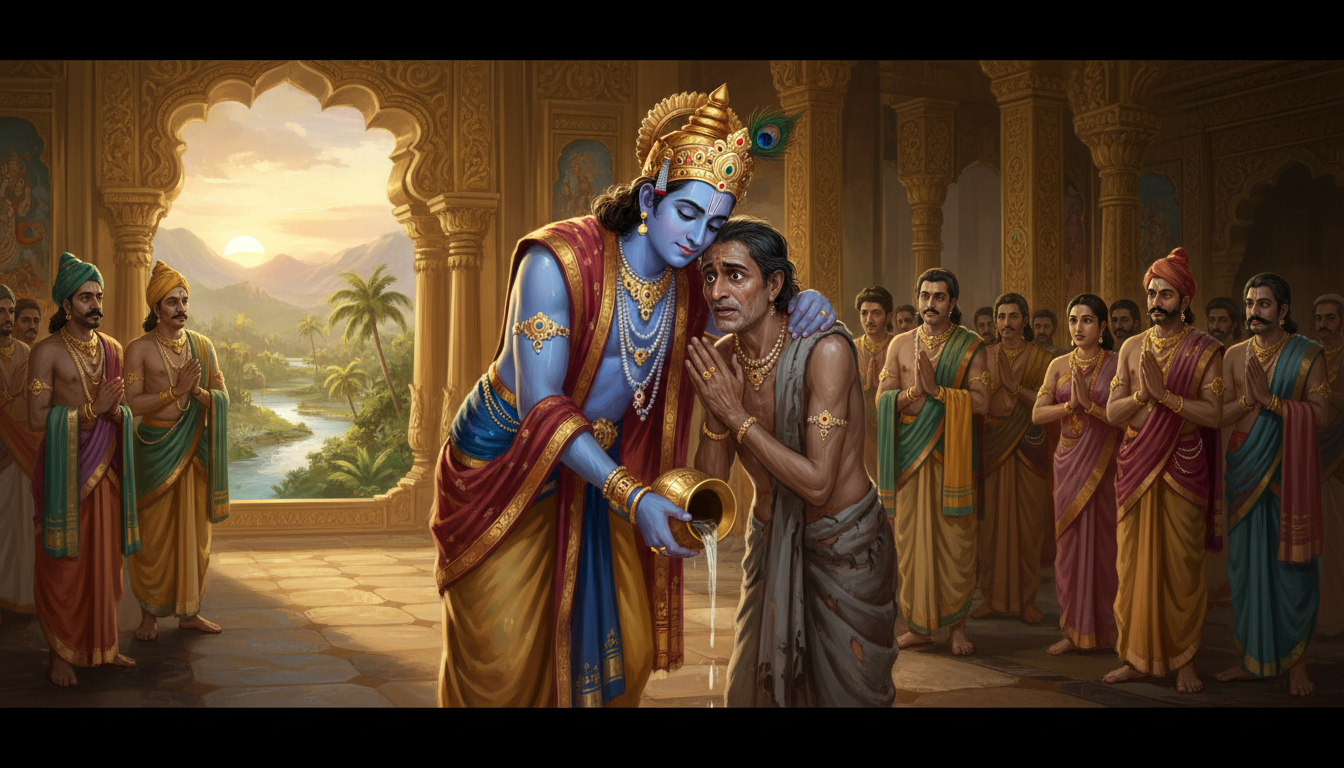
Bhagavad Gita Chapter 16, Verses 1-9: Two Estates
Fearlessness first, and the world without a Lord
Abhayam, and Why It Comes First
The chapter that follows opens without a question from Arjuna. Krishna simply begins listing, and what he lists are qualities: the marks of a person born into what he calls the daivi sampad, the divine estate or divine endowment.
The list running through verses 16.1 to 16.3 comes to more than twenty items, and the first word of it is chosen with care. Abhayam. Fearlessness.
Not truthfulness, which appears later. Not non-violence, which also appears later. Not charity or restraint or study, all of which are on the list and none of which lead it. Krishna begins his account of a good life with the absence of fear, and he says it to a man who had put down his bow that morning because he was afraid, though the fear had dressed itself up as compassion and as scruple about the law.
The placement is an argument in itself. Fear is what makes a person lie, because the truth has a cost. Fear is what makes him grasp, because he suspects there will not be enough. Fear is what makes him cruel, because cruelty is very often only a frightened man striking first. Put fearlessness at the head of the list and everything after it becomes possible; leave it out and each remaining virtue has to be held up against a constant inward pressure.
And Krishna has already laid the ground for it. Fifteen chapters of argument about the indestructible self, about action offered rather than owned, about an eternal fragment carried from body to body, converge on this one word. Abhayam is not bravado, and it is not the willed suppression of a tremor. It is what remains when a person has genuinely stopped believing that what he is can be destroyed.
Only then does the rest of the list unfold, and it unfolds quickly, as though the hardest thing had already been said.
The Marks of the Divine Estate
After fearlessness comes sattva samsuddhi, purity of one's own being, and then steadfastness in the yoga of knowledge, standing firm in what one has understood rather than agreeing with it and drifting away by evening.
Then the list moves outward into conduct: charity, dana; restraint of the senses, dama; sacrifice, yajna; study of scripture, svadhyaya; austerity, tapas; and uprightness, arjava, the quality of being straight and unbent, the same on both sides. These are the public disciplines, the things a person does where others can see him doing them, and they sit in the middle of the list rather than at its head.
Verse 16.2 turns inward again and gets harder. Non-violence. Truth. Freedom from anger. Renunciation. Peace, santi. Absence of slander, apaisunam, not speaking against people behind their backs. Compassion toward beings. Freedom from craving. Gentleness, mardavam. Modesty, and the absence of restlessness.
Verse 16.3 closes with a cluster that reads like a portrait of quiet strength: vigour, tejas; patience and forgiveness, kshama; fortitude, dhriti; cleanliness; freedom from malice; and freedom from excessive pride, na atimanita.
Read as a whole the list has a shape. It is not a code of prohibitions and it names almost no ritual acts. Most of the items describe a temperament rather than a behaviour, and several are the same quality seen from two angles: gentleness and non-violence, modesty and freedom from pride, peace and freedom from anger.
What is striking is how much of it concerns how a person occupies a room. Not slandering. Not being restless. Not carrying malice. Being straight. Being gentle. A person with these qualities is easy to stand near, and a good deal of the divine estate, on Krishna's accounting, consists precisely in not being hard on the people closest to you.
Then, in a single verse, he turns the whole picture over.
Six Words, and a Reassurance
Verse 16.4 needs only six words where the previous three verses had needed twenty-six qualities.
Ostentation, dambha, the display of a virtue one does not actually have. Arrogance, darpa. Conceit, abhimana, the swollen sense of one's own importance. Anger, krodha. Harshness, parushya, the roughness that shows in speech long before it shows in action. And ignorance, ajnana. These, Krishna says, belong to one born to the asuri sampad, the demonic estate.
The brevity is deliberate. The divine endowment has many faces because there are many ways of being decent, and each of them needs its own description. The demonic endowment has one face and only six names for it, because at bottom it is a single movement repeated: the self insisting on its own size.
Five of the six are that insistence. Display, arrogance, conceit, anger and harshness are all what a person does when he has placed himself at the centre and the world declines to confirm the arrangement. The sixth, ignorance, is not stupidity; it is the misperception that makes the other five feel entirely reasonable from the inside.
Then verse 16.5 states the stakes plainly: the divine endowment leads toward liberation, the demonic toward bondage. And Krishna, having drawn that line, turns immediately to the man in front of him and says something almost tender. Ma sucah. Do not grieve. You are born to the divine estate, Pandava.
It is worth noticing what he does not say. He does not tell Arjuna that the men across the field are asuric. He does not name Duryodhana, or Karna, or anyone standing under the Kaurava banners. The reassurance is given to one anxious listener about his own footing, at the exact moment when a long catalogue of virtues could have curdled into a checklist for measuring himself and finding a shortfall.
Arjuna was not being handed a weapon. He was being told he could stop worrying about which side of the line he stood on, and listen.
Neither What to Do Nor What to Avoid
Having offered that reassurance, Krishna sets out the frame for what follows. In verse 16.6 he says there are two orders of created beings in this world, the divine and the demonic. The divine he has described at length; now, he tells Arjuna, hear from me about the other.
The division sounds absolute, and generations of readers have taken it as a sorting of humanity into two bins. The chapter itself resists that reading, and the resistance is worth holding onto. What Krishna has listed on both sides are dispositions: sampad, an endowment or a stock of qualities, not a caste, not a species, not a party. Every quality on the divine list is available to a person who lacked it yesterday, and every mark on the demonic list is available to a person who has spent a decade cultivating the other. The two estates describe directions of travel, and nobody standing on the field of Kurukshetra was standing still.
Verse 16.7 begins the diagnosis, and it begins at the root rather than at the visible symptoms. They know neither pravritti nor nivritti, Krishna says: neither what should be undertaken nor what should be refrained from. Purity is not found in them, nor good conduct, nor truth.
That opening clause is far more precise than a general accusation of wickedness. The failure named is not that such people choose evil while knowing perfectly well where the good lies. It is that the whole category of what to do and what to leave alone has gone dark for them; the instrument that would register the difference is no longer reporting anything. A person in that condition is not defying a standard he can see. He genuinely cannot locate one, which is why everything he does feels to him like a reasonable response to circumstances.
And if the standard has gone dark, some account of the world has to take its place. Krishna gives that account next, and it is the most modern sounding sentence in the poem.
A World Without Foundation
In verse 16.8 Krishna reports what such people say about the world, and he lets them say it in their own voice. Asatyam apratistham te jagad ahur anisvaram. They declare the world to be without truth, without foundation, without a Lord; not brought about by any regular causation, having no origin but the mutual union of things, and caused by desire alone, kama haitukam.
It is a compact philosophy, and Krishna does not caricature it. The claim is that nothing is finally true, that nothing underneath holds anything up, that no order governs, that things came together the way things come together, and that appetite explains the rest. Anyone who has argued late at night with a determined cynic has heard every clause of it.
What the chapter says is not that the position is intellectually clumsy but that it is consequential. Verse 16.9 follows immediately: holding to this view, these lost souls of small understanding and cruel deeds come forth as enemies of the world, for its destruction. A person who has concluded that there is no foundation is not thereby liberated. He is unanchored, and being unanchored, his own appetite becomes the only thing left with any authority in him.
For a reader now the section is easy to misuse and worth handling with care. It is not a list for classifying other people, and Krishna hands it to Arjuna at precisely the moment when it could have become one, taking the trouble to say only, you are born to the divine estate, and never, they are not. The estates are dispositions, and any honest reader will find items from both lists somewhere in his own week.
The usable part is the order of the argument. What a person believes about whether anything holds up will eventually show in how he treats the people nearest him, and the first casualty is rarely truth or non-violence but simply gentleness. And the first item on the good list is not a virtue at all in the ordinary sense. It is fearlessness, because nearly everything on the other list turns out to be something a frightened person does.
Dharma Lesson
Krishna heads his list of divine qualities with fearlessness, because most cruelty, most dishonesty and most grasping is what a frightened person does when he believes something in him can be destroyed. The two estates he describes are dispositions and directions of travel, not classes of people, and he takes care to reassure Arjuna about his own footing without ever assigning anyone across the field to the other list. A person who concludes that nothing holds anything up is not thereby freed; he is unanchored, and appetite becomes the only authority left.