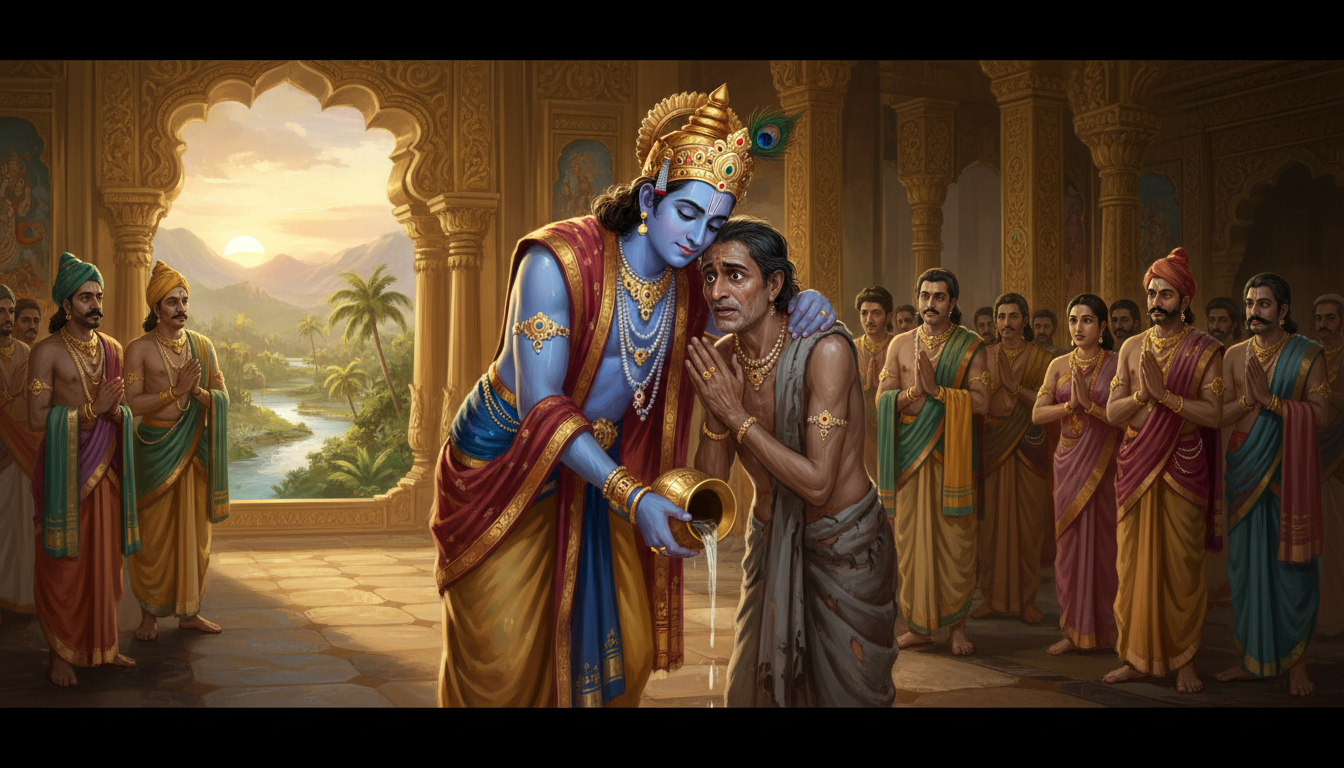
Bhagavad Gita Chapter 16, Verses 10-24: The Three Gates
The inner monologue of appetite, and how it closes
The Portrait Krishna Refuses to Soften
The armies still stood at their distance, and the dust of Kurukshetra had not yet risen, but Krishna's voice had turned inward, away from the field and toward the shape of a mind. He had spent the opening of this teaching sorting two natures, the daivi and the asuri, the godward and the self-seeking, listing their marks the way a physician lists symptoms. Now he stopped listing and began to narrate. Arjuna had asked, in effect, what such a mind actually sounds like from the inside, and Krishna did not intend to answer gently.
"There is a kind of anxiety, Arjuna," he said, "that has no floor. It does not end when its object is gained, because the mind that produces it was never built to be satisfied. It ends only at death, and even then it does not end so much as it is interrupted." He said this without cruelty, the way a man describes weather he has watched a long time. This was not a warning aimed at some distant sinner. It was a mirror held up close enough that no one could mistake the face in it for a stranger's.
What followed, Krishna told him, was the one place in this teaching where he would not speak in general categories. He would let the mind speak for itself, in its own words, so that the shape of its bondage would be unmistakable. Arjuna, who had heard duty and detachment and the imperishable self discussed in careful philosophical cadence, felt the register shift, as a listener feels a storyteller lean forward. The chariot did not move. The armies did not move. But something in the teaching had turned, from doctrine to portrait, and Krishna, who rarely let a verse go to waste, was about to spend several of them on nothing but the sound of a man congratulating himself.
A Hundred Nooses of Hope
"Given over to immeasurable anxiety, ending only at death," Krishna said, quoting the very words the mind uses of itself, "holding sense gratification to be the highest aim, certain that this is all there is." He paused on immeasurable, letting the word carry its full weight. Not large anxiety, not manageable anxiety, but anxiety without a boundary, because a mind that has made desire its compass has removed the one thing that could tell it when to stop.
He described such a person as bound by a hundred nooses of hope, reaching after each satisfaction as though it might finally be the one that holds, tightening every cord of longing even while pursuing the objects that promise release from longing. It was, Krishna noted, a peculiar arithmetic: each fulfilled desire does not close an account but opens two more. The man who wanted a village now wants a kingdom. The man who has a kingdom now cannot sleep for fear of losing it.
And because such a mind is never satisfied by honest means, Krishna said, it turns to unjust ones. Wealth gathered through deceit, through the exploitation of what is not truly one's own, becomes, in this mind, no different from wealth earned rightly, since the only test it applies is whether the coffer grows. He did not linger on condemnation here so much as diagnosis. This was not, he told Arjuna, a portrait of some foreign villain. It was the ordinary and recognizable shape that ambition takes when it has no outer measure, only the mind's own hunger reporting on its own progress, endlessly, and never once concluding that enough has been gained. The nooses tighten precisely because the one caught in them mistakes the tightening for freedom, mistakes acquisition for arrival.
The Voice That Speaks Inside Every Conquest
Then Krishna did something he did nowhere else in the teaching. He let the mind speak in its own first person, unmediated, so that Arjuna would hear not a description of vanity but vanity itself, talking. "This I have gained today," the voice said, as Krishna rendered it, "and that desire I shall obtain next. This wealth is already mine, and more still will be mine. That enemy I have slain, and the rest of them I will slay also."
The cadence was unmistakable, the rhythm of a man totting up a ledger of victories aloud to no one, because the audience he most needs to convince is himself. "I am the lord," the voice continued, "I am the enjoyer of all this. I am accomplished, I am powerful, I am happy. I am rich, I am well born. Who else is equal to me?"
Krishna let the last question hang in the air a moment before continuing, because it was the hinge of the whole passage. Who is equal to me is not really a question at all in such a mouth. It forecloses its own answer before it is asked, and that is precisely its danger: a mind that has already decided no one stands beside it has also decided that no counsel, no correction, no other measure need be consulted. "I will sacrifice," the voice went on, unwilling to leave even ritual outside its ownership, "I will give, I will rejoice," each verb bent toward display rather than devotion. Arjuna recognized the voice, not as a stranger's but as one he had heard, faintly, in his own better campaigns, and Krishna, watching him recognize it, said nothing further. The portrait was doing its own work.
Verses Krishna Would Not Water Down
"I will not soften what comes next," Krishna said, and Arjuna understood this as a kind of promise, the way a physician warns before delivering a hard diagnosis. Those who hate, who are cruel, who are the lowest among men, Krishna said, he casts again and again into the wombs of demonic natures, life after life. Not as punishment handed down from outside, he clarified, but as the natural continuation of a trajectory already chosen. A mind bent wholly on self-aggrandizement does not simply stop being that mind at death. It carries its own bent forward, into whatever form receives it next.
Caught in delusion birth after birth, Krishna said, such people never reach him. They sink, instead, to the most degraded state of existence, precisely because their own compass has never once pointed anywhere beyond their own hunger. This was the sternest passage in the entire song, and Krishna offered no cushion for it, no immediate qualifying grace. He wanted Arjuna to feel its full severity before he offered the way out.
Then, without softening the diagnosis, he named the mechanism plainly. Threefold is the gate of this hell, he said, the ruin of the self: kama, krodha, lobha, desire, anger, greed. Not obscure vices requiring rare circumstance to appear, but the three most ordinary currents of an untrained mind, present in some measure in nearly everyone. "Therefore," Krishna said, and here his voice gentled slightly, turning from diagnosis toward instruction, "let a man abandon these three." Not suppress them by force, not merely regret them after the fact, but release them as one releases a grip that has been clenched too long, understanding at last what that grip has been costing.
A Standard Outside the Self
"One who is freed from these three gates of darkness, Arjuna, works for his own good and so, in the end, reaches the highest state." Krishna said this quietly, letting it stand against everything harsh that had come before, not as a cancellation of the warning but as its natural completion. The severity was never the point in itself. It was there to make the escape route visible by contrast.
But Krishna did not leave the escape as vague as good intention. "One who discards the injunctions of scripture," he said, "and acts instead from whatever desire arises, attains neither perfection, nor happiness, nor the highest goal." This was, in its way, the most practical verse of the passage. The mind that narrates its own righteousness, as the voice in the monologue had done, cannot be trusted to judge itself. It needs a measure that stands outside its own hunger. "Let scripture, then," Krishna said, "be your authority in determining what should be done and what should not. Knowing what the teaching enjoins, act accordingly here."
Arjuna turned this over. He had come to this field trusting his own eye, his own grief, his own sense of what was owed to kinsmen, and Krishna had just spent a dozen verses demonstrating how persuasive and how hollow that inner voice could become when left unchecked. The lesson traveled easily past the battlefield. Anyone can recognize, in a quiet hour, some version of that ledger-keeping voice, this I have earned, that I deserve, who is equal to me, running quietly beneath their own best days. The gate is not closed by force of will alone. It is closed by consulting something larger than the self's own account of itself, and by trusting that measure even when the mind, mid-appetite, insists it needs no other judge.
Dharma Lesson
The mind that keeps its own tally of gains, enemies and honors will never find the tally complete, because the counting itself is the disease. Kama, krodha and lobha are not stray failings but the three gates through which a whole life is lost, and only a standard outside the self, what the Gita calls sastra, can be trusted to measure them.