The Herb in the Grandsire's Hand
A wounded Duryodhana asks Bhishma for reassurance and is given honesty, a pledge, and medicine
The Tents at the End of the Day
Sanjaya said that when the sixth day was over, the men who had spent it trying to kill one another went back to their tents with their persons covered in blood.
They rested a while, as the rule required. They washed. They praised one another for the feats of the day, which is a thing armies do in the evening whatever they have done to each other since dawn, and then they were seen again clad in mail and desirous of battle, because the war was six days old and nobody had yet learned how to stop.
That was the hour, O king, said Sanjaya to the blind man in the hall at Hastinapur, when your son went to the grandsire.
Duryodhana came overwhelmed with anxiety. He was not a beaten man. He had a hundred thousand chariots and the greatest bowman alive commanding them, and the day had ended with Bhishma breaking the Panchala ranks and driving them back before he withdrew to his encampment. But Bhima had come at him that evening with six and thirty shafts, had cut his bow and killed his four steeds and cut the umbrella from over his head, and had brought down the standard with the elephant device on it in the sight of all the kings, so that it fell out of the sky like lightning falling out of a cloud. Kripa had taken him up onto his own car. He had sat down on the terrace of it, feeling great pain.
He came to Bhishma still covered with blood trickling down from his wounds, and he did not have himself tended first.
That is the detail to hold at the start. The king of the Kurus walked through his own camp, past his own physicians, in the state Bhima had left him in, because there was something he wanted to hear more than he wanted to be treated, and only one man in the army could say it to him.
I Cannot Regain My Peace of Mind
"Our troops are fierce and terrible and carry innumerable standards," Duryodhana said. "They are, again, arrayed properly."
He began, as he always began, with the inventory. It was the way his mind worked. He had counted the akshauhinis before the war and been satisfied by the count, and he was counting again now with the blood still running down him, as though the arithmetic could be made to answer the thing that was actually wrong.
"Yet the brave and mighty car-warriors of the Pandavas, having penetrated into our array and afflicted and slaughtered our troops, escaped unhurt. Confounding us all, they have won great fame in battle."
Then the arithmetic ran out, and he said what he had come to say.
"Bhima again, having penetrated into our Makara array which was strong as the thunder-bolt, afflicted me with his terrible shafts, each resembling the rod of Death. Beholding him excited with wrath, O king, I was deprived of my senses. Even now I cannot regain my peace of mind."
There is no boast anywhere in it. This is the man who sent Uluka to the Pandava camp with insults dressed as messages, who had told Bhima across a hall full of kings exactly what he thought of him, and here at the end of the sixth day he was telling his grandfather in plain words that he had looked at that face coming toward him through the dust and his senses had gone, and that they had not come back.
"Through thy grace, O thou that art firm in truth, I desire to obtain victory and slay the sons of Pandu."
Through thy grace. He was not asking for a plan of battle. He was asking the oldest man in the world, the one who had held him on his knee and had held Yudhishthira on the other, to promise him that it would come out the way he wanted, and he was asking it because he no longer believed it himself.
The Grandsire Laughs Without Cheer
The high-souled son of Ganga, that foremost of all wielders of weapons, understood that Duryodhana was possessed by grief.
Sanjaya is careful about how Bhishma answered. He replied unto him laughing the while, though cheerless. There was a laugh, and there was nothing behind it. The old man made the sound a grandfather makes to a frightened child and did not feel any of it, and then he gave the child the truth in two halves, and the halves did not agree with each other.
The first half was the promise.
"Penetrating into their army with the utmost exertions and with my whole soul, O prince, I wish to give thee victory and joy. For thy sake I do not at all dissemble."
The second half was the reason the promise was worth so little.
"They that have become the allies of the Pandavas in this battle are fierce and numerous. Mighty car-warriors of great renown, they are exceedingly brave and accomplished in arms. Incapable of being fatigued, they vomit forth their wrath. Cherishing feelings of animosity towards thee, and swelling with prowess, they are not capable of being defeated easily."
That was the assessment of the commander of the Kaurava host, delivered to the king of the Kauravas, on the night of the sixth day, and no part of it is encouraging. He had just told Duryodhana that the enemy is angry with him personally, that the anger is deserved, and that it does not get tired.
And then, having said it, he pledged himself anyway.
"I will, however, O king, contend against those heroes with my whole soul and throwing away my very life. For thy sake, in battle, O thou of great glory, my life itself shall today be recklessly exposed. For thy sake I would consume all the worlds with the celestials and the Daityas, let alone thy foes here. I will fight with those Pandavas, and do all that is agreeable to thee."
He did not say he would win. He said he would spend himself. It is the whole of Bhishma's position in that war put into four sentences: a man who cannot approve of the cause, cannot leave the side, and therefore offers the only thing he still owns, which is his life, and offers it to a nephew whose wounds he is about to dress.
Advance
Hearing these words, Duryodhana became inspired with great confidence and his heart was filled with delight.
That is how quickly it worked. Bhishma had told him that the enemy could not easily be beaten and that he himself would probably die in the attempt, and Duryodhana heard the part about the whole soul and the thrown-away life and was happy. He did not wait. Cheerfully he ordered all the troops and all the kings in his army, saying, Advance.
And at that command the army began to move.
Sanjaya, who had the divine sight and was obliged to describe everything he saw with it, spends the rest of the section on the beauty of it, and the beauty is of a particular kind.
That large force, armed with diverse kinds of weapons, was exceedingly cheerful. The elephants and the steeds and the foot-soldiers on the field looked exceedingly beautiful. Huge tuskers, stationed in large bodies and skilfully urged, looked resplendent all around, and many royal combatants accomplished in diverse weapons were seen in the midst of the troops.
The dust that the cars and the foot-soldiers and the elephants and the horses raised as they were duly moved over the field was red as the morning sun, and it shrouded the rays of the sun, and it looked beautiful.
The many-coloured banners on the cars and the elephants, waving in the air and moving along the welkin, looked beautiful like flashes of lightning amid the clouds.
And loud and fierce was the uproar made by the twang of the bows stretched by the kings, resembling the roar of the ocean while it was churned in the Krita age by the gods and the great Asuras.
Then he gives the image he has been building toward, and it is not a compliment.
That army of your sons, looking so proud, consisting of combatants of diverse hues and shapes, shouting so fiercely, and capable of slaying hostile warriors, looked like those masses of clouds that appear at the end of the Yuga.
Duryodhana's cheerfulness had put an army in motion, and the man watching it move for the blind king could think of nothing to compare it to except the sky on the last day of the world.
The Roll of Names
It did not hold. Ganga's son, looking at his king again a little later, saw him still plunged in thought, and addressed him once more with what Sanjaya calls delightful words.
They were a list. Bhishma had understood something about Duryodhana that evening: that the man was soothed by counting, and that if he wanted to put him to sleep he would have to do it with names.
"Myself," he said, "and Drona, and Shalya, and Kritavarma of Satwata's race, and Ashwatthama, and Vikarna, and Bhagadatta, and Suvala's son, and Vinda and Anuvinda of Avanti, and Bahlika with the Bahlikas, and the mighty king of the Trigartas, and the invincible ruler of the Magadhas, Brihadbala the king of the Kosalas, and Chitrasena and Vivingsati."
Every one of them was somebody the king could see from where he stood. Drona, his teacher and the teacher of the men he was fighting. Shalya, the king of Madra, uncle to Nakula and Sahadeva, tricked into this army by Duryodhana's own hospitality on the road. Kritavarma, who had come out of Krishna's own city to fight on this side. Ashwatthama, Drona's son. Vikarna, the one brother who had stood up in the hall and spoken for Draupadi and had come to Kurukshetra anyway. Bhagadatta of Pragjyotisha with his elephant. Suvala's son, which is to say Shakuni, who had begun all of it with a handful of dice.
"And many thousands of car-warriors graced with tall standards, a large number of country-born steeds well-mounted with excellent horse-soldiers, and many infuriate elephants of large size with temporal juice issuing from their mouths and cheeks, and many brave foot-soldiers armed with diverse weapons and born in diverse realms, are all prepared to do battle for thy sake.
"These, and many others ready for thy sake to lay down their lives, are, as I think, competent to vanquish the very gods in battle."
It is a magnificent sentence, and Bhishma had one more to add to it, and the one he added took most of it back.
The Herb
"I should, however, always tell thee, O king, what is for thy good."
That is the formula of a counsellor who is about to say the thing his listener does not want, and Bhishma had used it on this nephew before, in the hall at Hastinapur, when nobody took the least notice.
"The Pandavas are incapable of being vanquished by the very gods with Vasava. They have Vasudeva for their ally and are equal to Mahendra himself in prowess."
There it is, plainly, from the commander of the army: the enemy cannot be defeated even by Indra and the celestials, because Krishna is standing in their chariot. He had just finished naming fifteen great warriors and thousands of cars and calling them competent to vanquish the gods, and now he told the king that the men those warriors were pointed at were beyond the gods altogether. Both statements were true. That was the trouble with them.
"As regards myself, I shall, however, always do thy bidding. Either I shall vanquish the Pandavas in battle or they will vanquish me."
It is the shortest and most honest description of Bhishma's remaining life that anybody, including Bhishma, ever gave. There were two ways out of the field for him and he named them both and expressed no preference between them, and there was no third.
Having said these words, the grandsire gave him an excellent herb of great efficacy for healing his wounds.
The text spends one line on it. He reached out, in the lamplight, in a tent, at the end of a day in which he had killed Panchalas by the hundred, and he handed his grandson a herb, and therewith your son was cured of his wounds.
The oldest man on the field, who had promised an hour earlier to throw away his own life for this boy, and who had just told him in the plainest words available that the war was probably lost, finished the conversation by treating the cuts Bhima had made in him.
Nothing else in the two sections is as much like a family as that.
The Mandala at Dawn
Then at dawn, when the sky was clear, the valiant Bhishma, that foremost of men well versed in all kinds of array, himself disposed his troops in the array called Mandala.
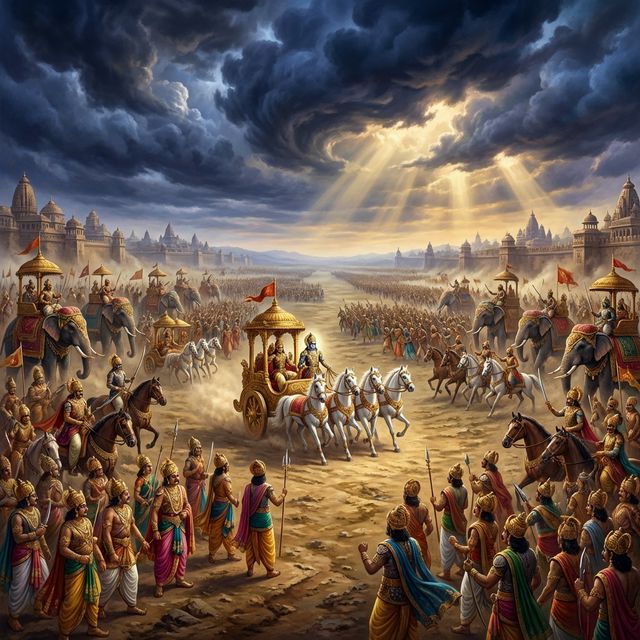
A vyuha is an argument made out of men. The Mandala is the circle, the array that has no flank because every direction is its front, and Bhishma built it that morning with a precision that Sanjaya sets down like a builder's specification: near unto every elephant seven cars, and near unto every car seven horsemen, and behind every horseman seven bowmen, and behind every bowman seven combatants with shields. It bristled with weapons. It was surrounded on all sides with many thousands of cars and with large bodies of horsemen armed with swords and lances.
Ten thousand horses, and as many elephants, and ten thousand cars, and the sons of Dhritarashtra in mail, guarded the grandsire. And Sanjaya notes what the arrangement actually amounted to: it was seen that Bhishma was protected by those brave warriors, and those princes themselves, accoutred in mail, were in their turn protected by him.
Duryodhana sat on his car in the middle of it, healed, possessed of every grace, and looked resplendent like Sakra himself in heaven. Loud were the shouts uttered by the sons of Dhritarashtra, and deafening the clatter of cars and the uproar of the musical instruments. And that mighty and impenetrable circle began to proceed, facing the west.
Yudhishthira, beholding the Mandala, answered it with the Vajra, the thunderbolt, and the two armies came at each other looking to break each other open, and the day dissolved at once into single combats.
Drona went against Virata. Ashwatthama against Shikhandi. Duryodhana himself rushed at Dhrishtadyumna. Nakula and Sahadeva went out against the king of the Madras, who was their mother's brother. Vinda and Anuvinda of Avanti against Iravan. Bhima against Kritavarma. Abhimanyu against Vikarna and his brothers. Ghatotkacha, prince of the Rakshasas, against Bhagadatta and his elephant, one infuriate creature going at another. Alambusha the Rakshasa against Satyaki. Yudhishthira against king Srutayush. Chekitana against Kripa.
And thousands of kings, with darts and lances and arrows and maces and spiked clubs in their hands, surrounded Arjuna.
The Man They Ran To
"Behold, O Madhava," Arjuna said, "the Dhartarashtra troops in battle, arrayed by the high-souled son of Ganga, acquainted with every kind of array. Behold those brave warriors, countless in number, and desirous of battle with me. Behold, O Kesava, the ruler of the Trigartas with his brothers. This very day I shall slay them all, O Janardana, before thy eyes."
Then the son of Kunti rubbed his bowstring and showered his arrows on that multitude of kings, and the great bowmen poured on him thick showers of arrows in return, like clouds filling a lake with torrents of rain in the rainy season.
Loud shouts went up from the Kaurava army when the two Krishnas were seen covered over with arrows. The gods and the celestial Rishis and the Gandharvas with the Uragas, watching from wherever such beings watch from, were filled with great wonder at the sight of those two men buried under weapons.
Then Arjuna, excited with wrath, invoked the Aindra weapon.
The prowess they beheld of Vijaya then seemed to be highly wonderful, said Sanjaya, insomuch that the showers of weapons shot by his foes were checked by his myriads of arrows. Among all those thousands of kings and steeds and elephants there was not one, O king, that was not wounded. The others he pierced each with two or three arrows.
And then the thing that ends the day's first movement, and that ought to be read slowly.
While being thus struck by Pritha's son, they sought the protection of Bhishma, the son of Shantanu.
They ran to the old man. Every king in that circle, cut and bleeding and out of ideas, turned his chariot and went to the place where the white-haired commander was standing, and Bhishma became the rescuer of those warriors, who were like men sinking in the fathomless deep.
He had told his grandson the night before that he would throw his life away for him, and this is what the promise looked like in daylight: an army coming apart and running toward one man to be held together.
And in consequence of those warriors flying away and mixing with the troops, the Kaurava ranks were agitated like the vast deep with a tempest.
Dharma Lesson
Bhishma gives Duryodhana two things in one conversation and they do not agree: the truth that the Pandavas cannot be beaten, and the promise that he will die trying to beat them. He does not soften the first to make the second easier to hear. That is what loyalty looks like when it is not the same thing as approval, and it is why the grandsire is neither a villain nor an ally in this war but a man paying an old debt at full price. The herb matters as much as the pledge. Having said the hardest thing he could say, he still reached out and treated the wounds.