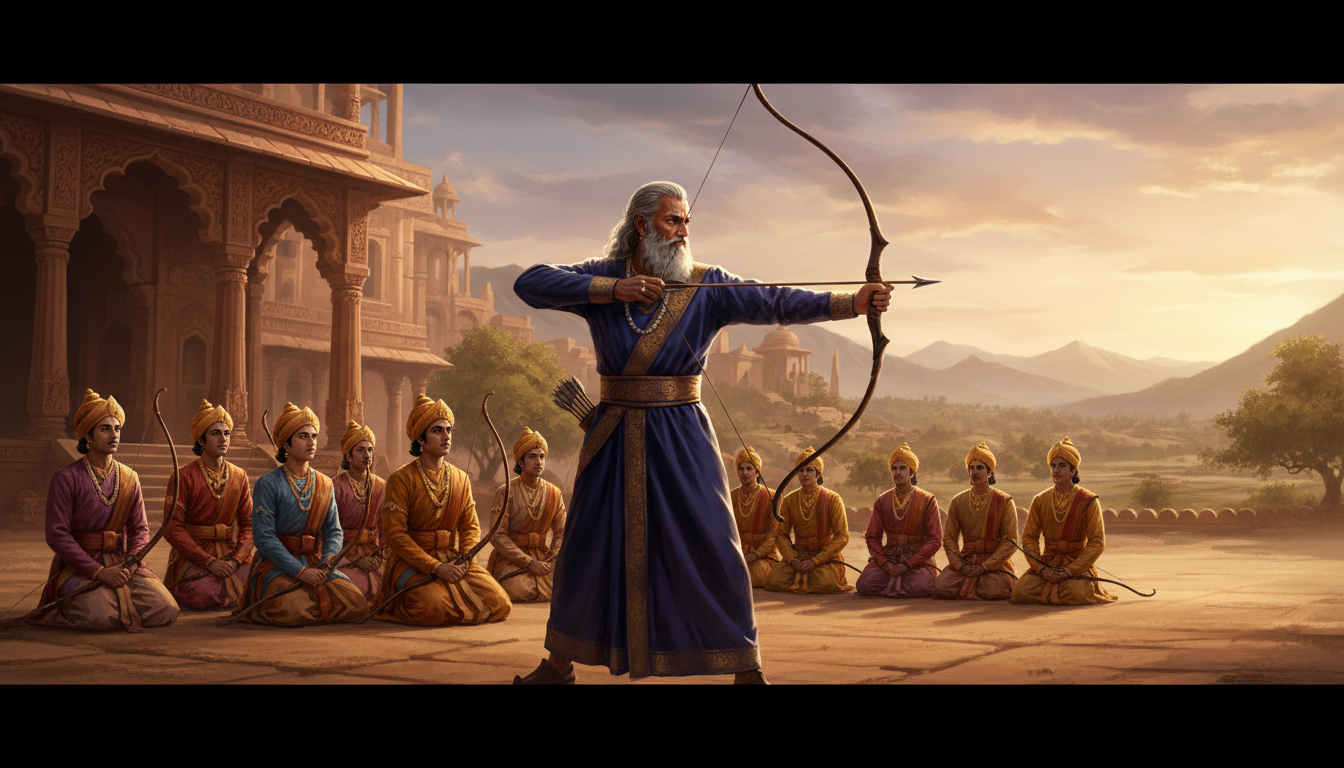
Riddle Answering Riddle
The sixth morning began, as so many mornings on this field now did, with a question posed in the shape of an army. Drona, who commanded the Kaurava host on the days Bhishma chose to rest his bow arm from the largest formations, arrayed his troops into the krauncha, the heron, a formation with a long probing beak of a vanguard and wings swept back on either side, built to peck through a defense at one chosen point while the wider mass held its shape around that strike.
Dhrishtadyumna, born from the sacrificial fire for the single purpose of ending Drona's life and commanding the Pandava host by right of that birth as much as by skill, studied the heron's shape from across the field and answered it the way a student trained by the same master might be expected to answer it. He called for the makara, the sea-monster, the same driving wedge Bhishma had used against them only the day before, and had his own captains ready it before Drona's advance had covered half the ground between the armies.
There was something almost unbearably intimate in it, two students of the same old teacher reading each other's intentions from the shape of moving men, each knowing exactly what the other meant to attempt because each had been taught, by the very same hand, exactly how such attempts were made. Drona had shaped Dhrishtadyumna's understanding of war as surely as he had shaped his own son's, not knowing, or perhaps knowing too well, that the shape he gave would one day be turned back against him.
The two arrays came together at midmorning, beak against wedge, and the ground between the armies filled, within minutes, with a chaos that neither formation's elegant design had quite predicted.
Alone Inside
Somewhere inside that chaos, Bhima did what Bhima always eventually did, which was decide that the battle in front of him was moving too slowly for a chariot to keep pace with his intentions. He climbed down, took up his mace, and went forward on foot into the packed heart of the Kaurava mass, exactly as he had done on the fourth day, only further this time, and with less thought for the ground behind him.
He did not mean to be cut off. No warrior means that. But the krauncha's wings, even broken at the beak, still held their shape along the flanks, and as Bhima drove deeper and deeper, chasing whatever resistance still stood in front of him, those wings closed quietly behind his path the way water closes behind a swimmer, and by the time anyone thought to look for him from the Pandava side, he was no longer visible at all, only a distant commotion somewhere in the middle of an army that was entirely the enemy's.
Word reached Dhrishtadyumna within minutes, carried by men whose faces told the news before their mouths did. The Pandavas' strongest fighter, the one whose mace-work had shaken the Kaurava center twice already this war, was somewhere inside the formation with no visible way back out, surrounded on every side by soldiers who would count his death the single greatest prize the war had yet offered them.
Dhrishtadyumna did not hesitate over the decision the way a lesser commander might have. He had spent his whole life being told what he was born for, and none of the tellings had ever mentioned standing at the edge of a battle while Bhima was lost inside it. He turned his own chariot toward the place the commotion was thickest and began, immediately, to cut his way in after him.
The Pramohana
To reach him, Dhrishtadyumna used a weapon few commanders on either side had cause to call on that early in the war: the Pramohana, an astra built not to kill but to bewilder, to fill the ranks around its target with a daze thick enough to slow a spear thrust or blur a bowman's aim just long enough for a single chariot to pass through ground that should, by every ordinary measure, have been impassable.
It opened a path through the krauncha's confused wing, and Dhrishtadyumna drove down it faster than the dazed Kaurava soldiers around him could recover their bearings, until at last, in the trampled churn at the formation's very heart, he found what he had come for: Bhima, mace still swinging, ringed by more enemies than any one man should have been able to face and somehow, impossibly, still standing at the center of the ring rather than beneath it.
There was no time for either man to ask the other how the day had gone so far. Dhrishtadyumna leapt down from his chariot, bow set aside for a blade better suited to the crush of bodies around them, and the two of them settled into position back to back, the way men fight when retreat has stopped being an option and the only remaining question is how much of the enemy's strength they can spend before the enemy spends theirs.
What followed was not the kind of fighting either army could easily narrate afterward, no clean duels, no single blows worth naming, only a long, grinding, close-quarters ruin visited on whatever came within reach of a mace on one side and a blade on the other. Soldiers who had been certain, minutes before, that they had trapped and would soon kill the Pandavas' strongest warrior discovered instead that they had merely given him a second warrior to trap alongside him, and that the two of them together were considerably harder to hold than either had been alone.
The Array Undone from Within
Back to back, the two of them turned the krauncha's own strength against it. A formation depends on every part of it holding its position relative to every other part, and Bhima and Dhrishtadyumna, fighting from inside rather than against it, needed only to keep moving, keep breaking whatever line tried to close around them, to turn the heron's careful shape into a chaos no order could survive.
More sons of Dhritarashtra fell in that grinding heart of the formation, caught between the two of them with nowhere to retreat that did not mean turning their backs on one blade or the other. Duryodhana, watching from behind the lines as reports of the collapse reached him faster than he could act on any of them, felt the day curdle into something achingly familiar: another gap opening in his center, another handful of brothers gone, another formation that had looked unbreakable at dawn proving, by afternoon, to hold no better than the ones before it.
By the time Bhima and Dhrishtadyumna finally cut their way back out to the Pandava side, the krauncha existed only as a name; the shape itself had been ground into the same churned and bloodied ordinariness as every other stretch of that field. The two of them emerged marked and exhausted but alive, and the soldiers who had feared Bhima lost for good that morning met his return with the kind of relief usually reserved for men risen from actual death.
Duryodhana did not wait for the fighting to fully end before his grief found its target. He had watched this same story play out too many times in six days now, his own carefully built strength undone from within by Pandava daring his side could neither predict nor match, and by nightfall his grief had curdled into something that wanted, urgently, somewhere to place the blame.
The Accusation
He found that place in Bhishma's tent. The old man was alone when Duryodhana entered, still in the plain dress he wore between battles, and Duryodhana did not trouble himself with any of the courtesies he usually observed toward his grandfather.
'Six days,' he said. 'Six days, and you have not ended this war, though every man on this field knows you could end it in an afternoon if you chose to fight the way you are capable of fighting. Bhima walks into the heart of our own army and walks back out again alive. Arjuna trades astras with you and loses nothing for it. I have buried brothers every single day since this war began, and you, the greatest warrior either side possesses, fight as though your whole heart were still with the men you are supposed to be killing.'
The accusation hung in the tent's lamplight, treachery, though he did not use the word outright, dressed instead as a question about loyalty that did not need the word to wound.
Bhishma's face, when he finally answered, held more grief in it than Duryodhana had ever troubled himself to look for there. 'I told you what this war would cost before the first conch ever sounded,' he said. 'I told you it was ruin, and you would not hear it, and now you come to my tent at night to ask why I have not made the ruin larger and faster to please you. I fight for your throne because I gave my word long ago that I would, and I will keep fighting until that word or my life runs out, whichever comes first. But do not ask me to hate them. I raised those boys on my own knee before I ever raised a bow against them, and there are debts a man owes that even a king's grandson cannot cancel with an accusation.'
Duryodhana left the tent unsatisfied, and the question he had carried into it did not die with the conversation. It would return, sharper and less patient, before many more days of this war had passed.
Dharma Lesson
Formations on this field are riddles posed between men who once shared a single teacher, and answering one always costs blood on both sides of the puzzle. Dhrishtadyumna's choice to cut into danger after Bhima shows that loyalty between brothers-in-arms can matter more than the safety of standing back. Bhishma's answer to Duryodhana's accusation reveals the true shape of his suffering: bound by an old vow to fight for a throne he no longer believes in, forbidden by that same vow from ever hating the family he still loves.