The Wheel and the Thunderbolt
On the seventh dawn Bhishma stood before the assembled ranks of the Kuru host and named the array he had chosen: the mandala, the great wheel, ranks curling in upon themselves like a coiled serpent so that no single point of the battle could be turned or flanked. Chariots stood shoulder to shoulder in circles within circles, and at the center rode Bhishma himself, white-haired, straight-backed, the axle around which the whole wheel would turn.
Across the field Yudhishthira watched the formation take its shape and called for the counter that the elder captains had prepared through the night: the vajra, the thunderbolt, a narrow driving wedge meant to punch through a circle at a single point rather than meet it rim to rim. "A wheel has no corners to break," Yudhishthira said, "so we will not try to break it. We will drive a nail through its hub."
The conches sounded, and for a moment the two shapes held - wheel and thunderbolt, patience and force, facing each other across the dust. Then the wedge struck the wheel's edge and the wheel absorbed it, bent around it, and both shapes came apart into something no general had ordered and no drum could call back: a hundred separate duels scattered across the plain, chariot against chariot, elephant against horse, each little knot of fighting its own small war with its own small ending.
Bhishma, from the center of the ruin his mandala had become, watched the field break into pieces and felt something between sorrow and recognition. He had built formations for sixty years. He had never yet built one that could hold a day.
The Oath of the Trigartas
Susharma and the Trigarta kings had sworn, weeks before, a vow no soldier swears lightly: that they would seek out Arjuna wherever he stood on the field and kill him, or die trying, every one of them, rather than return to their tents with the sun still living in the sky. It was called the oath of those who do not turn back, and on the seventh day the Trigartas came to collect on it.
They found Arjuna near midday and surrounded his chariot in numbers that would have unsettled a lesser archer - hundreds of chariots wheeling and closing, arrows falling like a sudden change of weather. Arjuna did not retreat. He turned the chariot into the heart of the ring and began the patient, terrible work the Gandiva was built for, loosing shafts faster than the eye could separate one from the next, until the outer edge of the Trigarta host began to thin like smoke pulled apart by wind.
Susharma himself pressed close, shouting the vow's own words back at his men when their nerve wavered - better dead with honor than living with a broken oath - and for a time his courage held the circle together. But courage does not turn arrows aside. One by one the Trigarta chariots emptied, and Susharma, wounded and reduced to a handful of followers, was forced back from the man he had sworn to kill.
Arjuna let him go. It was not mercy exactly - only the plain fact that Bhishma's mandala had scattered a hundred fights across the plain, and a hundred fights meant a hundred places Arjuna was needed at once. He wheeled the chariot away toward the sound of new fighting, already spent from an oath that was not his own, already committed to a hundred more oaths waiting for him before the sun went down.
Their Uncle's Sons
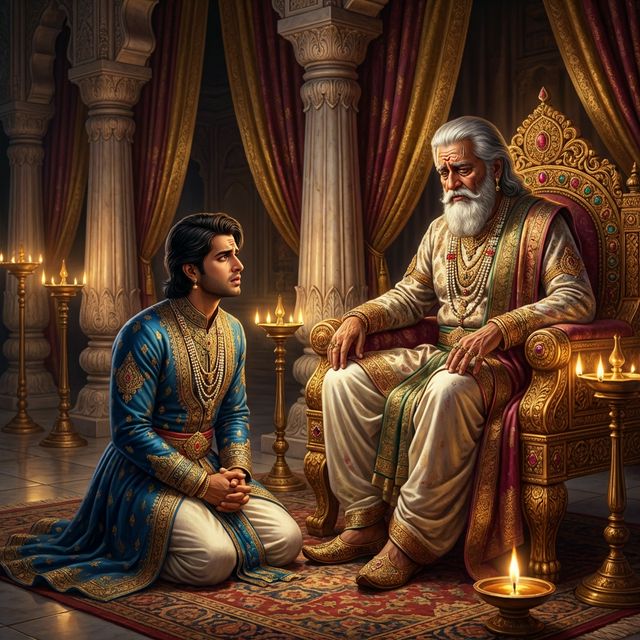
The strangeness found Nakula and Sahadeva at midday: the chariot bearing down on them flew the standard of Madra, and the man driving it against them had once put the reins of a colt into their boyish hands and told them not to be afraid of the horse's size, only its temper. Shalya, king of Madra, brother to their mother Madri, was arrayed now on the Kaurava side of a war that had no room left in it for who had taught whom to ride.
"Uncle," Sahadeva said, low, as the chariots closed, and it was not quite a greeting and not quite a plea, only the one word that fit what he felt.
Shalya heard it and something crossed his face, quickly put away. "I gave Duryodhana my word before I ever crossed the border and saw which camp my sister's sons had pitched their tents in," he said. "A king's word does not unmake itself because the field turns out to hold people he loves. Draw your bow, nephew. I will not draw mine slower for you."
He did not. Shalya fought the twins with the same skill he had once spent teaching them, matching arrow for arrow, turning their chariot's own tracks against them, and the fighting between uncle and nephews had a viciousness to it that neither side quite wanted and neither side could set down. Nakula took a wound along the forearm that would ache for a week; Sahadeva's bow was cut from his hands and re-strung twice before evening.
Neither drove the duel to its end. When the light began to slant and the noise of Drona's fighting rolled toward them from across the field, Shalya pulled back first, and the twins let him go, and none of the three ever spoke afterward of what it had cost to fight a man who had taught them the very skills they were using against him.
Shankha and the Grief of Virata
Drona had marked Virata's sons for death before the seventh day began - not from any particular hatred of the old king who had sheltered the Pandavas through their year of hiding, but because Virata's house had thrown its whole strength behind Yudhishthira, and a general who means to break an army breaks it first at the joints that will not easily mend.
Shankha, eldest of Virata's sons, met Drona's chariot in the afternoon with the confidence of a young man who had trained since boyhood for exactly this kind of test. He was not without skill. He held his ground through a first exchange of arrows that would have scattered lesser warriors, and for a few breaths it seemed the duel might run long.
It did not. Drona had spent forty years narrowing the distance between what he intended and what happened, and against that narrowing Shankha's courage was not enough. The prince fell before the sun had moved far past its height, and the news of it crossed the field in the particular hushed way that bad news travels among soldiers who do not want to be the one who says it aloud.
It reached Virata before evening. He had already lost Uttara, his youngest, on the very first day of the war, cut down while still learning which end of his own courage to trust. Now word came that Shankha too was gone, and the old king who had given the Pandavas a kingdom's shelter for a year understood, in the flat and wordless way grief arrives, that hospitality has a price no one quotes in advance. He did not weep where his soldiers could see him. He straightened his back, called for his chariot to be readied again, and rode back toward the fighting, because a war does not pause to let a father grieve, and because somewhere on that field his remaining children still needed a king rather than a mourner.
What the Night Counted
When the drums at last called both armies back to their fires, the seventh day left behind it the particular silence that follows a battle too large for any one person to have watched in full. No commander on either side could say with certainty who had won it. The mandala had held for an hour and then dissolved into a hundred private wars, and a hundred private wars do not add up to a single verdict - only to a hundred small griefs, carried back to a hundred different tents.
Yudhishthira walked among the wounded that evening as he did most evenings now, not because a king was required to, but because he could not make himself stop. He found Nakula's arm bound and Sahadeva's bow restrung and said nothing about Shalya, because there was nothing to say that either brother did not already carry. He heard, from soldiers still shaking with the memory of it, how Arjuna had turned back a thousand-strong oath by himself and ridden off before anyone could properly thank him. And he heard, last and heaviest, that Shankha of Matsya was dead, and that Virata had received the news standing, and had gone back to his chariot before the messenger finished speaking.
Bhishma, in the Kaurava camp, took no pleasure in the day's tally. He had wanted a formation that could not be broken and had built one that broke on the first real test, and he understood, better than the young men cheering around him, what that meant: not that the mandala had failed, but that no shape drawn in the sand can hold a war this size for very long. Formations were for the maps in a general's tent. On the field itself there was only the next duel, and the one after it, and the war grinding forward day by day like something with its own hunger, answering to no one's plan, not even his.
He slept badly that night, though he told no one why. Tomorrow the drums would sound again, and the wheel would be drawn once more, and once more it would not hold.
Dharma Lesson
War strips away the comforting fiction that battle lines and blood lines can be kept separate: Nakula and Sahadeva must fight the uncle who taught them archery, and Virata must grieve a son lost to the alliance he freely chose. Bhishma's mandala, an unbreakable formation on paper, dissolves within an hour into a hundred private struggles - a reminder that even the wisest plans cannot fully contain what war actually does to people. Loyalty, once given, carries its price to the end, and Shalya and Virata both pay it without pretending otherwise.