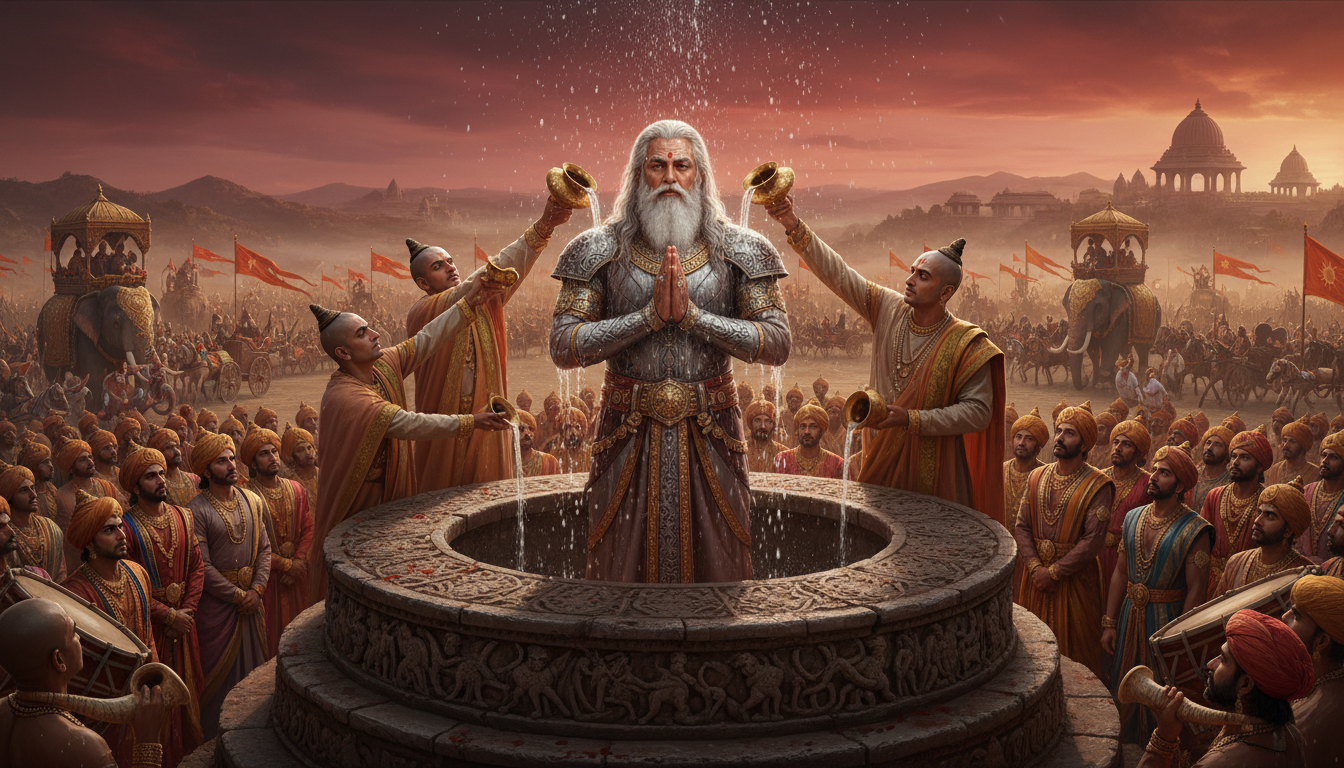
The Consecration of the Grandsire
Bhishma takes command on two conditions, and the sky rains blood
Superior, Middling, Inferior
After that night had passed away, Duryodhana distributed his eleven akshauhinis.
He did it the way a merchant sorts stock. He arranged his men, his elephants, his cars and his steeds into three classes, superior and middling and inferior, and then he distributed them among his divisions, putting the best in the van, the next in the centre, and the rest in the rear, so that the enemy would meet the finest thing he had on the first morning and the worst of it only if the first morning went badly.
There was nobody in that camp who did not know which of the three classes he had been put into. That is the thing about grading an army in front of itself. A man who has been told he is inferior stock and set in the rear does not fight the way a man in the van fights, and he does not need to be told twice which he is.
And having graded them, the Kuru king turned to the matter of what to put in their hands, and here the record stops sounding like a chronicle and begins to sound like a manual written by a man who intends to take a walled town and hold it afterwards.
The Inventory
Timber and planks, for repairing the damage the cars would sustain in the press of battle. Large quivers borne on the cars themselves. Tiger-skins and other stiff leather for enveloping the sides of the cars.
Barbed javelins to be hurled by the hand. Quivers borne on the backs of the steeds and on the backs of the elephants. Long-handled spears of iron, and missiles. Quivers borne on the backs of the foot-soldiers, and heavy clubs of wood. Flagstaffs and banners. Long heavy shafts to be shot from bows. Diverse kinds of nooses and lassoes. Armour of various kinds. Short pointed clubs of wood.
Oil, treacle and sand.
Earthen pots filled with poisonous snakes.
Pulverised lac and other inflammable matter. Short spears furnished with tinkling bells. Diverse weapons of iron, and machines for hurling hot treacle and water and stones. Whistling clubs of hard wood. Wax and heavy mallets. Clubs of wood set with iron spikes. Plough-poles and poisoned darts. Long syringes for pouring warm treacle, and planks of cane. Battleaxes and forked lances, and spiked gauntlets. Axes and pointed iron spikes. Cars with their sides covered in the skins of tigers and leopards. Sharp-edged circular planks of wood. Horns. Axes of the kuthara species, and spades. Cloths steeped in oil, and clarified butter.
A man does not put earthen pots of live snakes and syringes for hot treacle on his carts because he expects a contest between champions on an open plain. He puts them there because he has thought about what happens on the eighth day, and on the twelfth, and he has decided in advance that he does not mind.
And over all of it, the divisions of Duryodhana glittered with robes embroidered in gold and were decked with jewels and gems, and consisted of warriors endued with handsome persons, and blazed forth like fire.
Three Drivers to a Car
For the cars he would not take common men. Persons of good birth, cased in coats of mail, well skilled in weapons and accomplished in horse-lore, were employed as car-drivers.
Every car was furnished with drugs. The horses had rows of bells and pearls upon their heads, and there were banners and flagstaffs, and ornaments gracing the steeples and turrets of the cars, and shields and swords and lances and javelins and spiked maces stowed within reach.
To each car were yoked four steeds of the best breed. Upon each car were kept a hundred bows.
And each car had one driver in charge of the couple of steeds in front, and two more drivers in charge of the couple attached to the wheels on either side; and both of those last two were themselves skilled car-warriors, while the car-warrior standing in the car was himself skilled in driving steeds. Any one of the four men on that platform could have taken any of the other three positions.
Thousands of cars furnished in that manner and decked with gold, protected like fortified towns and incapable of being conquered by foes, were stationed on all sides of the camp.
Seven Men on Every Elephant
The elephants were furnished with rows of bells and pearls and decked with diverse ornaments, and in consequence of such accoutrements those animals looked like hills that had been graced with jewels.
On the back of each of them mounted seven warriors, and the seven were not seven of the same kind. Two were armed with hooks, to steer and to goad the animal. Two were excellent bowmen. Two were first-rate swordsmen. And one was armed with a lance and a trident.
The army of the Kuru king teemed with innumerable infuriate elephants of that sort, bearing on their backs loads of weapons and quivers filled with arrows. And there were thousands of steeds ridden by brave soldiers accoutred in mail and decked with ornaments and furnished with flags; and numbering in hundreds and thousands, all those steeds were free from the habit of scratching the ground with their forehoofs, and all were well trained, and decked with ornaments of gold, and exceedingly obedient to their riders.
And of foot-soldiers there were hundreds of thousands, of diverse mien, accoutred in armour of many kinds, armed with weapons of many species, and decked with golden ornaments.
The Arithmetic of an Army
To each car were assigned ten elephants as protectors. To each elephant, ten horses. To each horse, ten foot-soldiers. Nothing on that field was to stand alone.
And a large body of troops was kept back as a reserve, for rallying the ranks that would be broken, and it was reckoned on a different scale altogether: to each car of the reserve, fifty elephants; to each elephant, a hundred horses; to each horse, seven foot-soldiers. A commander who provides that carefully for rallying broken ranks has already decided which ranks are going to break.
Five hundred cars, and as many elephants, and fifteen hundred horses, and two thousand five hundred foot-soldiers, constitute a Sena. Ten Senas make a Pritana, and ten Pritanas a Vahini, though in common speech men use Sena and Vahini and Pritana and Dhwajini and Chamu and Akshauhini and Varuthini as though they all meant the same thing. Five times fifty men constitute a Patti. Three Pattis make a Senamukha, which is also called a Gulma, and three Gulmas make a Gana; and in Duryodhana's army there were thousands upon hundreds of such Ganas, of warriors capable of smiting and longing for battle.
Between the two sides the total was eighteen akshauhinis. Seven of them were the Pandavas'. Ten and one more were the Kurus'.
Out of all those men Duryodhana selected the brave and the intelligent and made them the leaders of his troops, placing an akshauhini under each: Kripa; Drona; Salya; Jayadratha the king of the Sindhus; Sudakshina the ruler of the Kamvojas; Kritavarman; Drona's son Aswatthaman; Karna; Bhurisravas; Sakuni the son of Suvala; and the mighty Vahlika. He used to bring them before him daily and at all hours and speak to them, and he offered them worship repeatedly before his own eyes; and thus appointed, all of them with all their followers became desirous of doing whatever was most agreeable to the king.
Eleven armies. Eleven commanders. And no one over them.
Like a Swarm of Ants
So Dhritarashtra's son, accompanied by all the kings, came before Bhishma the son of Santanu, and stood with his hands joined together, which was not a posture he adopted often.
"Without a commander, even a mighty army is routed in battle like a swarm of ants," he said. "The intelligence of two persons can never agree. Different commanders, again, are jealous of one another as regards their prowess."
It was true, and everybody standing in that hall knew exactly how true it was, because eleven of them had just been given an akshauhini apiece and every one of the eleven privately considered himself the equal of the other ten. Drona had taught half the men in the room. Kripa had taught the other half. Karna had been quarrelling with Bhishma for years about which of the two of them was the greater bowman, and Salya was the maternal uncle of two Pandavas and had been tricked into that army with a banquet on a road. Dushasana would take an order from his brother and from nobody else alive. Jayadratha had been dragged by the hair through a forest by Bhima not two years before and had spent the time since composing what he would do about it. Sakuni had brought the whole thing about with a pair of dice and had no troops of his own worth the name and expected to be consulted about everything.
Eleven men of that description, each with sixty-five thousand cars and more elephants than a small kingdom, would on the second morning of a battle be eleven separate wars going on beside one another. Duryodhana could see it. Whatever else may be said about him, he could count, and he had just spent a night counting.
The Brahmanas and the Haihayas
"O thou of great wisdom," Duryodhana went on, "it is heard by us that once on a time the Brahmanas, raising a standard of kusa grass, encountered in battle the Kshatriyas of the Haihaya clan, who were endued with immeasurable energy. And the Vaisyas and the Sudras followed the Brahmanas, so that all three orders were on one side, while those bulls among the Kshatriyas were alone on the other.
"In the battles that ensued, the three orders repeatedly broke, and the Kshatriyas, though alone, vanquished the large army that was opposed to them. Then those best of Brahmanas enquired of the Kshatriyas themselves as to the cause of it, and those that were virtuous among the Kshatriyas returned the true answer: 'In battle we obey the orders of one person endued with great intelligence, while ye are disunited from one another and act according to your individual understanding.'
"The Brahmanas then appointed one amongst themselves as their commander, who was brave and conversant with the ways of policy, and they succeeded in vanquishing the Kshatriyas. Thus people always conquer their foes in battle who appoint a skilled, brave and sinless commander, observing the good of the forces under him.
"As regards yourself, you are equal to Usanas himself, and you always seek my good, and you are incapable of being slain, and you are devoted to virtue. Be our commander, therefore. Like the sun among all luminaries, like the moon among the delicious herbs, like Kuvera among the Yakshas, like Vasava among the gods, like Meru among mountains, like Suparna among birds, like Kumara among the gods, like Havyavaha among the Vasus, so are you among ourselves. Protected by you as the gods are protected by Sakra, we shall become invincible even by the gods. March at our head as Agni's son marches at the head of the celestials, and let us follow you as calves follow the lead of a mighty bull."
Two Conditions
"It is even so, O mighty-armed one, as you say," said Bhishma. "But the Pandavas are as dear to me as you yourselves are. Therefore I should certainly seek their good as well, although I shall certainly fight for you, having given you a pledge to that effect.
"I do not see the warrior on earth that is equal to me, except that tiger among men, Dhananjaya the son of Kunti. Endued with great intelligence, he is conversant with innumerable celestial weapons; but that son of Pandu will never fight with me openly. With the power of my weapons I could in a trice destroy this universe with its gods and Asuras and Rakshasas and men. The sons of Pandu, however, are incapable of being exterminated by me."
Then he named his price, and there were two parts to it.
"I shall slay every day ten thousand warriors. If they do not slay me in battle first, I will continue to slaughter their forces in that manner. That is the first thing.
"There is another understanding on which I may willingly become the commander of your forces, and it behoves you to listen to it. O lord of earth, either Karna should fight first, or I will fight first. The Suta's son always boasts of his prowess in battle, comparing it with mine."
He had been asked for one voice and he had given two conditions, and neither of them was about the enemy. The first was about whom he would not kill. The second was about whom he would not stand beside.
So the old man had accepted, and in accepting had told the whole hall two things: that he would kill ten thousand a day and never one of the five men the war was actually about, and that he would not stand on the same field as the best archer his own side possessed.
Karna did not argue. He answered in two sentences and walked out of the war with them.
"As long as Ganga's son lives, O king, I shall never fight. After Bhishma is slain, I shall fight with the wielder of Gandiva."
A Cloudless Sky Rains Blood
After this, Dhritarashtra's son duly made Bhishma the commander of his force, distributing large presents; and after his installation in the command he blazed forth with beauty, and at the king's behest the musicians cheerfully played upon drums and blew conchs by hundreds and by thousands. Numerous leonine roars were sent forth, and all the animals in the camp uttered their cries together.
It was the sound a coronation makes. The whole camp was told at once, in the way armies are told things, by noise: the drums came up first, then the conchs under them, then the roaring of the men, and last of all the animals, who did not know what was being celebrated and joined in anyway.
And then, although the sky was cloudless, a bloody shower fell and made the ground miry.
Fierce whirlwinds came. The earth shook. The elephants roared without being goaded. Incorporeal voices were heard in the sky and flashes of meteoric falls were seen there. Jackals howled fiercely, foreboding great calamity. These and a hundred other kinds of fierce portents made their appearance at the moment when the king installed Ganga's son in the command of his troops, and the hearts of all the warriors were depressed.
Nobody stopped the ceremony. The drums went on. The conchs went on. Men stood in a rain of blood on a bright morning, with the ground turning to mud under their feet and the jackals crying in daylight, and they finished the consecration, because eleven armies had already been graded and provisioned and handed out, and the pots of snakes were already loaded on the carts.
The Camp That Shone Like Hastinapura
Then, having made Bhishma that grinder of hostile hosts his general, and having caused the Brahmanas by abundant gifts of kine and of gold to pronounce benedictions upon him, and being glorified by those benedictions, and surrounded by his troops, and with Ganga's son in the van, and accompanied by his brothers, Duryodhana marched to Kurukshetra with his large host.
And the Kuru king went over the plain with Karna in his company, which is a detail worth keeping: the two of them rode out together to choose the ground, the commander-in-chief and the man who had just sworn not to fight under him, and between them they measured out the camp on a level part of that plain.
It was pitched on a delightful and fertile spot abounding with grass and fuel, and when it was finished it shone like Hastinapura itself.
He had been told that an army obeys one voice or it obeys none. He had said it himself, with his hands joined, out of a story about brahmanas beating kshatriyas with a standard of kusa grass. And then he had accepted a commander who would not kill the five men the war existed to kill, and who required that the second greatest bowman on the field sit in his tent for as long as he lived.
An army obeys one voice or it obeys none. That was the argument, and it was a good one, and Duryodhana had made it himself with his hands joined and eleven kings listening. What he got in exchange for it was a commander who had told him in advance, in front of everyone, the two places where the arrangement would not hold.
Ten days later, on the field that shone like a city, Bhishma would be lying on a bed of arrows, and Karna would come into the war at last, and the arithmetic of that morning would begin to come due.
Dharma Lesson
An army obeys one voice or it obeys none, and Duryodhana argues that case himself with his hands joined. But the man who accepts command with conditions has already named the two places where he will fail, and everyone in the hall hears him name them. Bhishma will not kill the five men the war exists to kill, and will not stand on the field beside the best bowman his own side has.