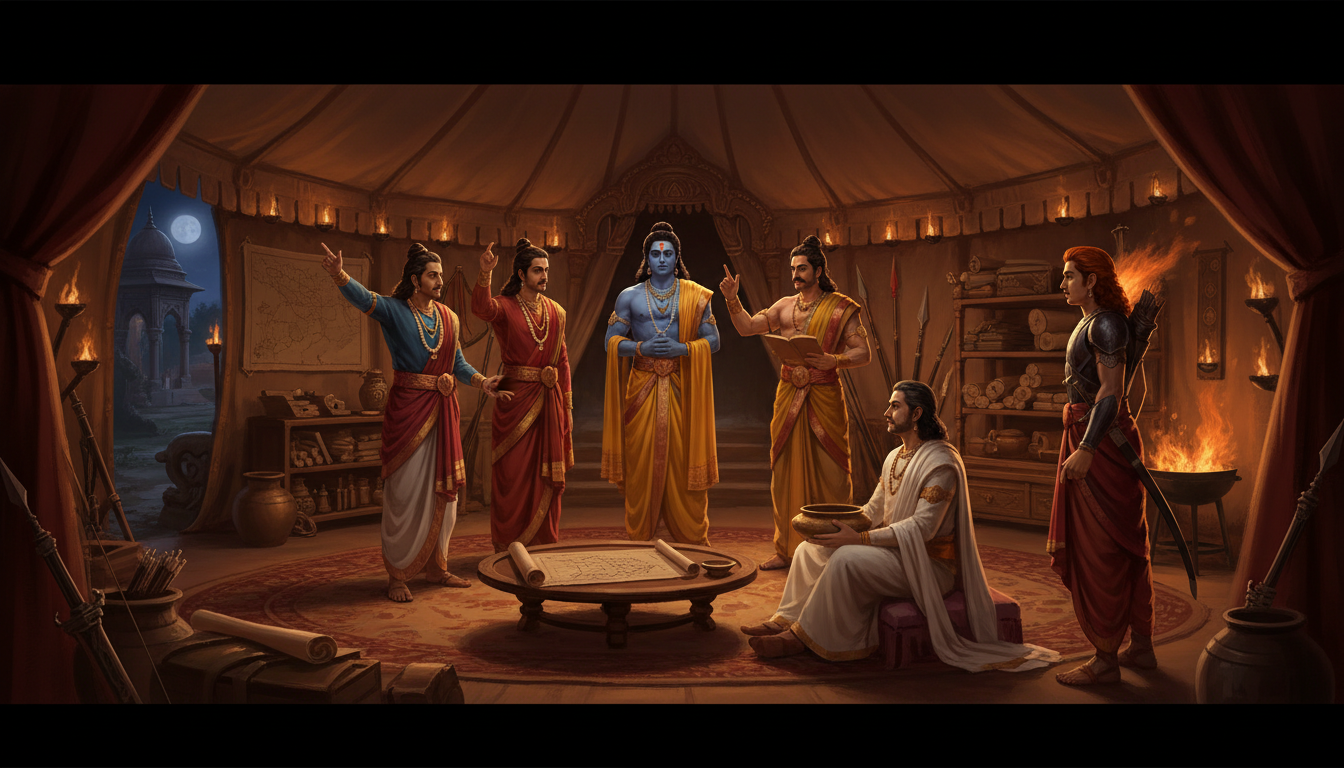
The Choosing of the Generalissimo
Five brothers name five different men, and Krishna names the sixth
Seven Divisions and No Head
Krishna had come back from Hastinapura that day with nothing, and had told them what the Kuru court had said and what it had tried to do to him, and now the light was going and there was one piece of business left that could not wait until morning.
Yudhishthira spoke to his brothers in Kesava's presence.
"You have heard all that happened in the court of the assembled Kurus," he said. "You have also understood the words uttered by Kesava. Draw up my troops, then, in the battle array in which they are to fight. Here are seven akshauhinis assembled for our victory, and hear the names of the seven celebrated warriors who will lead them: Drupada, and Virata, and Dhrishtadyumna, and Sikhandin, and Satyaki, and Chekitana, and Bhimasena of great energy.
"All of them are conversant with the Vedas. Endued with great bravery, all of them have practised excellent vows. Possessed of modesty, all of them are conversant with policy and accomplished in war, and all of them are competent in the use of every kind of weapon."
He stopped there, because the difficulty was not the seven.
"Now tell me, O Sahadeva," he said, "who is that warrior, conversant with all kinds of battle array, who may become the leader of these seven, and who may also withstand in battle Bhishma, who is like a fire that has arrows for its flames. Give me your own opinion, O tiger among men, as to who is fit to be our generalissimo."
It was the youngest who was asked first. That was deliberate. Yudhishthira had been in this family a long time and knew that if he asked Arjuna first, nobody after Arjuna would say anything worth hearing.
Sahadeva Names the Man Who Took Them In
Sahadeva did not hesitate, and he did not name a warrior. He named a host.
"Closely related to us," he said. "Sympathising with us in our distress. Endued with great might, conversant with every virtue, skilled in weapons and irresistible in battle: the mighty king of the Matsyas, Virata, relying upon whom we hope to recover our share of the kingdom. He will be able to bear in battle both Bhishma and all those mighty car-warriors."
Everybody in the tent understood the order in which he had said it. He had put the relation first, and the sympathy second, and the might third, and the skill fourth. A year ago the five of them had been a cook, a dancing master, a groom, a cattle-hand and a courtier's dice companion in that man's palace, sleeping in his rooms under false names, and Virata had not known who was under his roof, and had been decent to them anyway, and had given Uttara to Abhimanyu when he found out.
Sahadeva had tended his cattle. He had counted the herds and known the diseases of them and been thanked by that king in that king's own hall. When you ask a man who should lead an army, you find out what he cannot bring himself to be ungrateful about.
Nakula Names the Man Who Hates Drona
Then Nakula spoke, and Nakula was eloquent, and his answer took a while because he built it in courses like a wall.
"He that in years, in knowledge of the scriptures, in perseverance, in family and in birth is respectable," he said. "He that is endued with modesty, strength and prosperity. He that is well versed in all branches of learning. He that studied the science of weapons with the sage Bharadwaja. He that is irresistible and firmly devoted to truth. He that always challenges Drona and mighty Bhishma. He that belongs to one of the foremost of royal houses and is a famous leader of hosts. He that resembles a tree of a hundred branches, in consequence of the sons and grandsons who surround him."
He came to the two lines that mattered.
"That king who, with his wife, performed, moved by wrath, the austerest of penances for the destruction of Drona. That bull among monarchs who always cherishes us like a father. That father-in-law of ours, Drupada, should be our generalissimo. It is my opinion that he will be able to withstand both Drona and Bhishma rushing to battle, for that king is the friend of Angira's descendant Drona and is conversant with celestial weapons."
It was a strange recommendation and Nakula did not notice it was strange. He had praised the man twice for his enmity and once for his friendship with the same enemy, and had ended on the word father. Of all five brothers he was the one who thought about houses and alliances and who was owed what by whom; and asked to pick a commander, he had picked a relative with a grudge older than the war.
Arjuna Names the Fire-Born
After the two sons of Madri had given their opinions, Savyasachin spoke, and what came out of him was not an argument. It was a portrait, and he did it the way an archer describes a target he has already studied for years.
"This celestial person of the hue of fire and endued with mighty arms, who sprang into life through the power of ascetic penances and the gratification of sages; who issued out of the sacrificial fire-hole armed with bow and sword, accoutred in armour of steel, mounted on a car to which were yoked excellent steeds of the best breed, and the clatter of whose car-wheels was as deep as the roar of mighty masses of clouds.
"This hero resembling the very lion in the frame of his body and in his prowess, possessed of leonine shoulders and arms and chest, and a voice like the lion's roar. This warrior of handsome brows and fine teeth and round cheeks and long arms, of stout make, with excellent thighs and large expansive eyes and a strong frame. This prince who is incapable of being penetrated by weapons of any kind, and who looks like an elephant with rent temples.
"This Dhrishtadyumna, truthful in speech and with his passions under control, who was born for the destruction of Drona.
"It is this Dhrishtadyumna, I think, who will be able to bear Bhishma's arrows: arrows that strike with the vehemence of the thunderbolt and look like snakes with blazing mouths, that resemble the messengers of Yama in speed and fall like flames of fire consuming everything they touch, and that were borne before this by Rama alone in battle. I do not see the man except Dhrishtadyumna who is able to withstand Bhishma of great vows. Endued with great lightness of hand, conversant with all the modes of warfare, cased in a coat of mail incapable of being penetrated: that is my opinion of who is fit to be our generalissimo."
Of all the men on that side, Arjuna was the one who had actually stood in front of Bhishma's arrows, at Virata's cattle raid, with a boy holding the reins. He was the only speaker that evening who described the enemy at greater length than the candidate.
Bhima Names a Death
Bhima's answer was the shortest of the four and it did not contain a single word about administration.
"That son of Drupada, Sikhandin, who is born for the destruction of Bhishma, as is said by the sages and the Siddhas assembled together," he said. "Whose form on the field of battle, while he is displaying celestial weapons, will be seen by men to resemble that of the illustrious Rama himself. I do not see the person who is able to pierce with weapons that Sikhandin, when he is stationed for battle on his car and accoutred in mail.
"Except the heroic Sikhandin, there is no other warrior who is able to slay Bhishma in single combat. It is for this, O king, that I think Sikhandin is fit to be our generalissimo."
The others had named men who could withstand the grandsire. Bhima named the man who could end him, and he named him for that reason and for no other reason, and he did not pretend otherwise. He had been the first of them to say aloud in the assembly hall, years before, what he intended to do to Dushasana's chest and to Duryodhana's thigh, and he had not moved from any of it since. Ask Bhima who should command an army and he will hand you the instrument of a death and call it a nomination.
Four brothers had spoken. Four different men had been named, and not one of them was a brother, and every single answer had been about the man who said it.
The King Refuses to Choose
Then they all looked at Yudhishthira, who had asked the question, and who had the deciding of it, and who did not decide it.
"The strength and weakness, the might and the feebleness of everything in the universe," he said, "and the intentions of every person here, are well known to virtuous Kesava. Skilled or unskilled in weapons, old or young, let him be the leader of my forces who may be indicated by Krishna of Dasarha's race.
"Even he is the root of our success or our defeat. In him are our lives, our kingdom, our prosperity and our adversity, our happiness and our misery. Even he is the Ordainer and the Creator. In him is established the fruition of our desires. Let him, therefore, be the leader of our host who may be named by Krishna."
He glanced at the tent wall, where the light had gone almost entirely.
"Let that foremost of speakers say it, for the night approaches. Having selected our leader, and having worshipped our weapons with offerings of flowers and perfumes, we will at daybreak march to the field of battle under Krishna's orders."
It would be easy to call that evasion, and it was not. Four men had just named four candidates, and every one of the four had chosen out of his own history, out of gratitude or kinship or study or hatred. The eldest brother knew his own history perfectly well. He had put seven armies into the field over a game of dice he had insisted on playing, and he did not trust his own judgment about who should lead them, and he said so in front of everybody, and handed the decision to the one man in the tent who had nothing to avenge.
The Debt to Virtue Is Paid
The lotus-eyed Krishna answered, and he answered while looking at Dhananjaya, which everybody noticed.
"I fully approve of all those powerful warriors whom you have named for becoming the leaders of your troops," he said. "All of them are competent to withstand your foes. Indeed, they can frighten Indra himself in great battle, let alone the covetous and wicked-minded sons of Dhritarashtra."
Then he said the thing he had come back from Hastinapura to say.
"O you of mighty arms, for your good I made great efforts to prevent this battle by bringing about peace. By that we have been freed from the debt we owed to virtue. Fault-finding persons will not be able to reproach us for anything."
Nobody spoke. He had gone into that hall alone. He had asked for five villages. He had been answered with an order for his arrest.
"Foolish Duryodhana, destitute of understanding, regards himself as skilled in weapons, and though he is really weak he thinks himself possessed of strength. Array your troops soon, for slaughter is now the only means by which they can be made to yield to our demands. The sons of Dhritarashtra will never be able to keep their ground when they behold Dhananjaya with Yuyudhana as his second, and Abhimanyu, and the five sons of Draupadi, and Virata and Drupada and the other kings of fierce prowess, all of them lords of akshauhinis. Our army is possessed of great strength, is invincible and incapable of being withstood, and without doubt it will slay the Dhartarashtra host."
That was the whole of the peace, spoken over in one paragraph and closed. In the tent nobody argued about the war any more after that sentence. They argued about the fodder.
As Regards Our Leader
"As regards our leader," said Krishna, "I would name that chastiser of foes, Dhrishtadyumna."
Arjuna's name had been the one he chose. Not the man who had sheltered them, not the man who was their wife's father, not the man who existed to kill Bhishma; the man born out of a fire for the destruction of Drona, who was in his own person the beginning of the whole quarrel between Drupada and his teacher, and who was young, and had never held a field. Krishna had praised every name that was offered to him and then set all four of them aside, and no one in the tent objected, because the king had already said that whoever Krishna named would be the man.
All the monarchs who were there were filled with joy, and the shout the delighted kings sent up was tremendous, and after it the troops began to move about at great speed calling out to each other, Draw up, draw up. The neighing of steeds and the roars of elephants and the clatter of car-wheels and the blare of conchs and the sound of drums were heard everywhere together and produced a tremendous din, and the seven armies of the Pandavas began, in the dark, to become a thing with a shape.
Dhrishtadyumna himself said nothing that has been recorded. He was the son of a king who had spent a fortune and a lifetime of penance to produce him for one purpose, and he had just been handed seven akshauhinis by a man who had spent the whole of the previous fortnight trying to make sure they would never be needed.
News of the Grandsire
"When Yudhishthira heard that Bhishma had been installed in the command of the Kuru army," Janamejaya asked afterwards, "what did that mighty-armed son of Pandu say? What also did Bhima and Arjuna say? And what too did Krishna say?"
And Vaishampayana told him.
Word came in from the other side: Bhishma, the son of Ganga, the head of all the kings, the rival of Vrihaspati in intellect, resembling the ocean in gravity and the mountains of Himavat in calmness and the sun in energy, had been installed in the command of the Kuru army, to hold it until his death removed him.
Yudhishthira, well acquainted with what should be done in the face of dangers and calamities, summoned all his brothers and the eternal Vasudeva, and said it in a mild voice, as he said most things.
"Make your rounds among the soldiers, and remain carefully, casing yourselves in mail. Our first encounter will be with our grandsire. Look now for seven leaders for the seven akshauhinis of my troops."
"Those words of grave import which it behoves you to utter on an occasion like this have indeed been uttered by you," said Krishna. "Even this is what I also like. Let that now be done which should be done next. Let seven leaders be selected for your army."
So they were summoned, those warriors eager for battle, and appointed each to the command of a division: Drupada and Virata; that bull of Sini's race, Satyaki; Dhrishtadyumna the prince of Panchala; king Dhrishtaketu; prince Sikhandin of Panchala; and Sahadeva the ruler of the Magadhas, who was not the son of Madri but the son of Jarasandha, and whose father Bhima had killed with his hands in a wrestling hall in Girivraja.
And Above Them All
And above all seven of them was placed, in command of all the troops, that Dhrishtadyumna who had sprung from the blazing sacrificial fire for the destruction of Drona.
And Dhananjaya of the curly hair was made the leader of all those high-souled leaders, so that the general had a general over him and everybody in the camp understood the arrangement without anyone needing to explain it.
And handsome Janardana, endued with great intelligence, the younger brother of Sankarshana, was chosen as the guide of Arjuna and the driver of his steeds.
That was the whole hierarchy, settled in a single evening: a fire-born prince over seven kings, Arjuna over the fire-born prince, and over Arjuna nobody at all, only a pair of hands on the reins belonging to the one person in the army who had refused to carry a weapon into it.
They worshipped the weapons that night with flowers and with perfumes, as Yudhishthira had said they would. Four brothers had named four men and had each of them, without meaning to, said aloud what he was most afraid of: Sahadeva that they would be ungrateful, Nakula that they would be alone, Arjuna that Bhishma could not be endured, Bhima that Bhishma could not be killed. The fifth had been afraid of his own choosing and had said that aloud too.
In the morning they marched.
Dharma Lesson
Who a man would put in command tells you what he is most afraid of, and four brothers name four men out of gratitude, kinship, study and hatred without noticing they are describing themselves. Yudhishthira knows his own judgment is not to be trusted here and says so in front of everyone. The leader worth having is the one chosen for the war ahead rather than for the debts behind.