The Ascetic Who Would Not Be Carried
A thought Garuda never spoke aloud costs him his wings
Go, Galava, Go
"Persons that listen to the counsels of friends are rare," Narada was saying in the Kuru hall, to a prince who had heard the same thing from three other men that week. "Friends are rarer still that offer beneficial counsel. Obstinacy ought to be avoided, O son of Kuru's race, for it is fraught with great evil, and in this connection there is cited an old story about the disgrace that Galava met with through obstinacy."
Galava had waited on Vishvamitra for years without being asked to, out of respect and affection and the plain desire to do what was agreeable, and when at last the Rishi said to him, "With my leave, O Galava, go whithersoever thou mayest wish," the pupil would not go.
"What final gift shall I make you for your services as my preceptor?" he said. "It is in consequence of the final present that a sacrifice becomes successful. Such gifts are the fruit that a man enjoys in heaven. They are peace and tranquillity personified. What shall I procure for you? Let it be said."
Vishvamitra knew perfectly well that he had been conquered by this young man's service, and that there was nothing owing.
"Go," he said.
"What shall I give?"
"Go."
"What shall I give?"
And the illustrious Vishvamitra, who had stood a hundred years in his own hermitage with a dish of hot food balanced on his head, subsisting on air, because a guest had told him to wait, felt at last a slight rise of anger.
"Give me eight hundred steeds," he said, "every one of which is as white as the rays of the moon, and every one of which has one ear black. Go now, O Galava, and tarry not."
The Friend Who Came
After that Galava could not sit, or lie down, or eat. He grew pale and was reduced to a skeleton, and he lamented aloud in a way that a man only does when he believes nobody is listening.
"Where shall I find affluent friends? Where shall I find money? Have I any savings? Where shall I find eight hundred steeds of lunar whiteness? What pleasure can I have in eating? The very love of life is extinct in me. Repairing to the other shore of the great ocean, or to the furthest verge of the earth, I will relinquish my life.
"Death is preferable to life for the man who, having enjoyed the wealth of friends through their friendship, is unable to return their favour. The religious acts of that man lose their efficacy who, having promised to do a thing, fails to perform it and is thus stained with falsehood. What ungrateful person has ever earned fame? Where is his place and where is his happiness? Even I am that wretch."
And while he was saying it, his friend Garuda, the son of Vinata, came down out of the sky in front of him and was cheerful about it.
"You are a dear friend of mine," said Garuda. "It is the duty of a friend, when he is himself in prosperity, to look to the accomplishment of his friend's wishes. Whatever prosperity I have is constituted by Vishnu, the younger brother of Vasava. I have already spoken to him on your behalf, and he has been pleased to grant my wish. Come now. We will go together. I will bear you comfortably to the other shore of the ocean, or to the furthest extremity of the earth. Come, O Galava, and do not tarry."
It is worth noticing what had happened. The horses did not exist. Nothing about the debt had changed. But the man who had been talking about laying down his life stopped talking about it the moment somebody offered to carry him.
Which Quarter
"I have been commanded by God, who is the cause of all knowledge," said Garuda. "I ask you, then, towards which quarter shall I first take you to see what lies there? The eastern, the southern, the western, or the northern?"
And because he was Garuda, he could not simply wait for an answer; he had to describe them.
"That quarter towards which Surya the illuminator of the universe first rises; where at evening the Sadhyas engage in their austerities; where that Intelligence which pervades the whole universe first sprang; where the two eyes of Dharma and Dharma himself are stationed; where the clarified butter first poured in sacrifice afterwards flowed all around. That quarter is the gate of Day and of Time. There the daughters of Daksha in primeval times gave birth to their children and the sons of Kasyapa first multiplied. It was there that Sakra was first anointed king of the celestials, and there that the divine Creator first sang the Vedas, and there that the Gayatri was first preached by Surya to the reciters of that hymn. That is the gate of the three worlds and the path of heaven. It is called Purva, the first."
He described the west as well, where the mountain called Asta receives the sun each evening and is the cause of the twilight, and out of which Night and Sleep issue at the close of every day as if to rob living creatures of half their allotted span; where Surabhi the mother of cows repairs to the shore of a lake adorned with golden lotuses and pours forth her milk; where the headless trunk of Swarbhanu is seen in the middle of the ocean, still bent upon devouring the sun and the moon. And he described the north, which is called uttara because it is uttarana, that which saves from sin, where none can live that is unamiable or of unbridled passions; where in the asylum of Vadari the eternal Krishna and Jishnu dwell with the Creator; where Mahadeva, receiving her first upon his head, afterwards let the Ganga fall from the heavens to the world of men; where Kuvera was installed on the breast of Kailasa in the sovereignty of the Yakshas and the Rakshasas and the Gandharvas.
"Take me east," said Galava, "where the two eyes of Dharma are first opened, where you say the gods are always present and both truth and virtue reside. I desire to meet all the gods. Take me there, O younger brother of Aruna, so that I may behold them."
"Mount on my back," said Garuda.
The Storm Made by the Wings
For the first while Galava said beautiful things, because that is what a passenger does.
"Your beauty, O devourer of snakes, as you proceed, seems like that of the sun himself in the morning, the maker of the day endued with a thousand rays."
Then the speed came on properly.
"The trees, broken by the storm caused by the flapping of your wings, seem to pursue you in the course. You seem to drag the very Earth after you by that storm, with all the waters of her oceans and all her mountains and woods. The tempest of your wings raises the water of the sea into mid air with the fishes in it, and the snakes and the crocodiles. I see fishes with faces like our own. I see Timis and Timingilas and snakes endued with human faces, all of them crushed in that wind. My ears are deafened by the roar of the deep. I am so stunned that I can neither hear nor see. Indeed, I have forgotten my own purpose.
"Slacken your speed, O ranger of the sky, remembering the risk to a Brahmana's life. Neither the sun nor the cardinal points nor the sky itself is any longer perceptible to me. I see only a thick gloom. I cannot see your body and I cannot see my own. I see only your two eyes, resembling two radiant gems, and at every step I behold sparks of fire coming off your frame. Stop these sparks. Put out the dazzling of your eyes.
"O son of Vinata, I have no business to go with you. Desist. I have promised my preceptor eight hundred white steeds of lunar effulgence, each having one ear black in hue, and I see no way of fulfilling my pledge. There is one way that I can see, and that is to lay down my own life. I have no wealth of my own, nor any wealthy friend, and wealth however immense could not procure the thing anyway."
Death Is God Himself
Garuda did not slacken. He laughed, at that height, over that water, with a Brahmana clinging to his back and talking about suicide.
"You have little wisdom, O regenerate Rishi," he said, "since you wish to put an end to your own life. Death can never be brought about by one's own effort. Death is God himself. You do not get to schedule him because you are embarrassed about a debt."
"Then what am I to do?"
"Why did you not inform me of your purpose before this? There are excellent means by which all of it may be accomplished. Here is this mountain called Rishabha on the seaside. We will rest there for a time and refresh ourselves with food, and then, O Galava, I will return to the matter and we will settle it."
He went down toward the peak, and the noise of the wind of him fell away, and the sea flattened out again behind them and put back the fishes it had been holding in the air.
Galava, when he could hear his own voice again, tried to say something about the horses.
"Later," said Garuda. "There is a way to it and I know the way, and you have been so busy dying that you have not once asked me for it. First we eat."
The Woman on Rishabha
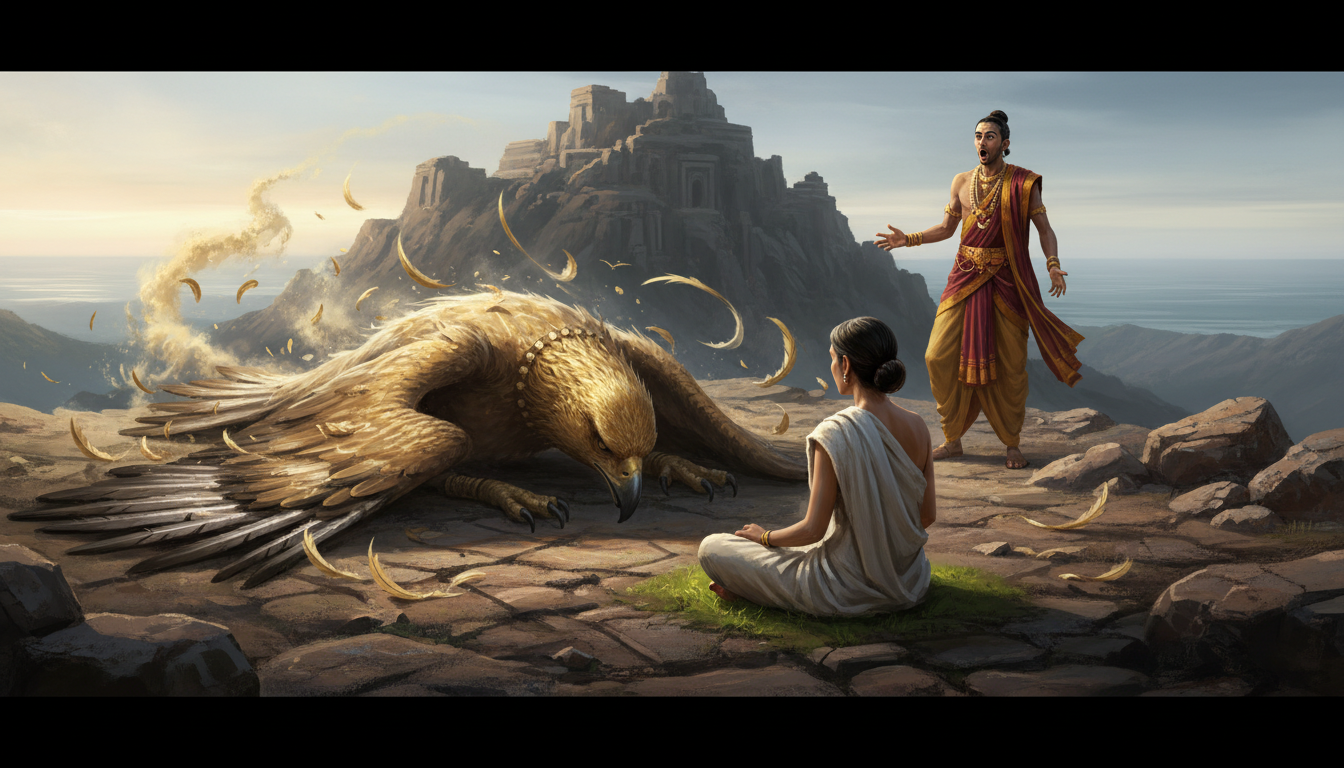
There was a Brahmana lady on the peak of Rishabha, of the name of Sandili, engaged there upon ascetic penances.
She was alone. There was no hermitage of pupils around her, no fire tended by attendants, nothing at all to show a visitor what her rank was or how far along she had come; and the two who alighted, the foremost of the twice-born and the king of birds, bent their heads to her and worshipped her, because both of them could feel it in the air of that place even if they could not see it.
She asked after their welfare, as a householder does, and gave them seats. Then she brought them cooked food, and they took it, first dedicating it to the gods with the proper mantras, and they ate.
It is a small scene and nothing is said in it. A woman on a mountain feeds two travellers who arrived without warning, and does it well, and asks them nothing about themselves.
Afterwards the two of them laid themselves down on the ground, full, in the warmth, and fell into a profound sleep.
One of them slept the sleep of a tired traveller. The other, before he went under, lay looking at the bare rock and the single fire and the woman sitting by it, and thought about the matter for a while, and came to a conclusion about it, and never opened his mouth.
A Ball of Flesh With a Head and Legs
Garuda woke first, from a desire of leaving that place, and found that his wings had fallen off.
Not broken. Not clipped. Gone, as though they had never been fastened on, so that the son of Vinata, who carries Vishnu, who took the Amrita out of heaven through a wheel of blades and a wall of fire, who had that morning been dragging the ocean into the sky behind him, was lying on a rock as a ball of flesh with only his head and his legs.
Galava woke and saw it and could not speak for a moment.
"What is this condition that has overtaken you," he said, "as the consequence of our stopping here? Alas, how long shall we have to reside in this place now? Have you harboured any evil and sinful thought in your mind? It cannot, I am sure, be any trivial sin that you have been guilty of."
Because that was the arithmetic of it, and both of them knew it. Whatever had been done, it had been done in silence, in sleep, on a mountain where the only other person present had given them her food and asked nothing; and the price of it had been every feather he had.
The Thought He Never Said Aloud
Garuda told him.
"Indeed, O regenerate one, I entertained the thought of carrying away this lady from this spot. She is crowned with ascetic success. I thought that she should be living where the Creator himself and the divine Mahadeva and the eternal Vishnu live together, and Virtue and Sacrifice personified along with them. I thought that was the proper address for a woman of her attainment, and that this rock was not."
He had not proposed it to her. He had not mentioned it to Galava. He had lain down and worked out, privately, between himself and himself, where somebody else ought to live, and had gone to sleep having decided it.
"I shall now prostrate myself before this holy lady," he said, "from a desire of doing myself good, and pray to her. I will tell her that it was with a heart full of pity that I entertained such a thought. Whether I acted rightly or wrongly, that was the wish, and it was evidently against her own, and it was cherished by me out of respect for her. It behoves her, from the nobility of her heart, to grant me forgiveness."
So he said it to her, lying there, unable to stand, in front of the woman he had intended to pick up and put somewhere better.
I Do Not Pardon Contempt
That lady became gratified with the prince of birds and with that bull of Brahmanas, and she spoke to Garuda.
"Fear not, O you of beautiful feathers. Resume your wings and cast off your fears."
Then, having lifted the punishment first, she said the rest of it, and she did not soften it.
"I was contemned by you. Know that I do not pardon contempt. That sinful being who entertains contempt for me would speedily fall away from all blissful regions.
"There is not a single inauspicious indication about me. I am perfectly blameless. In consequence of the purity of my own conduct I have attained to high ascetic success, and nobody put me here and nobody is required to move me. Purity of conduct bears virtue as its fruit. Purity of conduct bears wealth as its fruit. It is purity of conduct that brings on prosperity, and it is purity of conduct that drives away all inauspicious indications.
"Go, O blessed prince of birds, whithersoever you wish, from this place. Never entertain contempt for me. And take care that you do not hold in contempt any woman, even one that may be truly blamable. You shall again be, as before, invested with both strength and energy."
At these words of hers the wings came back on him, and when he stood up and opened them he found they were stronger than they had been before.
The Preceptor on the Road
With Sandili's leave, Garuda took Galava on his back and departed. They searched, and they failed to find the kind of steeds they were in search of, because eight hundred moon-white horses each with one black ear are not a thing that exists in quantity anywhere.
And on the road, of all people, they met Vishvamitra.
"O regenerate one," said that foremost of speakers, in front of the son of Vinata, "the time is already come when you should give me the wealth you promised me of your own accord. I do not know what you may intend. I have waited so long. I will wait some time more. Seek the way by which you may succeed in the matter of your promise."
Galava had nothing to say. Garuda looked at his cheerless friend, who was overwhelmed with sorrow, and put it to him without any comfort in it.
"What Vishvamitra said to you before has now been repeated in my presence," he said. "Come, therefore, O Galava, best of Brahmanas, and we will deliberate on the matter. Without giving your preceptor the whole of the wealth you promised, you cannot even sit down."
That, said Narada in the Kuru hall, is where obstinacy takes a man: he would not accept that nothing was owed, and now he could not rest until the impossible thing was paid, and along the road to paying it a friend who had only ever tried to help had lost his wings in his sleep for a kindness he never spoke. Duryodhana, who had been told that morning by Krishna, by Bhishma and by his own father that he might still put the war down, listened to the whole of it politely and asked for the rest of the story.
Dharma Lesson
Condescension does not become harmless by staying unspoken. Garuda never made his offer, never asked her, and lost his wings anyway, because deciding where somebody else ought to live is the oldest form of contempt. Sandili forgives the man and refuses to forgive the thought, and tells him to hold no woman cheap, not even one who might deserve it.