The Arm on the Bird's Shoulder
The strongest flier in the worlds, taught his size
The Cup He Would Not Open
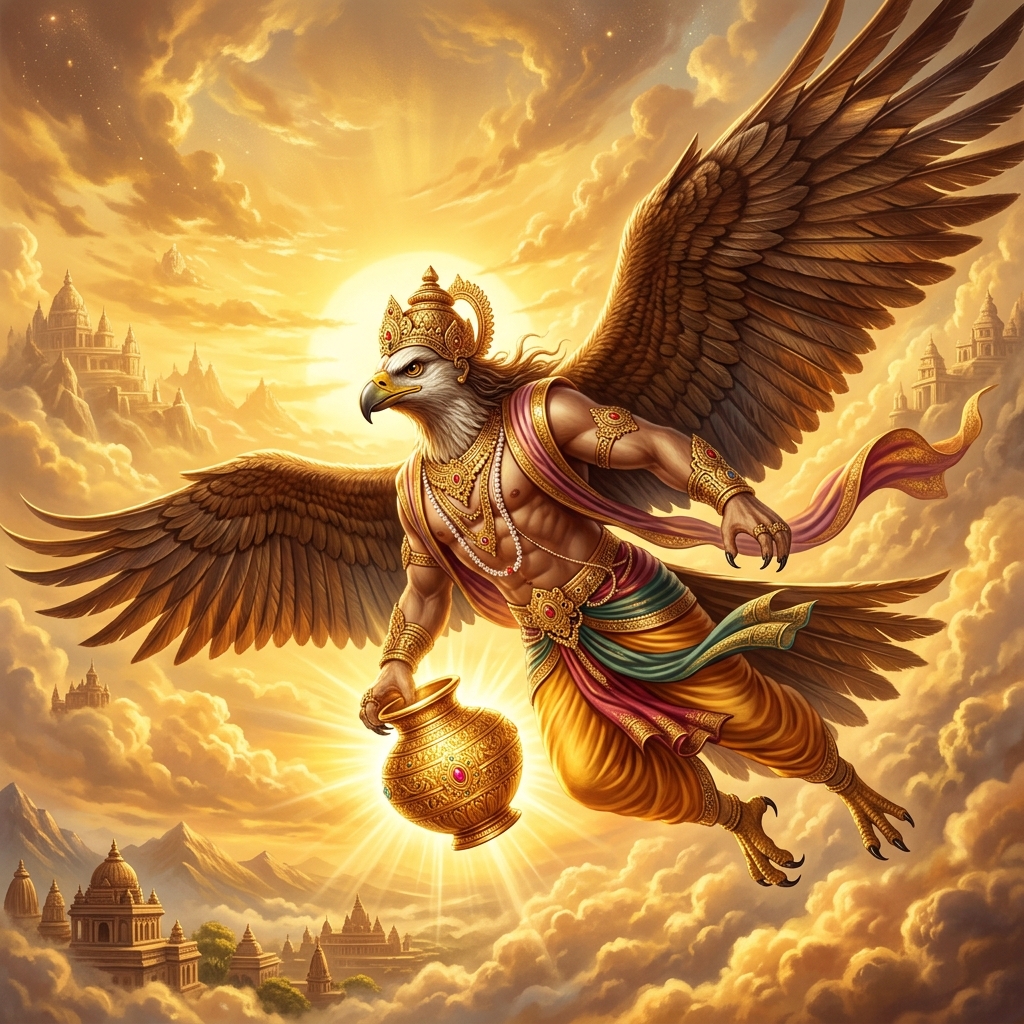
Garuda crossed the ocean between heaven and earth with the amrita locked in his talons, and even from the ground far below, fishermen said afterward that his shadow crossed three kingdoms before it was gone. He had fought the guardians of Amaravati, the fire that ringed the vessel, the spinning wheel of blades, the two serpents coiled around its stem, and Indra himself, whose thunderbolt had scored his wing and drawn no cry from him, and he had won. Vinata's freedom was already settled; the moment Kadru's messengers confirmed the nectar was truly his to deliver, the wager was closed and his mother walked free of her sister's spite. What remained was the last, simplest part of the errand: to carry the cup down to the world of serpents and set it in their hands, unbroken, undrunk.
He had not stopped since leaving the gods' city. Three days of open sky, no water, no rest, wounds still weeping where the thunderbolt had caught him, and beneath him always that golden vessel humming with a fragrance that made his throat ache. He could have tipped his head back over the ocean and no one in any of the three worlds would have known.
He did not.
The sky in front of him folded like a curtain, and where the mid-afternoon sun had been, a figure stood instead, dark as a monsoon cloud, four-armed, at ease in the empty air as though it were solid ground.
"You have flown since three mornings ago," the figure said, "and thirsted the whole way, and the cup in your hands has no lock on it. Why do you not drink?"
"Because it is not mine to drink," Garuda said. "It is the price of my mother's freedom, paid to her sister's sons. A man who sips from the ransom he is carrying has not delivered it - he has stolen it, only slower than a thief who takes it outright."
The figure smiled, and the ocean below them seemed to hold its breath. "I am Vishnu," he said, "and few among gods or men refuse a cup for a reason that plain. Ask of me a boon, Garuda, son of Vinata. I will not refuse you twice, so ask well."
What the Bird Asked For
Garuda considered a long moment, his wingbeats slowing until he only glided. He could have asked for the death of every serpent who had ever coiled around his mother's ankles, or wealth enough to build a nest of gold to rest his wings until the end of the age. He asked for something narrower.
"Two things," he said, "if you will hear them as one boon. First, let me stand undying without ever putting that cup to my own lips - I will not be poorer for handing over what I earned entire. Let your grace alone be my nectar, since I have refused the world's."
Vishnu's smile deepened. "That is modest, for a bird who broke Airavata's tusk today and shrugged off Indra's thunderbolt like rain. What else?"
Garuda hesitated, and then did not. "Set my likeness above your own head. Not beside you - above you, on the staff of your banner, so that when the three worlds lift their eyes to your chariot going into battle, mine is the shape they see first, wings spread wider than your crown."
The wind itself seemed to still at the asking. No one, in the memory of gods or the memory of serpents, had asked to stand higher than the one who holds up all worlds on the coils of his own vigilance. Vishnu looked at the bird for a long moment, at the wounds still open on his wings, at a beak that had not so much as tasted the drink of deathlessness though every worldly reason argued that he should, and inclined his head.
"So be it," he said. "Undying by my word alone, and set above me on my banner, where every eye that seeks me must first pass through you. It is granted."
The Bargain Turns
Garuda's chest swelled until he thought his own ribs might crack open with the pride of it - undying by a god's word, and set above that same god's head for the rest of time. He dipped low over the waves in something close to a bow.
"Then let me ask one thing of you in return," Vishnu said, "since a boon given and not returned sours quickly between friends. You have asked to stand above me. Will you also agree to stand beneath me - to carry me, wherever in the three worlds I must go, on your own back, as my vahana, for as long as the worlds turn?"
To Garuda this seemed the smaller request by far, almost an afterthought tacked onto the greater honor already granted. To be Vishnu's own mount, chosen and named, rather than merely a bird who happened to fly fast - what warrior of the sky would refuse that?
"Gladly," he said, "and proudly. Set your feet on my shoulders whenever you will, Lord. There is no weight in all the worlds I cannot bear."
"No weight at all?" Vishnu said, and there was something in his voice that Garuda, drunk on his own two boons, did not stop to notice.
"None," said Garuda.
Vishnu did not summon a chariot or a discus or a conch. He simply reached out with one hand, unhurried, the way a man rests his arm on a friend's shoulder after a long walk, and laid it across the base of Garuda's neck.
It was, by any measure a bird could name, a single arm. Four fingers and a thumb, no more.
Garuda's wings buckled.
Feathers Falling
He had carried the amrita of the gods across an ocean without resting his wings once. He had shattered the wheel of spinning blades that guarded it, taken Indra's thunderbolt across his back and flown on as though struck by a falling leaf, and outrun every asura and deva sent after him combined. None of it had bent so much as one feather out of place.
One arm did what all of that could not.
Garuda's neck dropped first, then his shoulders, then the great sweep of his wings, which had shadowed coastlines, folding inward like a tent whose central pole has snapped. He heard himself cry out, a sound he did not recognize as his own, thin and startled, nothing like the scream that had once emptied the halls of Amaravati. His talons, which had gripped a cup of the gods' own drink without spilling a drop through three days of unbroken flight, scraped uselessly at empty air as he sank.
Feathers came loose and spun away below him, catching the light as they fell toward the ocean, gold and green and the deep, storm-cloud black that had once made him look, from below, like a second night arriving early. He felt his spine curve under a burden with no visible mass, no edge, nothing a warrior could parry or a physician could name, and understood only that it was the heaviest thing he had ever been asked to hold, heavier than a mountain, heavier than the sky.
His body would not answer him. He went down.
What He Agreed to Carry
Garuda's talons found solid ground, a jut of rock rising out of the ocean, and there he crouched, wings splayed, breath tearing out of him, beaten by a single arm that had not even closed into a grip.
Vishnu lifted the arm away as gently as he had set it down. "Now you know," he said, "what you have agreed to carry."
Garuda understood, though it took him a long moment to find the words for it. That arm had not been muscle and bone laid across his shoulder. It had carried in it the weight of everything Vishnu sustains without complaint or rest, every world, every ocean, every creature drawing breath in all three realms, held up the way Garuda himself had just now failed to hold up one limb of it. Strength, he saw, was only ever a measure of what a body could lift for a moment before setting it down again. What he had just been shown, and what he had just failed at, was something else entirely: the willingness to carry a weight forever, without ever asking to set it down.
He rose from the rock on legs that still trembled, and bowed his great head lower than he had ever bowed it to Indra or to his own furious mother's enemies. "Then teach me to carry it," he said, "and I will stand above you and beneath you both, exactly as I asked and exactly as you asked, for as long as there are worlds to carry."
From that day the eagle became the Lord's own banner and his own seat, the two boons folded into a single bond neither had fully understood when they made it. What passed afterward between Indra and Garuda over the fate of the amrita itself, the snakes he would take as due payment, and the drops that fell on a bed of kusha grass and split the tongues of every serpent to come, belongs to another telling.
Dharma Lesson
Garuda's refusal to drink shows that a duty half finished is not yet done, however easy the theft would be. His later collapse under Vishnu's arm reveals the deeper lesson: raw strength is measured by what a body can lift, but greatness is measured by what a soul agrees to carry for others. The bird who never lost a battle became worthy of his place only when he learned to bow.