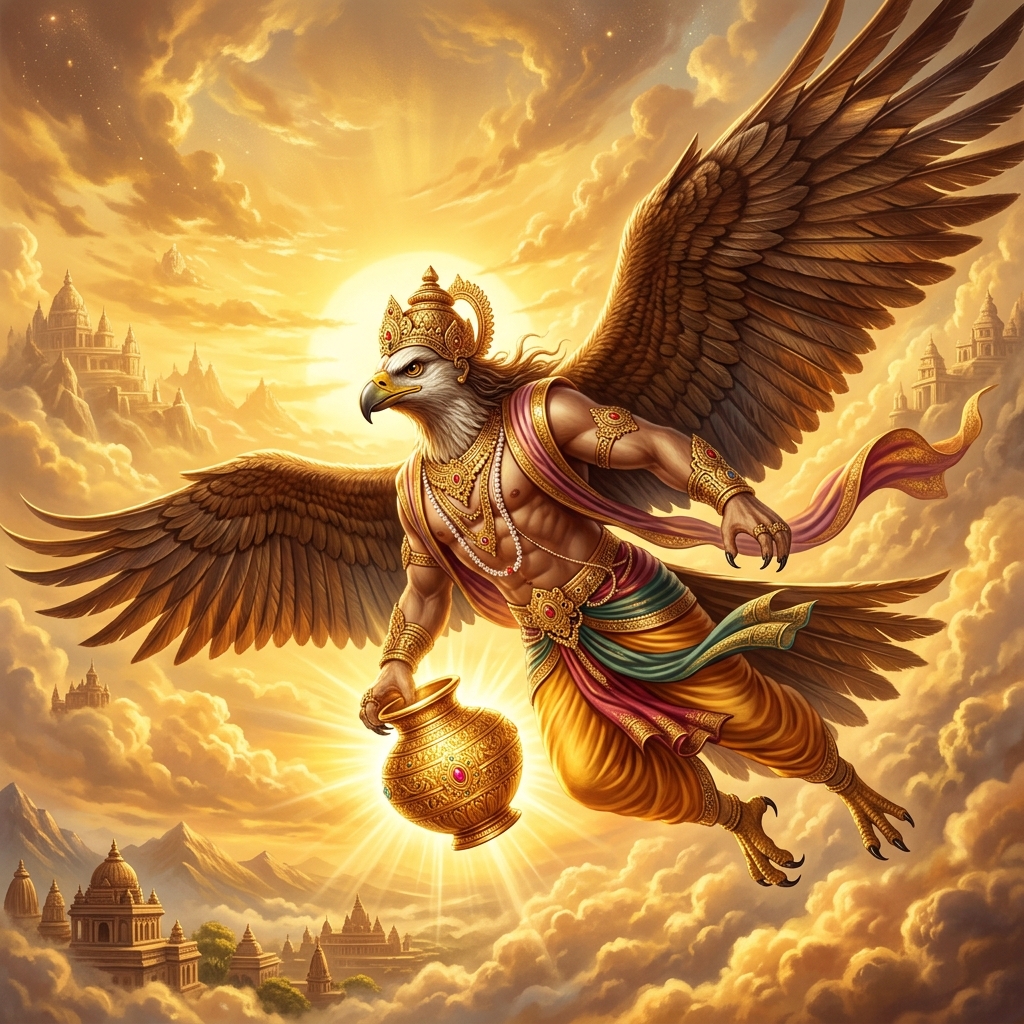
The Two Wives of Kashyapa
In the first ages of the world, when the gods and demons had not yet churned the milk-ocean and the great rivers of creation still ran new, the sage Kashyapa, lord among the lords of beings, took many daughters of Daksha to be his wives. Among them were two sisters, Kadru and Vinata, both radiant, both proud, both longing above all things to be mothers of mighty sons.
Kashyapa, pleased with the devotion of the two sisters, offered each of them a boon. Kadru asked for a thousand serpent sons, each equal in splendour, and her wish was granted. Vinata asked for only two sons, but sons who would surpass Kadru's thousand in strength and courage and brilliance. The sage smiled and granted this also, warning her that the greater gift comes more slowly and at greater cost.
In time Kadru laid a thousand eggs, and Vinata laid two. The eggs were placed in warm vessels and watched over for five hundred years. At the end of that long span, Kadru's thousand eggs broke open, and from them came the Nagas, the serpent race, hooded and gleaming, to fill the hidden places of the earth. Among them were Sesha, who would one day uphold the worlds, and Vasuki, who would become their king, and Takshaka, swift and proud and quick to anger.
But Vinata's two eggs had not yet stirred. Watching her sister surrounded by a thousand splendid sons while her own vessels lay silent, Vinata grew restless, then jealous, then reckless. Her impatience would soon set in motion a chain of suffering and wonder that would end only with the theft of the nectar of the gods.
Aruna and the Broken Egg
Five hundred years Vinata waited, and still her eggs lay unbroken while her sister revelled in her thousand sons. The mockery in Kadru's eyes, the easy laughter of the serpents at play, the silence of her own warm vessels - all of it pressed upon Vinata until she could bear it no longer.
In her impatience she took up one of her two eggs and cracked the shell before its time. From within came her first son, but he was only half formed. The upper part of his body was perfect and shining, but below the waist he was incomplete, unfinished, a body interrupted in its making. This was Aruna, and though his mother had ruined him through haste, there was fire in him still.
Aruna rose up before her, blazing with the light of dawn, and his eyes were full of sorrow and reproach. "Mother," he said, "in your greed for a son you have made me a cripple. Because you could not wait, I shall never walk whole upon the earth. For this you shall fall into slavery, and you shall serve the one with whom you compete for five hundred years. But your second son, if you let him come to ripeness in his own time, shall deliver you from bondage. Therefore be patient, and break not the second egg as you have broken me."
Having spoken his curse and his comfort together, Aruna rose into the sky. He went to the Sun, fierce Surya, whose unbearable heat was scorching the three worlds, and became his charioteer, sitting always before the burning disc to shield the worlds from its full blaze. To this day he is the redness of the dawn, the herald who goes before the morning. And Vinata, chastened and frightened, set her second egg aside and waited, nursing both her hope and her dread of the slavery that had been foretold.
The Wager on the Horse's Tail
Now in those days the gods and the demons had churned the great ocean of milk, using the mountain Mandara as their churning rod and the serpent Vasuki as their rope. From the churning rose many wonders - the moon, the goddess of fortune, the physician of the gods, and at last the nectar of immortality itself. Among the treasures that emerged was Uchchaihshravas, the divine horse, white as the autumn cloud, swiftest and most beautiful of all steeds, the very king of horses.
One day Kadru and Vinata, walking together, saw this celestial horse from afar. Kadru, ever fond of contention, turned to her sister with a glint in her eye. "Tell me quickly, dear sister, and without too much thought - what is the colour of that great horse's tail?"
Vinata answered at once, for she could see the animal plainly. "He is white, white from nose to tail, white as moonlight on snow. Surely you see it too."
But Kadru smiled her cunning smile. "You are mistaken. His body is white, I grant you, but his tail is black. Let us make a wager upon it. Whichever of us is wrong shall become the slave of the other, to serve her in all things." Vinata, certain of what her own eyes told her, agreed without hesitation. "Done," she said. "And tomorrow we shall go and look closely, and the truth shall settle it between us." So the two sisters parted, each to her own dwelling, agreeing to meet at dawn and judge the matter for themselves.
Kadru's Deceit
That night Kadru, who knew in her heart that the horse's tail was as white as the rest of him, sat brooding upon the wager she might lose. At last her cunning found a way, and it was a cruel one. She summoned her thousand serpent sons before her and laid upon them a terrible command.
"My children," she said, "tomorrow I have wagered against your aunt Vinata that the tail of the divine horse is black. If I lose, I become her slave. You must save me from this. Go now and cling to the tail of Uchchaihshravas, twining yourselves among its white hairs so densely that when we look upon it at dawn, the tail shall seem to be black. Do this for your mother."
The serpents recoiled from the deceit. Many among them were noble and righteous, and they would not stoop to such trickery. They refused to obey, and they told her so plainly. Then Kadru, mad with anger that her own sons would not join her in her cheating, pronounced upon them a dreadful curse. "Since you will not save your mother, hear your doom. The fire of the snake sacrifice shall one day consume you all. When King Janamejaya offers up the serpents in the great rite of his vengeance, you shall fall into the blazing pit and be burned to ashes."
So terrible was the curse, and so fearful were the gentler serpents of provoking her further, that in the end a portion of them gave way. Out of dread, not loyalty, they went and wound themselves into the white tail of the great horse, making it appear dark and matted. Thus by the cruelty of a mother against her own children was the wager fixed before it was ever judged.
Vinata Enslaved
When the grey light of dawn spread over the world, the two sisters rose and went together across the sky to where the divine horse Uchchaihshravas stood grazing. Vinata went with a light step and a confident heart, for she knew what she had seen.
They came near, and they looked upon the horse. His body was white, gleaming and pure, exactly as Vinata had said. But his tail - his tail was black, dark and tangled, for the serpents clung hidden among its hairs, woven so close that no white showed through. Vinata stared in disbelief. She could not understand it. Her own eyes had told her one thing the day before, and now they told her another. She did not know of the serpents coiled within, did not know of the wager fixed by treachery in the night. She only saw the black tail and her own defeat.
"You see," said Kadru softly, and there was triumph in her voice. "The tail is black, as I told you. You have lost, sister. By your own oath you are now my slave."
Bound by her word, undone by a deceit she could not even perceive, Vinata bowed her head and entered into bondage. She became the servant of her sister and of the thousand serpents, fetching and carrying, bearing them where they wished to go, obeying every command. The proud mother who had once asked for sons greater than her sister's thousand now laboured as a slave among them. And as the long years of her servitude wore on, her one remaining hope was the second egg, still unbroken, holding within it the son who Aruna had foretold would one day set her free.
The Hatching of Garuda
At last, when the appointed span of years was fulfilled, the second egg of Vinata broke open of its own accord, in its own ripe time. And from it came forth Garuda, the great bird, the eater of serpents, blazing like a heap of fire, swelling to a vastness that filled the sky.
So terrible was his radiance and so immense his growing form that the gods themselves were thrown into confusion. They mistook his brilliance for the fire that ends the world, and they ran to Agni, the lord of flame, crying out in fear. "You are spreading and growing, swelling to consume the worlds. Hold back your burning." But Agni answered that this was no fire of his. "This is the mighty bird Garuda, son of Vinata, equal to me in splendour, newly born and rejoicing in his strength." Then the gods came before Garuda and praised him with many hymns, calling him Lord of Birds, fire and sun and bringer of light, and they begged him to draw in his fearful blaze. Hearing their prayer, Garuda lessened his radiance and his size, that the worlds might endure his presence.
Great and golden, with wings that could darken the heavens and a beak and talons of dreadful power, Garuda looked upon the world for the first time. He saw his mother Vinata bowed in slavery, labouring at the bidding of Kadru and her serpent brood. The sight kindled in him a grief and an anger deeper than any fire. He swore in his heart that he would not rest while his mother wore the yoke of bondage. Soon enough the serpents, his cousins, would learn what it meant to set this newborn giant against them, and they would name the price of Vinata's freedom.
The Price of Freedom
Now that Vinata had borne so mighty a son, the serpents commanded that he too should serve, for the slave's children belong to the master. Garuda and Vinata were made to carry the thousand snakes upon their backs wherever they wished to go. One day the serpents bade Garuda bear them across the sea to a beautiful island in the midst of the ocean, a fair country of sandalwood groves and lotus pools. Garuda obeyed, but the weight and the indignity gnawed at him, and on his return he went to the serpents and asked them plainly what he might do to release himself and his mother from their slavery forever.
The serpents, conferring among themselves, saw their chance to demand the impossible. "There is one ransom we will accept," they said, "and one alone. Bring us the Amrita, the nectar of immortality, which the gods guard jealously in heaven. Steal it and lay it before us, and on that day your mother and you shall both go free. Fail, and you remain our slaves forever."
It was a price meant to be beyond reach, for the nectar was the most fiercely guarded treasure in all the worlds. But Garuda did not flinch. He went to his mother and told her of the task. Vinata, both proud and afraid, blessed him for the journey. "May the wind guard your wings and the regions of the sky protect you, my son. Go, and may you triumph." And before he set out, Garuda asked her what he should eat upon so long a flight, for hunger would gnaw at him. Vinata told him of a people far off who might serve as food, but warned him solemnly never to harm a Brahmana, however great his hunger - for to slay a holy man would be a sin that even his strength could not bear. With this counsel and her blessing, Garuda spread his enormous wings and rose into the heavens to do battle with the gods.
The Battle in the Heavens
Garuda climbed into the sky with a sound like a great wind rising, and the worlds trembled at his coming. In the heavenly city of Amaravati, the gods felt the omens of disaster. The earth shook; mountains tottered; the sun and moon grew dim; meteors fell streaming through the sky. Indra, lord of the gods, turned to the celestial sage and asked the meaning of these terrors, and was told that the mighty son of Vinata was coming to seize the nectar of immortality by force.
Then the gods armed themselves and arrayed their host about the Amrita, a glittering wall of celestial warriors with spears and discs and thunderbolts, clad in golden mail, resolved to defend the nectar with their lives. Garuda fell upon them like a storm upon a forest. He raised with the beating of his wings such a tempest of dust and wind that the gods were blinded and scattered, choking and stumbling, unable to see the foe that struck among them. He tore at them with beak and talon and wing, and one by one the celestial guardians were driven back, wounded and dismayed, until the host that had seemed so unbreakable was broken and flung in every direction.
The gods of wind and the gods of storm rallied and fought, but Garuda overcame them all. The Vasus fled bleeding; the Sadhyas and the Maruts were scattered; the keepers of the quarters of heaven gave way before him. Where the great bird passed, the proud army of the immortals melted like mist before the morning sun. Having swept aside the defenders, Garuda came at last to the inner place where the nectar was kept, and there he found the final guardians set in his path by the cunning of the gods.
The Ring of Fire and the Spinning Blades
The nectar of immortality was hidden behind defences more terrible than any army. First there raged about it a ring of fire, vast and roaring, its flames leaping to the sky and fanned by furious winds, a wall of blaze that none might cross. Garuda looked upon it and was not dismayed. He flew at once to the rivers, and taking up the waters of many streams in his great beak, he poured them again and again upon the flames. Mouthful after mighty mouthful he carried, until at last the roaring fire was quenched and the way lay open.
Then, making his vast body small as he willed, Garuda passed through where the fire had been. Beyond it he found the second guard: a wheel of sharp-edged blades, spinning without ceasing, keen as razors, turning so swiftly that it seemed a solid disc of cutting steel. Any creature that approached would be sliced to fragments in an instant. Garuda studied the dreadful machine, marking the rhythm of its turning, and then he shrank himself smaller still, until he was tiny as a thought, and slipped between the whirling spokes in the moment of an opening, untouched by a single edge.
Beyond the blades coiled the last and most fearful guardians: two enormous serpents, their bodies bright as flame, their tongues like lightning, their eyes filled with venom so deadly that a single glance could reduce a being to ashes. They lay watching, never blinking, ready to strike. Garuda, swift as the wind, beat his wings and flung dust into their unsleeping eyes, blinding them in an instant. Then, while they writhed and could not see, he fell upon them and tore them to pieces with beak and claw. The last defence was broken. Before him at last stood the vessel of the Amrita, gleaming with the light of deathlessness.
The Pacts with Vishnu and Indra
Garuda seized the pot of nectar and rose again into the sky, and not one drop did he drink, though immortality was in his grasp - for he had no wish for the nectar itself, only for the freedom of his mother. As he flew, the great god Vishnu beheld him and was filled with wonder at such selflessness. Pleased beyond measure, Vishnu came before him and offered a boon. "Ask what you will," said the god, "for you carry the nectar of the deathless and yet do not taste it."
Garuda answered, "Let me be greater than you, O Lord, and let me be immortal and free from age and decay without drinking this nectar at all." Vishnu granted both. "You shall be undying, and you shall fly above me upon my banner, higher than I." Then in return Garuda granted Vishnu a boon also, and Vishnu chose this: "Become my mount, that I may ride upon you." And so Garuda became the eternal vehicle of Vishnu, and the emblem upon his standard, bound to the great god in friendship forever.
As Garuda flew on, Indra hurled his thunderbolt, the dreaded Vajra forged from the bones of a sage, at the thief of the nectar. The bolt struck Garuda and yet could not harm him, could not so much as wound his flesh. But out of courtesy to the weapon that had felled the demon Vritra, and to honour the sage whose bones had formed it, Garuda let fall a single feather from his body, one shining plume drifting down. So beautiful was that feather that all the beings of the worlds gazed upon it in wonder, and from that day Garuda was called Suparna, the bird of fair feathers. Indra, astonished that his thunderbolt had failed and moved by the bird's grace, came near and asked for his friendship and begged to know the limit of his strength.
The Bargain and the Forked Tongues
Indra spoke to Garuda as a friend now, no longer as a foe. "Tell me, O mighty one, for what purpose do you carry away the nectar? I would not have you give it to any who might misuse it. If the serpents drink of it, they will become invincible and a plague upon the worlds." Garuda answered, "I bear it for a reason - to win the freedom of my mother, who is held in slavery by the serpents, who have set this as her ransom. But hear me: I have no wish that the snakes should ever drink of it. When I have set the pot down before them, you may take it back the moment they leave it untouched."
Indra rejoiced at this, and the two made their pact. "Whatever boon you desire, ask it of me," said the king of the gods. And Garuda asked, "Let the great serpents become my food, that I and my children may feed upon them forever." Indra granted it gladly. And so it was agreed: Garuda would carry the nectar to the snakes to free his mother, and Indra would snatch it back before they could drink, and ever after the serpents would be the prey of the eagle race.
Garuda flew down to the waiting serpents and set the pot of Amrita upon a bed of sharp kusha grass. "Here is the nectar I promised," he said. "My mother is now free, and her debt is paid. But you are unclean from your journey; purify yourselves with a bath before you touch so holy a thing." The serpents, delighted, agreed, and slithered away to bathe in the river before partaking. The moment they had gone, Indra swooped down from the sky, seized the pot of nectar, and bore it back to heaven. When the serpents returned, washed and eager, they found the grass bare and the nectar gone. In their desperate hope that some trace of the deathless drink might remain, they fell upon the kusha grass where the pot had rested and licked at the sharp blades. The keen edges split their tongues in two. And from that day to this, every serpent bears a forked tongue, the mark of that lost and longed-for nectar. So Vinata was set free at last, her long slavery ended by her son; and Garuda, the golden bird, soared into his deathless glory, the friend of Vishnu, the bearer of Indra's banner, and the eternal enemy of the snakes.
Dharma Lesson
A son's love for his mother can move mountains and challenge the gods themselves. Garuda's epic quest to free Vinata from slavery demonstrates that the fiercest battles are fought not for glory, but for those we love.