The Curse and the Fading of the Gods
In the long ages before the wars of kings, when the worlds were still young and the line between heaven and the deep was thin, the gods who dwelt in shining Amaravati found their splendour beginning to fail. There was a season in which the sage Durvasa, terrible in his austerity and quick to anger, wandered through the three worlds. Meeting Indra mounted upon his great white elephant, the sage offered the king of the gods a garland of celestial flowers, fragrant with the honey of the heavens. Indra took it carelessly and laid it upon the brow of his elephant, and the beast, maddened by the scent, cast it to the ground and trampled it.
The eyes of Durvasa burned. "You have grown proud, lord of the gods," he said, "drunk on your own glory, and you scorn the gift of a brahmin. Let your fortune leave you, then. Let Lakshmi, the goddess of all prosperity, depart from the heavens, and let the strength of the immortals wither away." Having spoken, he vanished, and his curse settled over the worlds like a slow frost.
From that hour the gods declined. The radiance went out of their faces, the vigour out of their limbs. Their wealth dwindled, their sacrifices grew thin, their will to act grew weak. And the asuras, the demons who were their ancient kin and their eternal foes, marked this weakness and rose against them. Battle after battle was fought across the rim of the worlds, and battle after battle the weakened gods were driven back, until they fled at last from their own bright city and gathered in fear, not knowing how their strength might be restored.
The Counsel of Vishnu
Bereft of their kingdom and broken in spirit, the gods went together to the highest of beings, to Vishnu the preserver, who reclines upon the coils of the cosmic serpent in the ocean of milk. Indra led them, and Agni and Vayu and the rest came behind, and they bowed their heads and laid their sorrow before him.
"Lord," they said, "the curse of Durvasa has stripped us of fortune. Lakshmi has fled, our strength is spent, and the asuras hound us from world to world. We cannot stand against them. Show us the way, for without you we are lost."
Vishnu, whose mind holds the turning of all ages, looked upon them with calm. "There is a remedy," he said, "but it is great, and you cannot accomplish it alone in your weakness. You must churn the ocean of milk, and from its depths will rise the Amrita, the nectar of deathlessness. Whoever drinks of it can never be conquered nor slain. But to churn that boundless sea you will need a strength beyond your own. Go, therefore, and make peace for a season with the asuras. Tell them that all the treasures of the ocean shall be shared, and the nectar of immortality with them. Let gods and demons pull together at the churn. Leave the rest to me. I shall see that the Amrita comes at last to you, and not to them."
The gods marvelled at this counsel, for the asuras were their bitterest enemies. Yet they trusted the word of Vishnu, and they went down to treat with their foes. Strange it was to see the immortals and the demons sit in council together, the old hatred set aside, bound for a time by the shared hunger for what lay hidden beneath the waters.
Mount Mandara and the Serpent Rope
For a churning rod they would need a mountain, and there was no mountain in all the worlds fit for the task save Mandara, whose peak touched heaven and whose roots ran deep into the underworld. Its slopes were a wilderness of clouds and forests, and beasts past counting dwelt upon it.
The gods and the asuras together set their hands to uproot it, but Mandara would not be moved, and many among them were crushed and flung aside by the labour. They returned again to Vishnu, and at his word the great serpent Ananta, eldest of the snakes, came and wound himself about the mountain. With strength that no host could match, Ananta tore Mandara from the earth, root and crag and forest entire, and bore it to the shore of the ocean of milk.
Then they came to the brink of the sea, that endless expanse pale as poured milk, and the gods spoke to the ocean itself. "We must trouble your waters to win the nectar," they said. And the lord of the waters answered, "Let it be so, if I am given a share of what comes forth." So consent was won. But still they had no rope long enough and strong enough to spin so vast a mountain. For this they sought out Vasuki, king among the serpents, and asked that he serve as the cord of the churn. Vasuki, for the promise of a portion of the Amrita, agreed, and offered the immense length of his body to be wound about the mountain's waist.
Kurma, the Tortoise Who Bore the Mountain
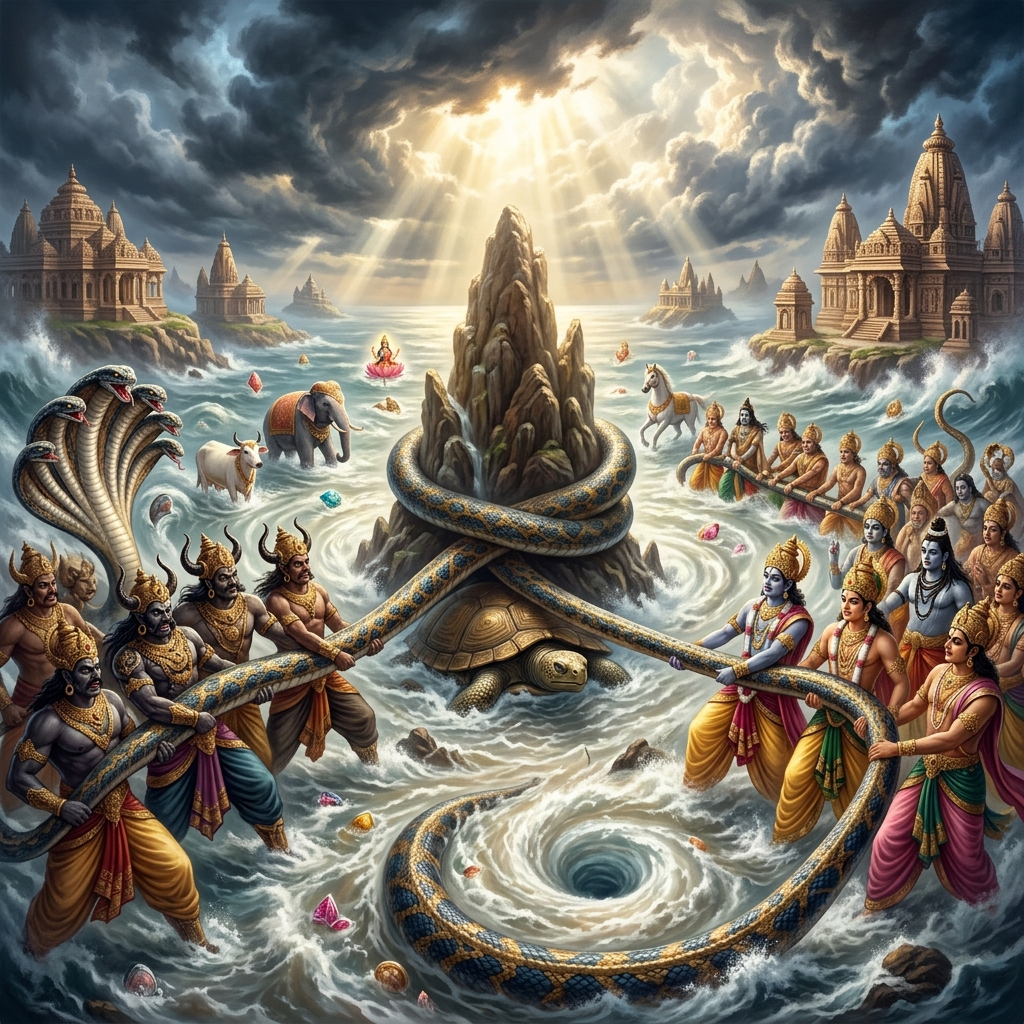
They set Mount Mandara upright upon the surface of the sea and began to wind Vasuki round it, and at the first heave of the churning the mountain began to sink. It had no base to rest upon, and the soft floor of the ocean could not hold its monstrous weight. Down it went into the deep, and with it sank the hopes of gods and demons alike.
Again they turned to Vishnu, who alone could find the answer to every failing. He took then the form of an enormous tortoise, Kurma, broad as a continent, ancient and unshakable, and he descended into the depths of the ocean. There he set himself beneath the foundering mountain and lifted it upon the dome of his shell, so that Mandara stood firm at last, pivoted upon the living back of the lord of the deep. And it is said that Vishnu was in three places at once in that hour: below as the tortoise bearing the weight, above on the mountain's summit pressing it down so it would not fly off, and unseen among the pulling hosts, lending his strength to both ends of the rope. Without that threefold presence, the churning could never have gone forward.
Now the demons and the gods took their stations. The asuras, proud and clamorous, demanded the head of Vasuki as the place of honour, and seized the serpent near his many hooded mouths. The gods took the tail. So they ranged themselves, foe against foe along the body of the snake, and braced their feet against the shore, and made ready to churn the ocean of milk.
The Great Churning
Then the churning began in earnest. The gods pulled, and the demons pulled, and Mount Mandara spun upon the back of Kurma, first one way and then the other, round and round without rest. The serpent Vasuki was stretched taut between the hosts and twisted with every turn, and the pain of it was beyond bearing.
From the thousand mouths of Vasuki there burst black smoke and gouts of flame, and these blew back into the faces of the asuras who held his head, scorching them and robbing them of breath, so that their strength flagged and their glory dimmed. The gods at the tail were spared the worst of the fire, and clouds gathered above them, and a cool rain fell upon their ranks and refreshed them as they laboured.
The whole world shook with the violence of the work. The forests upon Mandara were ground to splinters, and the beasts and birds of its slopes perished in the friction, and trees burst into flame and rolled blazing into the sea. Great herbs and gums and resins, the magical sap of countless plants, were crushed from the mountain and poured into the waters. Down through the churning sea sank the juices of those herbs, and where they mingled the ocean changed: first its milk grew thick, and then, with the heat of the labour and the strength of the herbs, it turned to clarified butter, gleaming and golden, and still the gods and demons churned on. The sun and moon wheeled overhead, the earth groaned upon her foundations, and the deep gave up its first hidden powers into the boiling sea.
The Rising of the Halahala Poison
Long they churned, and at first nothing rose but the changing of the waters. Then, before any treasure appeared, the ocean gave up something terrible. Up from the depths boiled a poison black and burning, the Halahala, the venom of the deep, and its fumes spread across the worlds. It was a poison so virulent that no creature could endure it. The smoke of it withered the heavens, the breath of it choked gods and demons alike, and where it touched, life shrank and died. The very churning faltered as both hosts reeled back, gagging and blinded, certain that all the worlds would be destroyed before any nectar could be won.
In that hour of terror they cried out together to the three-eyed lord, to Shiva, the auspicious one, the god of the mountains. For the safety of all creation, Shiva came. He looked upon the spreading poison, and he gathered it up, and he drank it down. He held the deadly Halahala in his throat and would let it neither sink to his heart, where it might harm the worlds that lived in him, nor cast it back upon creation. There it stayed, and its dark fire turned the throat of Shiva blue. From that day he is called Nilakantha, the blue-throated god, and his great act of self-sacrifice is remembered wherever the story is told. The poison stilled, the air cleared, and the gods and demons, marvelling and grateful, returned to the rope and took up the churning once more.
The Treasures of the Ocean
Now the sea, its terror spent, began to yield its wonders one by one, and each that rose was more glorious than the last. First came Surabhi, the cow Kamadhenu who grants all desires, and the sages and the keepers of sacrifice received her with joy, for from her would flow the offerings that nourish the worlds. After her rose Varuni, the goddess of wine, with rolling eyes, and the asuras claimed her gladly.
Then came the Parijata tree, fragrant and flowering, whose scent fills the whole of the heavens. And there rose a host of celestial maidens, the Apsaras, lovely beyond telling, born of the foaming waters. The cool Moon climbed up out of the sea, pale and shining, and Shiva took it to wear upon his brow. There rose Uchchaihshravas, the matchless white horse, swift as thought, and Airavata, the great white elephant with mighty tusks, the noblest of all beasts, whom Indra claimed for his mount. Up came the jewel Kaustubha, brightest of gems, and Vishnu set it upon his breast.
And then, seated upon a full-blown lotus, radiant and serene, rose Lakshmi herself, the goddess of fortune and prosperity, she who had fled the worlds at the word of Durvasa. The sages sang her praises, the celestial rivers came to bathe her, the elephants of the quarters poured pure water over her from golden vessels, and the heavens rained flowers. All the gods desired her, and the asuras longed for her, but the goddess of fortune chose Vishnu and went to his side, and rested upon his breast. In that moment the long curse was broken, for fortune had returned to the side of the gods, and the splendour that had fled from Amaravati began to gather again.
Dhanvantari and the Pot of Amrita
When the last of the lesser treasures had risen, the churning went on, for the prize for which all this labour had been undertaken had not yet appeared. The gods and the demons strained at the rope with the whole of their remaining strength, their eyes fixed upon the swirling centre of the sea.
At last the waters parted, and there rose a being clothed in glory, dark and beautiful, robed in fine garments and garlanded, learned in all the arts of healing. This was Dhanvantari, the divine physician, the father of medicine, and in his two hands he bore aloft a white vessel, gleaming and full. Within that pot was the Amrita, the nectar of immortality, the very end and purpose of the churning of the ocean.
A great cry went up from gods and demons alike, for the goal of all their toil now stood before them. But in the same instant the truce that had bound them was forgotten. The asuras, swift and greedy, rushed forward as one and tore the pot of nectar from the hands of Dhanvantari before the gods could move. "It is ours," they shouted, "ours, for we held the head of the serpent and bore the brunt of the fire. The nectar belongs to us alone." And they fled with the pot among them, snarling and quarrelling even with one another over who should drink first, while the gods stood stricken, seeing the fruit of the whole labour about to be lost.
Mohini, the Enchantress
The gods turned in despair to Vishnu, for if the asuras drank the Amrita, they would become immortal and invincible, and no power in the three worlds could ever again restrain them. "Save us, lord," they prayed, "or the worlds are undone."
Then Vishnu took upon himself a form he had never worn before. He became Mohini, a woman of such beauty that the like of her had never been seen in any of the worlds. Her face was the moon, her glance was a snare, her every movement a sweet bewilderment. She walked among the squabbling demons where they fought over the stolen pot, and at the sight of her all their quarrelling ceased, and they stood entranced, their hearts stolen quite away.
"Why do you wrangle so, you great and noble lords?" she asked, her voice like honey. "Give the nectar into my keeping, and let me share it out fairly among you, for you cannot trust one another, but you may trust me." Drunk on her beauty and flattered by her words, the demons, forgetting all caution, placed the pot of Amrita into the hands of Mohini and submitted themselves entirely to her will. "Whatever you do," they said, "whether you give to us first or last, we shall be content, for we trust you in everything." And so the deadliest treasure of the ocean passed, by the lure of beauty, out of the grasp of the demons and into the hands of Vishnu in disguise.
Rahu and the Origin of Eclipses
Mohini bade gods and demons sit in two long rows. With the grace of an enchantress she moved between them, the pot of nectar in her hands, but it was only to the gods that she gave the Amrita, passing the demons by with sweet words and promises, beguiling them so that they did not see the deceit until it was too late.
One among the asuras, however, was cunning. Rahu, a demon of subtle craft, slipped from his place, took on the likeness of a god, and seated himself in the row of the immortals between the Sun and the Moon. When Mohini came to him, he received the nectar upon his tongue. But the Sun and the Moon, keen-eyed, saw the deception and cried out at once. Before the Amrita could pass down the demon's throat, Vishnu loosed his discus, the flaming Sudarshana, and struck off the head of Rahu. Yet the nectar had already touched his tongue, and so his severed head could not die. It rose into the heavens, immortal and wrathful, while his body fell lifeless to the earth.
From that day Rahu has nursed an undying hatred for the Sun and the Moon, who betrayed him. Forever he pursues them across the sky, and now and again he overtakes them and seizes them in his deathless mouth. But having no throat, he cannot hold them, and they pass out from him again and shine free. This is the eclipse, which the people of the earth behold with awe, born of that ancient day of churning and the cunning of the headless demon.
The Battle for the Nectar
When the gods had drunk their fill and the Amrita was secure among them, Vishnu cast off the form of Mohini and stood revealed in his own great shape. The asuras saw then how they had been cheated of the prize for which they had laboured side by side with their enemies, and a terrible fury seized them. With one voice they took up their weapons and fell upon the gods, and there on the shore of the ocean of milk a fearful battle broke out.
But the contest was no longer equal. The gods had drunk the nectar of immortality; their strength was restored to them and more than restored, their wounds healed even as they were struck, and death could not touch them. Indra wielded his thunderbolt, Vishnu his discus and mace, and the demons, for all their numbers and their rage, could not stand against immortal foes. Spear and arrow and mountain-crag flew through the air, the sea was lashed into storm, and the asuras were cut down in their multitudes.
At last, broken and scattered, the surviving demons fled the field. Some plunged into the depths of the sea, others into the hollows of the earth, hiding themselves away from the wrath of the gods. The shore fell quiet. The gods had triumphed, and the nectar, and the heavens, and the fortune of the worlds were theirs.
The Gods Return in Glory
When the fighting was done, the gods set Mount Mandara back upon its place in the earth, with reverence and thanks, and they released the great serpent Vasuki, who had borne the whole weight of the churning upon his stretched and twisted body. They honoured Kurma the tortoise, in whose form Vishnu had upheld the mountain, and they gave thanks to the lord of the ocean and to all the powers that had aided them.
Then Indra and the immortals returned to shining Amaravati. Lakshmi, the goddess of fortune, had come back to them, and with her returned all the prosperity and splendour that the curse of Durvasa had taken away. The faces of the gods shone once more, their sacrifices grew rich, their strength was whole, and they ruled the three worlds in peace from their recovered heaven. To Vishnu they gave the highest praise, for it was his counsel that had begun the great labour, his strength as Kurma that had borne it up, and his cunning as Mohini that had won the nectar in the end.
Yet the churning of the ocean did not end the ancient quarrel of gods and demons; it only changed its shape. The asuras nursed their defeat in the deep places of the world and would rise again in age after age, and the gods, immortal now, would meet them again and again. So the story tells how fortune was lost and won back, how the deadly poison and the deathless nectar both came out of the same sea, and how the eternal enmity of the bright ones and the dark ones was set, by that one great labour, upon its endless course.
Dharma Lesson
Great achievements require cooperation even between adversaries. The churning of the ocean teaches that both good and evil forces must work together to bring forth treasures, but it is wisdom and selflessness that determine who ultimately benefits from the effort.