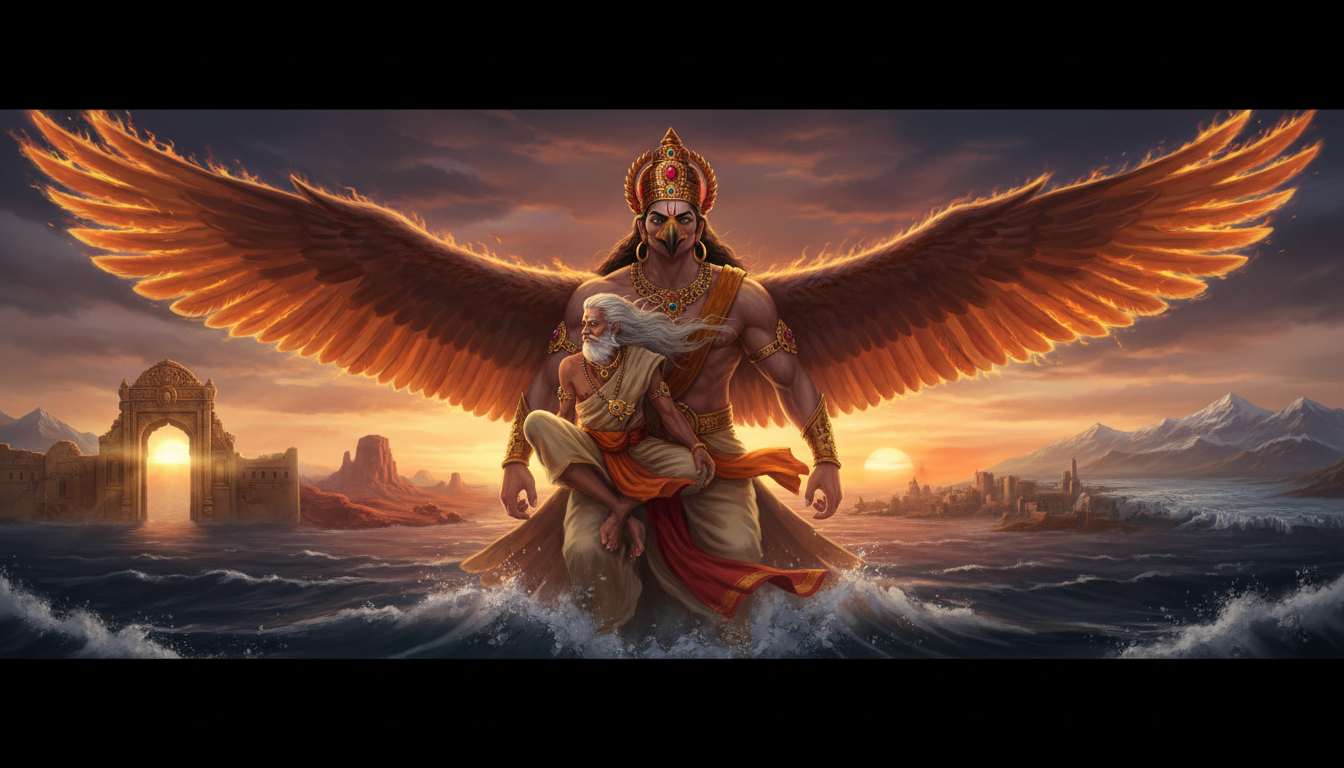
Garuda's Map of the World
The four directions described from a bird's back
A Story Told to a Man Who Would Not Listen
Janamejaya said, "He was wedded to evil, blinded by avarice, treading the wrong road, bringing grief to his kinsmen and joy to his enemies. Did nobody try to restrain him? Did the holy one say nothing, or the Grandsire?"
Vaishampayana said: They all spoke. Krishna spoke. Bhishma said what was beneficial. And Narada said a great deal, and this is some of it.
"Men who listen to the counsel of friends are rare," Narada said in that court, "and friends who offer beneficial counsel are rarer, because the friend who needs the advice is never where the friend who has it is standing. Obstinacy ought to be avoided. It is fraught with great evil. On that subject there is an old story about the disgrace a man named Galava brought on himself by being obstinate, and I will tell it to you.
"In ancient times, to test Vishvamitra, who was then engaged in austerities, Dharma came to him in person wearing the form of the rishi Vasishtha, feigning himself hungry. Vishvamitra was struck with awe and began at once to cook charu, rice boiled in milk, and took such care over it that he was slow, and by the time he came up with the dish, still steaming, the guest had already dined on the food the other hermits offered.
"I have already dined, said the holy one. Wait here.
"And he went away. And Vishvamitra waited. He stood in his hermitage still as a post with that food balanced on his head and held in his arms, and he subsisted on air, and a hundred years went by. All that while a young ascetic named Galava waited on him out of reverence and affection and the wish to do what was agreeable.
"At the end of the hundred years Dharma came back in the same shape, and found the man standing there with the dish on his head, and ate the food, which was still warm and fresh, and said, I am gratified, regenerate rishi. And by that Vishvamitra was divested of his kshatriyahood and endued with the status of a brahmana, and was filled with delight."
Eight Hundred Horses
"Pleased with the boy's hundred years of service," Narada went on, "Vishvamitra said to him, With my leave, Galava, go wherever you wish.
"And Galava, highly pleased, said in a sweet voice, What final gift shall I make you for your preceptorship? It is by the final present that a sacrifice becomes successful. The giver of such gifts obtains emancipation; they are the fruit a man enjoys in heaven; they are peace and tranquillity themselves. What shall I procure for my preceptor? Let it be said.
"Now Vishvamitra knew perfectly well that he had been conquered by the boy's service and owed him more than the boy owed him, and he tried to send him away. Go, he said. Go.
"And Galava said, What shall I give?
"Go.
"What shall I give?
"And at that obstinacy the rishi felt a slight rise of anger, and said at last: Give me eight hundred steeds, every one of them as white as the rays of the moon, and every one of them with one ear black. Go now, and do not tarry.
"That is what obstinacy is worth, king. He would not accept the gift of being let off, and so he was given a price no man on earth could pay, and it was his own tongue that fixed it."
The Friend Who Came Unasked
"After that," said Narada, "he could not sit, or lie down, or take food. He grew pale and was reduced to a skeleton, and he lamented in this fashion.
"Where shall I find affluent friends? Where shall I find money? Have I any savings? Where in the world shall I find eight hundred steeds of lunar whiteness? What pleasure can I have in eating? The very love of life is extinct in me. I will go to the other shore of the great ocean, or to the furthest verge of the earth, and relinquish my life there. What use is life to a man who is poor and unsuccessful and burdened with debt? Death is better than life for the man who, having enjoyed the wealth of friends, is unable to return their favour. The religious acts of a man who promises to do a thing and fails to perform it lose their efficacy, and he is stained with falsehood, and one who is stained with falsehood cannot have beauty or children or power or influence. What ungrateful man ever earned fame? Where is his place, and where his happiness? Even I am that wretch. Having obtained my object from my preceptor, I am unable to do his bidding.
"And he resolved, since he had never in his life craved anything from the gods, to go and seek the protection of Vishnu, the lord of the three worlds.
"And while he was still saying all this aloud to nobody, his friend Garuda, the son of Vinata, came down out of the sky and stood in front of him, cheerful about it.
"You are a dear friend of mine, Garuda said. It is the duty of a friend in prosperity to look to the wishes of his friends. What prosperity I have is constituted by Vishnu. I have already spoken to him on your behalf, and he has been pleased to grant my wishes. Come, we will go together. I will carry you comfortably to the other shore of the ocean, or to the furthest extremity of the earth. Do not tarry."
Which Quarter Shall I Take You To
"So they stood there," Narada said, "a brahmana with no money and a bird who could go anywhere, and the bird asked the only sensible question.
"I have been commanded by God, who is the cause of all knowledge, said Garuda. I ask you: toward which quarter shall I first take you, to see what lies there? The eastern, the southern, the western, or the northern? Tell me, and we will go, for I will always do what is agreeable to my friend.
"And then, before the man could answer, the bird began to describe them, because he had flown all four and had opinions about each, and because he could see that his friend had been staring at his own feet for so many months that he had forgotten there was a world at either end of the errand."
The East, Which Is Called the First
"That quarter," said Garuda, "is where Surya, the illuminator of the universe, first rises; where the Sadhyas engage in their austerities at evening; where that Intelligence which pervades the whole universe first sprang up; where the two eyes of Dharma are stationed, and Dharma himself with them. It is where the clarified butter first poured out in sacrifice afterward flowed all around. It is the gate of Day and of Time.
"There the daughters of Daksha in primeval times gave birth to their children, and there the sons of Kasyapa first multiplied. That quarter is the source of all the prosperity of the gods, for it was there that Sakra was anointed king of the celestials, and there that Indra and the gods underwent their penances. It is called Purva, the first, and it is called Purva also because in the earliest of times it was overspread by the Suras.
"It was there that the divine Creator of the universe first sang the Vedas. It was there that the Gayatri was first preached by Surya to the reciters of that hymn, and there that the Yajur hymns were delivered by Surya to Yajnavalkya. It was there that the soma juice, sanctified by boons, was first drunk in sacrifice, and there that the homa fires first drank offerings of their own kindred origin. It was there that Varuna went down into the nether regions and attained all his prosperity, and there that the birth and growth and death of the ancient Vasishtha took place. There grew the hundred branches of Om.
"It is where the smoke-eating munis eat the smoke of sacrificial fires, and where the thousand-rayed sun, rising, burns up out of anger all who are wicked and ungrateful among men and asuras. This is the gate of the three worlds. This is the path of heaven and of felicity.
"That is the east. We will go there if it pleases you. Or listen now to what I say of another quarter."
The South, and the Second Door of Yama
"In days of yore," said Garuda, "Vivaswat performed a sacrifice and gave this quarter away to his preceptor as the fee, and it is for that it is known as Dakshina, the gift.
"It is where the Pitris of the three worlds have their habitation. A class of celestials who subsist on smoke alone live there, and the Viswedevas dwell there with the Pitris, worshipped in sacrifices in all the worlds and equal sharers with them. This quarter is called the second door of Yama, and it is here that the periods allotted to men are counted out in trutis and lavas, the smallest measures there are. The celestial rishis live here, and the rishis of the Pitri world, and the royal rishis, and they live in great happiness. Here are religion and truth. Here the acts of men exhibit their fruits. This region is the goal of the acts of the dead, and every one of us must go there, and because creatures are overwhelmed by darkness they cannot come to it in bliss.
"Here are many thousands of malevolent rakshasas, so placed as to be seen by the sinful. Here, in the bowers on the breast of Mandara and in the houses of the rishis, the gandharvas chant psalms that steal away the heart and the intellect; and it was here that Raivata, hearing the Sama hymns sung in a sweet voice, walked away into the woods and left his wife and his friends and his kingdom behind him. It was here that Ravana, undergoing austerities, asked the gods for immortality, and here that Vritra by his conduct earned the enmity of Sakra.
"Here the river Vaitarani flows, filled with the bodies of those condemned. Arriving here, men attain the extremes of both happiness and misery. Here I once obtained for my food a prodigious elephant battling with an enormous tortoise. Here is the city called Bhogavati, ruled by Vasuki and by the naga Takshaka and by Airavata. Those who journey here after death meet a gloom so thick that neither the sun nor Agni can get through it. Worthy of worship as you are, even you will have to travel that road.
"Tell me if you wish to go that way. Otherwise, hear about the west."
The West, Where the Sun Puts Down His Rays
"This quarter," said Garuda, "is the favourite of king Varuna, the ruler of the ocean. The lord of the waters had his origin here, and here sovereignty lies. And since it is here that at the day's end, at paschat, the sun dismisses his rays, this quarter is called paschima, the west. For the ruling of all aquatic creatures and the protection of the waters themselves, the illustrious Kasyapa installed Varuna here as king.
"Quaffing the six juices of Varuna, the moon, the dispeller of darkness, becomes young again at the beginning of every fortnight. It was in this quarter that the daityas were routed and bound fast by the wind-god, and afflicted by that tempest and breathing hard as they fled, they lay down here at last to sleep the sleep that knows no waking.
"Here is the mountain called Asta, which is the cause of the evening twilight, and which receives the sun every day as he turns toward it lovingly. It is from this quarter that Night and Sleep issue out at the close of day and spread themselves, as if to rob all living creatures of half their allotted lives.
"It was here that Sakra, finding his stepmother Diti asleep and pregnant, cut the foetus into forty-nine pieces, from which sprang the forty-nine Maruts. It is toward this direction that the roots of Himavat stretch out toward the eternal Mandara sunk in the ocean, and if you journeyed a thousand years you would not come to the end of those roots. It is here that Surabhi, the mother of cows, comes to the shores of the great lake adorned with golden lotuses and pours out her milk. Here in the middle of the ocean is seen the headless trunk of Swarbhanu, who is always trying to devour the sun and the moon.
"Here wind and fire and earth and water are free, both day and night, from their painful sensations. It is from here that the sun's course begins to bend away from the straight path. Here the rivers that feed the ocean have their sources, and here in Varuna's house are the waters of the three worlds. And here is the abode of Vishnu, who is without beginning and without end.
"Tell me now toward which side we shall go."
The North, Which Is Superior to All
"Because this quarter saves from sin," said Garuda, "and because a man attains salvation here, it is called uttara, the north, for its uttarana, its power of carrying across. And because the abode of all its treasures stretches in a line east and west, the north is sometimes called the middle region.
"In this region, which is superior to all, nobody can live who is unamiable, or of unbridled passions, or unrighteous.
"Here, in the asylum called Badari, dwell eternally Krishna who is Narayana's self, and Jishnu the most exalted of all male beings, and Brahman the Creator. Here on the breast of Himavat dwells Maheswara, with the effulgence of the fire that blazes up at the end of the age, and as Purusha he sports here with Prakriti; and except by Nara and Narayana he cannot be seen by the munis, nor by the gods with Vasava at their head, nor by the gandharvas, nor the yakshas, nor the siddhas.
"It was in this region that Chandramas was installed to the sovereignty of the whole regenerate order. It was in this region that Mahadeva, receiving her first upon his head, afterward let the sacred stream Ganga fall from the heavens into the world of men. It was here that the Goddess underwent her austerities out of her desire to obtain Maheswara for her lord, and here that Kama and the wrath of Siva and Himavat and Uma all shone together. It was here, on the breast of Kailasa, that Kuvera was installed to the sovereignty of the rakshasas and the yakshas and the gandharvas, and here that his gardens called Chitraratha lie.
"Here are the celestial stream Mandakini and the mountain Mandara. Here the gardens called Saugandhikanaka are guarded always by rakshasas. Here are plains covered with grass, and the plantain forest, and the celestial trees. Here the seven rishis may be seen with Arundhati, and here the constellation Swati first rises to the view.
"And here, foremost of brahmanas, those truth-speaking munis called by the name of Dharma guard the source of the Ganges. Their origin and their features and their penances are not known to anybody. The thousand dishes they use for serving the food they offer in hospitality, and the edibles they create at will, are all a mystery. The man who passes beyond the point those munis guard is certain to meet with destruction; none but Narayana and the eternal Nara ever succeeded in passing it.
"Here also is the spot called Vishnupada, from the footprint left when Vishnu covered the three worlds with three steps at the sacrifice of Vali. Here at Usiravija, by the side of the golden lake, king Marutta performed his sacrifice. Here the shining gold mines of Himavat showed themselves to the rishi Jimuta, who gave the whole of that wealth away to the brahmanas and asked only that it be called after his name, and it is called the Jaimuta gold to this day.
"And here, every morning and evening, the regents of the worlds go about proclaiming: What business of what person shall we do?
"For these reasons and others the northern region is superior to all quarters, and because it is uttara, superior, it is called uttara, the north. The four have now been described to you in detail. Toward which do you desire to go? I am ready to show you every quarter of the earth."
Mount My Back
"Take me to the east," said Galava, "where the two eyes of Dharma are first opened, and where you have said the gods are always present, and truth and virtue reside. I desire to meet all the gods. Take me there, younger brother of Aruna, so that I may behold them."
"Mount my back," said Garuda.
"And he did," said Narada, "and then the poor man discovered what he had asked for.
"Your beauty as you go, he called out, is like the sun's in the morning. Your speed is such that the trees, broken by the storm your wings make, seem to be chasing you along your own course. You seem to be dragging the Earth after you, with all the waters of her oceans and all her mountains and forests. The tempest of your wings keeps lifting the water of the sea into the air, with the fishes and the snakes and the crocodiles in it, and I can see fish with faces like one another, and timis and timingilas, and snakes with human faces, all being crushed by the wind you make. My ears are deafened by the roar of the deep. I can neither hear nor see. I have forgotten my own purpose.
"Slacken your speed, ranger of the sky. Remember that a brahmana's life is at risk. I can no longer make out the sun, or the points of the compass, or the sky itself; there is only a thick gloom around me. I cannot see my own body. I can see only your two eyes, like radiant gems. At every step sparks of fire come off you. Put out the sparks and dim the dazzle of your eyes and slacken this speed of yours, for I have no business going with you at all. I promised my preceptor eight hundred white steeds of lunar effulgence, each with one ear black in hue, and I see no way of fulfilling my pledge. There is one way only that I can see, and that is to lay down my own life. I have no wealth, nor any wealthy friend, nor could wealth however immense procure what I need.
"And the son of Vinata, without slackening his speed in the least, laughed and said: You have little wisdom, regenerate rishi, since you wish to put an end to your own life. Death can never be brought about by a man's own effort. Death is God himself. Why did you not tell me your purpose before this? There are excellent means by which the whole of it may be accomplished. Here is the mountain called Rishabha on the seaside. We will rest there and take food, and then I will see about your horses."
Narada let that sit a moment in the Kuru court.
"He crossed the whole world on the back of the strongest thing that flies," he said, "and he could not see any of it, because he had a debt in front of his eyes that he had insisted on incurring. That is what obstinacy does to a man's sight. Consider it, king, before you answer your father."
Dharma Lesson
The world is larger than the errand that made you cross it, and a traveller who never looks up carries his burden the whole way and learns nothing. Galava is offered the four quarters of creation and can see only the eight hundred horses he owes. Narada tells the story to a prince who is about to make the same mistake with a kingdom.