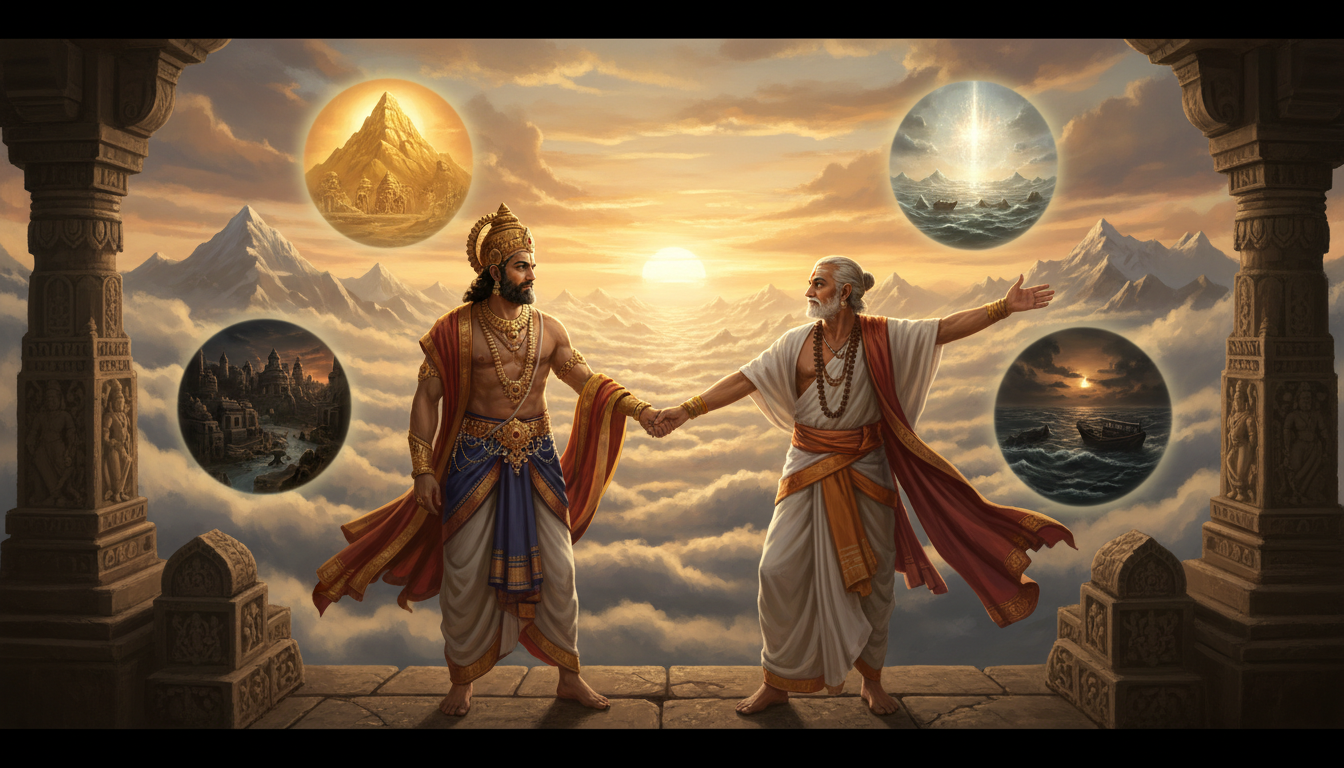
The Map of the Worlds
A priest naming the four quarters of the cosmos from a mountain shoulder
Sunrise on Gandhamadana
The bodies of the rakshasas had been carried off the summit at Kuvera's word, and the Pandavas had slept for several nights in the habitations the yakshas had kept, which were better lodging than they had known since Indraprastha.
At sunrise, having finished his daily devotions, Dhaumya came up to them with Arshtishena. The brothers bowed at the feet of both men and paid homage with joined hands to all the brahmanas who had followed them out of the kingdom and had not gone home.
Yudhishthira was the last to straighten. He had the look he had worn for months now, which was the look of a man doing sums in his head while other people talked. Five years of the twelve were gone. Arjuna had been away in Indra's house for all of them, and this mountain was the agreed place of meeting, and the meeting had not happened.
Kuvera had left him with a list, five days earlier, standing on this same rock: patience, ability, time, place and prowess, and these five, the lord of treasures said, lead to success in human affairs. He had also said that a kshatriya who understands the propriety of place and time may govern the world a long while, and that the man who from anger cannot see his own fall, and the man who does not know what is proper to the act, are destroyed in this world and the next. It was excellent counsel and Yudhishthira had been turning it over ever since like a coin he could not spend.
Dhaumya, who had been the family priest long enough to read that face, did not offer him consolation.
Instead he took the king's right hand in his own, the way one leads a man who is going to be shown something, and turned him bodily to face the east, where the sun was just then coming off the rim of the world.
"Look there, O mighty monarch," he said. "Before you speak of Hastinapura, look there, and I will tell you what you are looking at."
Bhima came and stood at his brother's shoulder. Draupadi came. The twins came. And the priest of a landless king began, at sunrise, on a mountain shoulder in the Himavat, to name the four quarters of the created world in order, as a steward names the rooms of a house.
The East, and Who Keeps It
"This king of mountains, Mandara, lies vast before you," Dhaumya said, "covering the earth as far as the ocean. Indra presides over this point, and Vaisravana with him, and it is graced with woods and forests and mountains. The intelligent sages, who are versed in every duty, say that this region is the abode of Indra and of king Vaisravana."
"Kubera," said Bhima, "whose yakshas I killed the day before yesterday."
"Kubera," Dhaumya agreed, "who came here in a car the colour of dark clouds and forgave you, and told your brother to check you. Do not interrupt."
He kept his hold on Yudhishthira's hand and did not let him turn away from the light.
"Now mark what happens at this point every morning of the world. The twice-born ones, and the sages versed in the duties, and the Siddhas, and the Sadhyas, and the celestials, all of them pay their adorations to the Sun as he rises from here. Not from Hastinapura. Not from Indraprastha. From here. That worship is going forward at this moment in every quarter of the earth and in the regions above it, and it does not pause to ask which of Vichitravirya's grandsons is sitting on a throne."
Yudhishthira looked at the light on Mandara a long while.
"You are telling me the east does not care," he said.
"I am telling you the east is occupied," said Dhaumya. "Indra keeps it. The lord of treasures keeps it. It is administered, O king, and not by you, and the sun comes up over it in good order whether your seal is on anything or not. There is comfort in that, if you will take it. Now turn."
And he moved the king's hand and turned him to his right, to the south.
The Southern Quarter and the Setting Mountain
"That lord of all living beings, king Yama, conversant with duty, presides over the southern region," said Dhaumya. "Thither come the spirits of the departed. And this is Sanyamana, the abode of the lord of departed spirits, sacred, and wonderful to behold, and crowned with prime prosperity."
Nobody said anything for a moment. Sanyamana means the place of restraint, the house of holding, and every person on that summit had someone in it.
"It is beautiful?" Draupadi asked.
"It is crowned with prime prosperity," Dhaumya said. "I am telling you what the sages tell. It is not a pit. It is a court, and the judge in it is conversant with duty. He does not hate the dead. He receives them."
"And the mountain beyond it?"
"The intelligent ones call that monarch of mountains by the name of Asta," he said. "The setting mountain. Every evening the Sun arrives at Asta, and having arrived there, O king, the Sun ever abides by the truth."
He let that stand, because it was the sentence he had brought the king out at sunrise to hear.
"Consider it," he said at last. "The Sun is the greatest of the visible powers. He crosses the whole sky in a day, and men in every country stand up when he appears. And when he comes to the end of his course, at the mountain where all courses end, what is required of him is not brilliance and not victory. It is that he abides by the truth. That is the whole of what is asked at Asta, of him and of everyone else who arrives there. You lost a kingdom at dice, Yudhishthira. You did not lose that, and it is the only property that is assessed in the south."
"Duryodhana will arrive at Asta also," said Yudhishthira, after a while.
"Every creature that has come into being arrives at Asta," said Dhaumya. "The spirits of the departed come to that quarter, and there is no other road out of the world. I did not turn you south to promise you your cousin's death. I turned you south to show you that the case is already listed, that the judge is conversant with duty, and that you are not required to sit on that bench yourself."
The West, and the Deep
He turned the king again, another quarter to the right, and now they were looking away from the sun at a sky still holding the last of the night.
"King Varuna protects all creatures," said Dhaumya, "abiding in this king of mountains, and also in the vast deep."
"That is all?" said Yudhishthira. "The east had Indra and Vaisravana and the whole assembly of the twice-born at their morning worship. The south had a city and a judge and a setting mountain. The west has one sentence."
"The west has water," said Dhaumya, "and one god in it, and there is not much to say about water except how much of it there is. Varuna does not preside over the west as a king presides over a court. He abides in it. He is in the mountain and he is in the deep at the same time, and what he does there is protect all creatures. Not the good creatures. Not the creatures of the four orders. All of them, the fish under the ships and the makaras that eat the fish, without an assembly, without heralds, without anyone at all watching him do it."
Nakula, who was young and still liked to catch out his elders, said, "Then how do we know he is doing it?"
"We do not," said Dhaumya. "That is the instruction. There is a whole quarter of the world where the work of protection goes on out of sight, unreported, unpraised, with nobody keeping count. A king who has been driven into the woods should be told that such a quarter exists. It is where most of the world's protecting is actually done."
The wind came up off the snowfields, and Draupadi drew her cloth about her shoulders, and Dhaumya turned the king once more, north.
Mahameru and the Court of Brahma
"There, illumining the northern regions, lies the puissant Mahameru," said Dhaumya, "auspicious, and the refuge of those who know Brahma. There is the court of Brahma. Remaining there, that soul of all creatures, Prajapati, created everything that moves and everything that does not move."
"Everything," said Yudhishthira.
"Everything, O highly fortunate one. Your enemies included, and the dice, and the man who threw them."
He went on before the king could answer that.
"Mahameru is the auspicious and healthy abode of the seven mind-born sons of Brahma, of whom Daksha was the seventh. And here it is, O child, that the seven celestial rishis, with Vashishtha at their head, rise and set. Look at that excellent and bright summit of the Meru. There sits the great sire with the celestials, and the celestials there are happy in self-knowledge."
Bhima, squinting north where there was nothing to see but cloud on cloud and a whiteness beyond them, said, "Happy in what?"
"In self-knowledge," said Dhaumya. "You may take it as a jest at your expense, Vrikodara, or you may take it as the fact. Those are gods. They have the drink of immortality, they have the gardens of Nandana, they have the Apsaras and the wealth of the three worlds. And what the account gives as the ground of their happiness is not any of that. It is that they know what they are."
"And the rishis rise and set there," said Yudhishthira, "like stars."
"Like stars, because that is what they are, and they go round that mountain in their order, and they were doing it before Kuru was born and will do it after the last of his line is ash. The seven of them, with your own family's ancestor at their head."
Draupadi said, "You have named the makers, and the court, and the seven who go round. Where in all of it is the part that belongs to us?"
"Under our feet," said Dhaumya. "Mandara covers the earth as far as the ocean, and the whole quarrel over the Kuru country would go into one fold of its skirt. That is not said to make you small, daughter of Drupada. It is said because a grief the size of a kingdom looks different when you are shown the frame it hangs in."
The Region Not Even the Gods Can Look At
"And next to the abode of Brahma," said Dhaumya, and here his voice changed, "is visible the region of him who is said to be the really primal Cause, the origin of all creatures, that prime lord, the god Narayana, who has neither beginning nor end."
"Visible," Yudhishthira repeated.
"Visible, and not to be beheld. That auspicious place is composed of all energies, and the celestials cannot look at it. The region of the high-souled Vishnu exceeds in effulgence the sun and fire together by its own native splendour, and it cannot be beheld by the gods or by the Danavas. It lies resplendent to the east of the Meru, where that lord of all creatures, the self-created primal Cause of the universe, having manifested all beings, looks splendid in his own excellent grace.
"Not to speak of the Maharshis, O best of the Kurus, even the Brahmarshis have no access to that place. It is the Yatis only who have access to it. There the luminaries cannot shine, O son of Pandu. There that lord of inconceivable soul alone shines, transcendental. By reverence and by severe austerities the Yatis, inspired by virtue of pious practices, attain Narayana Hari. And repairing there, and attaining that universal Soul, the self-created and eternal God of gods, high-souled ones who have Yoga success and are free from ignorance and pride have not to return to this world."
He stopped. The sun had cleared the eastern ridge behind them and the whole snowfield to the north had gone from grey to a white that hurt.
"This region," Dhaumya finished, "is without beginning, or deterioration, or end, for it is the very essence of that God."
Yudhishthira stood holding his priest's hand like a child and looked at a place he had been told he could not see, and did not ask a single question about Hastinapura.
The Sun and the Moon Go Round
"Now attend to the machinery," said Dhaumya, "because a king should know how the year is made.
"The Sun and the Moon, O son of the Kurus, every day go round this Meru, and they course in opposite directions. The other luminaries also go round this king of mountains in the selfsame way. Thus the worshipful Sun, who dispels darkness, goes round this mountain, obscuring the other lights as he passes. Then, having set, and the evening being passed, that Maker of day takes a northerly course. Then, nearing the Meru again, the divine Sun, ever intent on the good of all beings, courses once more facing the east.
"And in this same way the divine Moon, together with the stars, goes round the mountain, dividing the month into its sections by his arrival at the Parvas. Having unerringly coursed round the mighty Meru and nourished all creatures, the Moon repairs again to the Mandar. In the same way that destroyer of darkness, the divine Sun, moves on this unobstructed path, animating the universe."
Sahadeva, who kept the reckoning of days for the family and had done since the first month of the exile, said quietly, "Then the Parvas are not a thing we invented for the sacrifices."
"They are the joints of the moon's road," said Dhaumya. "We put our sacrifices at the joints because they are there, and not the other way about. The full moon does not arrive because a brahmana wants to light a fire. You count the nights on your fingers, Sahadeva, and I have watched you doing it, and every night you have counted has been the moon coming round a mountain that neither of us has ever seen."
Winter, Sweat, Sleep and Rain
"And now the year itself," said Dhaumya. "When, desirous of causing dew, the Sun repairs to the south, then there ensues winter to all creatures. Then, turning back from the south, by his rays he draws up the energy from all creatures, both mobile and immobile. Thereupon men become subject to perspiration, and fatigue, and drowsiness, and lassitude, and living beings feel always disposed to slumber. Thence, returning through unknown regions, that divine and effulgent one causes shower, and by that revives beings. And having cherished the mobile and the immobile by the comfort of shower and wind and warmth, the powerful Sun resumes his former course."
"Unknown regions," said Yudhishthira.
"Unknown," said Dhaumya. "The account says so plainly and does not pretend otherwise. Part of his road is not shown to us. He goes out of sight, and the shower comes, and that is as much as anyone on this mountain is going to be told."
He let go of the king's hand at last.
"O Partha, ranging thus, the Sun unerringly turns on the wheel of Time, influencing created things. His course is unceasing. He never rests, O Pandava. Withdrawing the energy of all beings, he renders it back again. Dividing time into day and night, and into Kala and Kashtha, that lord deals life and motion to all created things.
"You have been given twelve years and a thirteenth. You did not choose the number and you cannot spend it faster. But it is measured off the same wheel that makes the sweat on a labourer's back in the hot months and the water in the tank afterwards, and it is turned by one who never rests and takes nothing for it. If you want a model for a king, you have been standing in his light since we began."
The Month That Was a Year
That was the whole of it. The priest bowed and went to his fire, and Arshtishena went to his, and the Pandavas were left on a summit with the quarters of the world named around them and nothing to do.
They stayed. Gandharvas and maharshis came gladly to visit them there, and the mountain was worth the visiting: slopes and summits filled with flowers, loud with peacocks and cranes, lakes covered with lotuses and edged with trees, swans and karandavas on the water. Because of the mountain's own splendour and the brightness of the annual plants there was hardly any difference on that summit between night and day. Living where the Sun himself cherishes all that moves and does not move, they watched him rise and set, and they saw the rising mountain and the setting mountain, and all the cardinal points, exactly as they had been shown.
And it did them no good at all, because they were waiting for their brother.
They recited the Vedas and performed the daily rituals and kept their vows and abided by the truth, and said to one another, "Let us take our pleasure here by joining Arjuna, who is accomplished in arms, and let it be soon." Beholding the romantic woods, thinking of Kiritin, they found that every day and every night appeared to them as a year. Joy had left them at the moment when the high-souled Jishnu, with Dhaumya's permission, matted his hair and walked off into the woods from Kamyaka at his brother's command, and no summit in the Himavat could give it back.
So, O Bharata, those descendants of Bharata passed one month on that mountain with difficulty.
And Arjuna, having dwelt five years in the abode of him of a thousand eyes, and having obtained from the lord of the celestials the weapons of Agni and Varuna and Soma and Vayu and Vishnu and Indra and Pasupati and Brahma and Parameshthi and Prajapati and Yama and Dhata and Savita and Tvashta and Vaisravana, bowed to him of a hundred sacrifices, went round him, took his permission, and came cheerfully to the Gandhamadana.
Dharma Lesson
A man who has lost a kingdom is helped less by being promised it back than by being shown how small the quarrel is inside the frame of the whole world. The quarters are already governed, the sun keeps his course without resting or being thanked, and at the setting mountain what is asked of the greatest of the visible powers is only that he abide by the truth. That much no dice game can take.